Register For Our Mailing List

Register to receive our free weekly newsletter including editorials.

Home / 655

Take my money and lie to me… again

This will be the third time I’ve written specifically about private assets under the “take my money and lie to me” title, and honestly, I wish I didn’t have to do it.

The first time I did so, in December of 2022, a large Canadian mortgage lender with a sterling reputation decided that they would suspend redemptions on a fund that was marketed to investors as a safe, high-yielding fixed income alternative. As I write this in early 2026, the fund still has not resumed business as usual.

The investment returns, once reliably in the high single digits, since turned negative.
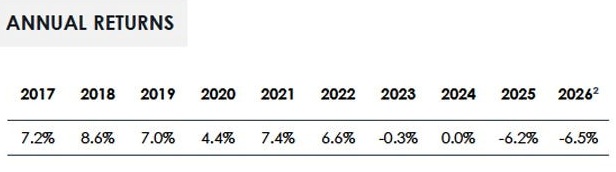
Oops!

But this was just the first of many. There are others. I have a client who owns one of these failing private funds from their prior advisor. We are trying to help them sell this thing, to no avail. Last quarter the fund manager was able to redeem 0.07% of the requested units for sale. That’s not a typo. That’s seven one-hundredths of one percent.

In other words, the client is effectively trapped.

And then earlier this month, news hit that yet another private Canadian real estate investment fund would be freezing redemptions, and is considering going public to grant their unitholders liquidity. This seems to be to be a fascinating opportunity to see what kind of value the public markets are willing to place on non-traded assets. I’m not sure exactly how this story ends, but it could accelerate the rush out of private funds.

(In case you’re wondering, I’m purposely leaving out the names of these firms to avoid dealing with the inevitable blowback from advisors who have client money in these funds. Let’s just say, if you know, you know. And you probably wish you didn’t.)

Look, there’s a clear pattern emerging here, and it’s not limited to the Canadian real estate market. South of the border, things are not going too great either. Blue Owl Capital (Redefining alternatives®) can’t seem to get its name out of the news.

But don’t forget about BlackRock, which limited redemptions in a flagship private credit fund for the first time ever.

Or Blackstone, which reportedly had to inject $400 million of its own capital into a fund to meet redemption requests.

Or this private German pension fund for dentists that blew up €1.1 billion speculating in private assets (oops!)

Meanwhile, this week the FT published a piece explaining how two private equity firms are offering UBS Wealth Management a cut of their performance fees in exchange for pushing their private capital products to their client base, made up of some of the world’s wealthiest private client investors. This isn’t unique, and it tells you a lot about whose interests your high end ‘wealth manager’ is serving when he or she loads your portfolio up with these funds. While the current investors are clamoring to get out, your ‘trusted advisor’ is using your wealth to provide exit liquidity.

Tone deaf marketing (aka making stuff up and hoping they don’t notice)

And while these private funds increasingly show signs of cracking and buckling under a complete lack of liquidity, the salespeople do their best to keep the cash pouring in from new investors. Coincidentally, this week I happened to come across this slide from a Canadian institutional money manager’s marketing deck, outlining their expected returns under various economic scenarios.
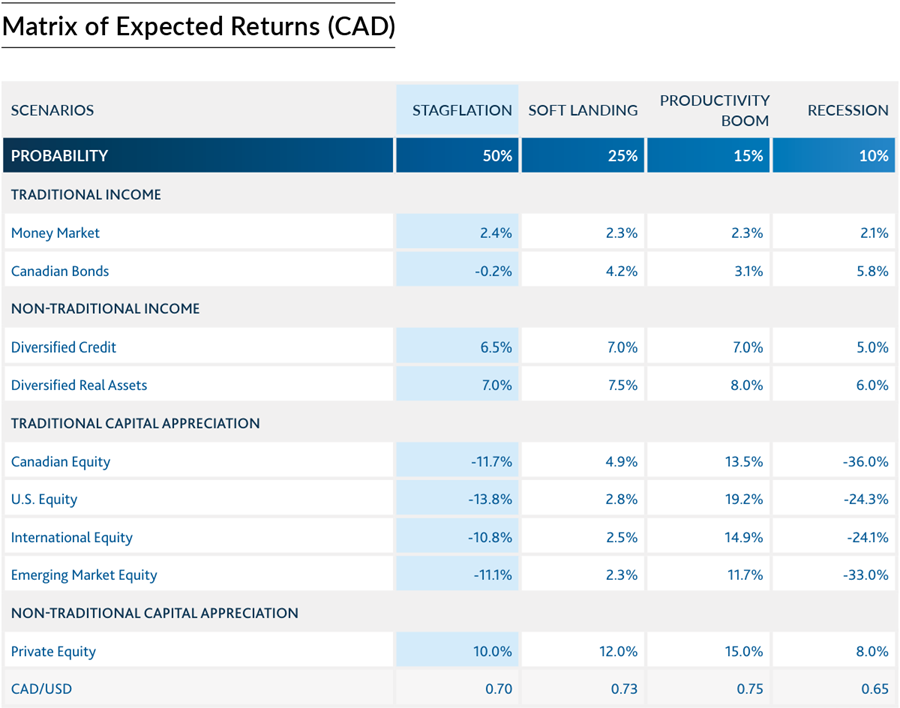
I’m at a bit of a loss for words here, but here is one that comes to mind: bul**hit.

The manager expects that in a stagflationary or recessionary economy, public market equities will get crushed. But private equity, and ‘non-traditional’ income (private debt) will somehow, magically, do just fine.

Now, I just gave you examples of private debt funds around the world imploding, all while global stock markets are clinging near all-time highs. If the stock market falls 10-30%, as the manager believes will happen in these potential scenarios, there is no plausible scenario where these private assets go UP. None.

This goes beyond bad investing, or poor investor education. It’s misleading marketing. Less charitably, it’s a [complete and utter] lie.

It’s why I write my newsletter. It’s why I wrote this book. Thanks for reading and thanks for your support!


Geoff Saab is the author of Low Risk Rules: A Wealth Preservation Manifesto, and writes a free newsletter at lowriskrules.substack.com


  •   25 March 2026
  •      
  •   


Leave a Comment:

RELATED ARTICLES

Managed accounts and the future of portfolio construction

Not all private markets are ‘volatility laundering’

What the private credit boom means for investors

banner

Most viewed in recent weeks

How cutting the CGT discount could help rebalance housing market

A more rational taxation system that supports home ownership but discourages asset speculation could provide greater financial support to first home buyers.

Want your loved ones to inherit your super? You can’t afford to skip this one step

One in five Australians die before retirement and most have not set up their super properly so their loved ones can benefit from all their hard work and savings. 

Super is catching up, but ageing is a triple-threat

An ageing Australia is shifting the superannuation system’s focus from accumulation to the lifecycle of retirement. While these pressures have been anticipated for decades, they are now converging at scale and driving widespread industry change.

Has Australia wasted the last 30 years?

The 20 years after Peter Costello left Treasury have been deemed wasted...by Peter Costello. The missed opportunities for Australia began long before.  

Meg on SMSFs: Last word on Div 296 for a while

The best way to deal with the incoming Division 296 tax on superannuation is likely doing nothing. Earnings will be taxed regardless of where the money sits, so here are some important considerations.

The 5% deposit scheme is bad for homeowners and Australia

An ‘affordability’ scheme making the county more vulnerable to economic shocks and contributing to the deteriorating financial situation of everyday Australians.

Latest Updates

Investment strategies

The thin line between investing and gambling

Prediction markets are blurring the line between investing and speculation and savvy investors can profit from this trend by heeding the advice of famed investor, Benjamin Graham.

Strategy

The refinery problem: A different kind of energy crisis in 2026

The Strait of Hormuz closure due to US-Iran conflict severely disrupted global energy supply chains. While various emergency measures mitigated the crude impact, the refined product market faces unprecedented stress.

Gold

Are we running out of gold?

Geopolitical instability and challenges with new gold discoveries mean we may be approaching a structural shortage of mineable gold, but what does this mean for gold's overall long-term availability?

Investment strategies

ETF investors adding to portfolios during recent volatility

In the face of recent market volatility investors continue to add to their ETF portfolios with these ETFs getting notable inflows, indicating that long-term fundamentals remain solid.

Strategy

Policy setting in democracies

Democracies aren’t a given, and policymakers need to be mindful not to alienate communities and instead be more aligned with mainstream ideas and attitudes. 

Investment strategies

Take my money and lie to me… again

As private funds increasingly show signs of cracking and buckling under a complete lack of liquidity, the salespeople do their best to keep the cash pouring in from new investors. 

Economy

Australia was once a world leader in innovation, now the system is ‘broken’

Ambitious Australia joins a long line of reports examining research and development, finding Australia has fallen behind its peers on many fronts. It urges bold reform to address declining productivity and research spending.

Sponsors

Alliances

© 2026 Morningstar, Inc. All rights reserved.

Disclaimer
The data, research and opinions provided here are for information purposes; are not an offer to buy or sell a security; and are not warranted to be correct, complete or accurate. Morningstar, its affiliates, and third-party content providers are not responsible for any investment decisions, damages or losses resulting from, or related to, the data and analyses or their use. To the extent any content is general advice, it has been prepared for clients of Morningstar Australasia Pty Ltd (ABN: 95 090 665 544, AFSL: 240892), without reference to your financial objectives, situation or needs. For more information refer to our Financial Services Guide. You should consider the advice in light of these matters and if applicable, the relevant Product Disclosure Statement before making any decision to invest. Past performance does not necessarily indicate a financial product’s future performance. To obtain advice tailored to your situation, contact a professional financial adviser. Articles are current as at date of publication.
This website contains information and opinions provided by third parties. Inclusion of this information does not necessarily represent Morningstar’s positions, strategies or opinions and should not be considered an endorsement by Morningstar.