Register For Our Mailing List

Register to receive our free weekly newsletter including editorials.

Home / 260

Talk to your family about ageing and your will

Parents are often uncomfortable talking to their adult children about personal matters, but there are many benefits in having such a conversation. It should include our investments and more generally, our goals and plans.

My wife and I first did this some years ago, when I decided to graduate from full-time work. Most retirees find, after time passes, that it’s useful to repeat the exercise, as circumstances change and nothing ever works out quite how you projected. It then could become the year's most important focal point.

I realise that some families, particularly in generations past, have found it difficult to discuss personal details at this phase of life with their adult children. Neither my wife nor I ever had such a conversation with our parents.

Our first talk

Our first effort with our own children has gone down in family history as ‘Dad's Decumulation Talk’. Yes, as you might guess, I did most of the talking. Just before we started, my wife placed a cartoon in front of me. In it, there’s a family sitting around a kitchen table. The youngest one’s head barely comes above the table. And Dad is saying: “Before we begin this family meeting, how about we go around and say our names and a little something about ourselves.”

I got the message: “Remember you’re their father, not a businessman.” I’m told I conducted myself appropriately. It became a bonding experience in the family, and we’ve been able to discuss financial matters with our children, our matters and theirs, ever since.

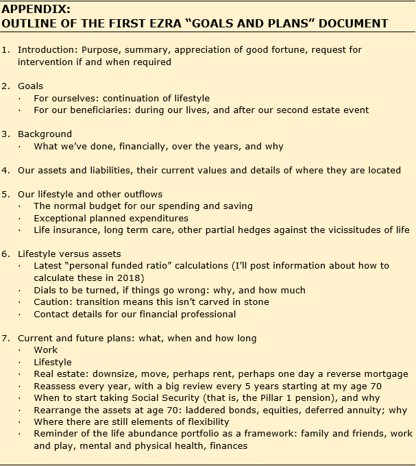
At the time I gave them a document entitled “Goals and Plans,” which we prepared to give them enough background that, if and when the need arose, they could be confident about making decisions for us.

I’m including an outline of what our document contained as an appendix, as some people asked for it when I mentioned it in a talk.

The following is not meant to be a comprehensive list or a substitute for talking to your legal and financial advisers. When I refer to your adult children or other close family members, that’s a generic way of saying ‘whoever it is that you’d like to have take charge of your affairs, during or after your lifetime’. That might be a professional or a financial institution.

I’ve found it helpful to think of three dimensions regarding the information to be shared.

1. Where the important documents are

The first is a list of important documents and where they are to be found, preferably in one place, known to your children. This includes government-issued documents relating to your identity (birth, marriage, citizenship etc.) Include in this information regarding assets and liabilities, such as home ownership, cars, bank accounts, savings bonds, credit cards, life insurance, savings plans related to work or retirement, other invested assets, and other miscellaneous things you own.

There are also important legal documents under this heading, such as your will, powers of attorney, and advance directives, like a living will, medical power of attorney, end-of-life instructions, and so on. And contact details of important people, not just professionals like your doctor, your lawyer, your financial professional, but also close friends and relatives.

It’s often said that many people die without a will. My father-in-law, who was in the insurance business, told me that everybody already has a will. A will is a document that says what will happen to your estate after you’re gone. The law says what will happen, if you haven’t written your own document. So think of the law as your will. You do have a will, no matter what you think – it just may be that somebody else wrote it for you. Better to override it with your own wishes!

2. Sharing goals and plans

The second dimension relates to levels of involvement. (I found this at Anderson Elder Law, in an article in their Resources section dated 24 March 2015.)

The least involved level is where your children know where to find the information mentioned above. Next, you may want to share some of the actual information with them, such as your finances and your will. Once you start doing this, you will probably want to repeat the exercise periodically, as we now plan to do. At this stage you’re still in full control. It may later become necessary for them to assist you, or to share responsibility for your affairs, or to take over that responsibility completely.

A friend who is going through her own parents’ late phase of life reminds me that, in that phase, the relationship between parents and children can change completely. The parents need the children, rather than the other way around. The parents can become fragile and susceptible, and easy to be taken advantage of. The children worry about the parents and have to soothe them. My friend adds, feelingly: “I don’t know what I’d do if I couldn’t trust someone to take care of me …”

No doubt, therefore, you will have consulted your children before making the required arrangements and got their agreement to whatever goes into the relevant documents. And you’ll have given them a list of the medications you take and ensured that your professionals know they should consult your children and where to find them. It can provide great peace of mind to know that all of this has been discussed before the need for the arrangements to be carried out ever arises, even if one day you may not remember ever having done this.

It's peace of mind not only for you but also for your children, who may be worried about whether they'll have to support you financially at the end. For your children's sake, don't leave this conversation so late that your mental capacity is declining.

3. The ‘estate event’ (otherwise known as death)

The third dimension involves saving trouble for your executor after your estate event. (I was amused to discover that American insurance agents don't like talking about death. Instead, they refer euphemistically to your ‘estate event’.)

Some wills are hotly contested by family members who can’t stand one another. You may not be able to solve this conflict while you’re alive. The angst that it may be possible for you to spare your executor arises from dividing up your personal possessions or leaving clear instructions about how to divide. Paul Sullivan (in his Wealth Matters column in The New York Times on 15 April 2016) wrote:

“… just think for a second what it would be like on Christmas morning if your children ran downstairs and there were all of these presents, bright and shining, big and small, but with no name tags on them. Can you imagine the free-for-all that would ensue?”

Don Ezra has an extensive background in investing and consulting and is also a widely-published author. His blog posts at www.donezra.com focus on helping people prepare for a happy, financially secure life after they finish full-time work.
  •   28 June 2018
  • 7
  •      
  •   
7 Comments
Gary M
June 28, 2018

Great story! Personally my parents talked to us kids about what was in their will – but I would rather not know. Better to assume you get nothing (or assume one of them will live on for decades more, so you get nothing for decades)

Too many boomers I know are sitting on $1m+ debts just waiting for their parents to die. That’s their Plan A to get out of debt!

SMSF Trustee
June 28, 2018

Gary M's observation is all too true. And elder abuse is going to be one of the next big social issues. It's appalling in many situations.

Even having this conversation with the kids doesn't guarantee against that. We've made sure that our PoA and Guardianship arrangements include an independent third person closer to our age that needs to be involved in significant decisions, not just the kids.

Charlie T
June 28, 2018

Facing a "bad result" from prostate cancer we are in the process of updating wills, medical directives etc. This article has helped with this process. One thing we have completed is to assess our possible future financial requirements and then disperse the approximate surplus evenly to our 4 adult children on the assumption it is better to see them enjoy it now instead of from the grave.

Ramani
June 28, 2018

We owe you a debt of gratitude for highlighting a little-understood issue about an uncontrollable event that touches many. The trauma of posthumous resolution is largely minimisable.

In addition to dealing with wealth accumulated over life, less financial and numerical issues must be identified and aired, like: what the seniors would want in twilight time, and the extent to which this could be met: visiting an old acquaintance, helping a dear cause ahead of inheritors and reconciling past gripes by extending a hand of affection.

Don't assume convergent aims even with partners, and prepare for expectation gaps that might affect the remaining life and relationships. Keeping control of what you want to say and how is critical. Dominant relatives and consequent elder abuse cannot be wished away.

Things like POA, EPOA and living will are best discussed when things are quasi-normal. Call it non-financial 'stress testing'.

Sadly we as a society do not pay attention to getting people off active work to active and then passive retirement, like we prepare the youth. We should.

Something I do not grasp: if descendants are by law entitled to the estate (whether testate or not), why do things change when the estate is negative: should not the laws of testacy / intestacy apply equally too? "To my second son whom I educated at Harvard at great cost, relative to my other offspring, I allocate 30% of my unpaid debt..." Perhaps a lawyer or philosopher could elucidate?

John
June 30, 2018

Thank you for the entertaining and helpful story and for the discussion agenda. I’m an actuary so I will especially look forward to the “personal funded ratio” calculations!

I wonder whether timing of “the conversation” might be a key issue, and the answer may not be the same for every family. I’m an extreme example: I’m over 60, my wife is a little younger, but we started family formation very late in life and our ultimate beneficiary is still in primary school. Obviously we can’t talk to him now even though I am already retired. But even when he’s old enough to understand we want him to forge his own life and create his own financial success rather than being one of the children who are described in Stanley and Danko’s book “The Millionaire Next Door” as being on “economic outpatient care” (regular parental hand outs) or like Gary M’s boomers, waiting for parents to die to get out of debt.

We aren’t filthy stinking rich but we are pretty comfortable. If we have “the conversation” too early, how do we avoid the result that our son becomes an entitled “trust fund kid”?

G Cross
July 01, 2018

Disagree with this, it only creates a sense of entitlement, and potential conflict, and can take away the incentive for children to make their own way in life. Some things are best left unsaid but a expertly designed will is essential and good notes explaining everything safely stored in a safe deposit box.

Vishal Teckchandani
July 02, 2018

I'm glad to be an only child.


Leave a Comment:

RELATED ARTICLES

How to avoid inheritance fights

Estate planning made simple, Part II

Watch out, it's not easy being the executor of an estate

banner

Most viewed in recent weeks

Warren Buffett's final lesson

I’ve long seen Buffett as a flawed genius: a great investor though a man with shortcomings. With his final letter to Berkshire shareholders, I reflect on how my views of Buffett have changed and the legacy he leaves.

The housing market is heading into choppy waters

With rates on hold and housing demand strong, lenders are pushing boundaries. As risky products return, borrowers should be cautious and not let clever marketing cloud their judgment.

Why it’s time to ditch the retirement journey

Retirement isn’t a clean financial arc. Income shocks, health costs and family pressures hit at random, exposing the limits of age-based planning and the myth of a predictable “retirement journey".

Australia's retirement system works brilliantly for some - but not all

The superannuation system has succeeded brilliantly at what it was designed to do: accumulate wealth during working lives. The next challenge is meeting members’ diverse needs in retirement. 

The 3 biggest residential property myths

I am a professional real estate investor who hears a lot of opinions rather than facts from so-called experts on the topic of property. Here are the largest myths when it comes to Australia’s biggest asset class.

Welcome to Firstlinks Edition 637 with weekend update

What should you do if you think this market is grossly overvalued? While it’s impossible to predict the future, it is possible to prepare, and here are three tips on how to best construct your portfolio for what’s ahead.

  • 13 November 2025

Latest Updates

Investment strategies

Australian stocks will crush housing over the next decade, 2025 edition

Two years ago, I wrote an article suggesting that the odds favoured ASX shares easily outperforming residential property over the next decade. Here’s an update on where things stand today.

Property versus shares - a practical guide for investors

I’ve been comparing property and shares for decades and while both have their place, the differences are stark. When tax, costs, and liquidity are weighed, property looks less compelling than its reputation suggests.

Investment strategies

What if Trump is right?

Trump may be right on two trends: nations are shifting from aspiration to essentials and from global dependence to self-reliance, pushing capital toward security, infrastructure, and energy.

Gold

After a stellar 2025, can gold shine again next year?

Gold has had a remarkable 2025, with the spot price likely to post its strongest return since 1971. This explores the key factors that will shape the outlook for the yellow metal next year, and long-term.

Superannuation

Critics of Commonwealth defined benefit schemes have it wrong

Critics like Clime's John Abernethy have questioned many aspects of defined benefit pensions for public servants. This is an attempted rebuttal, suggesting these pensions aren't the problem they're made out to be.

Infrastructure

Why airport stocks deserve a place in long-term portfolios

Aircraft constraints are holding back global air travel. Those constraints should soon ease which combined with a structural boom in travel demand could be a boon for global airport stocks.

Investment strategies

What is the future of search in the age of AI?

Search is changing fast. AI tools like ChatGPT and Google’s Gemini are reshaping how we find information, opening new opportunities for innovation, user engagement, and future revenue growth.

Sponsors

Alliances

© 2025 Morningstar, Inc. All rights reserved.

Disclaimer
The data, research and opinions provided here are for information purposes; are not an offer to buy or sell a security; and are not warranted to be correct, complete or accurate. Morningstar, its affiliates, and third-party content providers are not responsible for any investment decisions, damages or losses resulting from, or related to, the data and analyses or their use. To the extent any content is general advice, it has been prepared for clients of Morningstar Australasia Pty Ltd (ABN: 95 090 665 544, AFSL: 240892), without reference to your financial objectives, situation or needs. For more information refer to our Financial Services Guide. You should consider the advice in light of these matters and if applicable, the relevant Product Disclosure Statement before making any decision to invest. Past performance does not necessarily indicate a financial product’s future performance. To obtain advice tailored to your situation, contact a professional financial adviser. Articles are current as at date of publication.
This website contains information and opinions provided by third parties. Inclusion of this information does not necessarily represent Morningstar’s positions, strategies or opinions and should not be considered an endorsement by Morningstar.