Register For Our Mailing List

Register to receive our free weekly newsletter including editorials.

Home / 660

The 25-year property trust default is being questioned

For a quarter of a century, the discretionary trust has been the automatic structure for sophisticated property investors in Australia. Accountants defaulted to it. Investors defaulted to it. In our brokerage, we’ve written deal after deal into trust structures without the question of whether it was the right vehicle really coming up.

In the last few weeks, I’ve seen that default start to be questioned. Clients who have held property through trusts for fifteen years are now openly asking whether trusts will still be the right structure if the CGT changes go through, and whether company structures might be the better option. Look, we don’t know yet what Treasurer Chalmers will actually announce on 12 May, but the possibility of a discount cut, a full return to pre-1999 indexation, or something else entirely has been enough to put ownership structure on the table for a cohort that has not seriously revisited it since Peter Costello introduced the discount in 1999.

As director of a commercial finance brokerage, my view is from the adviser side rather than the tax policy side. And for the specific cohort at the centre of the current speculation, multi-property, top-marginal, holding for capital growth, the conversations I’m having now sound different to the conversations I was having six months ago.

The 33% number isn’t random. In my opinion, it’s structural

One of the rates Treasury is reportedly modelling is a reduction in the CGT discount from 50% to 33%. Interesting number.

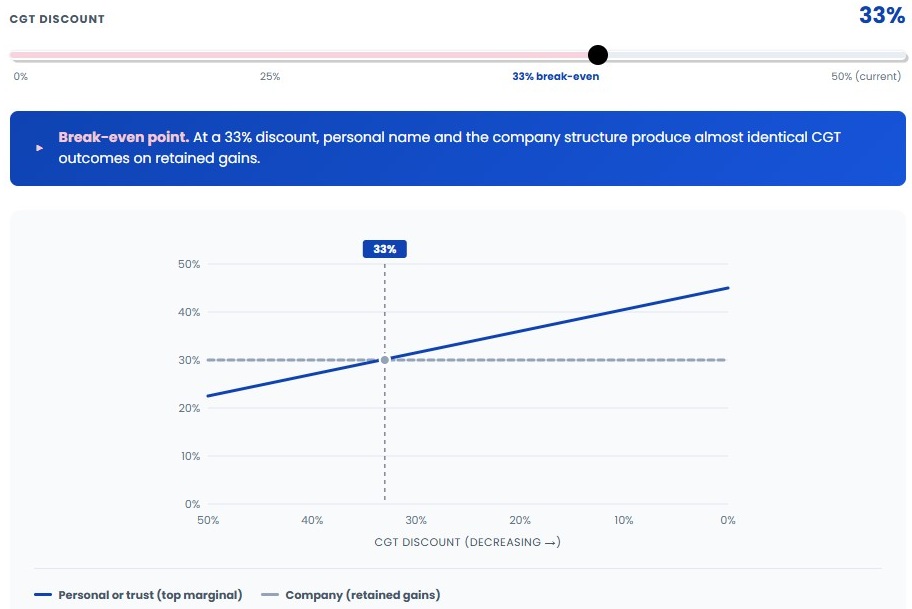
At 33%, the arithmetic on the trust-versus-company decision for a top-marginal investor holding for capital growth sits almost exactly at break-even on new acquisitions. A single top-marginal investor in a trust pays 45% (ex Medicare levy) on 67% of the gain at a 33% discount, which works out at 30.2% overall. A company pays 30% on the full gain. Above 33%, the trust structure still comes out ahead. Below 33%, the company structure starts to compete. That comparison applies to gains retained in the entity; extraction back to the investor re-attracts personal marginal tax, which is a separate question.
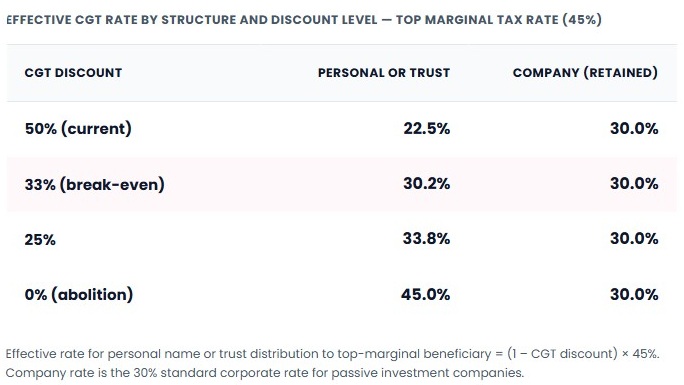
33% is the precise point at which the structural case for trusts, for this specific cohort, stops being automatic.

I don’t think it’s a coincidence that 33% is the number turning up in the modelling. It sits at a threshold that matters structurally for the exact cohort the reform is aimed at, and it’s likely no accident that this is where the debate is landing. That’s my read, anyway.
What this might mean in the second half of 2026

A few possibilities seem worth watching, depending on what comes out on budget night.

If the reform lands at 33% or lower, I’d expect the trust-versus-company conversation to become a live one across the multi-property cohort on new acquisitions. Grandfathering of existing holdings would mean no mass restructuring of current portfolios, but the flow of new investor capital could start tilting toward company structures over the second half of 2026 and into 2027.

If the reform lands above 33%, the structural case for trusts holds and the conversations I’m seeing now quietens. The current uptick in client enquiries about alternative structures fades.

If the reform takes the indexation path instead of a rate cut, the arithmetic changes entirely. The break-even still exists but moves around with inflation assumptions and hold periods. Different question, same cohort revisiting it.

The broader point for readers

The public debate about CGT reform has been conducted mostly at the policy level: the right mechanism, the right rate, the right distributional outcome. That’s the conversation Treasury is resolving.

The 33% number is structurally meaningful for this cohort in a way the public debate hasn't really surfaced. That's worth knowing, whether or not the reform ultimately lands there.

I’ll be watching budget night like everyone else. And like the accountants and advisers working through these questions alongside their clients, the second read on what’s announced will matter as much as the first. That, I suspect, is where a fair amount of the real behavioural response to any reform will sit. Not in whether investors exit the market, but in how they choose to structure their next entry into it.


Nadine Connell is Co-Founder & Director of Smart Business Plans, a Gold Coast-based commercial finance brokerage. She is an authorised credit representative of LMG Broker Services (CR 553930, MFAA member). This article is general information only and does not constitute personal financial or tax advice. Readers should obtain independent professional advice relevant to their circumstances.


  •   29 April 2026
  •      
  •   


Leave a Comment:

RELATED ARTICLES

Six capital gains tax and depreciation facts for property investors

banner

Most viewed in recent weeks

Indexation implications – key changes to 2026/27 super thresholds

Stay on top of the latest changes to superannuation rates and thresholds for 2026, including increases to transfer balance cap, concessional contributions cap, and non-concessional contributions cap.

The refinery problem: A different kind of energy crisis in 2026

The Strait of Hormuz closure due to US-Iran conflict severely disrupted global energy supply chains. While various emergency measures mitigated the crude impact, the refined product market faces unprecedented stress.

The missing 30%: how LIC returns are understated, and why it matters

The perceived underperformance of LICs compared to ETFs is due to existing comparison data excluding crucial information, highlighting the need for proper assessment and transparent reporting.

Little‑known government scheme can help retirees tap into $3 trillion of housing wealth

The Home Equity Access Scheme in Australia allows older homeowners to tap into their home equity for retirement income, yet remains underused due to lack of awareness and its perceived complexity.

Origins of the mislabeled capital gains tax ‘discount’

Debate over the CGT discount is intensifying amid concerns about intergenerational equity and housing affordability. This analysis shows that the 'discount' does not necessarily favor property investors.

Div 296 may mean your estate pays tax on assets your beneficiaries never receive

The new super tax, applying from 1 July, introduces more than just a higher rate on large balances. It brings into focus a misalignment between where wealth sits and where the tax on that wealth ultimately falls.

Latest Updates

The ultimate superannuation EOFY checklist 2026

Here is a checklist of 28 important issues you should address before June 30 to ensure your SMSF or other super fund is in order and that you are making the most of the strategies available.

Retirement

Two months into retirement

A retirement researcher's take on retirement and her focus on each of her six resource buckets to stay engaged during the transition and beyond.

Superannuation

Markets have always delivered for super fund members. What if they don’t?

What happens if market resilience in the face of ongoing geopolitical tensions ends? Potential decade-long market weakness shows the need for contingency planning.

Retirement

We tend to spend less in retirement …

Studies show that a drop in expendure during retirement leads to a happier retirement. But when costs ramp up again later in life, it's a guaranteed income that makes spending more hurt less.

Shares

Can you value a share just using dividends?

A cow for her milk, a stock for her dividends. Investors are too quick to dismiss this valuation technique. 

Property

The 25-year property trust default is being questioned

The 33% CGT discount rate being floated isn’t random. It sits at the structural break-even between trust and company for the multi-property cohort. That’s driving the conversation we’re hearing now.

Investment strategies

Are active managers bringing a knife to a gunfight?

How passive investing has permanently changed market structure — and why sophisticated tools are now the price of survival.

Sponsors

Alliances

© 2026 Morningstar, Inc. All rights reserved.

Disclaimer
The data, research and opinions provided here are for information purposes; are not an offer to buy or sell a security; and are not warranted to be correct, complete or accurate. Morningstar, its affiliates, and third-party content providers are not responsible for any investment decisions, damages or losses resulting from, or related to, the data and analyses or their use. To the extent any content is general advice, it has been prepared for clients of Morningstar Australasia Pty Ltd (ABN: 95 090 665 544, AFSL: 240892), without reference to your financial objectives, situation or needs. For more information refer to our Financial Services Guide. You should consider the advice in light of these matters and if applicable, the relevant Product Disclosure Statement before making any decision to invest. Past performance does not necessarily indicate a financial product’s future performance. To obtain advice tailored to your situation, contact a professional financial adviser. Articles are current as at date of publication.
This website contains information and opinions provided by third parties. Inclusion of this information does not necessarily represent Morningstar’s positions, strategies or opinions and should not be considered an endorsement by Morningstar.