Register For Our Mailing List

Register to receive our free weekly newsletter including editorials.

Home / 668

The GST cannot stop inflation

The ABC recently ran a series asking what, if anything, governments can do about high inflation beyond simply relying on the Reserve Bank to raise interest rates (a policy tool that every knows is cruel and unusual).

One idea that gets floated is using the GST as an active stabilisation tool, automatically increasing the GST when inflation rises, and cutting it when inflation falls.

At first glance, this sounds sensible. If inflation is too high, why not temporarily raise consumption taxes to dampen spending?

But when you actually model the idea formally, the results are surprisingly bad. Terrible in fact!

The charts below show the welfare loss and inflation volatility in an economy as a function of a single parameter: how aggressively the GST responds to inflation. At zero the GST rate never changes (the economy today). As the parameter becomes positive the GST rises automatically whenever inflation rises with greater degrees of responsiveness.
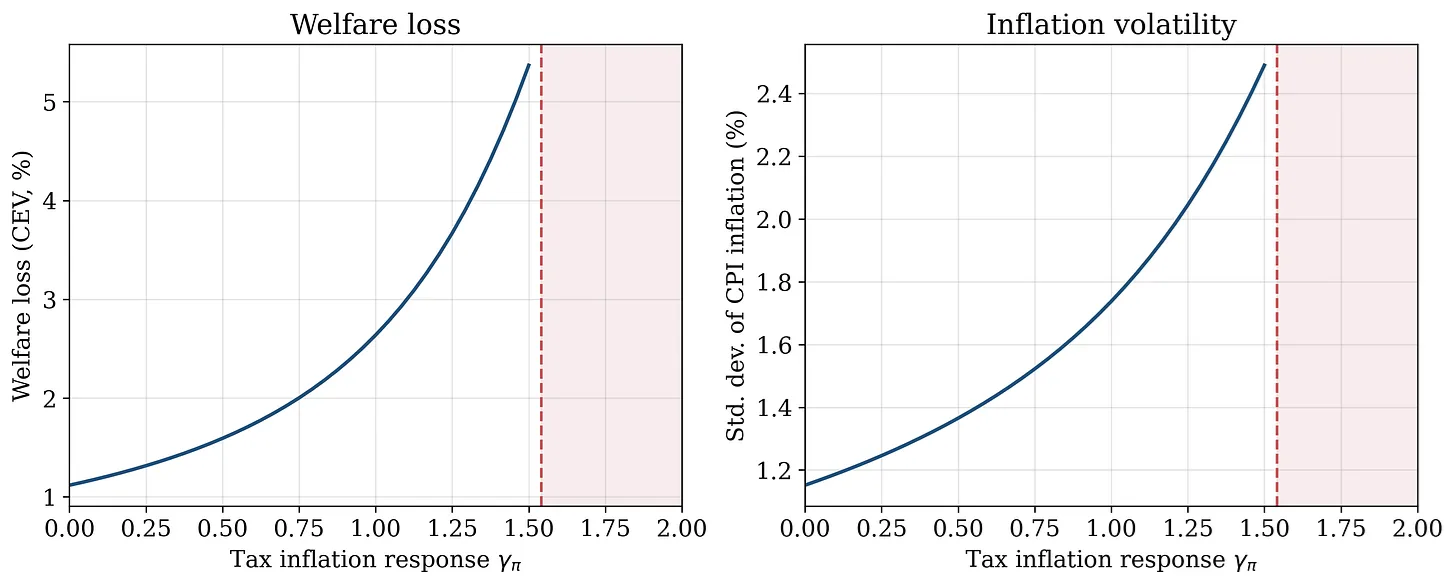
Perhaps surprisingly, welfare falls sharply (ie welfare losses increase) the more aggressively the GST responds to inflation. Inflation itself also becomes substantially more volatile. What explains this counter intuitive result!?

Downward dog inflation

Imagine we lived in a world where the GST automatically increased whenever inflation rose. If inflation jumped by 3 percentage points the GST would mechanically rise from 10% to 15%.

Now consider the sort of shock Australia has recently experienced: turmoil in the Middle East pushing up global oil prices.

To keep things simple imagine you run a yoga studio. Your business barely uses petrol directly, so the oil shock itself is not especially important for your costs.

But the GST is.

In Australia, firms typically advertise and set prices inclusive of GST. And because many firms only adjust prices infrequently — perhaps once or twice a year — they have to think carefully about where taxes and costs are likely to be over the coming year when they decide on prices today.

So what happens when news breaks of a major geopolitical conflict likely to push inflation higher?

In a world with a varying GST policy, the answer is obvious: businesses immediately expect the GST rate to rise in the near future. War today, means high oil prices in the coming weeks, which means higher inflation prints in the coming months and thus a higher rate of GST for the next year or so.

As a yoga studio owner, this matters enormously. If the GST rises from 10% to 15% while your advertised prices stay fixed, your after-tax revenue falls and your profit margins get squeezed.

So what is the rational response?

You raise prices today.

Even though the oil shock barely affects your own business directly, the expectation of higher future GST causes you to increase prices immediately in anticipation.

And once every firm in the economy starts thinking this way, the policy becomes self-reinforcing.

The initial inflation shock causes firms to expect higher GST rates in future. Firms then raise prices more aggressively today to pay for those future taxes. That additional price-setting behaviour pushes inflation even higher, which in turn triggers even larger GST increases.

Rather than stabilising inflation, the policy amplifies it increasing volatility. In fact if the GST-responsiveness-to-inflation parameter gets too high (about 1.5 in the plots above) the economy becomes “indeterminate” which is economist speak for double plus bad.

Under a constant GST regime, many firms — like the yoga studio — might barely respond to an oil shock at all. But once GST becomes an active “counter-cyclical” tool, even firms with little direct exposure to the original shock have an incentive to raise prices preemptively.

The result is higher inflation volatility, more distorted price-setting behaviour, and ultimately lower welfare across the economy.

The irony is that while counter-cyclical GST policy sounds stabilising in theory, once you account for forward-looking firms and sticky prices, it can end up making inflation dynamics substantially worse.


Dr Isaac (Zac) Gross is a lecturer in economics at Monash University. This article was first published via Zac’s blog, Gross National Product, and is reproduced with permission.


  •   24 June 2026
  •      
  •   


Leave a Comment:

RELATED ARTICLES

Is 'The Great Australian Dream' a sham?

7 questions, 70 opinions on major policies facing Australia

Readers back mining tax and gas reserve but not Stage 3

banner

Most viewed in recent weeks

Noel Whittaker’s take on the budget

Marketed as a fix for inequality and housing affordability, the latest budget instead delivers a tangle of tax changes that leave everyday Australians worse off.

Australia has no death duties. Technically.

Australia may not levy formal death duties, but a growing web of tax measures is quietly shaping what wealth passes between generations. Now, the 2026 budget adds another layer.

Welcome to Firstlinks Edition 662 with weekend update

The debate over the budget is increasingly shaped by frustration and perceptions of unfairness, rather than clear-eyed assessment of policy outcomes.

How to minimise tax with a will

Inheritance tax implications in Australia may surprise some, as poor estate planning without proper wills or trusts can lead to costly tax bills and delays for beneficiaries.

Testamentary trusts post-budget: Estate planning, tax reform and the ‘death tax’ debate

Proposed Budget changes to taxation are casting new uncertainty over testamentary trusts, prompting closer scrutiny of estate planning structures and the real implications of reforms still taking shape.

Back to the future - Why indexing CGT is a good idea

A return to indexation of capital gains would be a fairer way to compensate households for the effects of inflation than the current discount. Importantly, it opens the door to future, broader reforms to stop the taxation of inflation.

Latest Updates

Investment strategies

Choose your hedges wisely… and often

A new market regime is exposing the fragility of static hedges. With correlations shifting and safe havens flipping, investors must rethink diversification and adopt more adaptive tools to protect capital.

Investment strategies

Yields take centre stage again

The Australian credit landscape is shifting. Yields are rising, issuance is strong and spreads continue to tighten. Income is re‑emerging as the dominant driver of returns, though pockets of risk may be building beneath the surface.

Investment strategies

The grass is always greener: Rethinking Australian vs global equities

Australia's once‑dominant sharemarket is losing ground as others surge ahead, prompting investors to question home‑bias instincts. Meanwhile, the US market appears attractive. Is it time to revisit your global equity allocation?

Investment strategies

Stop asking if there's a stock market bubble. Ask this instead.

Markets continue to push onwards despite valuations looking stretched by historical standards. Bubble talk is rampant, however investors may be focusing on the wrong thing. The real story sits deeper than the headlines.

Taxation

The GST cannot stop inflation

Raising the GST when inflation jumps sounds clever on paper, until we examine how it may play out in practice. What is pitched as a simple inflation fix can lead to a sharp turn in the wrong direction for prices.

Shares

Why SpaceX is coming to your super fund

SpaceX’s blockbuster debut is grabbing headlines, but the real story for Australian investors is much quieter. Giant listings eventually filter into super funds and ETFs, subtly reshaping portfolios long before most realise.

Taxation

Is the government being honest with us about its business CGT changes?

The government’s assurances on small‑business concessions don’t withstand the scrutiny. Token carve‑outs and a lack of credible rationale for CGT changes may reshape how Australia rewards long‑term value creation. 

Sponsors

Alliances

© 2026 Morningstar, Inc. All rights reserved.

Disclaimer
The data, research and opinions provided here are for information purposes; are not an offer to buy or sell a security; and are not warranted to be correct, complete or accurate. Morningstar, its affiliates, and third-party content providers are not responsible for any investment decisions, damages or losses resulting from, or related to, the data and analyses or their use. To the extent any content is general advice, it has been prepared for clients of Morningstar Australasia Pty Ltd (ABN: 95 090 665 544, AFSL: 240892), without reference to your financial objectives, situation or needs. For more information refer to our Financial Services Guide. You should consider the advice in light of these matters and if applicable, the relevant Product Disclosure Statement before making any decision to invest. Past performance does not necessarily indicate a financial product’s future performance. To obtain advice tailored to your situation, contact a professional financial adviser. Articles are current as at date of publication.
This website contains information and opinions provided by third parties. Inclusion of this information does not necessarily represent Morningstar’s positions, strategies or opinions and should not be considered an endorsement by Morningstar.