Register For Our Mailing List

Register to receive our free weekly newsletter including editorials.

Home / 672

The missing link in the CGT debate

As unintended consequences of the Labor tax package in the federal budget continue to roll out, one that could have far reaching effects is the loss of tax neutrality between retained earnings and distributed profits under the new capital gains tax regime.

Consider the tax effect of removing the 50% CGT discount and replacing it with an inflation indexed system.

Two shareholders each receive $70 of value from a company that has already paid $30 company tax. One receives it as a fully franked dividend, while the other receives it as a realised capital gain. Assume inflation has been negligible. Both shareholders are on the top marginal tax rate of 47%.

The dividend receiving shareholder pays tax of 47% x ($70 dividend + $30 franking credit) - $30 franking credit = $17. Add the $30 company tax paid and the effective tax rate paid on the $100 corporate profit = 47%.

Under the 50% discount regime, the shareholder realising his capital gain pays 50% x 47% x $70 = $16.45. Plus the $30 company tax, and the effective tax rate paid on the $100 corporate profit = 46.45%.

The results demonstrate a remarkable level of tax parity under the two scenarios.

However, under the new CGT indexed system where inflation has been virtually zero, the shareholder pays almost 47% x $70 = $32.90. And with the $30 company tax, the combined tax burden approaches 62.9% on $100 corporate profit.
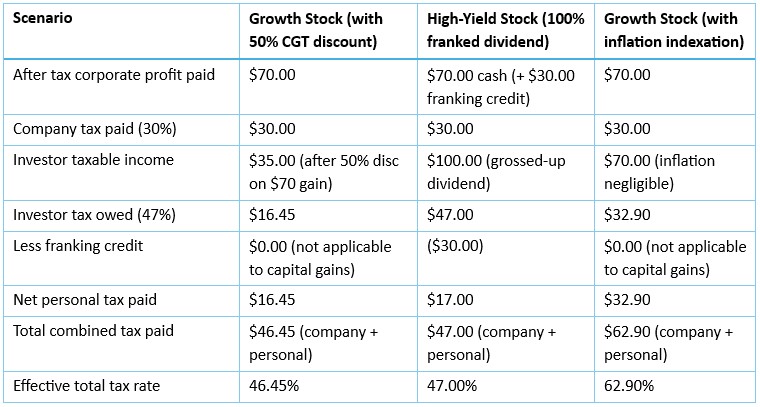
The nexus between the taxation of dividend income and realised capital growth has been broken.

The dividend imputation system was designed to ensure that company profits are taxed only once at the shareholder's marginal rate. For dividend paying stocks, franking credits prevent double taxation. But realised gains do not receive franking credits.

Capital gains generated by retained earnings have been less shielded from double taxation. The previous 50% CGT discount partly offset that problem by reducing the shareholder-level tax. But the introduction of inflation indexation potentially removes that partial tax offset.

The tax gap between the two forms of return therefore widens, creating a tax-induced bias in investor behaviour towards high-dividend paying companies, away from those that reinvest earnings for growth. Investors invest in growth companies for capital gains, but if that incentive is dampened, all else being equal, then investor sentiment could shift.

But the implications go beyond investor bias. It extends to capital allocation. If retained earnings are seen to be more heavily taxed than distributed earnings, boards may face greater pressure to reduce retained earnings and increase dividend payout ratios. Which may in turn mean less long-term reinvestment such that capital is allocated less efficiently. Tax considerations, as well as business fundamentals, could influence board decisions.

And beyond that still further, is the question as to what effect less investment in R&D and productivity-enhancing efficiencies in general has on productivity growth. Logically, a tax system unfavourable to growing businesses, must adversely affect productivity.

Growth companies typically invest more in new capital and technologies, expand capacity, and are innovative. They drive productivity. Whereas high dividend yielding companies are generally more mature with fewer investment opportunities, generating cash with less productive uses for it.

The new capital gains tax arrangements come at a time when Australia is in the midst of a protracted productivity growth slump.

According to the Productivity Commission, Australia’s labour productivity (GDP per hour worked), fell by 0.6% in the March 2026 quarter, and grew by just 0.3% over the year. And the long-term trend has seen productivity growth averaging around 1.5% per year during the 1990s and 2000s, then fall to next to no growth over the last five years (about 0-0.1%).

Productivity growth is now at anaemic levels which limits the rate at which the economy can grow without stoking inflation and means lower growth in living standards.

The government introduces at its peril any tax policy that reduces the tax neutrality between distributing profits and reinvesting them, which could divert capital away from productivity enhancing opportunities. And doubly so that peril when productivity growth is at a virtual standstill.


Tony Dillon is a freelance writer and former actuary. This article is general information and does not consider the circumstances of any investor.


  •   22 July 2026
  • 18
  •      
  •   
18 Comments
Edward
July 23, 2026

Agree 100%. An absolute disgrace. But the hatred and envy of Labor towards older retirees is such that so long as those are hit, the rest are simply collateral damage.

7
Trevor
July 23, 2026

Yes the 30% minimum capital gains tax rate is scandalous and needs to go.
For what it’s worth it is now officially coalition policy to abolish it.
My local MP (teal) voted against Labor’s tax increases so I’m feeling more kindly towards her now :)

3
Michael
July 23, 2026

If there was going to be a minimum, I would have thought that 15% (or thereabouts) would have been more appropriate. Setting the minimum at 30% appears a tax grab to me.

Jon Kalkman
July 23, 2026

The Treasurer tells us that the new tax on capital gains is to ensure that investors (who will now pay a minimum of 30% CGT on ALL their capital gains) pay the same tax as salary earners. That is assertion nonsense, of course, because workers only pay 30% tax on the portion above $45,000. Because of the progressive nature of our tax system, tax on $45,000 is only $4020, or a little under 9%.

So let’s continue the nonsense and suggest that, in order to ensure that ordinary income is taxed the same as investment income, a teacher aid will need to pay tax on ALL of their income at a minimum of 30%. Their new tax on $45,000 is now $13,500, not $4,020. They will then be taxed the same as the PAYE taxpayer presently earning over $200,000, because it is only at that level that taxpayers pay a minimum of 30% tax on ALL their income.

2
D Ramsay
July 23, 2026

A thousand thank you's Tony for this article

What it's all really about is a Govt that cannot manage money, does not do in depth homework (i.e. test all possible scenarios as is done in s/ware engineering) when formulating a budget, cannot stick to a budget (everything they initiate has cost blow outs - e.g. Tafe service providers, NDIS service providers, Consultants etc)

So they come up with poorly designed ways to suck more money out of us - the folks that have invested for their own future, whether you are in your mid 20's or much older we all become retirees eventually.
Now, in 2026, after 30+ years of investing under one set of rules and paying taxes (income and cgt) they move the goal posts and kick you in the teeth to go on with. Bravo to JanH's comment re "30% regardless of your income bracket"
I fully expect to see JC announce that he plans to tax all foreigners living abroad - heaps of $ there surely ?
What a bunch of low life specimens they are.

9
Peter Wilmshurst
July 23, 2026

Assuming away the indexation of the cost base and assuming zero payout ratio presents this comparison in the harshest light.

More realistic numbers, let's assume 14% RoE and 2x P/BV for the Australian market. Then the $70 of profit says BV is $500 and MV is $1,000. Assume 2% inflation (actually lower than history) and the investor gets a 2% on $1,000 cost base indexation benefit and their $70 of gains comes down to $50 of taxable gain, resulting in $23.50 of personal tax. Overall, therefore the tax rate would be 53.5%, so certainly higher.

BUT, most of that difference is because the company is acting against their shareholders' interests and hoarding franking credits, not because of the change in capital gains tax regime.

5
JM
July 23, 2026

Let's hope their "solution" to this truly strange new policy isn't to remove dividend imputation as well.

3
John
July 23, 2026

I repeat my posting from last week to Kate that the “discount component is widely misunderstood, partly having to do too much work as shown in table below, which includes the element Tony refers to being an allowance for the retained/taxed undistributed profit component of the value of the share being sold. Complex, impossible to explain in standard print media, but real and one of the reasons for a simple “50%” formula which broadly works. Apologies that the item/Keating/Ralph comparison lines d’n't present here as the desired table format.

CGT/Indexation Item Component Items Keating Ralph
30% Minimum No No
Negative Gearing Yes Yes
Indexation Process Messy Discount -Simple
Wages/CGT same tax rate Yes NO
Averaging 20%/ Five Years Discount component
Symmetry -Real gains/losses No Discount component
Double Tax -Undistributed Profits Yes Discount component

The loss of averaging, the anti-symmetry and the double taxing are huge losses in the new proposals. All without proper explanation or disclosure. A disgrace, by all but particularly Treasury that is supposed to protect us from this nonsense.

2
Wayne
July 23, 2026

I think that your assumption that inflation is negligible is distorting your calculation. For example say inflation is 2.5% and you get a 6% return as a CG on your growth stock and 2% ff dividend on the same stock held for a year (so 75% of the $70 is CG and 25% is a dividend). Your 6% return is offset by inflation to be 3.5% then taxed at 47% so your 0.75 * $70 CG ($52.5) only 58%, ((6%-2.5%)/6%), of it is subject to tax so 0.58*52.5*0.47 gives $14.31 tax. The tax on the dividend would be 70/0.7*0.25*0.47=11.75 and add back the $30 company tax to get 14.31+11.75+30=$49.08 total tax paid. So total tax 49% on the $100, compared to 47% on your high yield stock. Also need to think about the total position because your share price has likely gone backwards on your high yield stock after inflation.

1
Patrick
July 23, 2026

I am struggling to understand the comparison between NPAT assumed to be 100% paid out as a fully franked dividend and the same NPAT resulting in the same level of share price growth. Would it not be more relevant and realistic to ascribe further assumptions such as relative PE for high dividend stocks and low dividend stocks (say ASX200 vs S&P500) and the multi-year after tax returns? If the company is held for 5 years, and the dividend receiving investor receives $70 FFDs, growing each year by earnings growth with commensurate share price growth (assuming P/E constant, with a growing E) compared to the high growth stock that retains earnings, presumably with a higher P/E and higher Eg? That is, after n years, what is the total after tax return each investor gets factoring the opportunity cost of the additional tax on the FFDs.

I have tried to get my head around the new tax system in terms of changes to yield vs growth focus for investors and to me, it invariably comes out to the question "what investment strategy will most likely achieve my target outcome within the constrains of my risk profile given the prevailing tax system?"

This feels a little like the Div 296 tax argument with people saying they should withdraw from super. Sure, save a bit of tax but where will you then invest the withdrawn funds and what is the tax outcome of that?

1
Richard
July 23, 2026

Excellent comments from JanH .
VERY IMPORTANT.

1
Jack
July 23, 2026

As Tony points out a tax on investment income reduces investment, capital formation and productivity- all of which are necessary to increase employment and the taxable income it generates. So that we encourage investment over consumption, investment income, including bank interest, should be preferentially taxed compared to income derived from personal exertion.

1
Richard Lyon
July 23, 2026

Sorry, Tony, but this is a meaningless exercise!

I would say that it's like comparing apples and oranges, but I think that the two fruit have more in common than the elements in your comparison.

Why would you ever get the same capital gain for a share not paying a dividend as the net cash from that dividend? And why should the total tax take be the same (but only from a top-band taxpayer) in both cases? What is the policy imperative for that?

The reality, as Peter Wilmshurst implies, is that the company has a choice between distributing franking credits and reinvesting net profits. The financial impact on its shareholders will vary according to the characteristics of those shareholders (and their marginal Australian tax rate is just one of those characteristics). And, in turn, the financial impact on shareholders is just one of the considerations that the company must make.

It's fair enough to highlight the way in which discounting for inflation will change the balance between paying dividends and retaining profits. But don't pretend that the new regime has broken any kind of golden relationship between dividends and growth.

Tony Dillon
July 23, 2026

Hi Richard. You have missed the point of the article. And that is that the new tax arrangements have created a bias away from investing for capital growth towards investing for income.

And no. I’m not comparing apples with oranges. For the purpose of comparing tax outcomes, I have simply posited two economically equivalent ways of delivering the same after-tax corporate profit to a shareholder. And taken the argument from there. You have been too literal with the numbers. It may have been a situation of say, ten times $7 franked dividends versus $70 realised profit. Same numerical outcome. And I have used a top-band taxpayer to highlight the point. To show how far apart the effective tax rates could be.

And I’m not actually saying the tax outcome should be the same. Rather that the tax policies make dividend investing now more appealing than prior. In any case, there are strong reasons why taxing capital profits should be more favourable than taxing income. Cheers

4
Richard Lyon
July 23, 2026

Tony, I stand by my criticism and point you to my comment that it's fair enough to talk about the change in the balance between distribution and retention.

As to the apples and oranges, I'm not sure how many people contemplate how much of their capital gain is post-tax income of the company, let alone what that means in terms of the ATO's total tax take. I really don't think that you can meaningfully align them.

Lots of people say that there are strong reasons why taxing capital profits should be more favourable than taxing income, and then fail to present a single one. Add yourself to that list.

Ignoring the ridiculous 30% minimum, the new regime does tax (gross) capital profits more favourably than income, because of the CPI discount. Yes, there's a technical issue when gains are less than CPI, but that was in the pre-1999 version, too. (Amusingly, the EM for the new regime says that the non-indexation of losses is for the same good reasons as the pre-1999 regime, but doesn't bother to elaborate on that!) In what way should capital gains be further advantaged? Eliminating franking, perhaps?

Stephen
July 23, 2026

Evidence from the change in the CGT regime in 1999 does not support the argument that a change in the CGT regime will cause a change in dividend payout ratios. A paper by the RBA (link below) shows that the payout ratio increased after the full franking of dividends in the 1980's but was not affected by the change to the CGT regime in 1999. The dividend payout ratio has mostly bobbled between 60 and 80 per cent of listed company profits since the late 1980's.

See Figure 4 in the paper below.

https://www.rba.gov.au/publications/rdp/2019/2019-04/australian-equity-market-facts-1917-2019.html

Will
July 23, 2026

Thanks for posting this Tony. Very insightful


Leave a Comment:

RELATED ARTICLES

Do franking credits matter?

What might the Tax White Paper say on imputation and CGT?

Is the government being honest with us about its business CGT changes?

banner

Most viewed in recent weeks

The strange effect of the 30% minimum capital gains tax

The 30% minimum tax on capital gains sits at the heart of the budget's proposed reforms. Yet the mechanics reveal anomalies that introduce unexpected distortions that raise questions about its design.

High quality businesses are on sale

Beneath the dominance of the ASX's largest stocks, much of the market has been left behind. High-quality companies are now trading at levels rarely seen, offering opportunities for investors willing to look deeper.

Does your will qualify for the discretionary testamentary trust exemption?

Treasury has confirmed the exemption many families were hoping for. But buried in the fine print are two conditions that could leave some wills on the wrong side of the exemption, despite years of careful planning.

Ranking three common retirement strategies

The defining challenge of retirement isn't just about building wealth, it's about converting your lifetime savings into sustainable income. A holistic understanding of different strategies can improve long-term outcomes.

Welcome to Firstlinks Edition 667 with weekend update

The downfall of the giant and three lessons for investors.

  • 18 June 2026

Why Australian shares are falling behind the world

Australia’s market boasts a long record of outperformance, but recent results tell a different story. Is the ASX’s lagging performance a temporary setback or evidence that structural forces will keep global markets ahead?

Latest Updates

Superannuation

Are you making these SMSF mistakes?

After four decades advising investors, there are a few common mistakes I've seen SMSF investors make. From holding too much cash and chasing yield to overtrading and trusting tips. Are these errors costing you?

Retirement

Retirement spending is not one-size-fits-all

New data challenges the idea that Australians are underspending their super. The bigger issue may be helping retirees navigate complexity, make confident decisions and use their savings to support security, wellbeing and choice.

Taxation

The missing link in the CGT debate

A little-noticed consequence of Labor’s tax changes could have implications well beyond investors’ tax bills. The issue raises bigger questions about incentives, capital allocation and the drivers of long-term economic growth.

Investment strategies

The surprising beneficiaries of the AI boom

While markets obsess over AI winners, a larger, more predictable growth engine is forming. A surge in electricity demand and infrastructure build‑out reveals the quiet, durable assets evolving beneath the AI story.

Superannuation

When losses in super become irreplaceable

The notion of 'you can afford more risk' assumes that losses can be replaced. Above a $2.1 million super balance the law says otherwise, and a worked example shows the refill takes decades, or never happens.

Retirement

Why I object to ‘hitting a number’ for retirement

Many investors dream of “hitting their number” and walking into retirement. But what if reaching that milestone is the moment they should be asking the tough questions? After all, there's a lot more to life than a high portfolio value. 

Planning

Does your will qualify for the discretionary testamentary trust exemption?

Treasury has confirmed the exemption many families were hoping for. But buried in the fine print are two conditions that could leave some wills on the wrong side of the exemption, despite years of careful planning.

Sponsors

Alliances

© 2026 Morningstar, Inc. All rights reserved.

Disclaimer
The data, research and opinions provided here are for information purposes; are not an offer to buy or sell a security; and are not warranted to be correct, complete or accurate. Morningstar, its affiliates, and third-party content providers are not responsible for any investment decisions, damages or losses resulting from, or related to, the data and analyses or their use. To the extent any content is general advice, it has been prepared for clients of Morningstar Australasia Pty Ltd (ABN: 95 090 665 544, AFSL: 240892), without reference to your financial objectives, situation or needs. For more information refer to our Financial Services Guide. You should consider the advice in light of these matters and if applicable, the relevant Product Disclosure Statement before making any decision to invest. Past performance does not necessarily indicate a financial product’s future performance. To obtain advice tailored to your situation, contact a professional financial adviser. Articles are current as at date of publication.
This website contains information and opinions provided by third parties. Inclusion of this information does not necessarily represent Morningstar’s positions, strategies or opinions and should not be considered an endorsement by Morningstar.