Register For Our Mailing List

Register to receive our free weekly newsletter including editorials.

Home / 686

The mortgage free retirement is fading

For decades, Australians have been told a simple story about retirement. Work hard, build your super, pay off the mortgage and retire debt-free.

That vision has shaped everything from financial advice and retirement calculators to the way Australians think about financial success itself. Owning a home outright by retirement has been more than an aspiration. It has been an assumption.

But our research for Vanguard’s How Australia Retires 2026 report suggests the traditional expectation of a mortgage-free retirement may no longer hold for many younger Australians.

Nearly half of Gen Z Australians and more than one-third of Millennials expect to retire with a mortgage. Even among Generation X and Baby Boomers, almost one in four believe they are likely to carry housing debt into retirement.
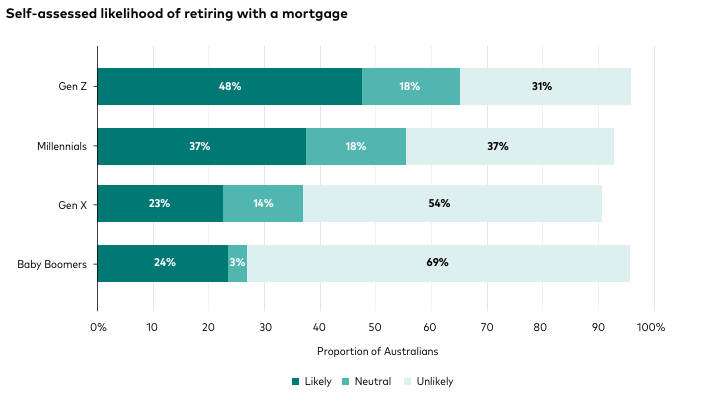
These findings suggest that one of the foundations underlying traditional retirement planning may be shifting.

How housing pressures are reshaping retirement

Much of Australia's retirement system evolved in an era when housing debt was typically paid off before retirement. But younger generations are navigating a very different housing market. They are buying later, borrowing more and carrying debt for longer, raising the likelihood of entering retirement without a paid-off home.

That matters because a household entering retirement with a mortgage faces very different choices and spending pressures from one that owns its home outright.

It is no surprise, then, that younger Australians generally believe they will need significantly more income in retirement than today's retirees.

Australians under the age of 45 estimated they would require more than $90,000 a year in retirement, compared with around $60,000 reported by Australians aged 65 and over.

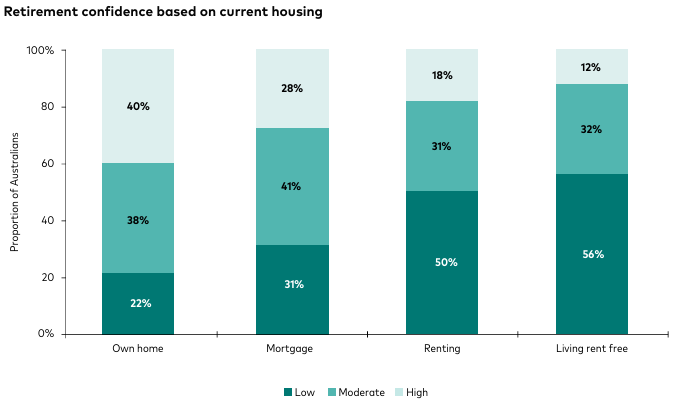
Our research also found that housing status was closely linked to retirement confidence.

Australians who owned their home outright reported the highest levels of retirement confidence, while confidence was lower among those with a mortgage and considerably lower among renters.
The trade-offs of carrying a mortgage into retirement

Among those expecting to retire with a mortgage, 45% expect to continue repayments in retirement, while 39% expect to use superannuation to pay off their mortgage in one transaction.

For those that have the choice, both approaches can be entirely reasonable, but neither is without compromise.

Using super to clear a mortgage can ease financial pressure, but it also reduces the savings available in retirement for lifestyle and other spending. Holding on to those savings means keeping more money invested but also means living with debt for longer.

These are not simple decisions. For a growing share of Australians, they will become central retirement-planning questions.

The role of planning in retirement confidence

When it comes to retirement confidence, one factor stands out clearly: planning.

Nearly half of working-age Australians have no retirement plan. Yet Australians with a clear retirement plan report much higher levels of confidence than those without one.

75% of Australians who know exactly what they need and how to achieve it report high retirement confidence compared with just 4% of those with no plan.
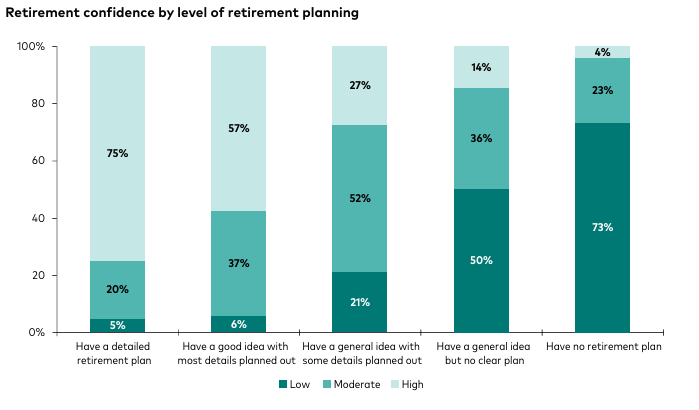
While no one can predict future house prices, interest rates or living costs, the research highlights that taking small, consistent actions can help people build confidence and feel better prepared for the retirement they want.

As retirement continues to evolve, our assumptions need to evolve with it. Having a plan and engaging early may matter more than ever.


Osei Wiafe, PhD is a Retirement and Superannuation Research Specialist with Vanguard's Investment Strategy Group and lead researcher on the How Australia Retires 2026 report. Vanguard is a sponsor of Firstlinks.

For more articles and papers from Vanguard, please click here.


Notes: All data sourced from Vanguard's How Australia Retires 2026 report, based on a survey of a nationally representative sample of over 1,800 Australians aged 18 years and over in February 2026. Read the report on Vanguard’s website.

This article contains factual information of a general nature only and does not contain financial product advice. It has not been prepared taking into account your objectives, financial situation or needs and may not be applicable to your circumstances. Before making financial decisions, consider your circumstances and seek professional advice from a suitably qualified adviser.

The survey results presented in this article reflect respondents’ self-reported expectations, intentions and confidence at the time of the survey. They are illustrative only and should not be taken as estimates or forecasts of individual retirement outcomes.


  •   28 October 2026
  • 3
  •      
  •   
3 Comments
Mark B
October 29, 2026

I have no doubt that the majority of this data is accurate and people will retire with mortgages but they do so knowing that they have access to growing Super balances, especially now with 12% contributions. So long as Super grows faster than the mortgage interest rate it's a good strategy.

In my own case in order to reduce the amount of Super to pull out (we are in pension phase) we took out as much mortgage on the new property when we downsized (even though new place cost more!) since we purchased the new one before selling the old one. Crazy market two years ago and we couldn't risk any other way!

So then after selling the old place and ploughing as much back into Super as possible we retained the 30 year mortgage even though we have an offset and no interest is ever paid on it. This gave us the flexibility to help the kids use that finance in the future if required and also helped increase the tax free % in Super due to re-contributing back the downsizer and non concessional contributions.

Net result is that it looks like we have a mortgage in retirement but the reality is that there is no debt outstanding and it's an available line of credit if required. I'm sure that we are not the only ones in this situation.

2
Sammm
November 01, 2026

I sortve did the same thing. I am living off my super though it looks like I have 2 mortgages. However its all now offset and am mortgage free. As it is very difficult to get a loan if I ever would need it, and it is difficult to get a new credit card.

The only thing is i pay a $350 fee for the homelobe package.


Leave a Comment:

RELATED ARTICLES

The 5% deposit scheme is bad for homeowners and Australia

The Bengen 4% Rule: Lost in translation

The key question to inspire a confident and purposeful retirement

banner

Most viewed in recent weeks

Division 296: the initial moves to make before the windows close

What if the best superannuation strategy isn't about earning more, but acting before your options disappear? Several overlooked planning windows are narrowing, with consequences that can last for decades.

The retirement scorecard: how many of these questions can you answer?

From the maths of retirement, estimating spending and picking the right asset allocation to survive a poor decade, here are the questions every retiree – current or future – should be able to answer for themselves.

Testamentary trusts: Treasury has picked the wrong reading

A decades-old estate planning tool has survived one tax crackdown only to be caught by another. The surprise isn't who the reform is targeting, but who could end up paying the price for drafting choices made years ago.

Superannuation’s structural failings

Politicians are fighting over access to super, but they may be arguing about the wrong thing. The system’s three fundamental flaws have been hiding in plain sight for decades, costing Australians far more than they realise.

Avoid unnecessary CGT with this estate planning clause

A simple estate plan can create a ticking time bomb. One overlooked clause can pit spouses against children, delay inheritances, and potentially leave a family facing an unexpected tax bill worth hundreds of thousands of dollars.

Higher yields are creating opportunities in global bonds

Bond markets are adjusting to a new reality, but not in the ways investors expect. With markets repricing and capital competing for attention, investors may need to rethink where resilience and opportunity lie. 

Latest Updates

Retirement

The retirement account that Australia should have

Our retirement system asks one account to do two very different jobs. A dedicated "rainy day" account separating income from emergency savings could deliver better outcomes and greater peace of mind for retirees.

Investing

What the US midterm results mean for investors

Democrats have regained control of Congress, changing the equation in Washington. Whether that proves positive for investors will depend less on the result itself and more on what happens next for growth and markets.

Taxation

Should the capital gains tax reward risk?

A reader query on the recent CGT reforms has revealed a bigger issue. One overlooked feature of the old system may have done more than compensate for inflation. As we move to indexation, are we forgetting to reward risk?

Investment strategies

Bonds: The income and diversification trade-off

Rising yields have made bonds attractive again, but that does not mean they will behave as expected. As inflation, fiscal pressures and geopolitical risks reshape markets, the role of bonds may be more complicated than it appears.

Investment strategies

Why high-dividend investing deserves another look

Income investors have endured several lean years, but signs of a recovery are emerging. As opportunities improve, investors face an important choice between chasing headline yields and building a reliable source of income.

Investment strategies

Why 'overvalued' has been such an expensive word

Investors love simple rules, especially when markets appear stretched. Yet some of the strongest returns have arrived when the outlook seemed least attractive. This leaves an important question that history struggles to answer.

Investment strategies

AI – A good kind of bubble or just a bubble?

Investor obsession with AI is attracting unprecedented amounts of capital and confidence. But beneath the excitement lies uncertainties about returns, funding and risks that enthusiasts may not be paying enough attention to.

Sponsors

Alliances

  • ASA-Logo-RGB-ActiveGreen-web.png

© 2026 Morningstar, Inc. All rights reserved.

Disclaimer
The data, research and opinions provided here are for information purposes; are not an offer to buy or sell a security; and are not warranted to be correct, complete or accurate. Morningstar, its affiliates, and third-party content providers are not responsible for any investment decisions, damages or losses resulting from, or related to, the data and analyses or their use. To the extent any content is general advice, it has been prepared for clients of Morningstar Australasia Pty Ltd (ABN: 95 090 665 544, AFSL: 240892), without reference to your financial objectives, situation or needs. For more information refer to our Financial Services Guide. You should consider the advice in light of these matters and if applicable, the relevant Product Disclosure Statement before making any decision to invest. Past performance does not necessarily indicate a financial product’s future performance. To obtain advice tailored to your situation, contact a professional financial adviser. Articles are current as at date of publication.
This website contains information and opinions provided by third parties. Inclusion of this information does not necessarily represent Morningstar’s positions, strategies or opinions and should not be considered an endorsement by Morningstar.