Register For Our Mailing List

Register to receive our free weekly newsletter including editorials.

Home / 362

Why the poor will pay more for aged care next year

From a financial advice and user perspective, it’s crucial to understand the impact of the coming drop in the 'aged care interest rate' or Maximum Permissible Interest Rate (MPIR). Advisers should look at a client’s personal circumstances, consider alternative scenarios and model not just the cost today but what it is likely to be in the future.

The MPIR is expected to drop to an all-time low of 4.10% from 1 July 2020. As with any change to government rates and thresholds, this change will create winners and losers. Unfortunately, the ‘losers’ are the low-means residents, people who are financially disadvantaged and receive government assistance with their accommodation cost whose lump sum could increase substantially. Ironically those who are not financially disadvantaged, known as ‘market price’ residents could be substantially better off if they pay by daily payment.

Let’s look at the impact the reduced MPIR will have on new and existing residents, explore what this means for an aged operator’s financial position and how advisers can deliver great advice to their clients.

1. Impact on new residents

When someone moves into residential aged care, they are assessed based on their assets and income to determine whether they are classified as a ‘low means’ resident or a ‘market price’ resident. It should be noted that this means assessment is not compulsory, those who choose not to submit an assessment will be considered a market price resident. The diagram below shows how the combination of assets and income determine the resident’s classification.

2. Impact on low-means residents

Where the person’s assets and income are below the orange line their accommodation contribution is calculated at 17.5% of assets above $50,500 plus 50c per dollar in excess of $27,736.80/year. The income threshold for a member of a couple is slightly lower at $27,216.80/year. The result is divided by 364 to calculate the person’s DAC (Daily Accommodation Contribution). For people with assets and income below both the asset and income thresholds (inside the green line) their Daily Accommodation Contribution (DAC) is $0.
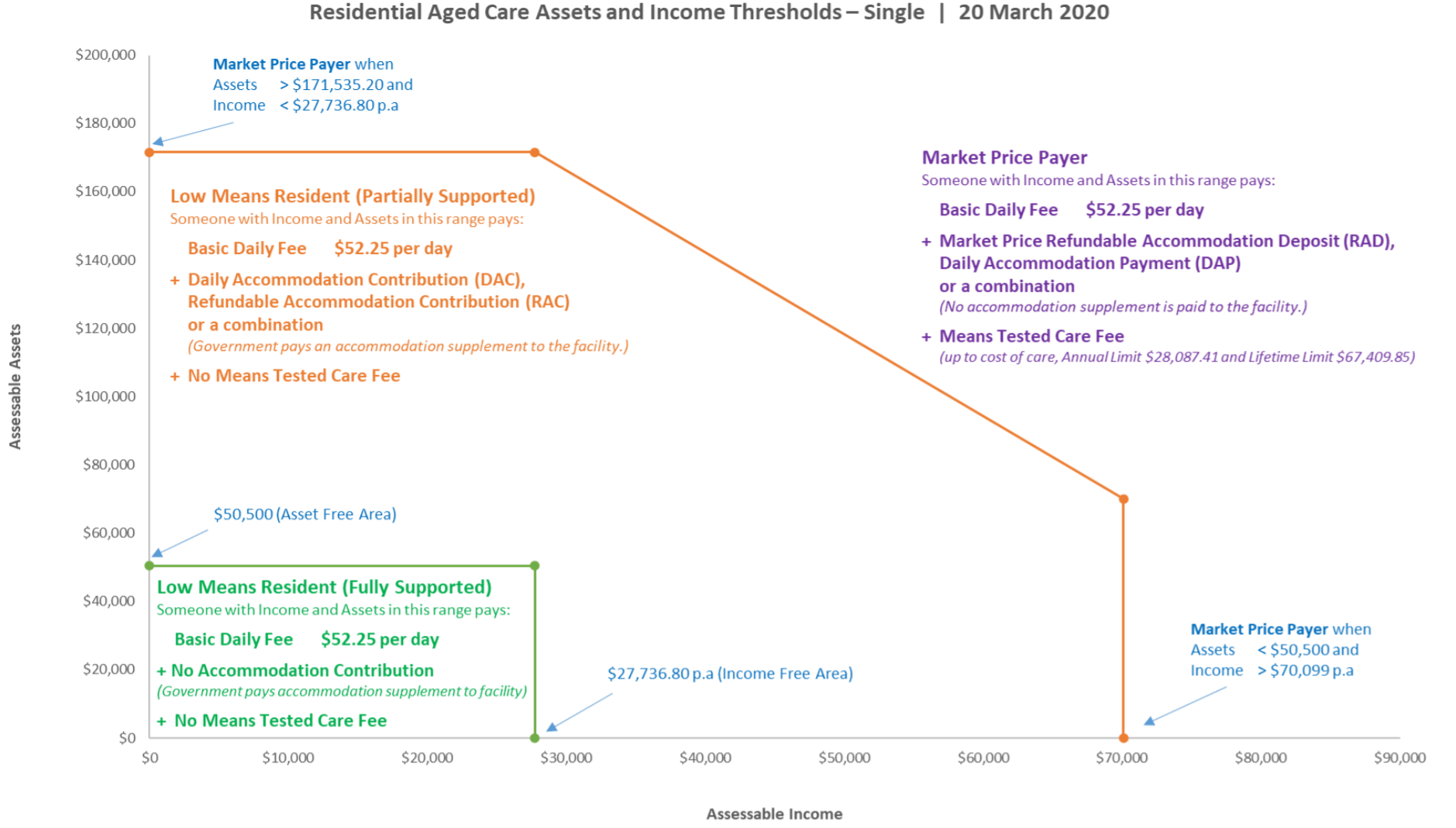
Source: Learn, Build, Deliver pro.agedcaregurus.com.au ACG Advice builder.

Low-means residents have the option of paying their accommodation contribution by daily payment, lump sum or a combination. The lump sum, known as the Refundable Accommodation Contribution or RAC, is calculated by dividing the daily accommodation contribution (annual) by the MPIR. In effect the daily accommodation contribution is the interest payable on that equivalent lump sum.

By nature of the formula the lump sum accommodation price for low means residents has an inverse relation to movements in MPIR, similar to bond pricing and yields. A decreasing interest rate (MPIR) will result in the equivalent lump sum increasing. Since the introduction of the Living Longer, Living Better (LLLB) reforms in 2014 the MPIR has reduced from 6.69% to 4.10% from July 2020. Changes to the MPIR don’t affect existing residents, the rate is set on the date of entry to the aged care home and doesn’t change while the resident lives there.

Changes to the resident’s financial position will cause their accommodation contribution to be recalculated, if their assets and/or income reduce then their contribution reduces. Likewise, if their assets and/or income increase (which is far more common) then their accommodation contribution increases (they can also be subject to a means tested care fee). But they are always classified as a low means resident while they live in that aged care home and the accommodation contribution they can pay is capped at the Government funding the facility can receive (known as the accommodation supplement).

The amount of accommodation supplement the aged care home can receive is based on the standard of the accommodation and the ratio of low means residents to market price residents.

The table below shows the maximum funding an aged care home can receive based on their building standard and low means ratio.
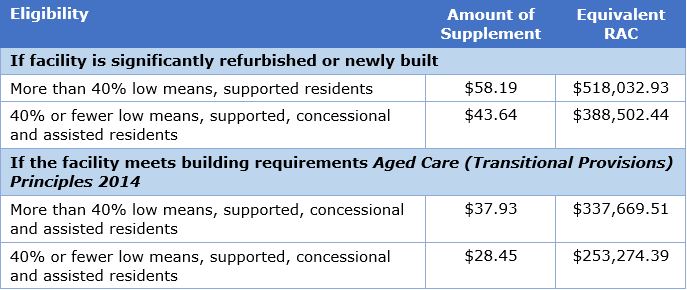
Source: https://pro.agedcaregurus.com.au/ Resource library

3. Impact on market price payers

For market price payers who enter care after 1 July the reduction in MPIR won’t change their lump sum amount but their daily accommodation payment (DAP) will be less. For example, a market price Refundable Accommodation Deposit (RAD) of $400,000 today has an equivalent DAP of $53.59, after 1 July the DAP will be $44.93 a saving of $3,161/year.

Historical context and need for advice

When the LLLB reforms were introduced in July 2014 a RAD of $400,000 had an equivalent DAP of $73.32 per day in 2014 this has subsequently decreased to $44.93 per day from 1 July 2020, a huge saving of 63% to the resident and a substantial drop in income to the aged care home.

In contrast, low means residents in 2014 could pay a maximum DAC of $52.49/day and their equivalent lump sum was $286,380. From 1 July, while the maximum DAC has only increased to $58.19/day the equivalent lump sum will be a staggering $518,033.

Like all great advice, the advice needs to take into consideration the client’s personal financial needs and objectives.

There are many clients who may be on the borderline, while it may seem illogical, increasing their assessable assets to push them over the threshold to become a market price payer may be a good idea.

If the client is going to be a low means resident and they want to pay by lump sum, moving in now rather than after 1 July could mean the difference between paying $434,343 versus $518,033. Of course, the RAC is an exempt asset so paying more could actually be of benefit to their pension, paying the higher RAC could equate to an extra $6,500/year in age pension.

For other clients strategies to reduce their assessable assets could save them a great deal. Reducing the assessable assets by $20,000 could reduce the DAC by $9.62/day or $3,500/year – the reduction to the equivalent lump sum is $85,366.

The change to the MPIR could change the ratio of low means residents an aged care home chooses to keep. If the home meets the new (or refurbished) building standards but has a ratio less than 40% low means residents, the most they can receive is $43.64/day or $388,502 as a lump sum from a low means resident. But if the ratio reaches 40%, they can receive $58.19/day or $518,033 as a lump sum. This may be very attractive, especially if their market price is below $500,000 as the market price doesn’t cap what a low means resident can pay.

Changes to the home’s funding don’t just impact on what new residents can pay, they also impact on existing resident. A resident who moved in 2 years ago and is currently paying a DAC $43.64/day could find that their costs jump up to $58.19/day – as a lump sum the cost would increase by just over $92,000 from $276,059 to $368,100.

Many low-means residents think they can’t afford great advice, we think they can’t afford not to get it.


Jemma Briscoe is Head of Research and Technical Advice at Aged Care Gurus. This material is general information only and does not take into account your objectives, financial situation or needs. There is a free webinar on this topic on 14 July at 12.30.


  •   17 June 2020
  • 7
  •      
  •   
7 Comments
Barry Lowther
June 17, 2020

As usual, these figures are 'smoking mirrors'! I think that you'd have to be an Einstein to make sense of them. No wonder we are all afraid of getting old, and needing care. If you have no money, you, once again, go to the end of the queue.

Rachel
June 20, 2020

Actually Barry it’s quite the opposite. Aged care homes must have a ratio of low means residents to market price payers, with the drop in interest rate it may be the low means residents who are prioritised.

Simone
June 17, 2020

Barry, don't be overwhelmed by the numbers. There are options for those who have income and assets and for those who do not. Help is available, you just need to know where to find it.

Peter
June 19, 2020

You say "Help is available". Can you be specific and name some examples as my experience the past twelve months suggests that obtaining meaningful help is quite difficult.

Rachel
June 20, 2020

Hi Peter, If you are looking for an adviser who understands all of the options and implications - pension, cost of care, estate planning etc - look for a Retirement Living and Aged Care Specialist. There is a panel on Aged Care Gurus website https://agedcaregurus.com.au/seekadvice/

Peter Anich
June 18, 2020

Much of the article makes sense, and yes it is good to compare 'just over' to 'just under' the threshold scenarios. One peculiarity, how does a low means person pay "$434,343 versus $518,033" if they are only worth less than $171,535?

Philip
November 03, 2020

Brilliant diagram...finally understand why dac was greater than dap but shouldn't be since my brothers position is in the market price region. I now have some ammunition to argue. It really is stupid that a partially supported person should pay more than a non supported person. It does show the poor government support for the aged care sector that this should be allowed to continue. They just don't care for the disadvantaged. Was the aged care royal commission made aware of this nonsense planning?


Leave a Comment:

RELATED ARTICLES

Aged care reforms: are the changes fair?

‘Tis the season, and aged care may be on the wish list

10 things I learned about dementia and care homes from close range

banner

Most viewed in recent weeks

Want your loved ones to inherit your super? You can’t afford to skip this one step

One in five Australians die before retirement and most have not set up their super properly so their loved ones can benefit from all their hard work and savings. 

Indexation implications – key changes to 2026/27 super thresholds

Stay on top of the latest changes to superannuation rates and thresholds for 2026, including increases to transfer balance cap, concessional contributions cap, and non-concessional contributions cap.

Super is catching up, but ageing is a triple-threat

An ageing Australia is shifting the superannuation system’s focus from accumulation to the lifecycle of retirement. While these pressures have been anticipated for decades, they are now converging at scale and driving widespread industry change.

Has Australia wasted the last 30 years?

The 20 years after Peter Costello left Treasury have been deemed wasted...by Peter Costello. The missed opportunities for Australia began long before.  

The refinery problem: A different kind of energy crisis in 2026

The Strait of Hormuz closure due to US-Iran conflict severely disrupted global energy supply chains. While various emergency measures mitigated the crude impact, the refined product market faces unprecedented stress.

3 ways to defuse intergenerational anger

With the upcoming budget increasingly likely to include bold proposals to alter the tax code I’ve outlined three incremental steps with fewer unintended consequences.

Latest Updates

Investment strategies

War can’t be good, can it?

War brings immense human suffering and geopolitical chaos, but historically, equity markets have shown a certain detachment and resilience amid conflict, leading to increased profitability despite initial panic.

Property

Origins of the mislabeled capital gains tax ‘discount’

Debate over the CGT discount is intensifying amid concerns about intergenerational equity and housing affordability. This analysis shows that the 'discount' does not necessarily favor property investors.

Superannuation

Div 296 may mean your estate pays tax on assets your beneficiaries never receive

The new super tax, applying from 1 July, introduces more than just a higher rate on large balances. It brings into focus a misalignment between where wealth sits and where the tax on that wealth ultimately falls.

Investment strategies

There’s more to software than just code

AI-driven fears of collapsing software moats has triggered indiscriminate sell-offs. This has created mispricing opportunities as markets overreact to uncertainty and rising discount rates.

Economics

Europe: A new growth trajectory powered by reform and investment

Europe is undergoing a major transformation driven by security threats, US pressure, and a shift from austerity to growth. EU member states are taking proactive measures to enhance competitiveness and resilience.

Investment strategies

Orbital AI data centers prepare for launch

The new space race is driven by AI as data centers in space offer continuous solar power and reduced environmental impact. Orbital AI aims to speed data processing and ease Earth's resource strains.

Retirement

Little‑known government scheme can help retirees tap into $3 trillion of housing wealth

The Home Equity Access Scheme in Australia allows older homeowners to tap into their home equity for retirement income, yet remains underused due to lack of awareness and its perceived complexity.

Sponsors

Alliances

© 2026 Morningstar, Inc. All rights reserved.

Disclaimer
The data, research and opinions provided here are for information purposes; are not an offer to buy or sell a security; and are not warranted to be correct, complete or accurate. Morningstar, its affiliates, and third-party content providers are not responsible for any investment decisions, damages or losses resulting from, or related to, the data and analyses or their use. To the extent any content is general advice, it has been prepared for clients of Morningstar Australasia Pty Ltd (ABN: 95 090 665 544, AFSL: 240892), without reference to your financial objectives, situation or needs. For more information refer to our Financial Services Guide. You should consider the advice in light of these matters and if applicable, the relevant Product Disclosure Statement before making any decision to invest. Past performance does not necessarily indicate a financial product’s future performance. To obtain advice tailored to your situation, contact a professional financial adviser. Articles are current as at date of publication.
This website contains information and opinions provided by third parties. Inclusion of this information does not necessarily represent Morningstar’s positions, strategies or opinions and should not be considered an endorsement by Morningstar.