Register For Our Mailing List

Register to receive our free weekly newsletter including editorials.

Home / 652

Do HNWI get better advice?

There are several studies that show that retail clients who get advice from brokers do not end up with better portfolios or improved performance. Here is a classic study from Canada that shows that while good advisers can create enormous value for clients, the average adviser does not. What made me perk up, though, was when I came across a study of clients in the rarefied world of German and Swiss private banking that shows a result to the contrary.

Maria Maas and her colleagues managed to convince a German private bank with offices in Germany, Switzerland, and Luxembourg to hand over 969 client portfolios. Of these, about 800 portfolios were self-managed by the clients, while about 160 were managed with the help of an adviser from the bank. Note that the differences between the advised and non-advised clients in this case are tiny. 92% of the clients are German, all of them have substantial financial assets (otherwise they wouldn’t be clients of the bank), and they all have very similar levels of income, age, risk profile, and financial literacy. The only real difference was the use of an adviser or the lack thereof.

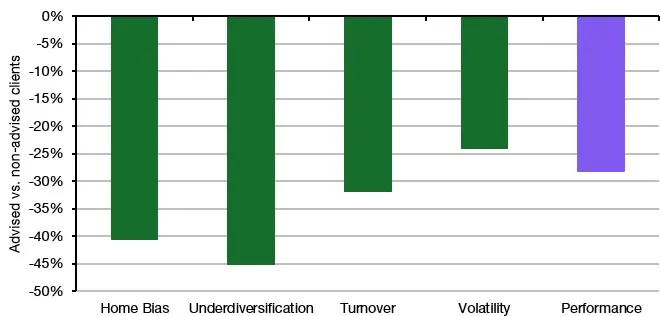
Below is a chart that summarises the key differences in terms of portfolio risks and behavioural biases between advised and non-advised clients. A negative number means that clients using an adviser have better (read: less risky) portfolios.

Difference between advised and non-advised clients’ portfolios
Source: Maas et al. (2025)

As you can see, the chart shows that clients who use an adviser have, on average, less of a home bias and more diversified portfolios. This directly contradicts the results of the Canadian study I linked to above. Clients who use an adviser also have portfolios with lower volatility and generally have lower turnover in their portfolios – something that has long been established as a key driver of underperformance.

But also note that despite these more diversified portfolios and the reduced turnover, the average return of the advised clients’ portfolios is lower than the return of the non-advised clients.

The authors of the study claim that advisers in this private bank are giving good advice because they reduce risks and behavioural biases in client portfolios. But one chart in the paper caught my attention. And I think that gives a hint at the true story.

Forgive my cynicism. As someone who has worked in Swiss private banking for almost 20 years, I don’t think private bank advisers are any better than retail advisers in Canada or anywhere else, for that matter. And the overwhelming evidence in previous studies points to advisers not adding any benefit to clients, on average (again, a good adviser can make a big difference, but you first have to find a good adviser).

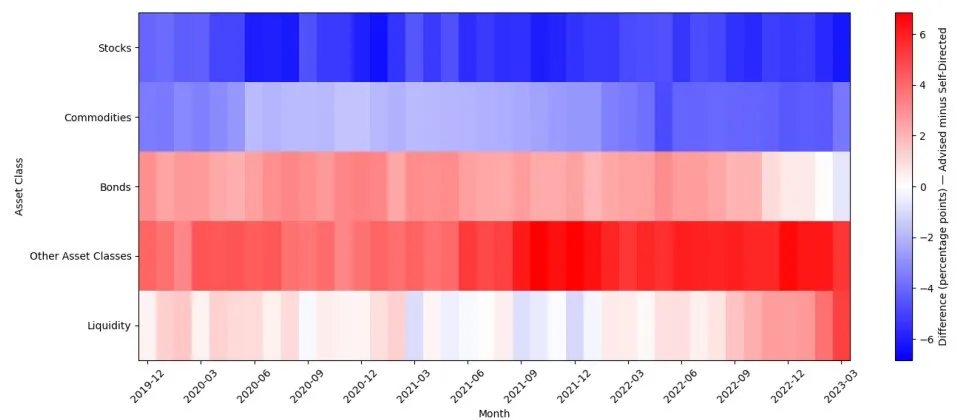
Below is that chart from the paper. It shows the average difference in portfolio allocation between advised and non-advised clients over time. Blue shades indicate that non-advised clients have a higher allocation, red shades indicate advised clients have a higher allocation.

Average difference in allocation
Source: Maas et al. (2025)

The chart shows that non-advised clients have more equities and fewer alternatives and bonds in their portfolio. Indeed, every private bank adviser will tell you that the incentive structure for them is such that they are trying to sell funds and preferably funds with high fees to the client.

Compared to non-advised clients who predominantly think about single stocks, this means that diversification is almost certainly higher in advised portfolios, while home bias and portfolio turnover are lower. That alone reduces volatility considerably.

But over the last twenty years, the trend has also been towards recommending alternative asset funds (hedge funds, private equity, infrastructure, etc) to clients because they promise additional diversification to the client and higher fees to the bank advising the client. Unfortunately, these alternative asset classes often end up with higher fees but lower returns than a simple stock/bond portfolio.

The result is that clients who use an adviser end up with more diversified and lower risk portfolios, but also with lower returns and almost always higher fees. I can’t prove that this is what is going on in this study, but I think my explanation is a bit more likely than assuming that private bank advisers are somehow better than their peers who work at brokerage firms or advise retail clients.


Joachim Klement is an investment strategist based in London. This article contains the opinion of the author. As such, it should not be construed as investment advice, nor do the opinions expressed necessarily reflect the views of the author’s employer. Republished with permission from Klement on Investing.


  •   4 March 2026
  • 3
  •      
  •   
3 Comments
Dean
March 05, 2026

This article should come with a warning that it was written by a foreign based investment consultant, and has little to no relevance to professional financial advice in Australia.

It focuses on portfolio construction, which is a very minor aspect of financial advice in Australia. Most Australian advisers are far more focused on issues like ownership structures, tax efficiency, debt management, effective use of superannuation, appropriate asset allocation for the client's risk profile, cashflow & budgeting, retirement forecasting, aged care funding, and estate planning. They add value by improving overall outcomes, and helping clients achieve their goals with greater peace of mind.

Many Australian financial advisers do no portfolio construction at all, with it being outsourced to specialists, or by following a low cost index approach. But they add considerable value for their clients via the other areas mentioned.

2
Simone
March 06, 2026

This just tells me I might be wasting my money getting Quintet Private Bank to manage my portfolio. It really reminds me of the 70 plus studies showing Drones have no impact on Humpback whales, but "one" New Zealand study that didn't actually see any Humpback whales found a small whale related to a Dolphin was disturb by drone noise. Hence that's the study that is frequently dragged out.

One of the things I learned after completing a Masters Degree is the flaws in research & it's easy to find one study out of 100 that shows the opposite. Thankfully 99 of those other studies in this space prove the opposite. Is Mr Joachim Klement allowing his personal biases to get in the way with proper research and perhaps have some bone to pick with his Bank.

Mr Joachim whilst focusing on portfolio performance of "that" Bank fails to point out that decades of research ( a lot trying to disprove the value of advice) have now without doubt academically, using independant University academic (and biased paid studies too), conclusively shown the value of Financial Advice and paying a Financial Planner. Mr Joachim won't becoming Dr Joachim anytime soon.

2
 

Leave a Comment:

RELATED ARTICLES

Are the good times about to end?

Platinum's new international funds boss shifts gears

Five charts show predicaments facing financial advice

banner

Most viewed in recent weeks

How cutting the CGT discount could help rebalance housing market

A more rational taxation system that supports home ownership but discourages asset speculation could provide greater financial support to first home buyers.

Want your loved ones to inherit your super? You can’t afford to skip this one step

One in five Australians die before retirement and most have not set up their super properly so their loved ones can benefit from all their hard work and savings. 

Super is catching up, but ageing is a triple-threat

An ageing Australia is shifting the superannuation system’s focus from accumulation to the lifecycle of retirement. While these pressures have been anticipated for decades, they are now converging at scale and driving widespread industry change.

Has Australia wasted the last 30 years?

The 20 years after Peter Costello left Treasury have been deemed wasted...by Peter Costello. The missed opportunities for Australia began long before.  

Meg on SMSFs: Last word on Div 296 for a while

The best way to deal with the incoming Division 296 tax on superannuation is likely doing nothing. Earnings will be taxed regardless of where the money sits, so here are some important considerations.

The 5% deposit scheme is bad for homeowners and Australia

An ‘affordability’ scheme making the county more vulnerable to economic shocks and contributing to the deteriorating financial situation of everyday Australians.

Latest Updates

Investment strategies

The thin line between investing and gambling

Prediction markets are blurring the line between investing and speculation and savvy investors can profit from this trend by heeding the advice of famed investor, Benjamin Graham.

Strategy

The refinery problem: A different kind of energy crisis in 2026

The Strait of Hormuz closure due to US-Iran conflict severely disrupted global energy supply chains. While various emergency measures mitigated the crude impact, the refined product market faces unprecedented stress.

Gold

Are we running out of gold?

Geopolitical instability and challenges with new gold discoveries mean we may be approaching a structural shortage of mineable gold, but what does this mean for gold's overall long-term availability?

Investment strategies

ETF investors adding to portfolios during recent volatility

In the face of recent market volatility investors continue to add to their ETF portfolios with these ETFs getting notable inflows, indicating that long-term fundamentals remain solid.

Strategy

Policy setting in democracies

Democracies aren’t a given, and policymakers need to be mindful not to alienate communities and instead be more aligned with mainstream ideas and attitudes. 

Investment strategies

Take my money and lie to me… again

As private funds increasingly show signs of cracking and buckling under a complete lack of liquidity, the salespeople do their best to keep the cash pouring in from new investors. 

Economy

Australia was once a world leader in innovation, now the system is ‘broken’

Ambitious Australia joins a long line of reports examining research and development, finding Australia has fallen behind its peers on many fronts. It urges bold reform to address declining productivity and research spending.

Sponsors

Alliances

© 2026 Morningstar, Inc. All rights reserved.

Disclaimer
The data, research and opinions provided here are for information purposes; are not an offer to buy or sell a security; and are not warranted to be correct, complete or accurate. Morningstar, its affiliates, and third-party content providers are not responsible for any investment decisions, damages or losses resulting from, or related to, the data and analyses or their use. To the extent any content is general advice, it has been prepared for clients of Morningstar Australasia Pty Ltd (ABN: 95 090 665 544, AFSL: 240892), without reference to your financial objectives, situation or needs. For more information refer to our Financial Services Guide. You should consider the advice in light of these matters and if applicable, the relevant Product Disclosure Statement before making any decision to invest. Past performance does not necessarily indicate a financial product’s future performance. To obtain advice tailored to your situation, contact a professional financial adviser. Articles are current as at date of publication.
This website contains information and opinions provided by third parties. Inclusion of this information does not necessarily represent Morningstar’s positions, strategies or opinions and should not be considered an endorsement by Morningstar.