You know a financial issue has become mainstream when it develops its own acronym as a descriptor; as FORO, the fear of running out (of retirement savings), has in recent years.
It’s not hard to see why. Australia’s four-plus million current retirees didn’t have the benefit of high rates of super guarantee (SG) over the entirety of their working lives. Many were already mid-career at the commencement of SG in mid-1992. Hence the concern surfaced in a 2019 National Seniors survey, that saw more than half of respondents answering ‘frequently’ or ‘occasionally’ to the question: ‘Do you worry that you might outlive your savings and investments?’
Longer life expectancies may also be adding to the FORO angst, with the current Australian Life Tables (2020-22) projecting the cohort life expectancy for a 65-year-old male to be 86.4 years and that of an equivalently aged female to be 89.1 years in 2026. As these are median estimates, half this cohort would be expected to survive beyond these ages.
Taken together, it is therefore unsurprising that FORO is a real, present and salient concern for many. So how worried should you be? Well, that depends.
On the one hand, Treasury’s 2020 Retirement Income Review (RIR) cited studies which found that retirees were passing away with around 90% of the assessable assets they had at the point of retirement. On the other, a 2021 study by the Association of Superannuation Funds of Australia (ASFA) found that over 90% of those aged 80-plus had no super remaining in the four-year period before death.
Something doesn’t add up. Or does it? Well, that depends.
Super as two sub-systems
The apparent contradiction resolves itself in two ways. First, RIR and ASFA are pointing to different outcomes; the former considers all assessable assets while the latter looks only at superannuation. And it is not uncommon for some amount withdrawn from super in pension phase to be recycled into other non-super savings.
The second is to recognise that superannuation isn’t one homogenous system but two sub-systems instead: APRA-regulated funds and Self-Managed Superannuation Funds (SMSF).
The table below provides some key statistics for each.
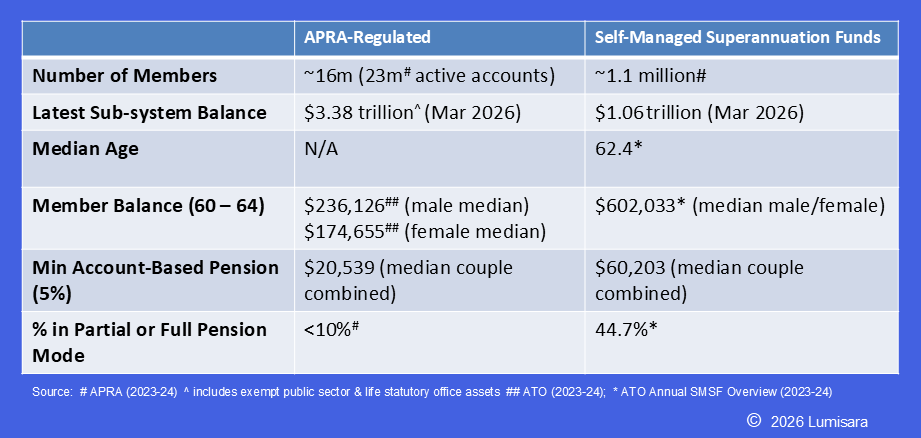
Australia’s $4.44 trillion in superannuation was, at the end of March 2026, split essentially 76%-24% between APRA-regulated funds and SMSFs by balance, and 94%-6% by members. The median* SMSF near-retiree (60 to 64 years-old) has between 2.5 and 3.5 times the super balance of an equivalent APRA-regulated member.
That, as it turns out, matters a lot in answering the FORO question. To do so I’ll focus just on superannuation wealth per ASFA, and not total household financial resources per RIR.
Here are the four factors which, in my opinion, have the strongest predictive power as to whether you will run out of super before you run out of life.
Factor 1: Super balance at retirement
It isn’t controversial to suggest that the larger a super balance is at retirement, the longer (all else equal) it should last. ASFA concedes as much in its 2021 paper, noting that of those aged 80-plus with super remaining on death, the average balance was $375,096 (with the median at $117,000), thus “reflecting the small number of retirees with high superannuation balances”.
Evidence of this ‘portfolio size effect’ has been further strengthened by a recent paper^ from the Monash Centre for Financial Studies (MCFS), which modelled retirement portfolio depletion in account-based pensions over 10-year periods, with differing asset allocations from 100% bonds to 100% equities. Outcomes were benchmarked against the ASFA modest and comfortable retirement standards.
For a ‘balanced’ 60/40 portfolio, the probability of drawing the ASFA comfortable income and ending the first decade with more than 90% of the account balance eroded was 100% for a starting balance of $100,000, 38% for the median APRA-regulated female starting balance, less than 3% for the median male equivalent, and effectively zero for balances above $500,000.
The average remaining account balance for the 60/40 portfolio after a decade was $0 for a starting balance of $100,000, around $380,000 for a starting balance of $600,000 and some $680,000 for a starting balance of $1 million.
Factor 2: Housing situation and lump sum withdrawals
In an ideal world, you’d build your super over three-plus decades of contributions and earnings growth, then use the entire balance to support your lifestyle in retirement via one or more income stream products, living in the house you comfortably paid off before retirement.
That scenario is, unfortunately, applying to fewer Australians, due to increasing household debt levels, led by housing (mortgage) debt which has increased from around 30% of household disposable income in 1990 to sit around 135% by 2020, according to the RIR.
The effect of this debt expansion has seen the proportion of homeowners aged 65-plus with outstanding housing debt rise from around 7% in 1990 to nudge 14% in 2020.
That, in turn, is driving many near or recent retirees to make withdrawals from super to reduce or eliminate housing and other debt, as I have previously written about. HILDA data produced by The Melbourne Institute suggests that of males who retired between 2015 and 2019 and who withdrew some of their super, 43% ($108,428) of the average balance was withdrawn, while for females the figure was 47% ($78,092).
Any such reduction in super would amplify the portfolio size effect, especially for APRA-regulated super fund members with more modest balances.
Factor 3: Investment and sequencing risk
Assuming you’ve cleared your debts and now have what we at Lumisara term a Net Pension-Generating Super (NPGS) balance ready to start a pension, investment and sequencing risk enter the FORO fray.
These are two of several financial risks that retirees face, but they are not the same and can impact retirement portfolios in different ways.
Investment risk is illustrated via the chart below, which shows the frequency of financial year returns for the median ‘growth’ option APRA-regulated pension fund since the start of super guarantee.
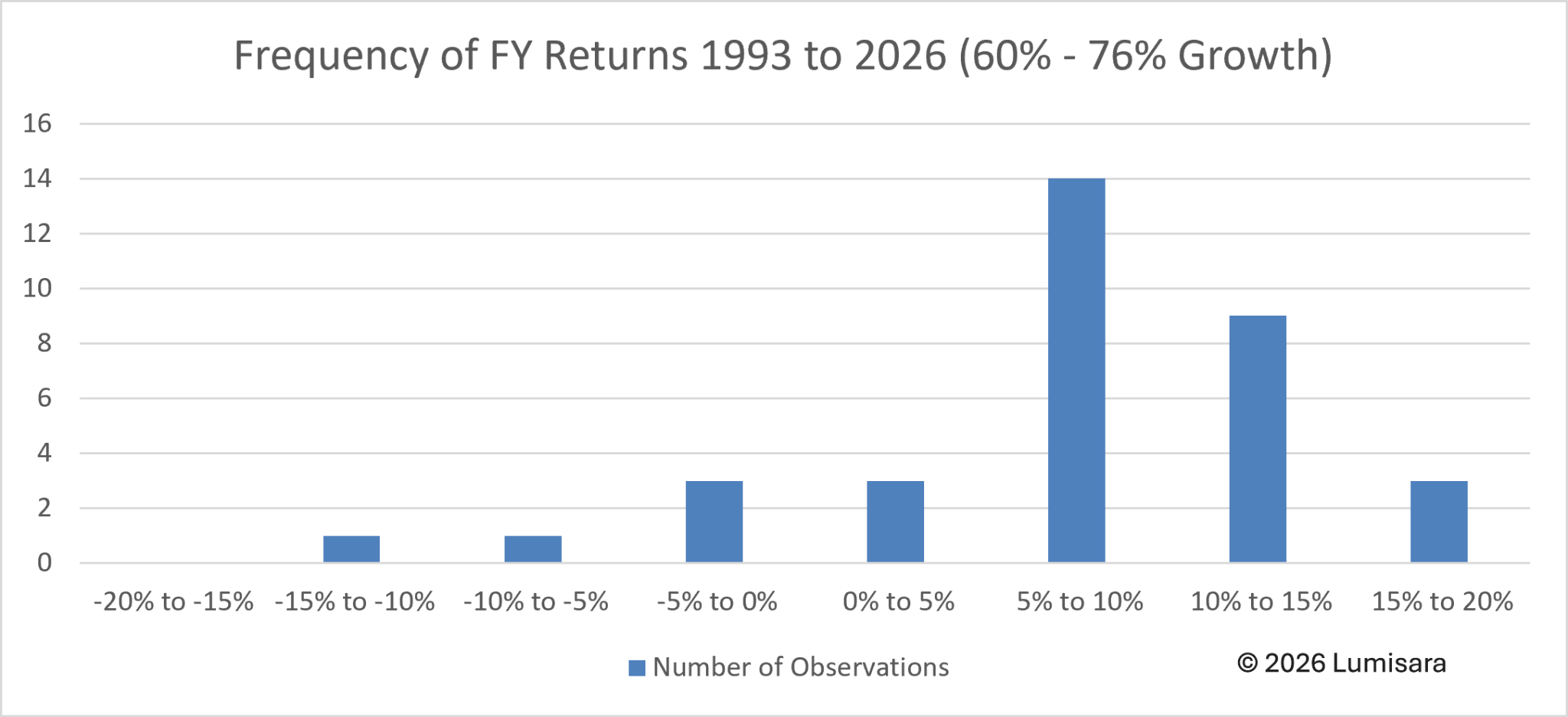
While the 34-year return was a little over 7% p.a., the range of returns varied from a high of almost 18% in 2020-21 to a low of almost -13% in 2008-09. Sequencing risk, however, occurs when a series of poor or negative returns cluster together, as occurred between 2001 and 2003, and between mid-2007 and early 2009.
When those clusters interact with pension payments made from an account-based pension, it can accelerate the time to account depletion, as demonstrated here using the volatility earlier this year.
The MCFS paper likewise found sequencing risk has a pernicious effect on account-based pensions, with the modelling showing an early downturn could reduce ending balances by up to 25%, with the effect most severe for smaller starting balances.
Factor 4: Longevity hedging and luck of the retirement draw
We’ve thus far discussed FORO in the context of account-based pensions, by far the most popular retirement income stream choice amongst Australian retirees.
Retirees are, however, free to hedge their personal longevity risk via a product provider who will exchange the purchase price of a lifetime annuity for an income stream that will continue for as long as they do.
These products were in reasonable demand back in the mid-to-late 1990s when they were fully exempt from the age pension assets test and their rates nudged into the low-to-mid teens. But the stepped removal of the exemption by late 2007, together with falling long bond yields, saw demand shrink.
The recent reintroduction of a partial asset test exemption (for certain innovative lifetime products), together with a regulatory push for APRA-regulated funds to help members manage longevity risk, has seen a recent uptick in their use.
Which leads to the role of luck. Those who retired in the late 1990s and acquired lifetime annuities in part or full (thus hedging longevity risk at sharp rates while enjoying an age pension uplift) experienced, with the benefit of hindsight, an extremely fortuitous confluence of events. They may very well be Australia’s luckiest retirees, devoid of FORO.
Those who retired just a few years later, in mid-2007, when lifetime annuities offered no yield or age pension advantage, were battered by the sequencing risk effect of the global financial crisis. Many had to return to the workforce to mitigate their FORO. Fortune was not on their side.
FORO is about risk management
It is perfectly rational to wonder if your super is going to last as long as you do. It’s the reason the ‘How much super is enough?’ question is one of the most asked. FORO causes a lot of angst, of that there is no doubt.
It’s anxiety-provoking because the future is both unknown and unknowable. We just can’t know how long we’ll live, how our income needs might change during retirement, how future laws impacting our wealth and finances will evolve, and how our portfolios are going to perform from year-to-year and over the longer term. These are risks that every retiree faces.
What we can, however, get a sense of is the predictive factors that help superannuation balances go the distance. Those include one’s net pension-generating super (NPGS) balance at the start of retirement, and thereafter the prudent management of investment and sequencing risk, or alternatively shifting some of that FORO risk to a lifetime income stream provider.
Harry Chemay is a co-founder of Lumisara, a consultancy that assists clients across wealth management, FinTech and the APRA-regulated superannuation sector, with a particular focus on the late accumulation to early decumulation phase of the retirement journey.
* The ATO annual SMSF data release provides average SMSF balances by age cohort and gender, but not median balances. For 2023-24, male 60–64-year-old SMSF members had an average balance of $1,049,826 while equivalent females had an average balance of $911,758.
^ Le, T and Ruthbah, U (2025), ‘Comfort or Collapse: Why Balance Size and Design, Not Just Returns, Decide Retirement’, Monash Centre for Financial Studies, October 2025
Disclaimer: This article is for information purposes only and does not purport to be general or personal financial product advice. As such you should not rely on it in making financial decisions. Should you wish to have your personal financial needs and circumstances taken into account, you should consider engaging the services of a suitably qualified financial adviser.