The investment landscape changed dramatically on Budget night. The Government's objective was simple: to impose a minimum 30% tax rate on investment gains, regardless of a person's income. The result is the extraordinary situation where a self-funded retiree on a modest income who does not receive the Age Pension could pay a flat 30% tax on capital gains while losing the benefit of both the tax-free threshold and the 16% tax bracket that normally applies to taxable income between $18,201 and $45,000.
Furthermore, as far as listed shares are concerned, the CGT indexation provisions and the treatment of capital losses have created a minefield. Already, this is causing a swing away from direct share investment towards ETFs and managed funds. Fortunately, there is one investment that sidesteps many of these problems – insurance bonds (also referred to as investment bonds). They've been around for a long time but have become relatively unknown because many of today's young advisers have never heard of them, while many people who once knew them no longer understand how they work.
Why does this matter? Because for many investors the new rules mean tax efficiency has become more important than ever. Investment decisions can no longer be based solely on expected returns. The way those returns are taxed may now make the difference between a good investment and a great one, particularly for retirees and families planning across generations.
A good way to understand insurance bonds is to compare them with superannuation. In both cases, your money is invested in a range of assets that you choose, and the fund pays tax on your behalf. Consequently there is no need to include annual earnings in your tax return. Contributions to super can come from either pre-tax or after-tax dollars – contributions to insurance bonds can only come from after-tax dollars.
The key differences are that superannuation funds generally pay tax at 15%, while insurance bond funds pay 30%. Super contributions are limited and your money is generally locked away until you reach your preservation age, currently at least 60. The large super funds are also notorious for the time they can take to pay death benefits. In addition, there may be tax of up to 17% if the taxable component of your superannuation is left to a non-dependent child, and if your super balance exceeds $3 million you may also be subject to Division 296 tax.
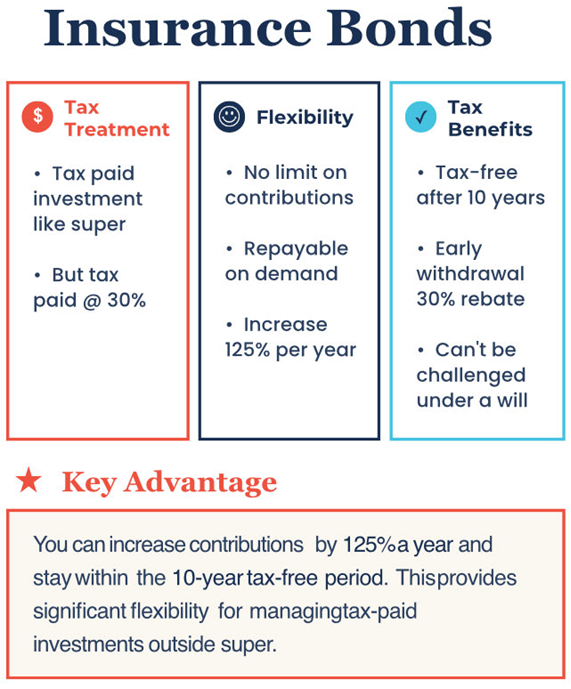
Insurance bonds avoid these issues. There are no contribution limits, your money always remains accessible and can be withdrawn quickly, and there is no death tax payable.
This flexibility is a major attraction. If you hold the bond for 10 years it can be redeemed tax-free. However, you can withdraw all or part of your investment whenever you wish. If you cash it in before 10 years, the profits are taxed as normal income, but you receive a 30% tax rebate to recognise the tax already paid by the fund, making the investment highly tax-effective for many investors.
Suppose an investor earns $65,000 a year and cashes in a bond for $50,000 that originally cost $40,000. The tax on the $10,000 profit will be $3,250, but the rebate will be $3,000, leaving just $250 tax to pay. They also offer significant capital gains tax advantages.
Case study 1
Sarah is in her early 40s, is single and has a family trust set up with her as the sole beneficiary which she plans on using once she establishes a family. Sarah holds down a well-paid job and is currently on the highest marginal tax rate of 47% (including the Medicare levy). Sarah has accumulated in her family trust $100,000 of assets, currently held in a short-term deposit account earning an assumed return of 5% p.a. Sarah is looking to manage her trust's investments in a more tax-effective manner and has considered an insurance bond as an alternative. She has run the numbers to compare the after-tax outcome of her trust investing in cash directly, versus using an insurance bond that earns the same amount on a pre-tax basis. Based on the analysis, over a 10-year period, Sarah would be almost $25,000 better off on an after-tax basis.
Sarah is also quite keen on taking on more risk while still being highly tax-effective, so she looks at other investment classes and decides that she’d like to consider Generation Life’s Tax Effective Australian Share Fund option to provide her that exposure. Her analysis shows that based on her $100,000 initial investment, if she’d invested in the Generation Life insurance bond earning an assumed 9% p.a. on a pre-tax basis, she would be almost $59,000 better off on an after-tax basis over a 10-year period, compared to investing directly in an equivalent index fund strategy.
In both cases, Sarah’s after-tax returns would improve. In addition, because the earnings were held within the insurance bond structure, her personal assessable income would also reduce, meaning that her marginal tax rate would have fallen from the 47% to 39% (including Medicare levy).
Insurance bonds are also exceptionally effective estate-planning tools because they sit outside the will and generally bypass probate.
Case study 2
Rachel is 60 and wants to provide for her family. She has two children, Sam and Louise, who have one and three children respectively. To reflect the different family sizes, she wants Sam's family to receive $100,000 and Louise's $300,000. She invests $400,000 in an insurance bond, naming Sam to receive 25% of the proceeds and Louise 75%. Because the bond passes directly to the nominated beneficiaries, it bypasses her estate and probate.
If she later changes her mind, she can simply alter the nominations without rewriting her will. Even divorce or remarriage does not affect the nominations unless she chooses to make changes. If Rachel lives another 20 years, the $400,000 could easily grow to more than $1.3 million, helping her legacy keep pace with inflation. If the grandchildren need help with university fees or a house deposit before then, she can withdraw part or all of the investment.
Case study 3
Think about Harry, aged 80, remarried after a nasty divorce, who wants to leave bequests to children of both marriages. He knows there is acrimony within the family and wants to ensure his assets are distributed exactly as he intends, without costly legal disputes.
He invests $250,000 in each of five separate insurance bonds, naming a different child as the beneficiary of each. Because an insurance bond is a life policy, the proceeds are generally outside the estate and cannot normally be challenged, allowing Harry to distribute his wealth exactly as he intends.
Insurance bonds are also an excellent way for grandparents to help their grandchildren.
Most financial institutions will not accept investments in the name of a minor. If the money is held by a parent or grandparent as trustee, the income may be subject to children's penalty tax rates of up to 66%. Investing in a parent's name can reduce family tax benefits, push them into a higher tax bracket or affect eligibility for the superannuation co-contribution. Investing in a grandparent's name may also reduce their Age Pension as the investment grows.
Insurance bonds provide an elegant solution. After 10 years the proceeds can generally be withdrawn tax-free, but there is no obligation to do so. The investment can remain in the bond for as long as you wish. Nor are they just for wealthy investors. Most providers allow you to start with a modest investment and add to it over time.
Consider a simple example. Grandparents want to establish an investment for a grandchild with an initial contribution of $10,000. They hope to add more over time but don't want to commit themselves to doing so. Their adviser recommends an insurance bond owned by the mother, with the grandchild nominated as the future owner on a specified date.
When taking out this type of policy you can nominate a date at which the policy will automatically transfer to the child.
Now comes the best part. Until the policy is transferred to the child, the parent retains complete control over the investment, including the ability to change the date of transfer. There is also no capital gains tax on the transfer.
Can you think of a better intergenerational investment? The parent retains complete control, there is no annual personal taxable income and it’s invested tax effectively. The money is available whenever it is needed. The bonds tick every box. There is no death tax, no widow's tax, no lack of access, and they can sit outside of your estate providing certainty around asset distribution. One final advantage is that the proceeds from redeeming a bond are generally paid into your bank account within 10 working days.
Noel Whittaker is the author of Making Money Made Simple and numerous other books on personal finance. His advice is general in nature and readers should seek their own professional advice before making any financial decisions. Email: [email protected].