The AFL has announced a move this season to a Final Ten by adding a ‘wildcard’ round to its existing Final Eight format. But has it got the formula right?
First, a recap of the Final Eight system that has been in place since 2000, according to final ladder positions.
Week 1
- Game One: 1 v 4
- Game Two: 2 v 3
- Game Three: 5 v 8
- Game Four: 6 v 7
Week 2
- Game Five: loser One v winner Three
- Game Six: loser Two v winner Four
Week 3
- Game Seven: winner One v winner Six
- Game Eight: winner Two v winner Five
Week 4
- Grand Final: winner Seven v winner Eight
We also assess the fairness of this finals format by determining the premiership chances for each team implied solely by the finals structure. This is done by assuming that each final is a 50:50 contest. Such an approach strips out external influences like home ground advantage, form, injuries, and so on, leaving the finals system itself as the sole determinant of premiership prospects.
Possible paths to premiership for teams 1 to 4, and premiership winning probabilities:
- Path 1: win week1 - win week 3 - win week 4.
Assuming a 50% probability of winning per final, probability of a premiership via this path = 0.5 x 0.5 x 0.5 = 12.5%. That is, in shorthand notation: W-W-W = 0.5 x 0.5 x 0.5 = 12.5%.
- Path 2: lose week 1 - win week 2 - win week 3 - win week 4.
That is, L-W-W-W = 0.5 x 0.5 x 0.5 x 0.5 = 6.25%.
Therefore, total probability of winning the premiership, teams 1 to 4 = 12.5% + 6.25% = 18.75%.
Path to premiership for teams 5 to 8, and premiership winning probabilities (there is only one path possible): W-W-W-W = 0.5 x 0.5 x 0.5 x 0.5 = 6.25%.
(Check: teams 1 to 8 probabilities sum to 100%)
Now many AFL diehards would remember the old Page-McIntyre Final Four system that was in place in the VFL from 1931 to 1971. It worked as follows:
Week 1
- Game One: 1 v 2
- Game Two: 3 v 4
Week 2
- Game Three: loser One v winner Two
Week 3
- Grand Final: winner One v winner Three
In the same vein as above, the premiership winning probabilities are (again assuming 50% win probability per final):
- Teams 1 & 2: W-W or L-W-W = (0.5 x 0.5) + (0.5 x 0.5 x 0.5) = 37.5%
- Teams 3 & 4: W-W-W = 0.5 x 0.5 x 0.5 = 12.5%
But why consider the old Final Four premiership winning probabilities?
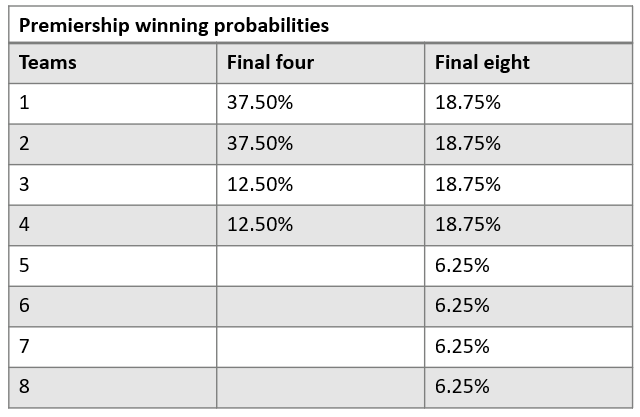
Because teams 1 and 2 probabilities (Final Four) at 37.5% = twice that of teams 1 to 4 (Final Eight) at 18.75%. And teams 3 and 4 (Final Four) at 12.5% = twice that of teams 5 to 8 (Final Eight) at 6.25%.
And this is because the Final Eight system is basically two Final Four conferences: teams 1, 4, 5, and 8, and teams 2, 3, 6, and 7 (with conference crossover in week 3). The winners of each Final Four, play off in the grand final.
Hence Final Eight premiership probabilities = 0.5 x Final Four probabilities. The 0.5 factor reflecting the extra win required. In summary:
Table 1
Given all that, wouldn’t the natural progression from a Final Eight to a Final Ten, be two Final Five conferences (with crossover)? Rather than a ‘wildcard-fed’ Final Eight?
Consider the McIntyre Final Five system from 1975 to 1990. That finals format progressed as follows:
Week 1
- Game One: 2 v 3
- Game Two: 4 v 5
Week 2
- Game Three: 1 v winner One
- Game Four: loser One v winner Two
Week 3
- Game Five: loser Three v winner Four
Week 4
- Grand Final: winner Three v winner Five
And the premiership winning probabilities are:
- Team 1: 37.50%
- Teams 2 & 3: 25.00%
- Teams 4 & 5: 6.25%
(See Footnote for Final Five probabilities detail).
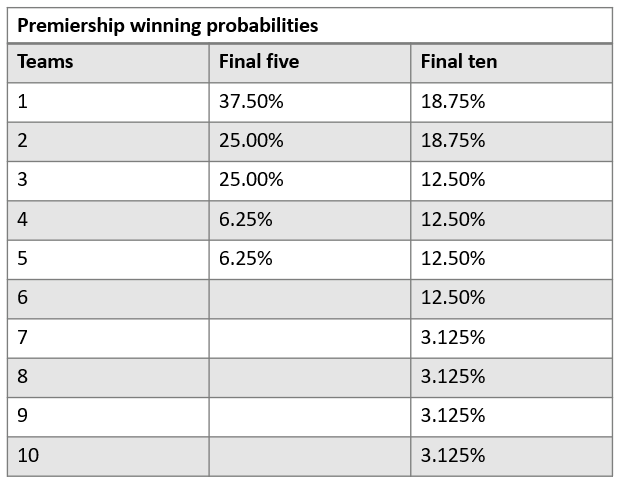
It follows then that a ‘two-conference’ Final Ten will have probabilities: 0.5 x Final Five probabilities, yielding:
Table 2
In order to compare the ‘two-conference’ Final Ten, with the ‘wildcard’ Final Ten, we also need the premiership winning probabilities under the wildcard system.
The ‘wildcard’ Final Ten has teams 7 v 10, and 8 v 9 in the first week of the finals, to determine positions 7 and 8 for the Final Eight format commencing in week 2.
These four teams will therefore now need to win five games to take out the premiership. The probability being: 0.5 x 0.5 x 0.5 x 0.5 x 0.5 = 3.125%.
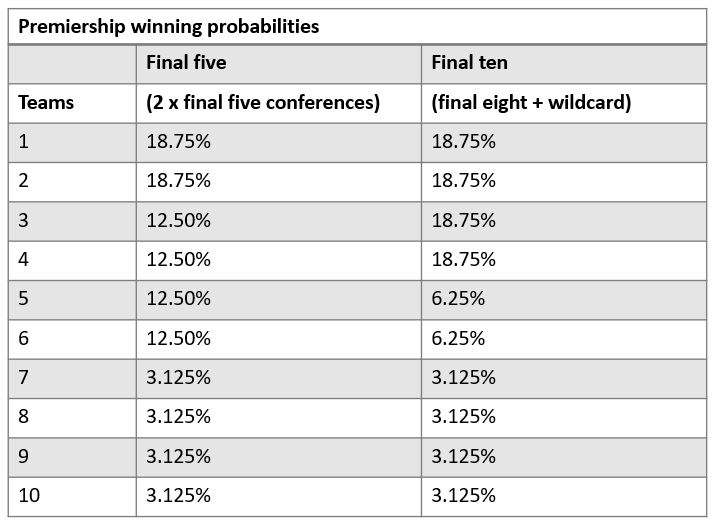
Premiership winning chances for teams 1 to 6 remain unchanged from Table 1. We have then:
Table 3
Observations:
- The commercial logic from an AFL point of view in moving to a ‘wildcard’ Final Ten, is two extra finals, with more teams ‘alive’ deeper into the season, and less ‘dead’ rubbers. But the motivation might seem to be more commercial than competitive.
- Teams 7 and 8 are the big losers in going from a Final Eight to a Final Eight ‘plus wildcard’ format, with their probabilities halving from 6.25% to 3.125%. They have gone from having some semblance of a chance of winning the premiership (à la the Western Bulldogs in 2016 when they won from 7th) to realistically just now making up the numbers.
- However, the same small probabilities for teams 7 and 8 also emerge in the Final Ten conference model. A consequence perhaps of any Final Ten, that the bottom rung teams have little chance. Unless a format was devised over more than five weeks, but that’s one for another day.
- The ‘two-conference’ Final Ten version, genuinely rewards the top team in each conference, with the winning probabilities of those two teams superior to teams following. Better teams should have higher chances, and the conference model achieves that.
- Table 3 shows probabilities invariant for teams 1 and 2, and teams 7 to 10, with all redistribution occurring between teams 3 to 6. But that redistribution is key to competitive balance.
- The two-conference format smooths out probabilities for the mid-rung teams, with teams 3 to 6 enjoying the same reasonable winning chance of 12.5%. And probabilities progress in a smoother fashion from top to mid, unlike the wildcard version, where there is a ‘cliff effect’, with winning chances plummeting from team 4 to team 5 (18.75% to 6.25%).
- Under the two-conference system, there would be two more finals than the wildcard version, 13 finals versus 11, both played over five weeks. And so would be even more of a commercial win for the AFL. If the objective is additional content, the ‘two-conference’ Final Ten dominates the wildcard model commercially.
Overall, a Final Ten conference format offers a smoother and more coherent finals structure. Premiership chances are more graduated, and it genuinely rewards the top two teams over the rest, while utilising arguably the best finals format the VFL/AFL has ever implemented, in the McIntyre Final Five system.
The ‘add-on’ of a wildcard round, however, gatecrashes a proven Final Eight format rather than integrating with it. A wildcard approach appears to be a rushed decision that comes at the expense of competitive balance, without exploring alternatives that are fairer, more logical, and better aligned with ladder outcomes.
Tony Dillon is a freelance writer and former actuary. This article is general information and does not consider the circumstances of any investor.
Footnote
McIntyre Final Five premiership paths and probabilities:
- Team 1: win week 2 – win week 4 or lose week 2 – win week 3 – win week 4:
W-W, or L-W-W = (0.5 x 0.5) + (0.5 x 0.5 x 0.5) = 37.50%
- Teams 2 & 3: win week 1 – win week 3 – win week 4 or lose week 1 – win week 2 – win week 3 – win week 4 or win week 1 – lose week 2 – win week 3 – win week 4:
W-W-W, or L-W-W-W, or W-L-W-W = (0.5 x 0.5 x 0.5) + 2 x (0.5 x 0.5 x 0.5 x 0.5) = 25.00%
- Teams 4 & 5: win week 1 – win week 2 – win week 3 – win week 4:
W-W-W-W = (0.5 x 0.5 x 0.5 x 0.5) = 6.25%