Register For Our Mailing List

Register to receive our free weekly newsletter including editorials.

Home / 647

Finding yield on the ASX

Like the track Upside Down by Diana Ross in the final series of Stranger Things, the ASX has become an upside-down world in which riskier dividend yields sit below risk-free government bond yields. Now is as important a time as ever for investors to think carefully about what bond-like stocks to hold in their portfolios.

Introduction

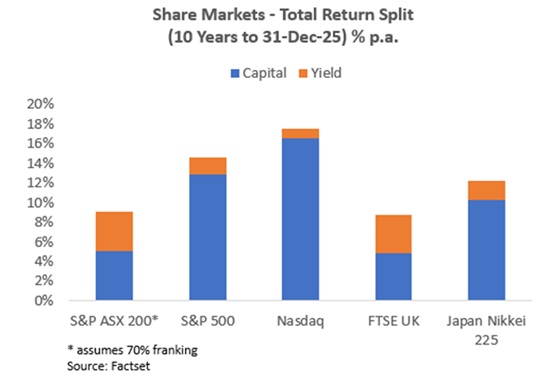
The Australian share market is known for its yield appeal. As shown in the below chart, yield comprises a more meaningful portion of total return than for a number of other offshore share markets, and especially so after allowing for Australia’s unique dividend imputation system.
Our yield status in Australia reflects, among other things, the following:

  • Many companies are domestic only (ie only operate in Australia), a constraint on growth (vs major offshore markets which serve much larger addressable markets);
  • Many are mature and incumbent, again limiting reinvestment opportunities (eg major banks, telcos, health insurers, and most REITs and consumer staples);
  • High payout ratios (which iterates with the above two factors), limiting capital available for reinvestment to grow; and
  • Taxation – Australia’s unique imputation system makes dividends a more efficient way to return capital to shareholders than other methods (eg share buybacks).

What is the yield of the ASX at present?

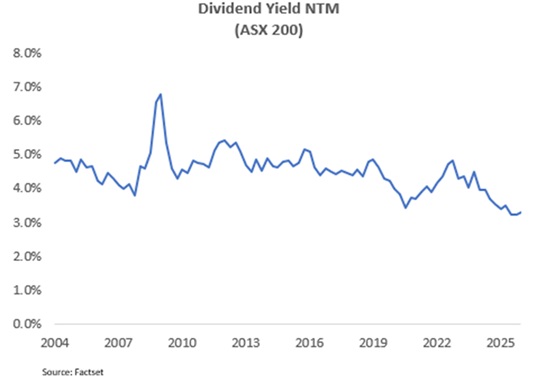
The yield on the ASX200 is currently ~3.4%. This is its lowest level in 20 years.
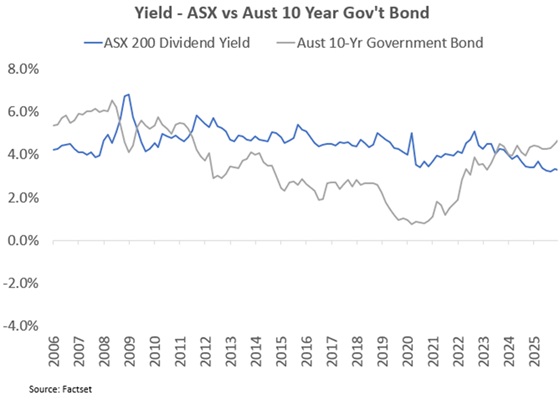
The low yield of the ASX is even more revealing when overlaying the yield of Australian 10-year government bonds. Notice in the next chart that the yield of the ASX has mainly exceeded the yield of 10-year government bonds – a sensical outcome given equities are riskier than bonds. However, since mid-2023 equity yields have tracked below government bond yields.
Is lack of yield made up for in higher growth?

Bond yields are fixed; dividends are not. One therefore might ask whether stronger dividend growth has compensated for today’s lower dividend yields.

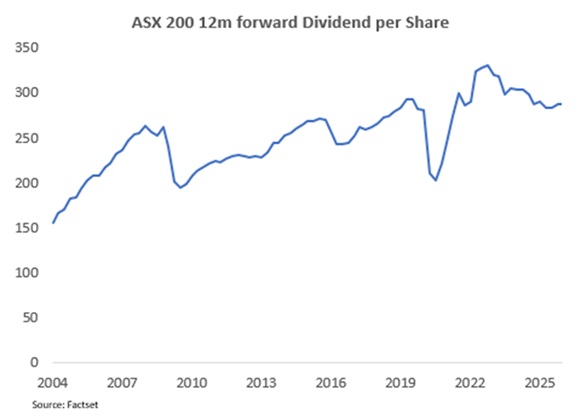
Unfortunately, the answer is no. The next chart plots the rolling 12m-forward dividend per share of the ASX 200. After a collapse then spike during the COVID-19 period, dividends have since retreated to be around 2019 levels. Also note the cyclical nature of the time series, which reflects dividend volatility from the two largest sectors of the ASX – banks and resources. Overall, unlike in the pre-GFC period when low yield sat alongside strong dividend growth, today it's low yield and low-to-no-growth.
Where is the low yield of the ASX coming from?

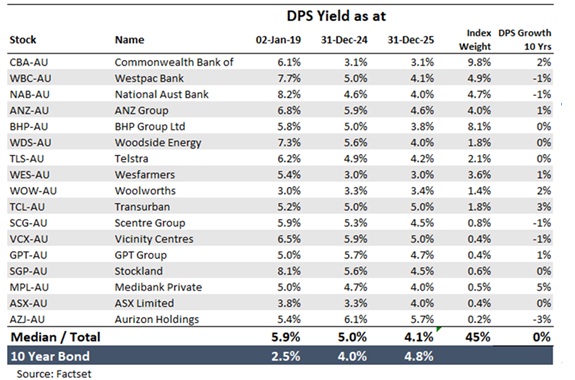
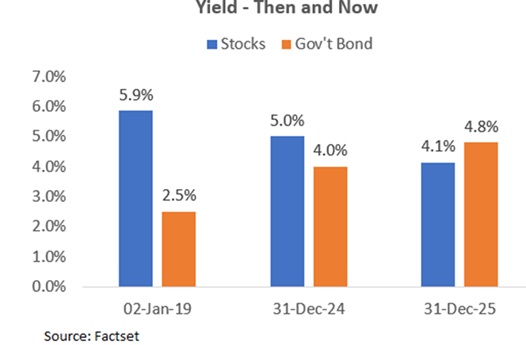
In the main, the decline in yield for the ASX comes from the big end of town being rated differently to a time ago. The table below lists 17 large cap companies known as reliable dividend payers. This group collectively accounts for 45% of the ASX 200. Note at the bottom of the table the weighted average yield of the basket (using today’s index weightings). Back in 2019, this basket yielded 5.9% (before grossing up for franking) vs the Aussie 10-year government bond yield at 2.5%. Fast forward to today and you get 4.1% dividend yield vs 4.8% for the 10-year bond. Upside down.

Also observe that the long-term growth rate in dividends from these stocks overall is 0%. This further validates why we have compared ASX yield stocks with government bonds given their fixed income nature.
Why is it so? What will it take for value to return?

We don’t have good answers on this. On fundamentals, none of the above names have changed to offer either more growth or less risk than a time ago (same for the broader market). Thus, explaining the grind down in yield has us resort to the vagaries of liquidity and sentiment. The rise of passive investing, smart beta ETFs (eg VHY.ASX), and super funds seemingly having more money than there are assets to invest in, has contributed to today’s picture. It begs the question: what is it going to take for conditions to return normal – i.e. a world not upside down? Or, more practically, how can investors find value in this environment?

What should investors do? Is it time to buy a LIC?

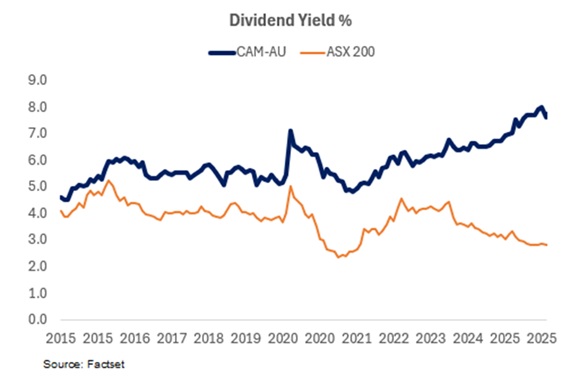
The backdrop of higher bond yields and pausing policy rate cuts in Australia represents a challenge to ASX investors focused on yield. Not only has yield meaningfully declined, but it’s also not growing. It is self-evident that as demand for high yield ETFs and passive products has grown over time, return prospects have diminished. A well-known casualty of this trend has been reduced demand for listed investment companies (LICs), resulting in many trading at meaningful discounts to book value and yields well above the ASX. Clime’s own LIC, Clime Capital (CAM.ASX) is a prime example of this, trading at a 15% discount to NTA and yielding 7.7% with 50% franking.
 

Steve Lambeth is Portfolio Manager for Australian Equities at Clime Investment Management Limited, a sponsor of Firstlinks. The information contained in this article is of a general nature only. The author has not taken into account the goals, objectives, or personal circumstances of any person (and is current as at the date of publishing).

For more articles and papers from Clime, click here.


  •   28 January 2026
  • 11
  •      
  •   
11 Comments
Peter
January 29, 2026

Hear! Hear! CAM . What a disappointment.Held them for a few years but no longer. And now only 50% franked to make matters worse.
Far better investments around .

3
AlanB
January 30, 2026

Yields (current dps/current share price) are lower because prices are higher.
But look at the dividend yield we now get on shares we bought years ago.

3
Jan H
January 29, 2026

LICs may pay high dividends at the expense of capital growth. Example, CAM pays 7.7% 50% franked but its long-term share price is in decline since its 2009 low, post GFC.
In 2009 its price was roughly 0.47 and only 0.71 sixteen years later. If you had held the share for that time, the income may have made up for the capital loss. I haven't calculated that. Other shares paying fully-franked dividends and capital growth are a much better investment in my experience.

1
stan mcdonald
January 29, 2026

Fully agree with Jan H,it is total shareholder return that matters.
The only refinement needed then is whether to measure with franking credits or not.

Dudley
January 29, 2026


"income may have made up for the capital loss":

Nope:
https://www.marketindex.com.au/asx/cam/advanced-chart
ADJ of splits & dividend, Indexed to 100
= (322 / 105) ^ (1 / (2026 - 2005)) - 1
= 5.76% / y.

3
Rob
January 29, 2026

It all depends on perspective really.
I am a large, long term holder of CAM (900,000 shares at last count) and am very happy with the performance per se - yes the discount to NTA is annoying - but what I have bought is a replacement income, with some prospect of capital growth to come (but not entirely essential).

1
Stan
January 29, 2026

Perspective ? Rob,check your numbers.If you bought anytime in the last 17 years you are looking at a capital loss,the size of which depends on when you purchased.
What is your annualised total return ?

2
Rob
January 29, 2026

Yes, I currently have a paper loss, but in reality I've lost nothing if I don't sell (other than another opportunity perhaps, but with a lower yield?).
Remember, I'm buying an income, I don't really care what the share price does - I'm not selling. As it stands CAM pays me $48,600 pa in cash and another $10,400 pa in franking credits - that's $59,000 pa. That'll do me thanks.
Cheers

Les
January 29, 2026

Ineresting article and analysis Steve re dividend yields. As a short/medium termTrader/Chartist I'm not at all interested in dividend yeilds unless, by accident or luck I pick some up on the way through a trade. I'm just too impatient to wait for a hopefully good divdend from any ASX listed Company. As you stated bond yeilds are looking more attractive for passive investors long term. Sectors at any time have my interest and right now Gold, Silver and Uranium are making me smile.

Alee1256
January 31, 2026

Gold, silver, uranium and copper, have nothing to do with income growth and yield. Article is "Finding yield on the ASX".
Not a chartist here but sold most of the above mentioned just before all went down. Now will put all my hefty profits in income stocks and ETFs.

1
 

Leave a Comment:

RELATED ARTICLES

Are franking credits worth pursuing?

Two thematics to watch in volatile times

What’s going on in Australian equities?

banner

Most viewed in recent weeks

2 billion reasons to fix retirement income

A proposal to address Australia's 'stranded balances' in retirement by requiring super funds to transition members to pension phase at 65, boosting retirement income and reframing super as a source of income.

The ultimate superannuation EOFY checklist 2026

Here is a checklist of 28 important issues you should address before June 30 to ensure your SMSF or other super fund is in order and that you are making the most of the strategies available.

Do super funds need a massive wake up call?

UK retirement expert, Guy Opperman, believes super funds are failing at supporting members in deaccumulation. Here is what Australia should do about it. 

Two months into retirement

A retirement researcher's take on retirement and her focus on each of her six resource buckets to stay engaged during the transition and beyond.

Reforming the taxation of wealth and wealth transfers

As the budget approaches debate continues about the need and method for addressing wealth inequality. Could reinstating wealth transfer taxes be the answer?

Welcome to Firstlinks Edition 662 with weekend update

The debate over the budget is increasingly shaped by frustration and perceptions of unfairness, rather than clear-eyed assessment of policy outcomes.

Latest Updates

Back to the future - Why indexing CGT is a good idea

A return to indexation of capital gains would be a fairer way to compensate households for the effects of inflation than the current discount. Importantly, it opens the door to future, broader reforms to stop the taxation of inflation.

Australia has no death duties. Technically.

Australia may not levy formal death duties, but a growing web of tax measures is quietly shaping what wealth passes between generations. Now, the 2026 budget adds another layer.

Strategy

The folly of the Iran war

From oil shocks to fractured alliances, the Iran war carries the hallmarks of a historic policy misstep - one that could tip an already fragile global economy into crisis.

Taxation

Noel Whittaker’s take on the budget

Marketed as a fix for inequality and housing affordability, the latest budget instead delivers a tangle of tax changes that leave everyday Australians worse off.

Investment strategies

The red metal's long game

Copper has had a rough few weeks but investors should not ignore the potential for future price increases as supply increasingly falls behind demand.

Taxation

The lesser-known effects of changed property taxes

The budget’s property tax reforms are being framed as fairness measures, but they risk splitting the housing market, penalising lower‑income investors and introducing distortions that may prove costly.

Latest from Morningstar

Why stocks sometimes fall for no obvious reason

The vast and opaque world of private assets is a powerful gravitational force - and when trouble hits, it's the more liquid public equities that often the feel it first.

Sponsors

Alliances

© 2026 Morningstar, Inc. All rights reserved.

Disclaimer
The data, research and opinions provided here are for information purposes; are not an offer to buy or sell a security; and are not warranted to be correct, complete or accurate. Morningstar, its affiliates, and third-party content providers are not responsible for any investment decisions, damages or losses resulting from, or related to, the data and analyses or their use. To the extent any content is general advice, it has been prepared for clients of Morningstar Australasia Pty Ltd (ABN: 95 090 665 544, AFSL: 240892), without reference to your financial objectives, situation or needs. For more information refer to our Financial Services Guide. You should consider the advice in light of these matters and if applicable, the relevant Product Disclosure Statement before making any decision to invest. Past performance does not necessarily indicate a financial product’s future performance. To obtain advice tailored to your situation, contact a professional financial adviser. Articles are current as at date of publication.
This website contains information and opinions provided by third parties. Inclusion of this information does not necessarily represent Morningstar’s positions, strategies or opinions and should not be considered an endorsement by Morningstar.