Every piece of investing wisdom you have ever absorbed is an instruction for going up. Let winners run. Time in the market beats timing the market. Don't just do something, sit there. Ignore the noise and hold. They are all rules for accumulation: rules for the long climb, when the only job is to stay invested and let compounding do the work. Not one of them tells you how to get off. Not one tells you how to land.
That gap matters the moment your money has a deadline. In many cases, investing aims at a number you must hit by a date: the lump sum that clears the mortgage, seeds the business, covers the school fees, or meets a settlement date you have already signed. A goal with a date attached is a different problem from a goal without one, and the rule that builds the portfolio is precisely the wrong rule for landing it.
What buy and hold quietly assumes
Buy and hold rests on an assumption almost nobody says out loud: that you have time to recover. A 30% fall is survivable, even welcome, when you have a decade for the market to climb back and for new savings to buy in cheaply. Eventually, the market recovers. Across rolling 20-year periods, a fully invested share portfolio has historically never finished underwater (US data, after inflation). The catch hides in two words: 'historically' and 'eventually'. A deadline deletes both. It fixes the date you must sell, and the market does not consult your calendar.
Here is the part the maxims skip. If you hold a lump sum and neither add nor withdraw, the order in which good and bad years arrive makes no difference to your final balance. The arithmetic simply multiplies out: a strong year followed by a weak one lands exactly where the reverse does. So where is the danger? Not in the sequence. It is in the single fact that you do not get to choose which year is your last. The deadline chooses, and hands you whatever the market is doing that day. Worse, your portfolio is at its largest just as the deadline arrives, so a bad year at the end is a bad year applied to the most money you will ever have. If you are still contributing, sharper again: the balance peaks exactly where a fall does most damage.
$237,000 on one ordinary year
Take a growth-tilted portfolio of $400,000 with a seven-year goal of $700,000. A steady 8.3% would land it almost exactly on target, with nothing to spare, which is the whole appeal of growth assets. Now suppose it does better, like a strong run of 12% a year for six years lifting it to $789,500, comfortably ahead of the goal with a year still to go. On paper, the investor is home.
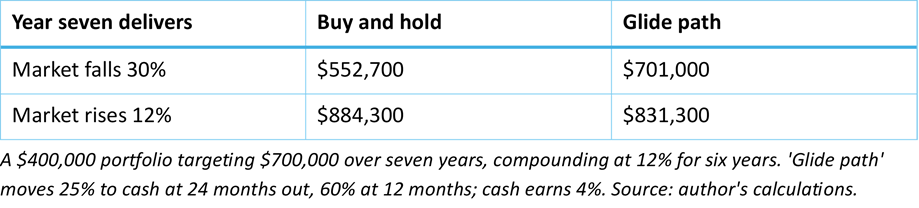
Then year seven delivers a 30% fall. Severe, but not exotic, with share markets producing drops of that order in 2008, in early 2020, and across 2022 for anything growth-heavy. The $789,500 becomes $552,700. At the deadline. A portfolio that was $89,500 ahead of its goal finishes $147,300 short: a swing of almost $237,000 in twelve months, with no year eight in which to recover. The investment thesis may be perfectly intact. The arithmetic of the goal is not.
Let the calendar outrank the thesis
The institutions solved this long ago, and named it for what it resembles. A target-date fund runs a 'glide path': it begins almost entirely in shares and, as the target date nears, automatically winds risk down toward cash and bonds. So the landing never rides on a single year. As the deadline approaches, the calendar, not the thesis, sets the asset mix.
The do-it-yourself version is a written, dated schedule, fixed before you need it and followed regardless of how the market (or your conviction) looks on the day. The schedule behind the table above: 24 months out, move a quarter to cash; 12 months out, take it to 60%, and hold that to the deadline. The percentages matter less than the commitment. The purchasing stays flexible; you buy when the opportunity and the conditions align. The derisking does not, it runs on schedule whatever the market is doing. Flexibility lives in the buying decision; protection lives in the timetable.
This overrides every accumulation instinct, which is the point: thesis discipline says 'hold' at exactly the moment the goal says 'sell'. Build the rule to resist yourself under pressure, because near a deadline the urge to wait just a bit longer is the most expensive instinct you own.
The cost of the parachute
The sharper objection is Paul Samuelson's: time diversification is a fallacy, and if shares suit you for 40 years, they should suit you equally for one month. But Samuelson was pricing risk appetite. A date you cannot move is not a preference; it is a liability.
None of this is free either, and the practical objection is a good one. Going to cash early forgoes the very compounding that makes growth assets worth holding. In the far more common case where the deadline lands in an ordinary or good year, the glide path simply costs money. In the example above, about $53,000 of upside surrendered in the year the market rose. Over long horizons, time in the market beats nearly every attempt to sidestep its bad days.
The glide path is not a market call. It is not trying to beat buy and hold, or the crash; it lands on the goal, clearing $700,000 by about $1,000. It is insurance. Like all insurance it loses a little most of the time and earns its keep in the one outcome you cannot survive. You pay a known, modest premium: forgone upside. To remove an unknown, unsurvivable risk: arriving at a fixed date with too little and no time left. That trade only makes sense for the slice of capital tied to a hard number and a hard date. The rest of the portfolio can stay fully invested and let its winners run.
The discipline that grows a portfolio and the discipline that lands one are not the same, and the second is the one almost nobody writes down. Every maxim you trust is built to keep you in your seat. A deadline turns staying in your seat into the risk. So decide now, in writing, the date the calendar takes over from the thesis. The market will not do you the courtesy of crashing in a convenient year, and a plan made under pressure at the worst possible moment is not a plan. It is a hope.
Trevor Schmid has more than 20 years' experience across superannuation and financial advice and holds growth shares of the kind described here. The schedule and percentages above are illustrative, not a recommendation, and moving to cash can trigger capital gains tax. This article is general information only and does not consider anyone's objectives, financial situation or needs.