As unintended consequences of the Labor tax package in the federal budget continue to roll out, one that could have far reaching effects is the loss of tax neutrality between retained earnings and distributed profits under the new capital gains tax regime.
Consider the tax effect of removing the 50% CGT discount and replacing it with an inflation indexed system.
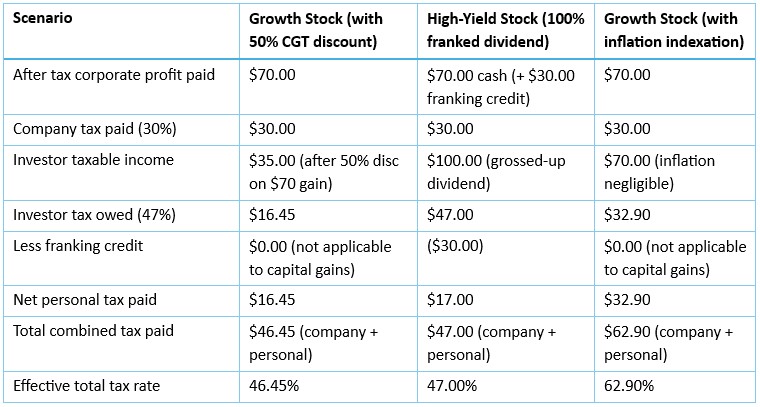
Two shareholders each receive $70 of value from a company that has already paid $30 company tax. One receives it as a fully franked dividend, while the other receives it as a realised capital gain. Assume inflation has been negligible. Both shareholders are on the top marginal tax rate of 47%.
The dividend receiving shareholder pays tax of 47% x ($70 dividend + $30 franking credit) - $30 franking credit = $17. Add the $30 company tax paid and the effective tax rate paid on the $100 corporate profit = 47%.
Under the 50% discount regime, the shareholder realising his capital gain pays 50% x 47% x $70 = $16.45. Plus the $30 company tax, and the effective tax rate paid on the $100 corporate profit = 46.45%.
The results demonstrate a remarkable level of tax parity under the two scenarios.
However, under the new CGT indexed system where inflation has been virtually zero, the shareholder pays almost 47% x $70 = $32.90. And with the $30 company tax, the combined tax burden approaches 62.9% on $100 corporate profit.
The nexus between the taxation of dividend income and realised capital growth has been broken.
The dividend imputation system was designed to ensure that company profits are taxed only once at the shareholder's marginal rate. For dividend paying stocks, franking credits prevent double taxation. But realised gains do not receive franking credits.
Capital gains generated by retained earnings have been less shielded from double taxation. The previous 50% CGT discount partly offset that problem by reducing the shareholder-level tax. But the introduction of inflation indexation potentially removes that partial tax offset.
The tax gap between the two forms of return therefore widens, creating a tax-induced bias in investor behaviour towards high-dividend paying companies, away from those that reinvest earnings for growth. Investors invest in growth companies for capital gains, but if that incentive is dampened, all else being equal, then investor sentiment could shift.
But the implications go beyond investor bias. It extends to capital allocation. If retained earnings are seen to be more heavily taxed than distributed earnings, boards may face greater pressure to reduce retained earnings and increase dividend payout ratios. Which may in turn mean less long-term reinvestment such that capital is allocated less efficiently. Tax considerations, as well as business fundamentals, could influence board decisions.
And beyond that still further, is the question as to what effect less investment in R&D and productivity-enhancing efficiencies in general has on productivity growth. Logically, a tax system unfavourable to growing businesses, must adversely affect productivity.
Growth companies typically invest more in new capital and technologies, expand capacity, and are innovative. They drive productivity. Whereas high dividend yielding companies are generally more mature with fewer investment opportunities, generating cash with less productive uses for it.
The new capital gains tax arrangements come at a time when Australia is in the midst of a protracted productivity growth slump.
According to the Productivity Commission, Australia’s labour productivity (GDP per hour worked), fell by 0.6% in the March 2026 quarter, and grew by just 0.3% over the year. And the long-term trend has seen productivity growth averaging around 1.5% per year during the 1990s and 2000s, then fall to next to no growth over the last five years (about 0-0.1%).
Productivity growth is now at anaemic levels which limits the rate at which the economy can grow without stoking inflation and means lower growth in living standards.
The government introduces at its peril any tax policy that reduces the tax neutrality between distributing profits and reinvesting them, which could divert capital away from productivity enhancing opportunities. And doubly so that peril when productivity growth is at a virtual standstill.
Tony Dillon is a freelance writer and former actuary. This article is general information and does not consider the circumstances of any investor.