Register For Our Mailing List

Register to receive our free weekly newsletter including editorials.

Gold Demand Trends: Q4 and Full Year 2025

Groundbreaking year for gold

Demand volumes and the gold price both smash records

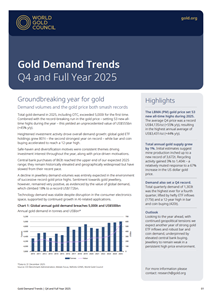
Total gold demand in 2025, including OTC, exceeded 5,000t for the first time. Combined with the record-breaking run in the gold price – setting 53 new all-time highs during the year – this yielded an unprecedented value of US$555bn (+45% y/y).

Heightened investment activity drove overall demand growth: global gold ETF holdings grew 801t – the second strongest year on record – while bar and coin buying accelerated to reach a 12-year high.

Safe-haven and diversification motives were consistent themes driving investment interest throughout the year, along with price-driven motivations. 

Central bank purchases of 863t reached the upper end of our expected 2025 range; they remain historically elevated and geographically widespread but have slowed from their recent pace.

A decline in jewellery demand volumes was entirely expected in the environment of successive record gold price highs. Sentiment towards gold jewellery, however, remained very positive, as evidenced by the value of global demand, which climbed 18% to a record US$172bn.

Technology demand was stable despite disruption in the consumer electronics space, supported by continued growth in AI-related applications. 

Highlights

  • The LBMA (PM) gold price set 53 new all-time highs during 2025. The average Q4 price was a record US$4,135/oz (+55% y/y), resulting in the highest annual average of US$3,431/oz (+44% y/y).
  • Total annual gold supply grew by 1%. Initial estimates suggest mine production inched up to a new record of 3,672t. Recycling activity gained 3% to 1,404t – a relatively muted response to a 67% increase in the US dollar gold price.
  • Demand also set a Q4 record. Total quarterly demand of 1,303t was the highest ever for a fourth quarter, lifted by hefty ETF inflows (175t) and a 12-year high in bar and coin buying (420t).
  • Outlook
    Looking to the year ahead, with continued geopolitical tensions we expect another year of strong gold ETF inflows and robust bar and coin demand, underpinned by elevated central bank buying. Jewellery to remain weak in a persistent high price environment.

Download the full paper
(login or registration required to read the full text, view charts and download files.
Registration is free, and gives you access to all downloads on WGC's website.)
 

  •   29 January 2026
  •      
  •   


Leave a Comment:

banner

Most viewed in recent weeks

Why spending more in early retirement can improve lifetime income

Conventional wisdom encourages retirees to preserve superannuation. But if those likely to qualify for the Age Pension later in life spend a little more today, it may deliver higher lifetime income and a more stable retirement.

It’s time for LICs to die

A high-profile dividend cut and a prominent fund manager’s apology have reignited a long-running debate. If investors can access similar exposures more cheaply and efficiently elsewhere, what exactly is keeping LICs alive?

Testamentary trusts survived the trust tax. The drafting battle has just begun.

The fight over testamentary trusts looked settled. Then the draft legislation arrived. Hidden in a technical detail is a question that could force many families to rethink wills they thought were already future-proof.

Is it time to bail on Australian stocks?

For generations, Australian investors have backed banks, miners and dividends. But has that loyalty come at a cost? A look at the numbers raises an uncomfortable question about where future returns will come from.

The new capital gains tax trap for your portfolio

Investors have long accepted one portfolio rule without much question. A major tax shift could change that calculation entirely, forcing difficult trade-offs between risk, discipline and an overlooked cost lurking beneath.

How the typical Australian Family could save $844,350 in taxes

The value of a testamentary trust is not determined by wealth alone. Depending on circumstances, it can reduce the tax burden on inherited income, create efficiencies and help build intergenerational wealth.

Latest Updates

Fixed interest

Higher yields are creating opportunities in global bonds

Bond markets are adjusting to a new reality, but not in the ways investors expect. With markets repricing and capital competing for attention, investors may need to rethink where resilience and opportunity lie. 

Economy

Are we in a recession?

What if the warning signs are already everywhere? From supermarket aisles to company failures, investors are being bombarded with recession signals. But most face a different risk that can be just as dangerous for portfolios. 

SMSF strategies

Meg on SMSFs - Division 296 actuarial certificates

The tax bill might be yours, but the event that caused it may not be. A key Division 296 calculation can sometimes attribute earnings in ways that many SMSF trustees won't instinctively expect or fully appreciate.

Property

The first impact of negative gearing reform is not the tax bill

Negative gearing changes formally begin in 2027, but the first consequences may already be here. A subtle shift is quietly influencing who can borrow, how much they can access and which property strategies still stack up.

Economy

The oil market is running out of easy answers

The biggest threat to markets may not be what investors are watching. The numbers have stopped adding up and supply is harder to measure, with forecasts becoming simple guesses. A more fragile reality is being masked.

Investment strategies

The state of investor knowledge in Australia

Australians are investing more than ever, yet a surprising divide is emerging between those building wealth effectively and those making costly mistakes. Surprisingly, the gap has little to do with income, age or starting capital.

Taxation

Complexity and capital gains

A case study shows that the ‘30% minimum CGT’ is a poorly conceived tax that adds significant complexity to an already over-complex system. A less complicated model would create a much fairer progressive tax scale.

Sponsors

Alliances

  • ASA-Logo-RGB-ActiveGreen-web.png

© 2026 Morningstar, Inc. All rights reserved.

Disclaimer
The data, research and opinions provided here are for information purposes; are not an offer to buy or sell a security; and are not warranted to be correct, complete or accurate. Morningstar, its affiliates, and third-party content providers are not responsible for any investment decisions, damages or losses resulting from, or related to, the data and analyses or their use. To the extent any content is general advice, it has been prepared for clients of Morningstar Australasia Pty Ltd (ABN: 95 090 665 544, AFSL: 240892), without reference to your financial objectives, situation or needs. For more information refer to our Financial Services Guide. You should consider the advice in light of these matters and if applicable, the relevant Product Disclosure Statement before making any decision to invest. Past performance does not necessarily indicate a financial product’s future performance. To obtain advice tailored to your situation, contact a professional financial adviser. Articles are current as at date of publication.
This website contains information and opinions provided by third parties. Inclusion of this information does not necessarily represent Morningstar’s positions, strategies or opinions and should not be considered an endorsement by Morningstar.