Register For Our Mailing List

Register to receive our free weekly newsletter including editorials.

2017 economic and market outlook: Stabilisation, not stagnation

  •   15 December 2016
  •      
  •   

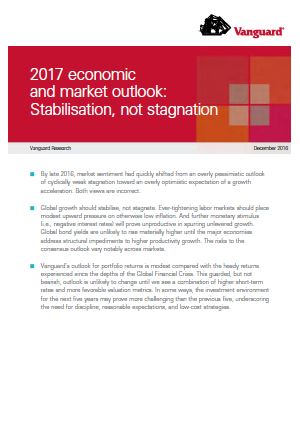
2017 economic and market outlook: Stabilisation, not stagnation


By late 2016, market sentiment had quickly shifted from an overly pessimistic outlook of cyclically weak stagnation toward an overly optimistic expectation of a growth acceleration. Both views are incorrect.

Global growth should stabilise, not stagnate. Ever-tightening labor markets should place modest upward pressure on otherwise low inflation. And further monetary stimulus (i.e., negative interest rates) will prove unproductive in spurring unlevered growth. Global bond yields are unlikely to rise materially higher until the major economies address structural impediments to higher productivity growth. The risks to the consensus outlook vary notably across markets.

Vanguard’s outlook for portfolio returns is modest compared with the heady returns experienced since the depths of the Global Financial Crisis. This guarded, but not bearish, outlook is unlikely to change until we see a combination of higher short-term rates and more favorable valuation metrics. In some ways, the investment environment for the next five years may prove more challenging than the previous five, underscoring the need for discipline, reasonable expectations, and low-cost strategies.


  •   15 December 2016
  •      
  •   
banner

Most viewed in recent weeks

Noel Whittaker’s take on the budget

Marketed as a fix for inequality and housing affordability, the latest budget instead delivers a tangle of tax changes that leave everyday Australians worse off.

Australia has no death duties. Technically.

Australia may not levy formal death duties, but a growing web of tax measures is quietly shaping what wealth passes between generations. Now, the 2026 budget adds another layer.

Welcome to Firstlinks Edition 662 with weekend update

The debate over the budget is increasingly shaped by frustration and perceptions of unfairness, rather than clear-eyed assessment of policy outcomes.

How to minimise tax with a will

Inheritance tax implications in Australia may surprise some, as poor estate planning without proper wills or trusts can lead to costly tax bills and delays for beneficiaries.

How inflation is quietly moving the goalposts on retirement

Inflation doesn’t just raise today’s bills - it quietly increases the amount needed to retire, while simultaneously making it harder to save. Three steps to take before June 30th to improve retirement outcomes.

Back to the future - Why indexing CGT is a good idea

A return to indexation of capital gains would be a fairer way to compensate households for the effects of inflation than the current discount. Importantly, it opens the door to future, broader reforms to stop the taxation of inflation.

Latest Updates

Investment strategies

High quality businesses are on sale

Beneath the dominance of the ASX's largest stocks, much of the market has been left behind. High-quality companies are now trading at levels rarely seen, offering opportunities for investors willing to look deeper.

Investment strategies

The whirlwind is upon us

Something unusual is happening in markets. The winners are pulling further ahead at an extraordinary pace. As return dispersion hits extreme levels, volatility is rising and the investing landscape is becoming harder to navigate.

Strategy

Inequality destabilises economies

Extreme wealth concentration is no longer just a side effect of growth. As inequality deepens, its consequences are shifting from a social concern to a broader threat to economic stability and democratic resilience.

Investment strategies

Have AI’s four horsemen arrived?

AI exuberance is colliding with economic reality. Cracks are emerging as spending surges, ROI remains uncertain and enterprise behaviour shifts. The next phase may look less like an expansion and more like a reckoning.

Taxation

Budget tax changes only scratch the surface. Here are 4 reforms Australia needs next

The 2026 budget has reignited Australia’s tax reform debate, but more work remains. Beneath the surface lies a harder question: what structural reforms are needed to make the country's tax system fit for the future?

Taxation

Negative gearing: quarantined, not killed

The Budget's negative gearing changes defer deductions rather than deny them, yet a worked example shows quarantining can halve the tax benefit's present value for buyers of established dwellings.

Investment strategies

Family offices have quietly taken over Australian private capital

In just four years, Australia's private capital landscape has transformed. We are seeing changes across who deploys capital, how deals are structured and why new platforms and investor pathways are rapidly emerging.

Sponsors

Alliances

© 2026 Morningstar, Inc. All rights reserved.

Disclaimer
The data, research and opinions provided here are for information purposes; are not an offer to buy or sell a security; and are not warranted to be correct, complete or accurate. Morningstar, its affiliates, and third-party content providers are not responsible for any investment decisions, damages or losses resulting from, or related to, the data and analyses or their use. To the extent any content is general advice, it has been prepared for clients of Morningstar Australasia Pty Ltd (ABN: 95 090 665 544, AFSL: 240892), without reference to your financial objectives, situation or needs. For more information refer to our Financial Services Guide. You should consider the advice in light of these matters and if applicable, the relevant Product Disclosure Statement before making any decision to invest. Past performance does not necessarily indicate a financial product’s future performance. To obtain advice tailored to your situation, contact a professional financial adviser. Articles are current as at date of publication.
This website contains information and opinions provided by third parties. Inclusion of this information does not necessarily represent Morningstar’s positions, strategies or opinions and should not be considered an endorsement by Morningstar.