Register For Our Mailing List

Register to receive our free weekly newsletter including editorials.

Home / 355

Giving and receiving the right aged care advice

Few stages in life are as complex and emotionally taxing as when the need for aged care arises. And while many people plan for retirement, often counting down the months and years, few plan for aged care.

One reason for the lack of planning is that most people are reluctant to move to a ‘nursing home’ (now called 'residential aged care facilities'). So possibly the most important thing to realise is that ‘aged care’ doesn’t equal ‘nursing home’.

Last year, more than 1.3 million people received aged care and more than 1 million received their aged care at home, a trend that will continue as the silent generation folk leave aged care and the baby boomers enter.

The challenges in providing or receiving quality advice start with the complexity. Moving beyond the bounds of residential aged care, there is a plethora of accommodation options available to senior Australians including apartments, granny flats, retirement villages and land lease communities, each with their own legal and financial implications.

Where would you like to live?

Before the need for care arises, many people are adamant about staying in the family home. But there can be downsides such as increasing maintenance or growing isolation if they are no longer driving or if there is a loss of a spouse.

And then there are the practical care elements. Many homes are not built for providing care, and while some modifications can be simple and inexpensive, others are expensive or simply impossible.

In some families and cultures, the responsibility of caring for ageing family members falls to the broader family and intergenerational living can benefit the whole family. However, these arrangements may establish what Centrelink calls a 'granny flat right'. Granny flat arrangements can have enormous implications, both emotionally and financially, as the older person has no legal ownership in the property.

Critical to these arrangements is an agreement that clearly outlines the rights and responsibilities of each party. It should contemplate likely changes such as:

  • the children are divorced
  • the children become ill or pass away
  • the need for appropriate insurances
  • any amortisation or residual value of the amount paid
  • the circumstances under which the agreement ends.

The whole family should seek advice to ensure that they understand the impact on pension entitlement and other government benefits, the stamp duty and tax implications, estate planning considerations and the future cost of aged care should home care or residential aged care be required.

Choices away from the family home

Retirement villages and land lease communities are becoming a favoured choice for many retirees. There is often a strong social network, many newer villages are built with the intention of catering to care needs (either now or in the future) and from a lifestyle point of view, people can strike a balance between doing what they are able to do (or want to do) for themselves with the ability to access support and care.

The buying power of these communities when it comes to care delivery is often second only to an aged care facility. Carers are able to move from one home to another in a matter of metres.

For others, the decision will be to move into residential aged care. A crucial consideration in the choice of living arrangements is the ability to access care and at what point a person may need to move on. Is care required now and what can be reasonably anticipated in the future? Will they move to somewhere that can support them as they age, or would they rather kick up their heels for as long as possible then move to a care environment when its needed?

While some retirement communities are designed to enable people to ‘age in place’, others are what we call ‘carefree’. In these communities, it is common for the contract to state that if the person requires ongoing care, they must leave the community.

Crunching the numbers 

When crunching the numbers without the right tools, financial advisers and their clients may discover the financial implications associated with the different accommodation choices and care options are complex and fraught with danger.

Not only does the adviser and client need to know the cost of these care options today but also the expected future costs and how decisions made today could impact the future.

Here are two situations:

1. A person entering a granny flat arrangement needs to consider the impact on their current situation, such as pension, rent assistance, amount of money paid for the arrangement and if the reasonable test is applied. In addition, will the arrangement include a provision for any residual value, what are the ongoing costs of care and how or when does the arrangement cease?

2. In retirement village decisions, it is not uncommon to see a range of alternative payment options. These include the standard Deferred Management Fee (DMF) model, prepaid management fees and even fully refundable options. They often have different shares of capital gain or loss, reinstatement costs, marketing and selling fees and buyback timeframes, and all these choices should be considered and modelled by a financial planner.

Let’s look at a specific example.

Betty is keen to right-size. She will be selling her home inner-city Melbourne home for $900,000 (net); she currently has $150,000 in investments and $20,000 of personal assets. Betty is receiving the full age pension and is looking to move into a retirement village nearby.

She has been offered a range of retirement payment options for apartment she is considering in the village. Outlined in the table below:
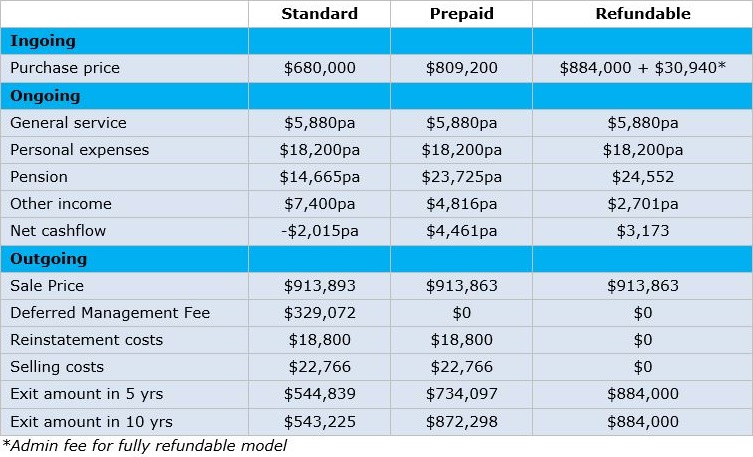
The financial implications for Betty are significant with her pension entitlement varying by almost $10,000 p.a., her exit entitlement varying by almost $340,000 after 10 years and a variation in the cash flow of more than $5,000 p.a. depending on which option she chooses.

An alternative to a retirement village is a Land Lease Community, sometimes referred to as a lifestyle community or over-55 village. This arrangement involves the client buying the home and leasing the land it sits on. A decision to move into a Land lease Community may have both a positive and negative financial impact.

Residential aged care may not be the first choice of accommodation. However, there may be limited accommodation options available when it comes to safety and wellbeing.

Often a response to a crisis

For many people, residential aged care is usually not thought about or planned for until a ‘crisis’ unfolds. This can make the decision rushed, emotionally difficult and very expensive. Understanding the options available before entering care can provide more choice and save thousands of dollars. The value of advice should not be underestimated.

Advisers narrowly defining aged care advice as helping people moving into residential aged care potentially leads to poor advice. Quality aged care advice must be based on the individual’s needs and objectives. It should cover granny flats, home care (not just Home Care Packages), retirement villages, Land Lease Communities as well as residential aged care and it’s about having the education, tools and resources needed to deliver that advice.
Jemma Briscoe is Head of Research and Technical Advice at Aged Care Gurus. This material is general information only and does not take into account your objectives, financial situation or needs.


  •   29 April 2020
  • 9
  •      
  •   
9 Comments
Doreen Matthews
April 29, 2020

The prospect of spending my last years in an aged care facility makes my blood run cold as from what I have read and heard the situation has a dreadful reputation. The recent public inquiry doesn't seem to have improved matters - or perhaps we don't hear anything. You recommend getting reliable advice - I am a relatively new widow with no close family in Australia and I am trying to do my 'homework' for that later stage. It has not been easy I can assure you, particularly in getting information from the Government departments. So my question is: who and where can I go to for unbiased and reliable/trustworthy face-to-face information?
Thank you.

Graham Hand
May 01, 2020

Thanks, we've asked Jemma for a response.

Jemma
May 04, 2020

Hi Doreen
Thanks for your comments. You are correct when it comes to finding reliable and trustworthy information, it can become a bit of a maze.
If you are looking for more information visit our website www.agedcaregurus.com.au, Rachel has published several books on this topic. Alternatively, we can put you in contact with one of Aged Care Guru Advisers in your local area they are listed on our website. Our national network of advisers can assist you with questions regarding the financial costs associated with the range of accommodation options and care choices available to you. I hope this assists you, take care.
Kind regards

Greg Barrie
May 06, 2020

Hi Doreen
If it's just information you're after the Financial Information Service at Services Australia (Centrelink) is a good start and free. I doubt you'll get face to face at the present time but they can help you over the phone until things get back to normal.
Cheers

Anastasia
April 30, 2020

This is a great article and shows how complex this is. My mother in law is in a retirement villa complex now owned by Stockland property trust (I don’t know if it is classified as land lease or a retirement village). Problem is my MIL is now 80 and may need to move to Higher level care but we don’t know how to organise transition as the village is a property company with a contract but no support to transition to Aged Care and only has equity in her villa. Do you have information for transitioning from one structure to another? A Retirement village switch to aged care home seems in no way seamless.

Christian
May 01, 2020

Please answer Doreens question as I’d like to know too. Asking for my mum who is now suddenly in hospital and pretty much unable to speak.

Lyn
May 02, 2020

Interesting article. Would be good to see comparative model by Jemma for Home Care Package re Betty stay in her home-- $170,000 Assets & full pension, and persons on part-pension - say $300,000 assets and 500,000 assets, per Govt incentive to be at home with help cleaning, showering, shopping etc to stay out of aged-care facility. I looked recently to plan (for 15 years) after a minor accident which made me think twice about if it had been worse and there is difference in weekly home-care package rate & hourly rate for cleaning etc between full and part pensioners (rightly so) but no scaling for those on reduced pension, making it unachievable ( I surmised for me). Income on higher asset amount doesn't yield difference needed a) to already top up part-pension as well as b) to pay higher rate for weekly package and higher hourly rates. To fund, current economic situation would mean selling investments at loss for some time thus reducing number of years to fund home-care package. Makes me realise arising economic situation will reduce future choice & need look outside the box for alternative such as offering spare room, food, off-street parking, internet, rent-free to working aged care worker or nurse in return for contracted hours cleaning/shopping/showering when that time arises for me. Food for thought as article suggests.

Robert
August 11, 2020

Having worked as a Certified Financial Planner and as a technical Manager for Prudential and Colonial- (combined for 35years) and now working in Providing consumers with “Aged Care Options and Calculations” it is interesting and frustrating to read others comments about “age care.” Any one can live anywhere provided they are willing to pay for it. Anyone can’t get “Age Care” unless they are assessed. “Age Care” tends to be an expression used when the client is in need of care- and receives some sort of government support. Retirement Villages- available to practically anyone- are not generally understood to mean “Aged Care”- though someone might call it that. “Aged Care” is an expression generally applied to individuals who have been assessed by ACAT- and are considered to need some specific care- whether in their own home such as receiving care packages (1-4) or when health has deteriorated - residential care in a “nursing home’ or Residential Aged Care Facility” These are assessed by Centrelink to determine the level of Government support. Its quite wrong to lump in all sorts of living or retirement living options- and call them “age care” Its unfortunate- but sometimes living at home - where one needs constant ongoing nursing care is practically impossible- though if one is well off- there are 24 hour nursing care at home services- which cost about $25,000 a month- and very suitable even for palliative care care clients who are well heeled. They want to die at home- with the grandkids and dog climbing over the bed. This might even suit a fairly ordinary person who has a couple of months to live- and where the family is willing to spend $50,000 or so. I have had a number of clients like that. Clients need good quality honest and unbiased information. Usually if they get that - including costs- affect on pensions- entry and exit and ongoing costs- they and their family are able to choose what is suitable for them. Not two people are the same.

nursing home catering
March 17, 2023

The mealtime at a senior care center does not have to be glum. A food service management company can hire employees who are both compassionate and passionate about their work. 


Leave a Comment:

RELATED ARTICLES

Why the poor will pay more for aged care next year

Super is catching up, but ageing is a triple-threat

Do HNWI get better advice?

banner

Most viewed in recent weeks

Are you making these SMSF mistakes?

After four decades advising investors, there are a few common mistakes I've seen SMSF investors make. From holding too much cash and chasing yield to overtrading and trusting tips. Are these errors costing you?

Why have Australian living standards 'fallen' and how do we fix it?

For the last few years there has been much talk of a 'cost-of-living' crisis in Australia and of 'falling living standards'. Lately this has flared up again with the pickup in inflation resulting in a renewed fall in real wages.

Will you run out of money in retirement?

Fear of running out has become a defining retirement anxiety. Why do some retirees die with substantial wealth while others deplete their nest egg? Evidence suggests the answer is more complicated than we think. 

Retirement spending is not one-size-fits-all

New data challenges the idea that Australians are underspending their super. The bigger issue may be helping retirees navigate complexity, make confident decisions and use their savings to support security, wellbeing and choice.

Four options for an income investor’s next dollar

What if Australia’s golden age of dividends is ending? Rather than overhaul your portfolio, it may be worth considering where new capital can work harder. I discuss four income strategies and the trade-offs behind each.

The missing link in the CGT debate

A little-noticed consequence of Labor’s tax changes could have implications well beyond investors’ tax bills. The issue raises bigger questions about incentives, capital allocation and the drivers of long-term economic growth.

Latest Updates

SMSF strategies

Meg on SMSFs: What do we think about reversionary pensions these days?

Reversionary pensions have long been a staple of SMSF estate planning, but are they still the best option? Meg Heffron revisits a once-clear favourite and asks whether changing super rules have shifted the balance.

The ageing ‘crisis’ has not and will not happen

Rising age dependency is frequently treated as a warning sign for economies. But when actual workforce participation is examined, a strikingly different picture emerges about ageing, productivity and economic sustainability.

Retirement

How does the 4% rule stack up?

The 4% rule has long been retirement's gold standard. But after a difficult period for investors, fresh analysis suggests a more conservative approach may significantly improve the chances of making savings last.

Shares

Four charts that expose market concentration risk

Investors have recently been rewarded for backing market leaders, but history suggests this eventually comes at a cost. Now may be the time to review whether your portfolio is carrying unintended risks beneath the surface.

Investment strategies

The case for gearing beyond property

Most Australians gear into property but ignore shares. That may be a mistake. Used carefully, geared equity strategies can enhance long-term returns, reduce cash tied up in growth assets and support retirement income goals.

Economy

Australia's $1 trillion debt pile

The headlines exclaiming that Australian government debt has hit A$1 trillion and US government debt has hit $40 trillion has turned heads, but how serious are they really? Will Australia's mix of debt create challenges?

Economy

Has 100 years of growth made us any happier?

For decades, GDP has been the benchmark for economic success, but has it made us materially happier? If happiness does not rise in lockstep with prosperity, are we overlooking what constitutes a successful society?

Sponsors

Alliances

  • ASA-Logo-RGB-ActiveGreen-web.png

© 2026 Morningstar, Inc. All rights reserved.

Disclaimer
The data, research and opinions provided here are for information purposes; are not an offer to buy or sell a security; and are not warranted to be correct, complete or accurate. Morningstar, its affiliates, and third-party content providers are not responsible for any investment decisions, damages or losses resulting from, or related to, the data and analyses or their use. To the extent any content is general advice, it has been prepared for clients of Morningstar Australasia Pty Ltd (ABN: 95 090 665 544, AFSL: 240892), without reference to your financial objectives, situation or needs. For more information refer to our Financial Services Guide. You should consider the advice in light of these matters and if applicable, the relevant Product Disclosure Statement before making any decision to invest. Past performance does not necessarily indicate a financial product’s future performance. To obtain advice tailored to your situation, contact a professional financial adviser. Articles are current as at date of publication.
This website contains information and opinions provided by third parties. Inclusion of this information does not necessarily represent Morningstar’s positions, strategies or opinions and should not be considered an endorsement by Morningstar.