Register For Our Mailing List

Register to receive our free weekly newsletter including editorials.

Home / 676

How much super should you have?

I recently wrote an article about why your super isn’t going to be enough. Part of the reason that you’re likely underestimating how much you need in superannuation is that it’s based on a best guess or other people’s circumstances. Most people don’t come up with a personalised estimate based on the vision you have for your retirement or your likely future expenses.

This is understandable. It is a difficult task to imagine how much you’ll need in the distant future. It is multiple decades for some of us. For instance, I have around three decades before I hang up my keyboard.

Just because something is difficult doesn’t mean it isn’t worthwhile. As you move through life you can refine your goal as retirement gets closer. Creating an initial estimate and refining as you have more clarity is much more helpful than relying on articles showing average super balances by age.

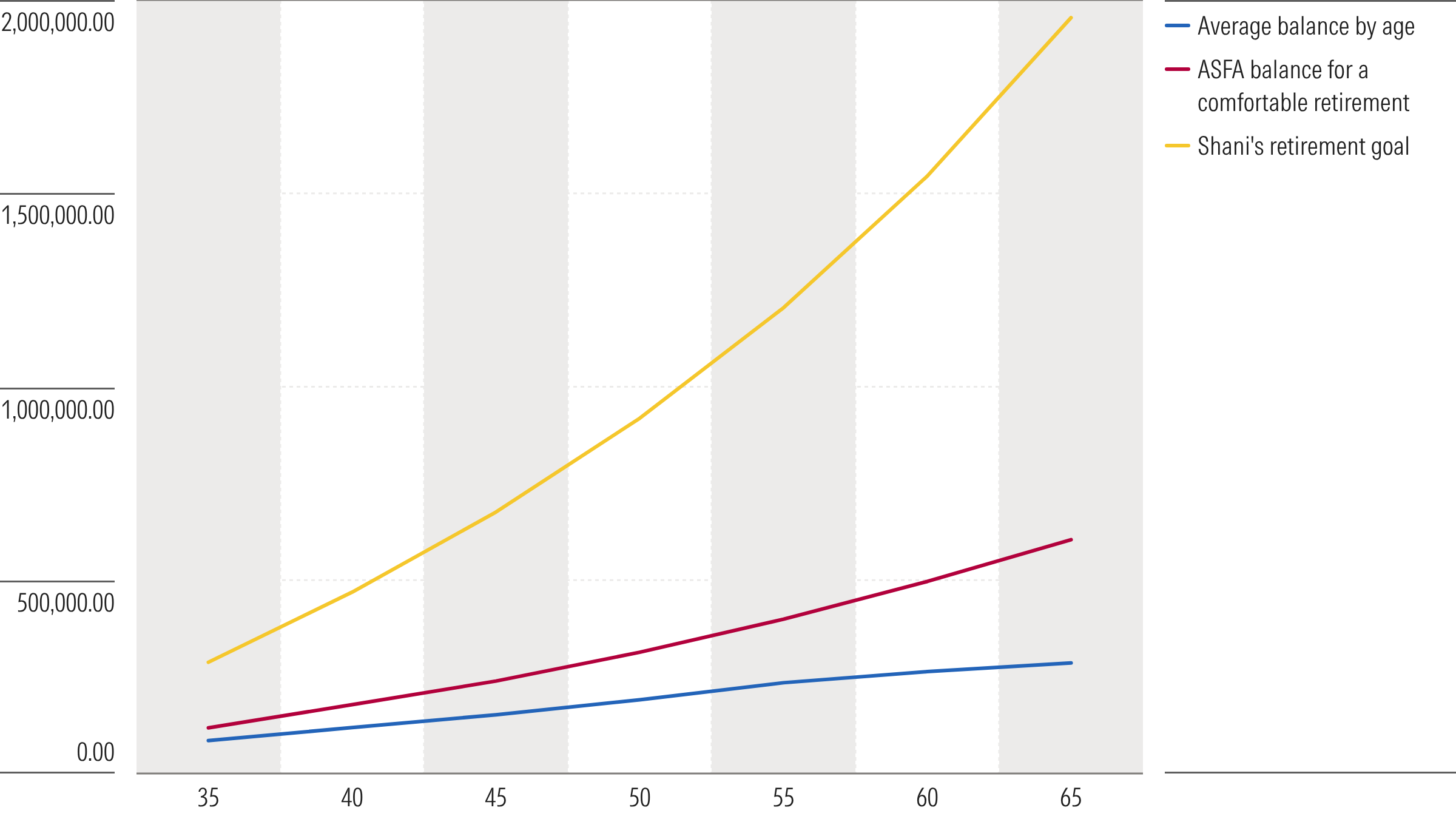
The average super balance for a particular age is particularly disconnected from what an individual should have in super. It does not reflect any of your circumstances or whether you’re on track to have a comfortable retirement. I run through an exercise to estimate how much I should have in each decade, and the disparity with the average super balance, and the recommended balance from ASFA.
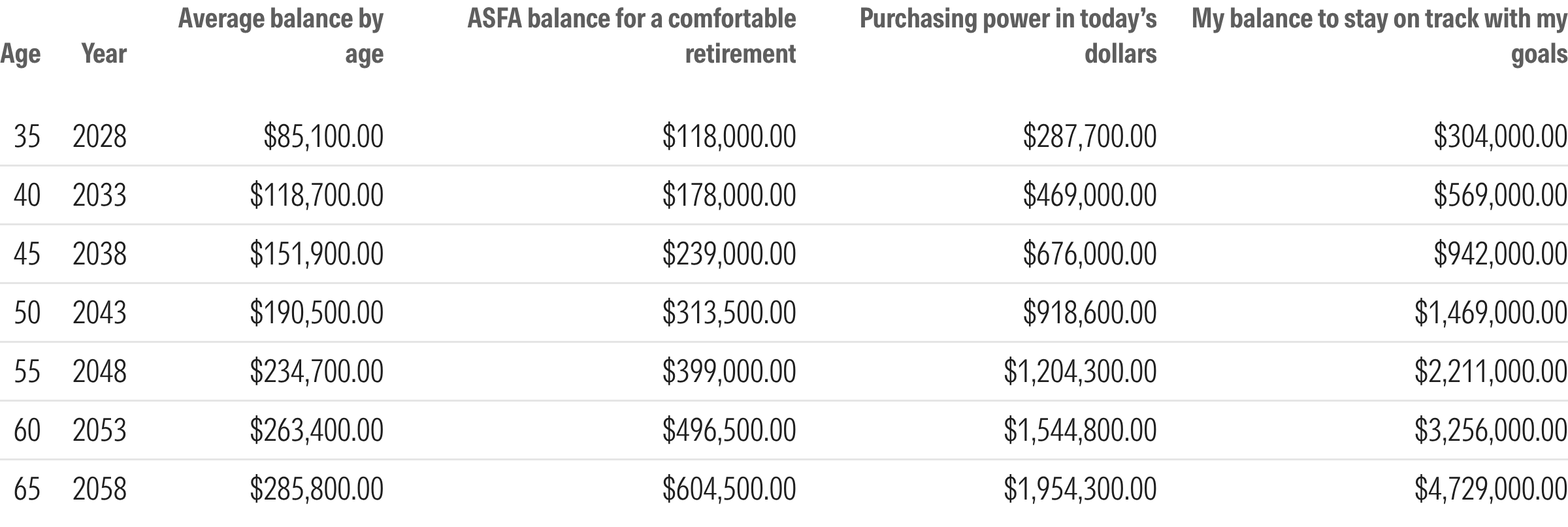
Source: APRA, ASFA and author’s own calculations

I encourage you to go through this exercise yourself. It’s important to spend some time thinking about the variables that go into the calculation.

My circumstances

I have estimated that I need an average of $75,000 in today’s dollars per year in retirement. This is a goal with two pathways. One path – the one I will explore today – I have purposely kept separate with my husband’s. I know I want to enjoy my retirement with him, and we will have a much more comfortable retirement with our combined balances. However, it is important to me that I maintain financial independence and have enough to support myself regardless of what happens in the multiple decades until retirement.

I have assumed in this scenario that my mortgage is paid off. Using the 4% rule, the balance I will need for my portfolio is $1,875,000 in today’s dollars (a future value of $4,485,195 in 2058).

Age
33 years old, with 32 years until fully accessing superannuation. These are the funds that I will use at age 65 when I am able to fully access my superannuation and set up a pension.

It does not include my Transition-To-Retirement plans or structuring. I have a separate financial goal with investments outside of superannuation to assist with transitioning out of full-time work prior to 65. This is supplemental to the $75,000. Think about your goal and when you are likely to access your retirement savings.

Retirement balance
$221,000. This is my superannuation but include any other accounts that will contribute to your retirement.

Contributions to superannuation per year (employer and salary sacrifice):
$27,000, or $23,000 after the 15% contributions tax. This will be all contributions to superannuation, after tax.

Projected returns in superannuation
Based on my asset allocation I’m estimating a projected return of 7.1%, after the 15% tax on earnings. 

Inflation rate
Inflation should be included in any estimate of retirement needs. The inflation estimate doesn’t require a perfect inflation rate. It is about making a reasonable assumption about how your spending is likely to change over the long-term. Your retirement spending will look different from your spending today, and the inflation rate applied to the broader economy may not perfectly reflect your personal experience.

That is why I think it is more useful to focus on the big picture rather than constantly adjusting your retirement target every time the latest inflation number changes. A forward-looking assumption, such as Morningstar’s 2.8% long-term inflation assumption, gives you a consistent starting point for thinking about what your future expenses might look like.

My approach calculates your inflation rate based on your personal circumstances instead of an aggregate basket. However, my ‘basket’ is going to look very different in retirement than it does now. For example – my largest expense – housing – will hopefully be reduced to just maintenance costs as I would’ve paid off the mortgage.

When your personal inflation rate will matter most is when you are managing your portfolio in retirement. Many of us are living for as long as our working lives when we retire. Your spending of your portfolio will directly impact the way you should manage capital, and the returns that you need to manage longevity risk.

Other considerations

Age pension
For my retirement, I want to and expect to be fully funded. Understand whether this will form part of your retirement income. MoneySmart’s calculator will be able to help you.

Spouse
I’ve excluded my husband’s retirement funds from this goal, but it is a personal decision. You may be in a position where there is an age gap between spouses and when superannuation can be accessed. Account for this in your calculations, and how much income is needed from each account.

Changes to circumstance
It is likely that there will be changes to your income over such a long period of time. It is important to account for career breaks where possible and adjust your goal accordingly. I have chosen not to include any salary increases in my calculation until they are realised. I then adjust my goal based on these increases if they happen.

Common ways retirement needs are calculated

There are a few ways that Aussie investors track progress. Back of the envelope checks may be inadequate and contribute to retirement shortfalls. For this piece I’m going to focus on two common methods investors use as a point of comparison:

  1. Looking at the average balance for their age and using that as a guide. Many people think they are fine as long as they keep up with the age-based bracket amounts as they age. Women are retiring with $380,000 on average.
  2. Looking at what the industry says. ASFA’s retirement standards says a comfortable retirement can be achieved with $630,000 for a single person who owns their own home.

There are issues with these sense checks. None take you or your circumstances into account. The average balance check meaningfully underestimates what many people will need for a comfortable retirement.

Comparison can also leave you discouraged and confused given the different measures of retirement progress. The purpose of measuring what you need in retirement is to give you an actionable goal that informs your decision making. This goal can be adjusted as your circumstances in retirement become clearer. The important thing is that it is specific to you and not based on measures that have nothing to do with your actual spending needs.

Difference in goal balance compared to common methods to estimate retirement needs
Final thoughts

The average balance for your age might give you a point of comparison, and industry benchmarks can provide a useful sense check, but neither tells you whether you are building enough to fund the life you want.

Working backwards from your retirement income goal gives you something much more useful: a target that is based on your circumstances, your spending and the time you have to get there. My target is likely to change as my circumstances do, and yours will too. I may earn more, spend differently, or decide that my retirement looks different from what I imagined at 33.

I have a number that gives me direction, but I know it will change. For me, that means checking in at different points throughout my working life and asking whether my balance, contributions and investment strategy are still moving me towards the retirement I want. That is far more actionable than simply asking whether my super balance is above average.


Shani Jayamanne is Director, Investment Specialist, at Morningstar Australia.


  •   19 August 2026
  • 12
  •      
  •   
12 Comments
Dudley
August 20, 2026


Possible that the Age Pension, or equivalent, does not pay enough in the future to cover cost of living. Possible that Age Pension will be 'universal' for Australians. Possible that production will be highly automated and wages will be obsolete, replaced by 'universal pension', or 'universal poverty'.

Individual outcomes are Serendipitous.

Future super value guesstimate arithmetic:
Tax in investment yield 15%, yield 7%, to 95, from 25, annual savings as portion of after tax average full time wage 25%, present value $0:
= FV(((1 + (1 - 15%) * 7%) / (1 + 3%) - 1), (95 - 25), -25%, 0)

Real yield, time, comparative savings rate.

Amp it up; Save 80% of after tax income to have a large stash or a fully owned home at a young age:

Google: "Bunk of Dad and Mum FastSaver Home Buying Calculator GitHub"
https://www.google.com/search?q=Bunk+of+Dad+and+Mum+FastSaver+Home+Buying+Calculator+GitHub

'Impossible! Would roowin me loif-stoil.' they said.


7
Lauchlan Mackinnon
August 23, 2026

Hi Shani,

I appreciate the thought you put into this, and your sharing of your own journey.

Of course, just comparing themselves with the national averages is only going to help people reach and maintain an average outcome. Professionals or above-average salary earners should be able to do much better than average. So you are right to reject that way of thinking about whether one is on track for good retirement outcomes.

But there are a whole host of problems with the approach that you and Mark use. I have expressed some of these to Mark previously, and sometimes repeatedly.

The first is that you tend to conflate different methods of calculating retirement fund numbers. There are two main approaches - ASFA and the 4% rule - and they are quite different.

The ASFA approach (with $630K for a comfortable retirement for a single) *assumes* the person will gradually spend down their capital, become eligible for a part Age Pension and receive that, and eventually become eligible for the full Age Pension. It also assumes a specific retirement budget, around $56K a year - which is well below your target of $75K.

ASFA itself doesn't provide for varying the retirement budget and determining what your new level of retirement capital needs to be. For example, if one wanted to increase one's retirement budget from $56K to $76K a year - for example to provide for additional travel and for further home improvement, car upgrades, and so on - ASFA doesn't tell us how to vary their figure for retirement capital accordingly. Also, for anyone who will be renting in retirement you have to perform the same exercise to increase your retirement budget to cover the rental costs as well. I had to use AI to reverse engineer ASFA's model and help me find a simple formula to use to understand how the retirement capital needs to change with changes to the retirement budget.

The 4% rule, by contrast, doesn't rely at all on the Age Pension, it is fully self-funded.

But the 4% rule isn't really well suited to The Australian retirement system. For starters, you can't just withdraw 4%, once you are over age 65. You are mandated to withdraw 5%. Also the amount of capital you can put into your superannuation fund is limited to around $2.1K. That's fine if your required retirement capital is below $2.1M, but clearly if the retirement budget is say $100K a year and the retirement capital accordingly, is $2.5M, you can't create a retirement pension account with $2.5M in it. There are workarounds for these things, but it's not as simple as "just use the 4% rule", it requires some thought.

Putting all that aside, you seem to be assuming that the only way to build super is through one's salary contributions. That may be true for many Australians, but not for all. Many Australians at some point in their life will have "windfall" receipts of cash, such as from inheritance, downsizing a property and making super contributions (and the downsizing contribution to super doesn't actually require downsizing), selling a business and contributing to super, redundancy payments, a period of increased capacity to save after kids leave home and the mortgage is paid off, or maybe even winning the lottery. Any of these can provide for transferring lump sums into superannuation, up to $130K a year or $390K for the next three years, using the bring-forward rule. Personally I made use of the lump sum non-concessional contributions to help grow my super.

You are right to think of your goals in terms of a retirement budget, in your case $75K. The problem is that the retirement budget in today's dollars will also evolve in terms of its real value, with inflation over time. We think in terms of a number in today's dollars. So we may think in terms of $75K (or another budget figure) now, but with inflation of say 3% a year over 20 years that would be more like $135K then for the same buying power. The problem is that we don't gradually adjust a projected budget in today's dollars like $75K year by year to adjust for inflation, but we should.

Also, no one can predict the future of the market. You may be right that a nominal growth of 7% is realistic. If you are looking at 30 year time frames I would be surprised if there isn't another bull market at some point and people could get higher growth (particularly with a stronger allocation to international equities and growth shares). But I think your estimate may either be conservative, or reflects a relatively conservative allocation for a long-term time horizon.

I think the best advice generally would be:

1. Pick a method: ASFA (Age Pension assisted retirement) or 4% rule (fully self-funded retirement) and plan accordingly
2. Understand the target (retirement capital at retirement) you need to work towards, and make sure you are on track
3. Whenever you can, make other lumps sum contributions that help move you closer
4. Track where you would likely end up at your planned retirement age if you continue making the contributions you plan to (or for a conservative estimate, make no further contributions) based on your assumptions around interest rates and growth.

But of course I am not a financial advisor and that is just an opinion, not personalised financial advice to anyone :)

4
Peter.C
August 23, 2026

Age
33 years old, with 32 years until fully accessing
superannuation,????
What’s changed??? Accessing your super account is 60 as long as you meet the condition of release, so many financial write ups I read continually write 65 or even 67. Why is this?
Love the rest of the article.

4
Lauchlan Mackinnon
August 23, 2026

Peter C,

The age 67 is the age at which one can access the Age Pension. Since the ASFA super targets assume people can access the Age Pension, they use a retirement date of 67.

Super is generally available from Age 65. However, you can access it from age 60 if you follow certain conditions, such as basically confirming you are no longer working and don't intend to work again, and that if you do start working again you'll follow conditions like any new contributions must go into a new accumulation fund. Essentially there are some hassles, but it's ok if you genuinely don't plan to work again. If you don't plan to work again, of course, your super needs to last you five years longer, and you don't get that further five years of growth (to age 65) before you retire on that level of retirement capital. So it may not be ideal financially.

So just stopping working at 60 and retiring on super is possible, but with strings and caveats attached. So people normally think of 65 as the retirement age at which one starts drawing down super.

Hope that helps :)

Bluey
August 23, 2026

It is assumed that in coming years the government will change it to 65, 67, etc (eg. UK). And don’t automatically expect grandfathering clauses!

1
Old super hand
August 20, 2026

The 4% drawdown rule is much favoured around the world by financial planners as you only need a calculator on your phone to do the numbers, it does not vary with age, and does not require any pesky calculations involving drawdown of capital or access to the Age Pension (or equivalent publicly funded retirement income). However, it is misleading to use that in Australia in order to achieve income (or rather drawdowns) in retirement of the order suggested above.

Basically given the inflation rate and investment earnings in the above example, Shani would maintain her superannuation largely unchanged over her entire retirement. This can be a goal for some who want to estate plan but it is not really retirement income planning. If you live long enough and drawdown on your super eventually you will get at least a part Age Pension.

1
John
August 20, 2026

By continuing to work for just 40 hours over a 30 period once a year, I have managed in retirement to reduce erosion of my super balance by $25k p.a. after tax on average via concessional contributions. Over the decade from age 65-75, after which I will not be able to make contributions to super, that's roughly $250k (plus earnings) extra into super than when I retired. Meeting the Work Test makes my 6% compulsory drawdowns close to US financial planner William Bengen's famous (1994) 4.15% unquestionably safe withdrawal rate. But will it be safe from Albanese & Chalmers' next raid on our super?

Rod in Oz
August 20, 2026

Good image Dudley. Appreciate all your timely and quirky comments + the included maths :)
Keep up the good work !

1
Ron Bird
August 20, 2026

Shani is right that one’s targeted super balance should be individualised with universal numbers such as those set by ASFA being worse than useless. One’s discretionary financial needs post-retirement are very much driven by one’s pre-retirement consumption patterns. One point made time and time again is that in Australia, we are not spending enough of our super balances. The implication being that retirees need to consume more. A more correct interpretation is that that the accumulated balances are much more than is required to fund our required consumption. Certainly, research undertaken both locally and overseas establishes that a contribution of 12% of salary establishes balances well beyond requirements and significantly distorts consumption patterns overtime, especially for lower income earners. Now we could go and introduce into the discussion on such things as home ownership and the aged pension. However, this would not change the fact that for the vast majority of those who spend a lifetime contributing 12% of salary,, their super balances will be more than adequate to fund their consumption needs.

Dudley
August 20, 2026


"not spending enough": Bull - market. Fixed by a 50% Bear - market.

As advertised here:
https://thumbs.dreamstime.com/b/bull-bear-statue-frankfurt-stock-exchange-21590324.jpg

1
Pantelone
August 21, 2026

Like the majority of professional actors, I don't own a house. I rent sharing the house with my wife who has been a full-time wife and mum. All our kids are paying off their houses. I am well beyond retirement age, but still get whatever acting work I am 'lucky' to get. And I am enjoying it. And I don't have to do relief teaching, hospitality, After-Care, Vacation Care, exam marking, conducting tests, exam invigilating, lecturing on the side anymore. I did have a short stint of cleaning windows and houses too. So, I am still earning a bit from acting, which I enjoy and find fulfilling, as I also did in recently completing a PhD on the side (Please don't think he must actually earn a lot because he's an actor: less than 2% of actors live full time on earnings from acting. So he's not lying: 'You should not be a full-time actor [joke] unless you are financially independent', said Tippi Hedrin). However, I got super from all those jobs over the decades, and I added when I could - it became a regular thing. With super of around $340,000 in allocated pension mode, some other somewhat modest savings, NO DEBTS, a full age pension for a couple, and some extra income from odd thespianic jobs, life is cruisey. I belong to the cohort which first benefited from compulsory super, on a starting 2% employer-contributing level. My grandchildren will now be debuting on 12% (contribution levels) - TWELVE!, so they are going to rack up the kind of millions to which Sharni aspires. Only then might our grown-up Joeys without any angst say 'Bye bye' to the age pension. The only downside is the uncertainty of tenure in the crazy rental zeitgeist in Kangaroo Land. I could learn German, and go and live there in a secure rental, but I hate WAGNER and musicals - not my scene. Also, I should remember that some of the interest on my super earnings along the way, in addition to tax from my work, went into the national coffers to pay for at least some of the age pension which my wife and I, and OUR HOUSE-OWNING FRIENDS, now whole-heartedly enjoy. I have my kind of great retirement. Act-ive, and truly profitable.


Leave a Comment:

RELATED ARTICLES

How inflation is quietly moving the goalposts on retirement

When you can withdraw your super

Clime time: Inflation cruels a comfortable retirement

banner

Most viewed in recent weeks

Why have Australian living standards 'fallen' and how do we fix it?

For the last few years there has been much talk of a 'cost-of-living' crisis in Australia and of 'falling living standards'. Lately this has flared up again with the pickup in inflation resulting in a renewed fall in real wages.

Will you run out of money in retirement?

Fear of running out has become a defining retirement anxiety. Why do some retirees die with substantial wealth while others deplete their nest egg? Evidence suggests the answer is more complicated than we think. 

Four options for an income investor’s next dollar

What if Australia’s golden age of dividends is ending? Rather than overhaul your portfolio, it may be worth considering where new capital can work harder. I discuss four income strategies and the trade-offs behind each.

Why spending more in early retirement can improve lifetime income

Conventional wisdom encourages retirees to preserve superannuation. But if those likely to qualify for the Age Pension later in life spend a little more today, it may deliver higher lifetime income and a more stable retirement.

The investment that sidesteps the new tax traps

Tax rules have changed, but many investors are still using yesterday’s strategies. Insurance bonds may offer advantages for those seeking greater control, tax efficiency and certainty about their wealth.

Testamentary trusts have secured the CGT exemption

Treasury’s latest CGT reform draft delivers a win for testamentary trusts and deceased estates, exempting estate-derived gains from the 30% floor. However, questions on death and divorce rollovers remain unresolved.

Latest Updates

Retirement

Why spending more in early retirement can improve lifetime income

Conventional wisdom encourages retirees to preserve superannuation. But if those likely to qualify for the Age Pension later in life spend a little more today, it may deliver higher lifetime income and a more stable retirement.

SMSF strategies

Who really loses from the SMSF borrowing ban?

The ban on borrowing to buy residential property inside a self-managed super fund was framed as closing a loophole for the wealthy. Yet ATO data suggests its effects may be felt more heavily on members with moderate balances.

Investment strategies

The investing rule that explains the next market crash

What if investment success depends less on picking the right assets and more on understanding the decisions of other investors? A principle borrowed from game theory offers a different perspective on markets.

Investment strategies

Gold: should you own the metal or the miners?

Gold is back in the headlines but investors may be asking the wrong question. Before deciding where prices are headed next, it's worth considering whether the investment you choose will deliver the outcome you're actually seeking.

Fixed interest

Global bonds markets are hiccupping

For decades, investors looked the other way as government debt ballooned. But a reckoning may be beginning. Bond markets are stirring and the consequences could reach far beyond markets into everyday life.

Property

Why investors are looking beyond traditional property sectors

A little-known corner of the property market may be quietly benefiting from powerful demographic and healthcare trends. Could this specialised sector offer investors something increasingly difficult to find: enduring demand?

Retirement

Retirement in reality - 6 months in

Is retirement really an identity crisis, or is something else at play? New insights challenge conventional thinking and reveal why some retirees struggle to fully embrace life after work.

Sponsors

Alliances

  • ASA-Logo-RGB-ActiveGreen-web.png

© 2026 Morningstar, Inc. All rights reserved.

Disclaimer
The data, research and opinions provided here are for information purposes; are not an offer to buy or sell a security; and are not warranted to be correct, complete or accurate. Morningstar, its affiliates, and third-party content providers are not responsible for any investment decisions, damages or losses resulting from, or related to, the data and analyses or their use. To the extent any content is general advice, it has been prepared for clients of Morningstar Australasia Pty Ltd (ABN: 95 090 665 544, AFSL: 240892), without reference to your financial objectives, situation or needs. For more information refer to our Financial Services Guide. You should consider the advice in light of these matters and if applicable, the relevant Product Disclosure Statement before making any decision to invest. Past performance does not necessarily indicate a financial product’s future performance. To obtain advice tailored to your situation, contact a professional financial adviser. Articles are current as at date of publication.
This website contains information and opinions provided by third parties. Inclusion of this information does not necessarily represent Morningstar’s positions, strategies or opinions and should not be considered an endorsement by Morningstar.