Register For Our Mailing List

Register to receive our free weekly newsletter including editorials.

Home / 471

How to avoid being a bad investor

Extended periods of market volatility regularly spark discussions around great investors and the traits that qualify folks to be included in that category.

This is probably because, like most things in life, no one really questions why things are going right, but everyone wants an explanation when things aren’t so great.

Rather than focus on what it is to be a great investor or how we could be the next Warren Buffett, perhaps the conversation would be more useful if it was couched in terms of how we could avoid bad investing behaviours that seem to appear when financial markets are turbulent.

Here are a few suggestions.

1. Don’t time the market

It is common to hear the phrase “time in the market, not timing the market” bandied about but while it sounds logical, Vanguard has done analysis to back up both parts of the phrase to explain why it makes sense, rather than take it at face value.

Timing the market is hard, and here’s why. To successfully time the market means an investor has to get not one but the following five factors right, all at the same time:

  • Identify a reliable indicator of short-term future market returns.
  • Time the exit from an asset class or the market, down to the precise day.
  • Time re-entry to an asset class or the market, down to the precise day.
  • Decide on the size of the allocation and how to fund the trade.
  • Execute the trade at a cost (reflecting transaction costs, spreads, and taxes) less than the expected benefit.

To further add to the complexity of the five factors above, getting all these factors right just once is not sufficient to reap the benefits of market timing. An investor would have to do this repeatedly in order to benefit meaningfully from the exercise.

The chart below illustrates this best, showing the return of a $1,000 portfolio in various scenarios, using a traditional balanced portfolio (60% shares, 40% bonds) as the base scenario. It shows that an investor who was right 100% of the time would see a 0.2 percentage point advantage in their annualised returns over 25 years, when compared to a balanced portfolio. Getting things right 75% of the time would see an investor better off than the base scenario at the end of 25 years by $252. And being right half the time meant underperforming the balanced portfolio.

Transaction costs were not taken into account in this analysis – meaning the returns would have been even lower had costs been accounted for.
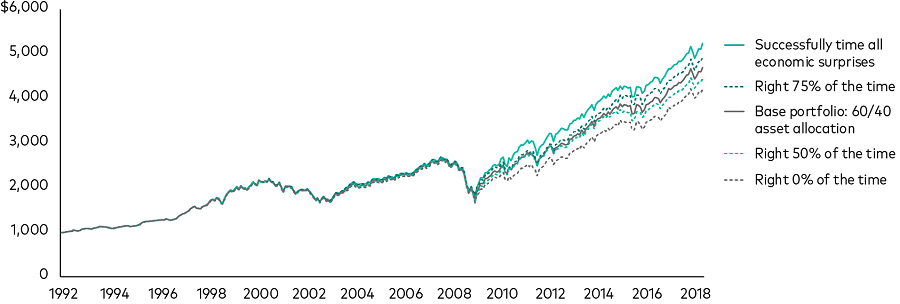
Source: Vanguard paper Here Today, Gone Tomorrow: The Impact of Economic Surprises on Asset Returns, November 2018. Vanguard calculations using data from the U.S. Bureau of Economic Analysis, the U.S. Bureau of Labor Statistics, Bloomberg, and Refinitiv.

Notes: The MSCI USA Index and the Bloomberg U.S. Aggregate Bond Index were used as proxies for U.S. stocks and U.S. bonds. The chart represents the growth of hypothetical portfolios with initial balances of $1,000 as of the start of 1992, growing through August 2018. Significant changes in nonfarm payrolls were used as economic surprises. The hypothetical investors would change the asset allocation to either 80% stocks and 20% bonds in anticipation of a positive economic surprise, or to 40% stocks and 60% bonds in anticipation of a negative surprise.

The other conundrum of market timing is not just knowing when to enter the market at the right time, but also exiting at the right time. It can be tempting to stay invested particularly during periods of heightened market volatility and when your portfolio balance fluctuates on a daily basis. But again, Vanguard analysis found that 80% of investors who sold equities and moved to cash during the COVID-19 induced volatility fared worse than those who held their nerve and stayed invested.

In moving to cash, those investors inadvertently locked in losses permanently and deprived their portfolios of the opportunity to benefit when markets recovered shortly.

This really brings home the point that not only is precise timing nearly impossible but also that being out of the market at the wrong time costs.

2. Spend time in the market and contribute regularly

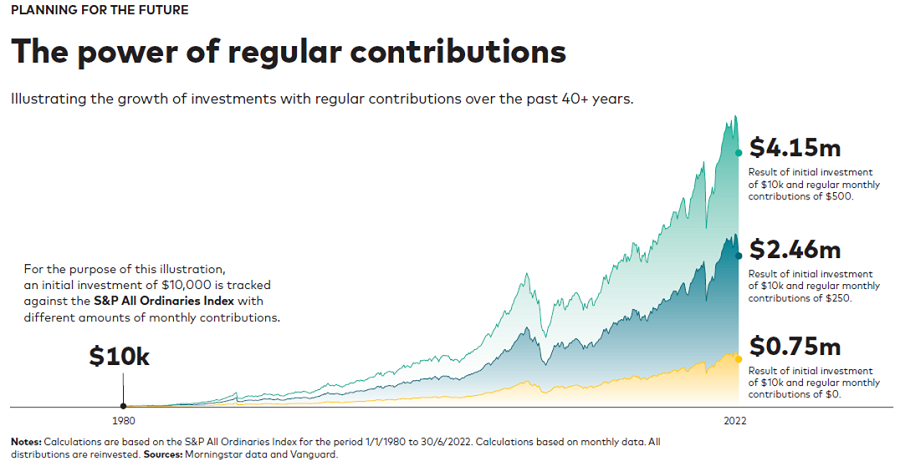
Time in the market is simply putting the theory of compounding into practice. While past performance is no guarantee of future performance, the latest Vanguard Index Chart shows that $10,000 invested in US Shares back in 1992, and left untouched over 30 years would grow to $182,376 while the same $10,000 invested in Australian Shares would result in $131,413 over the same period.

More importantly, the chart below shows that adding monthly contributions of $250 or $500 over that same 30-year period would result in a portfolio balance of almost $3 million or almost $5 million respectively.
3. Buying high and staying invested

Understandably, the thought of investing during a period of market volatility and potentially losing money can keep any logical person from entering the market. But Vanguard looked at the worst possible scenarios in the last 50 years to see what happened if an investor invested at the worst possible time – at the peak of a market right before a dip. The table below lists the three worst bear markets in the last five decades and shows how far the market dipped before it started recovering, and the time it took to recover.

Year

Drawdown

Recovery Time (years)

10Y return from peak

20Y return from peak

1970

-61.9%

8.6

4.2%

10.8%

1987

-41.3%

4.0

6.4%

10.9%

2007

-50.9%

5.9

3.0%

3.9%**

** Noting that this is only 15 years of data, not 20 years.

Notes: 10Y and 20Y returns are annualised total returns. Calculated using data from Australian total return and price indices represented by spliced MSCI Australia (1970-1992)/ASX 300 (1992+). Daily data was used and reflects local currency. 'Bear' periods represent a period where a peak to trough drawdown of 20%+ occurs, from the starting peak to the point of recovery.

Encouragingly, the results show that if an investor continued investing during the 1970 and 1987 bear markets, their portfolios would have returned an average of nearly 11% in annualised returns after 20 years. If an investor had entered the market just before the GFC, they would have experienced almost 4% in returns over the last 15 years, noting that those returns reflect a shorter period.

While we can’t all be the best investor in the world, we can certainly actively avoid being a ‘bad investor’ by learning from history and staying the course.


Robin Bowerman is a Principal and Head of Corporate Affairs at Vanguard Australia, a sponsor of Firstlinks. This article is for general information and does not consider the circumstances of any individual.

Vanguard Digital Index Chart: Build your own customised version of the index chart with 30-years of investment performance of major asset classes as well as key economic, social, political and demographic changes. This tool allows you to compare the growth of $10,000 invested in major asset classes over historical periods.

For articles and papers from Vanguard, please click here.


  •   17 August 2022
  • 8
  •      
  •   
8 Comments
Alex
August 19, 2022

What is often missed by those timing the market is not so much the exit point, where you sell as worries hit the market. It's that people don't know when to get back in, because the worries have not gone away when the market rises off the bottom.

Kevin
August 20, 2022

If you turn off the noise Alex there is only an entry point.Then you only pay brokerage on that entry point.

The last 7 years have been chaos.To reiterate CBA at $96 ,I'm going nowhere near them.Two years later CBA at $71- $72 ,I'm buying them.I think I got within 3 or $4 of bottom,it doesn't matter .

COVID comes along,all noise off and don't even look at prices.I went through that in 2008. - 9,they'll come back,same as before.I looked at prices for some of the GFC and then thought,don't look.

This one,CBA goes from $110 to $92 or $93 when I bought,bottom may have been $88 ,I don't know,it just means I pick up 3 dividends in 13 months roughly.

That's only in 7 years.Taking it back further and paying no attention to noise or opinions then CBA has gone from around $25 in 2000 to $100 now.What is there to worry about. Should CBA suddenly go against market moves and begin falling 10- 20% and dividends fall,then I will pay attention.I don't know why people think they should react to every article or daily moves,or constantly churn because the price has gone up or down 10% or so .

John
August 20, 2022

two points
1. What do active managers do? Ask them, and they will tell you that they analyze stocks and determine which stocks are under priced (and buy them) and which stocks are over priced (and sell them). All financial people tell you "its time in the market not timing the market", but isn't what active managers do timing the market?
2. If I have direct (or ETF) investments, I have the ability to sell those investments at real time prices. If I am planning to sell investments (eg to buy a car) then I don't have to sell right now, anytime in the next few days (or with current wait times for cars, the next few years :)) and I know that the market fluctuates +/- 0.5% to 1% each day, surely it is smart for me to just keep an eye on the prices, and chose to execute the sale when the prices are up their 0.5% to 1% (which they are from day to day) rather than just sell at any random time? The ability to pick when to sell (or buy) depending upon where the market is on any given day is the advantage of real time pricing which can only be afforded in the stock market (direct shares or ETFs) and cannot be matched with managed funds

Patrick Kissane
August 20, 2022

Timing the market can be looked on as insurance against the market going lower (and much lower). The question is: 'Is the cost of the insurance too great?'

Kevin
August 20, 2022

I think my idea of timing the market doesn't fit in with the financial industry narrative.The buy side is easy,buy after the price has gone down.This is on a concentrated portfolio.

I don't have a sell side,reinvesting dividends for 30 to 40 years really does produce spectacular results and eventually a high income in retirement..

Jan Mulder
August 21, 2022

I do think this time is different.
1 interest rates have never been so low , a totally ridiculous situation
2 since 2008 the financial industry has been continually supported by artificial means, money printing, dropping interest rates.
3 the concern about the environment and continually emphasize the need for growth, 2 totally disposed concepts.
4 an aging and declining population, in the past more people means more “consumers”
5 the ending of china’s role for cheap good to maintain our lifestyle.
6 The use of the U.S.dollar being the world’s reserve currency ( almost counterfeit money)
7 and all the tricky ways the financial industry keeps on coming up with ways to make money, e,g, how to make a profit out of something that is going down in value.
Sorry, I think we are in a mess.

Hop Duong
August 24, 2022

Time in the market but buy low would be best, I reckon. As the market always go up, in the long term, when it drops the probability of going up is higher than going further down. With deep pocket, analogous to wearing metal gloves, do catch those good falling knives and wait. Anything else is just waffles. Kind Regards,

Dale
August 30, 2022

Timing the market is absolutely not what this article suggests, in fact most articles espousing time in the market get it wrong as they use flawed assumptions as to what it is and do so from a strong bias of buy and hold as it servers their purpose. It is very rare to find anyone who can or even attempts to time a turn in a market down to the exact day, as this is very hard as the article suggests. Those who choose to time the market to achieve better returns than following an index do not do what this article suggest and never will, and so the comparison is flawed. Whilst some do, time the market short term successfully most do not attempt to do it as it is harder, rather they take a more medium view as it is much easier an more profitable to do. Finding reliable indicators for short, medium or even long term moves is not hard with a little knowledge. Those timing the market or stock look for confirmation that the probability of a move up or down has increased and then enter, they do not attempt to pick the exact day it occurs. The confirmation may be days or weeks from a low or high depending on the degree of move that active investor or trader is considering. DIY investors with a little knowledge have continually proven that they can achieve good returns an out perform the market from timing their buying an selling.


Leave a Comment:

RELATED ARTICLES

Shaky markets, steady mind

Winning by not losing: The silver rule of investing

A steady road to getting rich

banner

Most viewed in recent weeks

Warren Buffett's final lesson

I’ve long seen Buffett as a flawed genius: a great investor though a man with shortcomings. With his final letter to Berkshire shareholders, I reflect on how my views of Buffett have changed and the legacy he leaves.

13 ways to save money on your tax - legally

Thoughtful tax planning is a cornerstone of successful investing. This highlights 13 legal ways that you can reduce tax, preserve capital, and enhance long-term wealth across super, property, and shares.

The housing market is heading into choppy waters

With rates on hold and housing demand strong, lenders are pushing boundaries. As risky products return, borrowers should be cautious and not let clever marketing cloud their judgment.

Why it’s time to ditch the retirement journey

Retirement isn’t a clean financial arc. Income shocks, health costs and family pressures hit at random, exposing the limits of age-based planning and the myth of a predictable “retirement journey".

Taking from the young, giving to the old

Despite soaring retiree wealth, public spending on older Australians continues to rise. The result: retirees now out-earn the young, exposing structural flaws in the tax system and challenges for fiscal sustainability.

Welcome to Firstlinks Edition 637 with weekend update

What should you do if you think this market is grossly overvalued? While it’s impossible to predict the future, it is possible to prepare, and here are three tips on how to best construct your portfolio for what’s ahead.

  • 13 November 2025

Latest Updates

Investment strategies

Howard Marks: AI is "terrifying" for jobs, and maybe markets too

The renowned investor says there’s no shortage of speculative investors chasing AI riches and there could be a lot of money lost in the process. His biggest warning goes to workers and the jobs which will be replaced by AI.

Property

The 3 biggest residential property myths

I am a professional real estate investor who hears a lot of opinions rather than facts from so-called experts on the topic of property. Here are the largest myths when it comes to Australia’s biggest asset class.

Retirement

Australia's retirement system works brilliantly for some - but not all

The superannuation system has succeeded brilliantly at what it was designed to do: accumulate wealth during working lives. The next challenge is meeting members’ diverse needs in retirement. 

Retirement

Retirement affordability myths

Inflated retirement targets have driven people away from planning. This explores the gap between industry ideals and real savings, and why honest, achievable benchmarks matter. 

Retirement

Can you manage sequencing risk in retirement?

Sequencing risk can derail retirement, but you’re not powerless. Flexible withdrawals, investment choices and bucketing strategies can help retirees navigate unlucky markets and balance trade-offs.    

Retirement

Don’t rush to sell your home to fund aged care

Aged care rules have shifted. Selling the family home may no longer be the smartest option. This explains the capped means test, pension exemptions and new RAD exit fees reshaping the decision.

Shares

US market boom-bust cycles - where are we now?

This gives comprehensive data on more than 100 years of boom and bust cycles on the US stock market - how the market performed during these cycles, where the current AI uptick sits, and what the future may hold.

Property

A retail property niche offers a lot more upside

Retail real estate is outperforming as a cyclical upswing, robust demand and constrained supply drive renewed investor interest. This looks at the outlook and the continued rise of convenience assets. 

Sponsors

Alliances

© 2025 Morningstar, Inc. All rights reserved.

Disclaimer
The data, research and opinions provided here are for information purposes; are not an offer to buy or sell a security; and are not warranted to be correct, complete or accurate. Morningstar, its affiliates, and third-party content providers are not responsible for any investment decisions, damages or losses resulting from, or related to, the data and analyses or their use. To the extent any content is general advice, it has been prepared for clients of Morningstar Australasia Pty Ltd (ABN: 95 090 665 544, AFSL: 240892), without reference to your financial objectives, situation or needs. For more information refer to our Financial Services Guide. You should consider the advice in light of these matters and if applicable, the relevant Product Disclosure Statement before making any decision to invest. Past performance does not necessarily indicate a financial product’s future performance. To obtain advice tailored to your situation, contact a professional financial adviser. Articles are current as at date of publication.
This website contains information and opinions provided by third parties. Inclusion of this information does not necessarily represent Morningstar’s positions, strategies or opinions and should not be considered an endorsement by Morningstar.