Register For Our Mailing List

Register to receive our free weekly newsletter including editorials.

Home / 649

Is there a better way to reform the CGT discount?

One of the more controversial parts of our tax system – the capital gains tax discount – is currently under review in Canberra as part of a Greens-run Senate inquiry. The discount means that taxpayers who hold an asset for more than one year pay tax on only half of their gains.

Most submissions to the Senate inquiry have focused on the level of the discount. Arguments range from reducing it to zero to keeping it at 50%, though there is a loose consensus that the current settings are overly generous, and that the discount should fall to somewhere around 20–30%.

But rather than just debating the level of the discount, perhaps we should consider the reasons why we have such a discount in the first place and if there is now a better way to deal with these concerns?

Let’s start from first principles. Why shouldn’t capital gains just be taxed like other forms of income?

There are two good reasons why a realised capital gain shouldn’t be treated in line with other forms of income.

First, part of any capital gain is inflation. If you purchased some shares and they went up in price, but at the same time the price of the goods and services you would have purchased increased by the same amount, then this gain would not be “income” as you can’t buy anything extra with it.

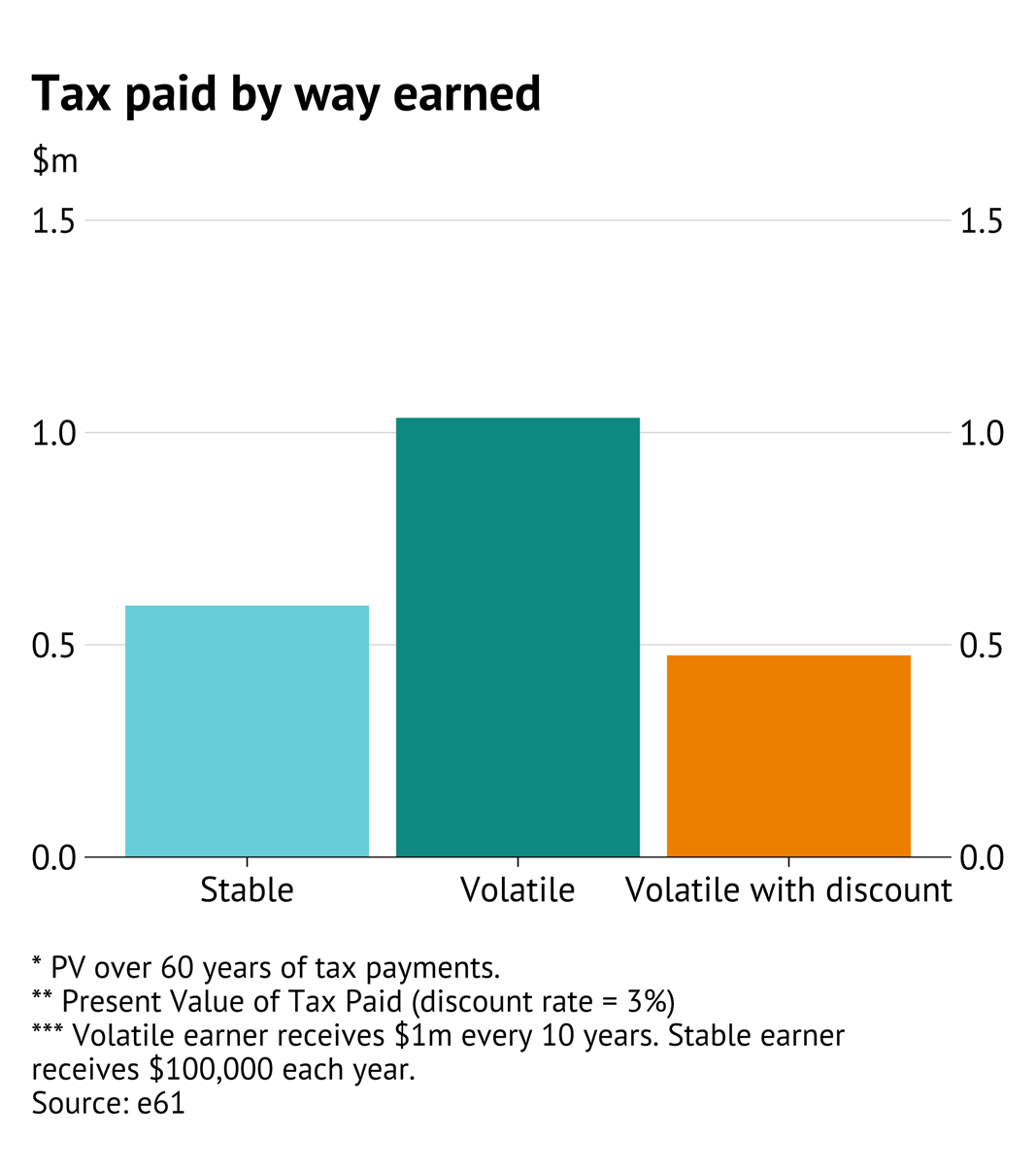
Second, capital gains are lumpy: they don't arrive in regular instalments like wages. Shares are typically held for four years before sale, houses for ten. And because our tax system is progressive, cramming several years' worth of gains into a single year pushes many taxpayers into a higher tax bracket.

To take a stylised example, an entrepreneur with lumpy income – earning the average full-time income as a capital gain once every 10 years – would pay 75% more tax than a wage earner receiving the same total lifetime income steadily over time.
The current capital gains discount was introduced as a simple way to mitigate these two justifiable concerns. However, it also has two important design flaws.

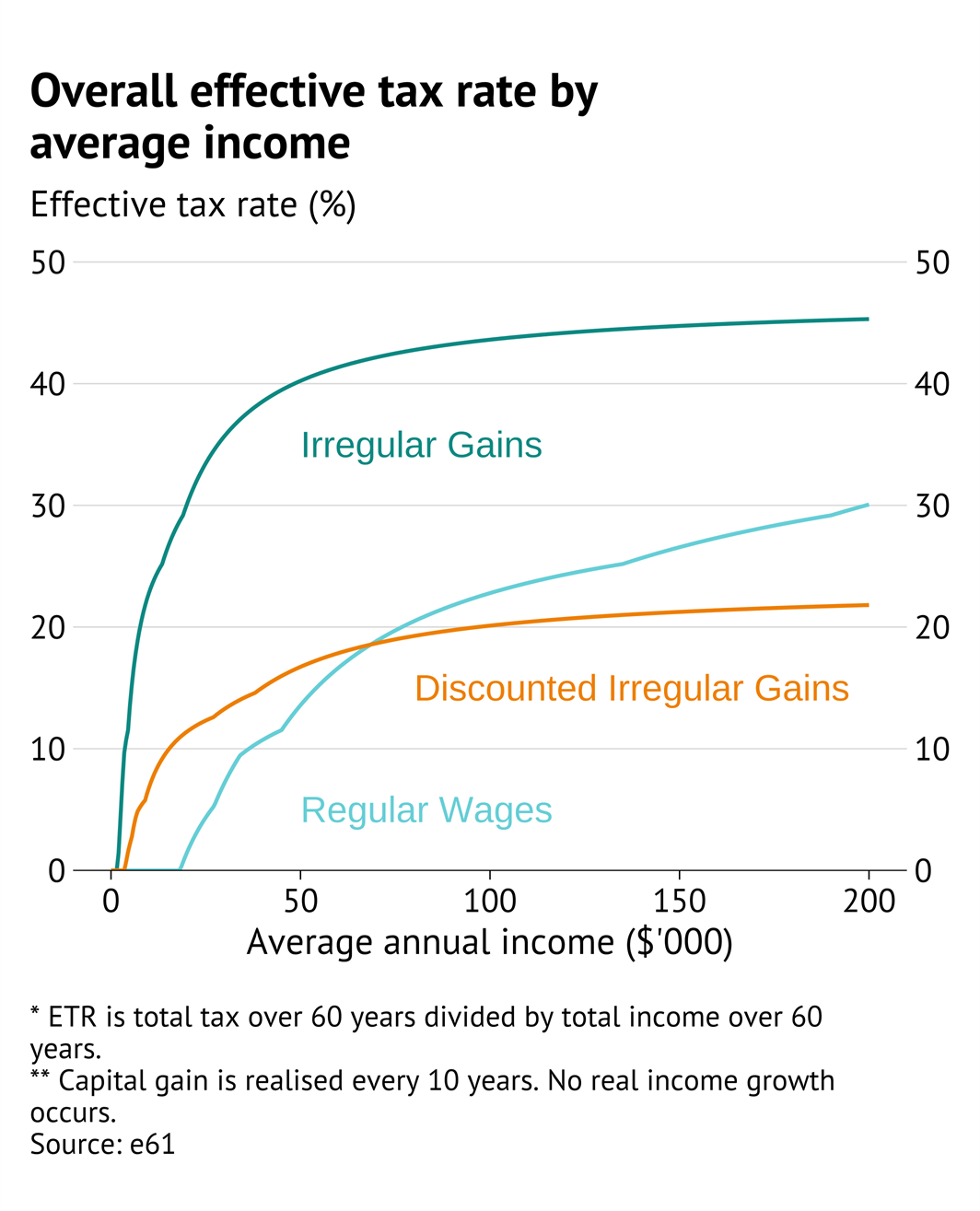
The first flaw is that it overcompensates high-income earners and undercompensates low-income earners for these issues.

Our analysis of tax records suggests that the current 50% discount overtaxes gains for individuals with incomes below $50,000, relative to a comparable wage earner. The discount then becomes increasingly concessional for higher-income individuals.
The second design flaw is that the capital gains tax discount provides an incentive for investors to shift towards capital gains generating assets and increase leverage.

While part of any capital gain is inflation and thus not real income, this is also true for other forms of capital income. Interest earnings, for instance, also contain an inflationary component, which means they are often taxed too heavily.

Applying an allowance for inflation only to capital gains distorts investment towards assets that generate gains as an inflation hedge. Furthermore, not taxing inflationary gains while allowing expensing for the inflationary component of debt incentivises individuals to leverage up.

These effects can be illustrated by looking at an asset which only increases in value with inflation. Pre-tax the real rate of return is 0%, which means that a tax system that leads to a negative post-tax return is one that penalises such investments while a tax system that generates a positive return encourages them.

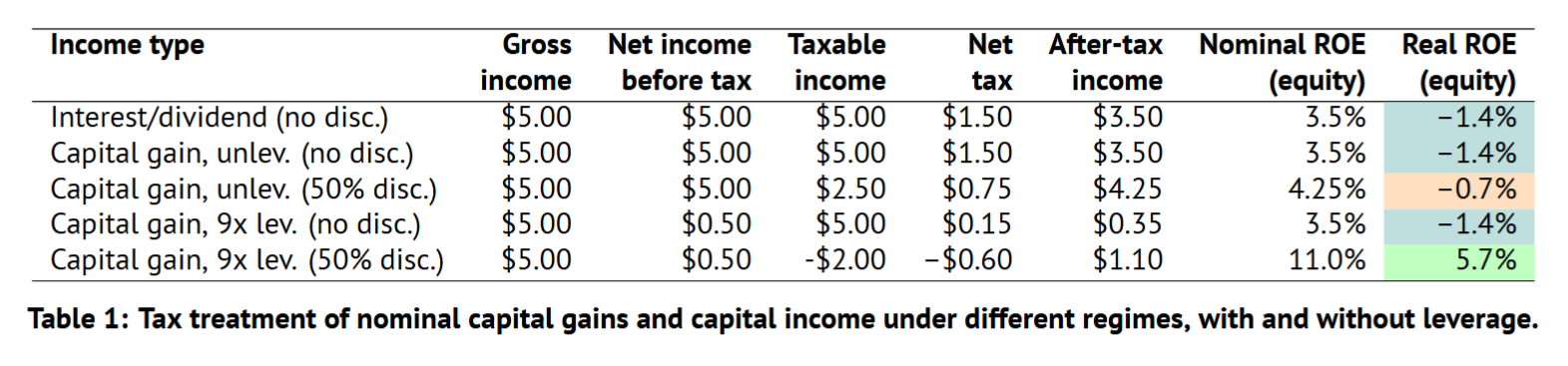
If we assume inflation and interest is 5% per annum and there is a flat 30% tax rate, then taxing nominal gains without a discount would lead to a –1.4% return on equity.

The capital gains discount would halve this loss to –0.7% if the asset was purchased without debt, seemingly reducing the distortion associated with taxing inflation. However, it also biases investments towards capital gains generating assets as the return on other capital income with the same real rate of return (e.g. interest) would remain –1.4%.

Leverage changes the story significantly when capital gains are discounted. If the individual borrows 90% of the capital necessary for the purchase, and has other taxable income, the return on equity becomes 5.7%. The investor generates a positive post-tax rate of return even though the asset price only increased by inflation!

This benefit for leverage would not happen without a capital gains discount – as income and expenses would be treated consistently by the tax system. In this case, the return would be –1.4% irrespective of the amount borrowed.

For this reason, individuals will borrow too much to purchase assets which act as an inflation hedge if there is a capital gains tax discount.
So, what's the alternative?

Prior to 1999, Australia’s tax system offered income averaging for lumpy gains and reduced taxable capital gains by inflation.

As discussed in the e61 submission to the Senate inquiry, this prior system highlights a way forward. With modern administrative data collection, such income averaging and inflation allowances could be incorporated into the taxation of all capital income in Australia – with appropriate adjustments to allowable expenses.

Rather than picking an arbitrary discount rate, these mechanisms would directly target the issues with taxing capital income at full rates. Simplified approaches – such as the dual income tax recommended by the Tax and Transfer Policy Institute – would also address many of these concerns.

In 1999, there was an argument that the trade-off between precision and compliance costs justified a broad 50% capital gains tax discount – leading to reasonable debate about whether this number is still appropriate. In 2025, it's worth stepping back and asking whether we can do better than just picking a new number between 0 and 50.


Matthew Maltman is a Senior Research Economist and Matt Nolan is a Senior Research Manager at the e61 Institute.


  •   11 February 2026
  • 42
  •      
  •   
42 Comments
OldbutSane
February 12, 2026

Agreed, the current one year holding period is way too short and a 5 year minimum should apply to all houses to get rid of the "flipping" that occurs with family homes. The current 50% discount discourages long term holdings. If you hold an asset for longer than it takes for inflation to double prices then the 50% discount is actually a disadvantage over indexation.

8
John N
February 13, 2026

I would agree it is more about the duration of holding v's level of discount. Taxation should favour/benefit the longer term holders and whack the short term flippers & traders with maximum taxation. This would include owner occupied properties where the 12 month CGT Free rule is used by flippers & traders. How longer duration holders are rewarded fairly both in terms of tax on capital growth is the challenge.

5
Harry
February 16, 2026

Good luck getting any major house renovation approved through council, let alone built within 12 months

Paul
February 12, 2026

"The holding period for an asset of only 12 months"
Only 12 months is a very long time for equities!
Real property is a different matter.

4
Vikas Khavare
February 15, 2026

Best is to keep current 50% captial gain concession but chnage to minimum
5 years holding time.

1
Andrew
February 12, 2026

Given that CGT discount was to compensate for inflation it should never have been 50% after 1 year, but anything to win a vote. Simplify it to 5% for each full year an asset is held with a maximum of 50% for a 10 year holding period to discourage "flipping". It could then possibly be sweetened even further to placate the masses by giving a maximum 60% discount for a 12 year holding which may be reasonable given the ups and dows in inflation over that long a period.

12
Steve
February 12, 2026

Andrew I think part of the problem we have had is trying to simplify something that is already dead-simple and that always leads to people complaining because the simplified version has some inevitable holes. The data on CPI is there. All you need is purchase date & cost, sale date and price and the real gain is calculated instantly by any modern computer or software. Quite possibly even the ATO could manage this. Further as per the old divide by 5 to calculate the marginal rate (which was then multiplied by 5 to get a net tax payable that tried to allow for a lumpy gain that takes sometimes years to accrue but is taxed all at once) can be replaced by "divide by the number of years owned, calculate increased annualised marginal tax and then multiply this again by the years owned". So say you have an asset for 7 years, and made a real gain of $35,000, you calculate the tax owing on 1/7 of the gain ($5000/yr), determine how much extra tax you pay on a $5000 gain at your actual marginal rate and multiply this amount by 7 to pay "seven years worth of tax" without being pushed into a higher tax bracket for a one-off gain accrued over many years. All of this is super simple, super fair and hopefully would leave little room for whinging, but I expect the Labor preference is to maintain a level of unfairness to rouse their troops (particularly the Green ones) to their cause. They have no interest in fairness as it removes a fabulous story for them to sell at election time. And of course if gains were seen as being fairly taxed the drive to tax unrealised gains loses some steam, but again we're not talking about fairness there, its 100% ideology.

8
Craig
February 14, 2026

Labor introduced cgt with a 5 year averaging (along with cpi adjustments).
It was simple and fair. Anyone with basic math skills could work it out.
But along came Howard, who messed it all up. Pretending that it was to simplify the tax system, when really it was to save his rich mates lots of tax.
Hard to believe we're still stuck with Howard's failures.

5
Don
February 15, 2026

Hi . I think this proposal is well thought and fair . I also agree that Labor/Greens are not looking at a fair system . I believe the holding period of only 1 year is too short. Especially as it includes owner occupied homes.

2
Tony
February 15, 2026

That’s pretty complicated when it applies to shares and dividends. Next to impossible to calculate. So no change on shareholdings since they’re real investments, apply is to property and you get my reserved support because I do not believe in any CGT discount on property, which is pure exploitation of the less well off.

Aussie HIFIRE
February 12, 2026

Yep, the extremely obvious answer is just to discount by inflation over the time period that the asset was held. It is a little more complex than a flat 50% discount and requires keeping some records, but you are supposed to keep records of this information anyway! If I recall correctly people who made their investments after CGT was first introduced and before the 50% discount was introduced in 1999 still have the option to use this method anyway, so re-introducing it for everyone presumably isn't something that is too difficult for the investors, accountants, and ATO to calculate.

7
David
February 12, 2026

The way CGT was set up by the Hawke government had fairness built in which has been eroded by successive governments of both persuasions in their attempt to get more revenue from it. Averaging, indexation, have both gone, being replaced by the last vestige of inflation compensation left in the the tax law, namely the 50% reduction of the "gain" under certain conditions. In 1985, all we had were hand calculators to assist with the arithmetic. Now we have spreadsheets. I am in favor of going back to the Hawke original. As an aside, measured in gold, the original Australian money, there has been no capital gain in virtually any asset, especially housing. That is why we have to have a second rate inflationary currency, to justify something to tax.

7
Aaron
February 12, 2026

Aussie HIFIRE
My understanding is that the indexation was capped when the changes were introduced in 1999. That is there is no adjustment for inflation past Sep 1999 for those assets held before. So it isn't really available now to anyone

1
Accountant
February 12, 2026

Based on ABS figures, which ARE available.

Roger
February 16, 2026

Accountant, I hope you haven’t been lodging ITRs on self-calculated ABS numbers for the last 25 years.

Peter Care
February 12, 2026

The best solution is to go back to the way it was in 1999. Your CGT cost base was indexed to inflation (CPI) and then the result was averaged over 5 years (similar to primary producers income), so there was a lower likelihood of moving into higher tax brackets.

It was a very fair system.

Unfortunately, John Howard and Peter Costello being lawyers did not understand the mathematical calculations so they changed it to a simple system they could understand. It encourages short term speculation as there is little benefit in holding assets for 10 years compared to 1 year.

Back then the only aids most people had to work out the calculation was pen, paper and a manual calculator.

Today complexity is no longer an issue with simple software programs and spreadsheets being able to make the calculation for you. A free calculator placed on the ATO website is all we will need.

With complexity no longer an issue, a return to the fairer pre 2000 system is the way to go.

7
Peter
February 12, 2026

I have no issue with CGT discount for shares but wonder if the addition of property has had the unintended consequence of making property a better investment than shares. The diversion of investor capital to property has both fuelled excessive increases in the property market and reduced the flow of capital to equity. Perhaps the capital that may have been invested in shares could have led to more innovation and opportunities for Australian ideas rather than going overseas for funding? An active asset (shares) should outperform a passive asset (property) but in Australia we seem to have created tax advantages that turn that upside down.

5
Michael2
February 12, 2026

agree, calculating against inflation was easy

1
Harry
February 16, 2026

And yet if you look at APRA’s paper “Banking on Housing” you’ll see a chart that shows that the percentage of investor loans for housing rose from 15% to 32% from 1985 to 2000. If the claim about the discount were true (that it drove investors into housing) you’d expect this trend to accelerate after 2000. What actually happened? The % of investor loans to only rose to 34% after 10 years.
The discount actually allowed other investments to compete against housing because the actual distortion was the 47% advantage the PPoR has over every capital investment.
Investors were just riding the wave created by mass investment into the tax free family home.

Our CGT is the highest in the world. The discount just makes it slightly higher than the OECD avg.
There is nothing magical about our marginal rates, despite the claims of “subsidies” capital investments are not the same as annual income

1
Roger
February 17, 2026

Agree 100%, Harry. WA house prices went backwards all through 2007 to 2020, when the CGT discount was in place. Prices took off again after COVID, with no changes in tax laws. It was, and always will be, supply and demand.

Margaret Wright
February 12, 2026

An inflation adjustment as suggested is the most sensible move. Today an app to do this would be as simple as providing an app which the investor could use online but which could also be easily checked. In today's world with AI a well designed app should be simple to develop and would enable online cross-checking..It's time. The numbers show that a reasonable percentage of investors sell not long after the first year which makes a mockery of the system. As at the moment owners purchasing a property for short term letting also have access to the CGT discount which is nuts.

5
Aussie HIFIRE
February 12, 2026

Or just have a simple calculator on the MoneySmart and ATO websites.

3
Harry
February 12, 2026

What was tedious before modern computing is easy peasy now. CPI charts embedded into capital gain adjusters available to all. Truth and measurement beat guesswork every time!!!!

1
Dudley
February 12, 2026


Abolish the 1 year holding period. All income to be discounted for inflation for calculating taxable income.

3
Michael2
February 12, 2026

it was easy before with adjusting for inflation, there were loads of calculators around even then

Bryan
February 12, 2026

Rather than look at capital gains, it may be preferable to ring-fence negative gearing losses. By allowing negative gearing losses to be offset against other income, it provides an incentive for investors to over pay (and over gear) their properties. The current system also provides investors with an unfair advantage over owner-occupiers - investors get tax deductible interest while owner-occupiers must meet their interest costs out of post tax income.

3
Steve
February 12, 2026

Bryan I have some uncertainty about negative gearing simply from a tax angle - you get relief from costs on an income producing asset (eg you write off costs if you rent a property but cannot write off costs of simply owning a block of land as there is no income production). Negative gearing means the costs exceed the income, so could one argue the owner bought the asset knowing they would not produce an income (ie a positive income). If so, why is it taxed differently to a block of land that also produces no income? Once you go "negative" you no longer have an income producing asset - so you should only deduct costs up to a nominal amount ($1??) of positive income, but no more. BUT I have a strong counter-argument which is that when a property is negatively geared, it means the rent is less than the costs of ownership and the "loss" can be seen as a subsidy to the tenant, who is allowed to live in the property for LESS than the actual cost to the landlord of owning the same property. From a tenants view, is that not a good outcome? This is why I struggle with the anger around negative gearing as the landlords are effectively subsiding tenants, and can only ever recover their marginal tax brackets portion of the loss - they will still carry a loss even when making a tax deduction. And if you lose money on the rental side, you have to make a gain just to break even - now there's a twist, remove the negative gearing deduction but allow accumulated losses to offset any capital gain- this would indeed be the "real" gain after inflation and other costs.

3
Bryan
February 12, 2026

Steve, when I refer to ring fencing, I mean the ability to offset losses against any income from property. This includes the capital gain when a property is sold.
As to your point about negative gearing being a "subsidy" for tenants, I think the real incentive for the property owner is the lightly taxed capital gain when he sells.

3
Maurie
February 12, 2026

Steve, so you are saying to treat the negative gearing deduction as a capital outgoing and hence an increment to the CGT cost base. I think you will find that Hawke Government attempted to quarantine the negative gearing deduction (1985) to be offset against future rental income or realised capital gains (by way of cost base adjustment) and it failed miserably due to pressure from the real estate lobby and investor backlash. I think Governments of all persuasions have been reluctant to revisit the issue ever since.

Lyn
February 18, 2026

Steve and Bryan, re "subsidy" to tenant/rental market---it is.
Eg. positive geared from start. Damage to fix for next let, R & M deduction $6500, I/tax 30% = 1950 tax saving so 4550 R &M wholly borne by owner in 1 tax year. Plus lost rent in weeks to fix.
Capital items $15,000 kitchen & carpet re careless overflows, more "subsidy" re depreciation over years of effective life though essential to 'replace to habitable condition'. Easy eg: if over 5 yrs, 1st year Depr 3000 x I/tax 30%= 900 tax saving. Cost borne 1st yr (3000-900)+(15000-3000)= 14,100, no workings lost opportunity income & subsequent 4 yrs. If added all costs borne to revised rent it would outprice market so takes years to recover $21,500 total expenditure from selling shares ( + lost future divs) to cover, generally by then merry-go-round again as tenants careless, eg. hobby artists (plenty of them, 3 in 20yrs), acrylic paint on blinds, walls, carpet not washed off at time, hardened = replacement, brush water emptied in toilet, hardened residue in bowl = toilet replacement.

50% disc CGT seems fair re ongoing balance of costs borne to keep in habitable condition. No credence ever given re investor's reality at the coalface with constant R&M balance borne from other AFTER tax income, the pundits in Canberra don't get the maths right. Would they rather investors withdraw from market and Govt provides subsidised public housing to fill the gap? Reckon will take them a darn sight more $ to do that than their 'perceived - lost' CGT.

Simon
February 12, 2026

How refreshing. Couldn't agree more with your assessment. Back to indexation asap. The principles are already there. Simples!

1
john flynne
February 12, 2026

Perhaps it could be a sliding scale eg 20% for 1 year, 30% for 2 years, 40% for 3 years, 50% for 4 years or longer.

John Bannister
February 12, 2026

If the residential CGT concession is removed it will reduce property turnover because a substantial part of the sale price will be lost in tax.
On the other hand there is no reason for the concession to apply to the family of a deceased owner. My suggestion is the the concession should expire on death of a surviving owner.
This will be inducement for owners to sell family residences early to protect the tax free gain. It is likely that these properties will be in the well serviced suburban areas. If this is combined with changes to planning laws to remove council discretions it could lead to substantial redevelopment of near city residential properties.

David
February 12, 2026

I am not in favour of death duties or any extra tax on death. My children may like to live in the home they were born in.

8
JohnnyB
February 13, 2026

The real solution is to have a separate CGT taxing regie (like FBT and GST) - it would give enormous scope and flexibility to taxing gains in the most effective manner, depending on the type of taxpayer and the particular transaction etc

Stuart
February 14, 2026

2 things - if you change the discount (eg to zero) should we still need a barrier between income and capital gains? eg part of the quid pro quo would be to have deductions against income for capital losses rather than to carry them forward and isolate it until you can find an offsetting gain

Would SMSF become a preferred investment vehicle under these proposals?

Lyn
February 14, 2026

David, agree, many children rent now high home price if wage just above average weekly wage. Have 2, 10 yrs apart, older on housing ladder 10yrs ago with tiny help, 10 yrs later at age ready to look, the younger can't. Decision together 5yrs ago to will modest home to younger to live in close-ish to 72hr/wk job for life with no late transport, on payment to estate specified $ via mortgage, the older gets that plus a bit more so no angst. Fairly update Will if value change to increase younger's payment to estate. Fed up if everchanging tax rules when much goes into forward planning (& legal cost), eg spoke bank, $10 unpaid many years on very old loan as safest place for Title who said if do older's future mortgage, only charge very low fee when time comes as little work re existing details and a settlement.
Method also frees up a rented home in future which appears to be no small matter.
Bet not alone re family in future in changing world as comments often reflect.

Barry
February 14, 2026

The table was making no sense at all, until I realised that there is a mistake in the table.
The taxable income for "Capital gain, 9x lev (no disc.)" should be 50c and not $5.00. After you fix that mistake, the table finally starts making sense. Can you fix up that table so that it starts making sense?

Barry
February 14, 2026

You could add an additional row to that table to show how much investors would make if they don't sell and just keep it compounding over the years. In a system of 5% inflation and 5% interest rates, if the asset has no real growth, just the nominal 5% growth in line with inflation, then investors make a nominal ROE of 18.5% per annum from the unrealised capital gain and the tax deduction on the interest. This is the most efficient way to invest. Don't sell. Avoid the CGT and just let it compound. You will make an 18.5% return on your equity per year in a system where there is no real growth, just inflation. You don't need to get lucky to make good money. All you need is inflation, which the Government is naturally creating every year.

maarcus wigan
February 15, 2026

I think there is another factor not obvious here

If the home was owned before 1984 no CGT applied. Full stop. That’s still in effect.

GeorgeB
February 17, 2026

IMHO a 50% discount to capital gains is way too generous for a property held only 12 months, but may not be generous enough if the property is held for decades, so a return to adjusting capital gains against CPI is by far the fairest way to tackle the CGT debate. It also does not seem fair to tax decades of capital gains in a single income year but rather it should be averaged so that tax brackets are consistent with annual gains.


Leave a Comment:

RELATED ARTICLES

Taking from the young, giving to the old

Clearing up confusion on how franking credits work

Raising the GST to 15%

banner

Most viewed in recent weeks

Building a lazy ETF portfolio in 2026

What are the best ways to build a simple portfolio from scratch? I’ve addressed this issue before but think it’s worth revisiting given markets and the world have since changed, throwing up new challenges and things to consider.

Ray Dalio on 2025’s real story, Trump, and what’s next

The renowned investor says 2025’s real story wasn’t AI or US stocks but the shift away from American assets and a collapse in the value of money. And he outlines how to best position portfolios for what’s ahead.

13 million spare bedrooms: Rethinking Australia’s housing shortfall

We don’t have a housing shortage; we have housing misallocation. This explores why so many bedrooms go unused, what’s been tried before, and five things to unlock housing capacity – no new building required.

21 reasons we’re nearing the end of a secular bull market

Nearly all the indicators an investor would look for suggest that this secular bull market is approaching its end. My models forecast that the US is set for 0% annual returns over the next decade.

Making sense of record high markets as the world catches fire

The post-World War Two economic system is unravelling, leading to huge shifts in currency, bond and commodity markets, yet stocks seem oblivious to the chaos. This looks to history as a guide for what’s next.

Welcome to Firstlinks Edition 644 with weekend update

Stocks bounced hard off April lows, gold hit record highs and even bonds gained – 2025 was a year where it was hard not to make money. This breaks down the year and how to best position portfolios for 2026 and beyond.

  • 8 January 2026

Latest Updates

Taxation

Is there a better way to reform the CGT discount?

The capital gains tax discount is under review, but debate should go beyond its size. Its original purpose, design flaws and distortions suggest Australia could adopt a better, more targeted approach.

Property

It's okay if house prices drop

The assumption that falling house prices are electorally fatal has shaped policy for decades. Evidence from upzoning suggests affordability can improve without reducing overall housing wealth.

Investment strategies

Investment bonds for intergenerational wealth transfer

Investment bonds can be a versatile and a tax-effective option for building wealth for longer-term investment goals. They can also be used as an estate planning tool, enabling the smooth transfer of wealth to younger generations.

Investment strategies

Why switching to income may make sense in 2026

Investors are jumpy as valuations continue to rise and income investing may provide a respite. In a challenging market for income investing AML offers their top picks.

Interviews

Retiring Schroders boss on lessons he’s learned, industry changes, and the market outlook

CEO Simon Doyle is retiring after 38 years in the finance industry. In an interview with James Gruber, he shares the three main lessons he’s learned, and where he sees opportunities and risks in markets today.

Investment strategies

How US midterm elections affect the markets

Investors may overlook the US midterms amid global events, but they could still impact markets. History shows markets react during midterm years, with increased volatility and lower returns. Will this year be any different?

Investing

Does increasing geopolitical risk lead to higher equity market returns?

Increasing geopolitical tensions has investors on edge but one study shows evidence of a war premium for equity markets.

Sponsors

Alliances

© 2026 Morningstar, Inc. All rights reserved.

Disclaimer
The data, research and opinions provided here are for information purposes; are not an offer to buy or sell a security; and are not warranted to be correct, complete or accurate. Morningstar, its affiliates, and third-party content providers are not responsible for any investment decisions, damages or losses resulting from, or related to, the data and analyses or their use. To the extent any content is general advice, it has been prepared for clients of Morningstar Australasia Pty Ltd (ABN: 95 090 665 544, AFSL: 240892), without reference to your financial objectives, situation or needs. For more information refer to our Financial Services Guide. You should consider the advice in light of these matters and if applicable, the relevant Product Disclosure Statement before making any decision to invest. Past performance does not necessarily indicate a financial product’s future performance. To obtain advice tailored to your situation, contact a professional financial adviser. Articles are current as at date of publication.
This website contains information and opinions provided by third parties. Inclusion of this information does not necessarily represent Morningstar’s positions, strategies or opinions and should not be considered an endorsement by Morningstar.