Register For Our Mailing List

Register to receive our free weekly newsletter including editorials.

Home / 349

Morningstar: Douglass interview, 29 top picks, corona research

Hamish Douglass exclusive interview

 
Hamish Douglass sent an update to his investors on 18 March 2020, including:
 
"As you are aware, the COVID-19 virus is a fast-moving and fluid situation. The most likely outcome of the efforts to contain this health emergency is a near total shutdown of the world’s economy over the next two to six months. This is likely to lead to a near total collapse in demand for many (but not all) businesses over this period. For some, this could prove fatal, particularly for small businesses and for businesses that have high financial leverage or high fixed costs. Only governments can prevent these businesses from failing. The potential financial and social consequences are very concerning. 
 
The shape of the economic recovery will depend upon the scale, timeliness and effectiveness of actions taken by governments and central banks to help businesses to survive and keep people employed over the next two to six months...
 
Over the past week, we have taken steps to increase the defensiveness of the Global Equity portfolio and have increased cash in the strategy from approximately 6% to approximately 15%. All cash is held in US dollars."

29 quality stocks at great prices

By Mark LaMonica, Individual Investor Product Manager, Morningstar

Great companies carve out a solid competitive advantage and as coronavirus rattles markets, many such names are trading at hefty discounts. Morningstar's list of 5-star rated stocks has expanded rapidly as prices fall and now includes 29 companies.

Market shocks can be cause for anxiety but if investors have the capital, such shocks can be an opportunity to pick up the stocks of great companies at discounts.

Investors define 'great' in different ways. From Morningstar's perspective, great companies are those that have carved out solid (and in some cases growing) competitive advantages that will allow them to thrive for years to come--in Morningstar parlance, they’ve built economic moats. Such companies are typically led by adept managers who have a record of allocating capital in ways that add value.

To find such exceptional firms, we looked for the following three qualities.

1. Economic moat: First, they need to boast wide or narrow Morningstar Economic Moat Ratings. In other words, these companies have strong competitive positions.

2. Exemplary stewardship: Second, they must earn our top Morningstar Stewardship Rating—exemplary or standard. In other words, these companies are led by exceptional corporate managers who have a proven record of making investments and acquisitions supporting the competitive advantages and core businesses of their companies--and they won't pay an arm and a leg to do so. They'll divest underperforming or noncore businesses. They'll find the right balance of investing in the business and returning cash to shareholders via dividends and share repurchases. And they'll assemble a portfolio of attractive operating assets and skilled human capital, and then execute well.

3. Discounted price: And lastly, the stocks of these companies must be trading at a decent discount to our fair value estimates, selling at Morningstar Ratings of 4 or 5 stars at the of writing.

We used the Morningstar Stock Screener to look for these qualities. Only three stocks made the cut. Don't think of this as a list of 'buys' though. Instead, think of it as a collection of names to investigate further. A 5-star rating does not suggest that the stocks won't drop further. The aim is not to pick the bottom, but to highlight to investors that they can pick names up at a discount.

The three companies are: 

  • Ansell Ltd: we view Ansell as well-managed and able to deliver a consistent, growing earnings stream
  • Ryman Healthcare Ltd: We believe Ryman can roughly triple its annual revenue by the end of our 10-year forecast period, as the group expands the number and maturity of villages under its management
  • Macquarie Group Ltd: Macquarie Group is a successful global asset manager and investment bank. Its main strengths are risk management, business unit interconnectedness and an ability to evolve and adapt to changing market conditions.

Although nobody know when the market will bottom, more companies are offering value than at any time in recent years.

Click here for access to Morningstar Premium for a free four-week trial, including portfolio management services from Sharesight and detailed research on 1600 global stocks as well as 450 ETFs and Funds, including the companies Morningstar currently rates as 5-star investments.

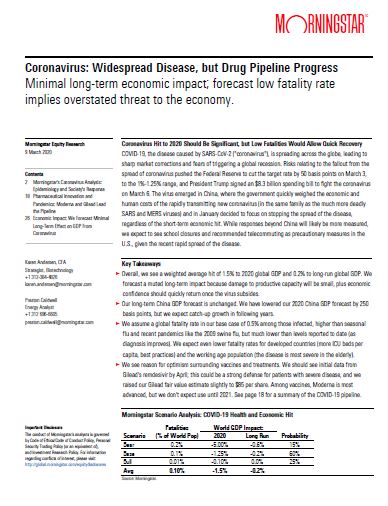
Coronavirus: widespread disease but drug pipeline progress

Morningstar's detailed research on coronavirus concludes there will be minimal long-term economic impact, with forecast low-fatality rates. It implies the threats to the economy are overrated, although please note this paper was first published to US subscribers on 9 March 2020. Click on the image for the full free paper.
 

  •   18 March 2020
  •      
  •   


Leave a Comment:

banner

Most viewed in recent weeks

Are you making these SMSF mistakes?

After four decades advising investors, there are a few common mistakes I've seen SMSF investors make. From holding too much cash and chasing yield to overtrading and trusting tips. Are these errors costing you?

Why have Australian living standards 'fallen' and how do we fix it?

For the last few years there has been much talk of a 'cost-of-living' crisis in Australia and of 'falling living standards'. Lately this has flared up again with the pickup in inflation resulting in a renewed fall in real wages.

Will you run out of money in retirement?

Fear of running out has become a defining retirement anxiety. Why do some retirees die with substantial wealth while others deplete their nest egg? Evidence suggests the answer is more complicated than we think. 

Retirement spending is not one-size-fits-all

New data challenges the idea that Australians are underspending their super. The bigger issue may be helping retirees navigate complexity, make confident decisions and use their savings to support security, wellbeing and choice.

Four options for an income investor’s next dollar

What if Australia’s golden age of dividends is ending? Rather than overhaul your portfolio, it may be worth considering where new capital can work harder. I discuss four income strategies and the trade-offs behind each.

The missing link in the CGT debate

A little-noticed consequence of Labor’s tax changes could have implications well beyond investors’ tax bills. The issue raises bigger questions about incentives, capital allocation and the drivers of long-term economic growth.

Latest Updates

SMSF strategies

Meg on SMSFs: What do we think about reversionary pensions these days?

Reversionary pensions have long been a staple of SMSF estate planning, but are they still the best option? Meg Heffron revisits a once-clear favourite and asks whether changing super rules have shifted the balance.

The ageing ‘crisis’ has not and will not happen

Rising age dependency is frequently treated as a warning sign for economies. But when actual workforce participation is examined, a strikingly different picture emerges about ageing, productivity and economic sustainability.

Retirement

How does the 4% rule stack up?

The 4% rule has long been retirement's gold standard. But after a difficult period for investors, fresh analysis suggests a more conservative approach may significantly improve the chances of making savings last.

Shares

Four charts that expose market concentration risk

Investors have recently been rewarded for backing market leaders, but history suggests this eventually comes at a cost. Now may be the time to review whether your portfolio is carrying unintended risks beneath the surface.

Investment strategies

The case for gearing beyond property

Most Australians gear into property but ignore shares. That may be a mistake. Used carefully, geared equity strategies can enhance long-term returns, reduce cash tied up in growth assets and support retirement income goals.

Economy

Australia's $1 trillion debt pile

The headlines exclaiming that Australian government debt has hit A$1 trillion and US government debt has hit $40 trillion has turned heads, but how serious are they really? Will Australia's mix of debt create challenges?

Economy

Has 100 years of growth made us any happier?

For decades, GDP has been the benchmark for economic success, but has it made us materially happier? If happiness does not rise in lockstep with prosperity, are we overlooking what constitutes a successful society?

Sponsors

Alliances

  • ASA-Logo-RGB-ActiveGreen-web.png

© 2026 Morningstar, Inc. All rights reserved.

Disclaimer
The data, research and opinions provided here are for information purposes; are not an offer to buy or sell a security; and are not warranted to be correct, complete or accurate. Morningstar, its affiliates, and third-party content providers are not responsible for any investment decisions, damages or losses resulting from, or related to, the data and analyses or their use. To the extent any content is general advice, it has been prepared for clients of Morningstar Australasia Pty Ltd (ABN: 95 090 665 544, AFSL: 240892), without reference to your financial objectives, situation or needs. For more information refer to our Financial Services Guide. You should consider the advice in light of these matters and if applicable, the relevant Product Disclosure Statement before making any decision to invest. Past performance does not necessarily indicate a financial product’s future performance. To obtain advice tailored to your situation, contact a professional financial adviser. Articles are current as at date of publication.
This website contains information and opinions provided by third parties. Inclusion of this information does not necessarily represent Morningstar’s positions, strategies or opinions and should not be considered an endorsement by Morningstar.