The investment analysis and historical FIIG client return figures referred to below were prepared by FIIG Securities Limited (AFSL 224659), a wholly owned subsidiary of AUSIEX.
Fixed income exchange traded funds (ETFs) have become a popular way for investors to access the bond market. They are familiar, liquid and easy to trade, making them a convenient option for investors and advisers building diversified portfolios.
But convenience should not be the only consideration when assessing fixed income investments.
Many investors assume a bond ETF will provide broad exposure to attractive income opportunities across the fixed income market. In reality, its performance is shaped by the index it tracks, the securities included in that index and the fees charged along the way.
This matters because many Australian bond indices are designed around the size and liquidity of the market, rather than an investor’s need for income.
Why direct bond portfolios can produce different outcomes
Recent analysis by FIIG Securities found that the median annual returns of a defined sample of FIIG direct bond client portfolios exceeded selected bond indices and fixed-income ETFs over several historical periods. While the results do not suggest that direct bonds will always outperform, they highlight an important question for investors: what exposure are you actually buying when you invest in a bond ETF?
The index may be more conservative than investors realise.
Most passive bond ETFs are designed to replicate an index and are unlikely to materially exceed it, particularly after fees.
Figure 1: Illustrative FIIG annual median client return series compared with selected bond indices (to June 2026)
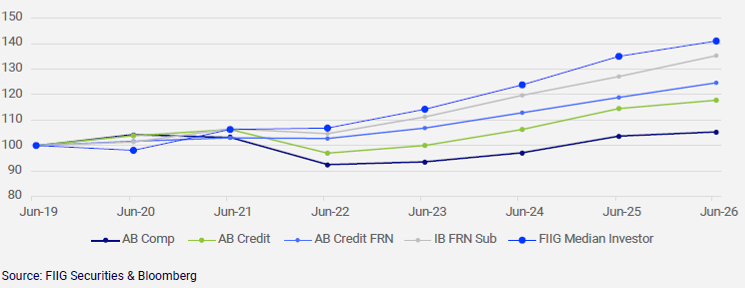
Median return methodology: The FIIG median is the middle annual portfolio internal rate of return (IRR) when eligible client returns are ranked. It is not the average return of all FIIG clients or the return of any particular investor. Eligible portfolios held at least five bonds, were valued at $250,000 or more and had an IRR calculated for the relevant year. Each annual median is calculated independently and may reflect different clients. The seven-year FIIG series links those annual medians and does not represent an investor’s actual seven-year return.
Table 1: Historical annualised returns (%) – FIIG client median-series, bond indices and selected ETFs
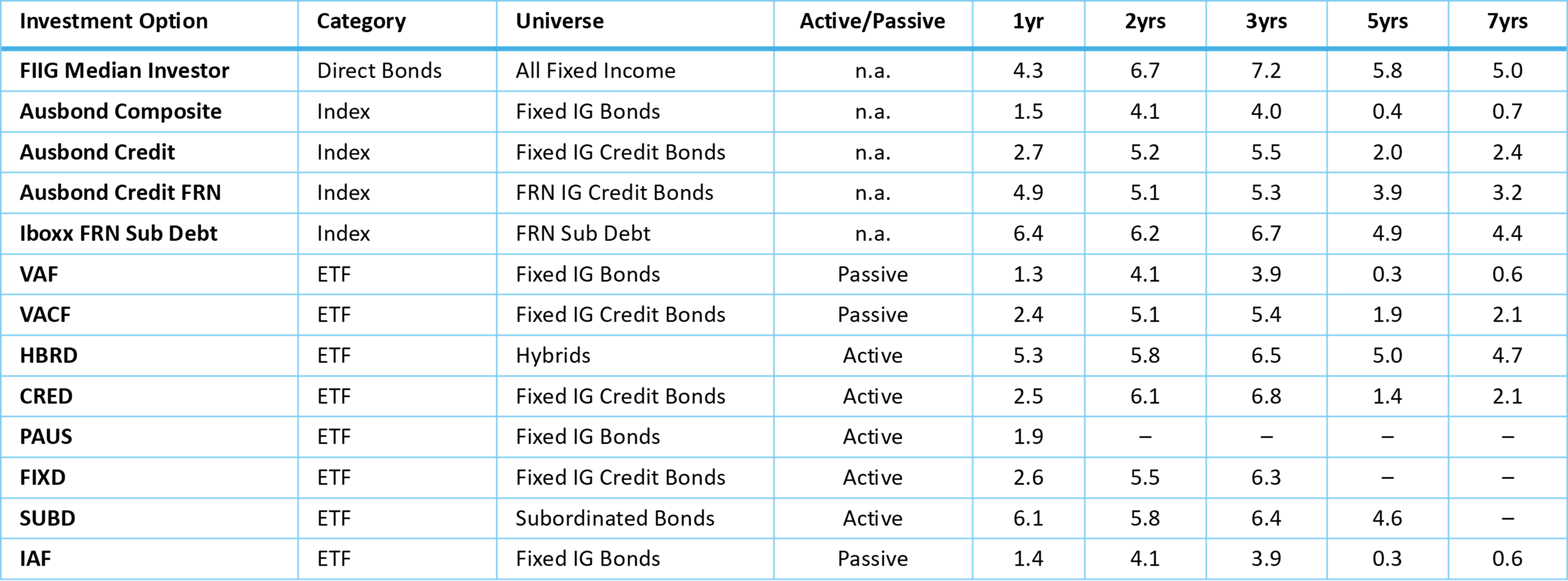
Source: FIIG Securities, Bloomberg. Results through 30 June 2026. The FIIG figures are derived from independently calculated annual client medians (see methodology above).
Comparison note: The FIIG client portfolios, bond indices and ETFs differ in underlying securities, credit risk, duration and liquidity. The historical returns are not adjusted for these differences and should not be regarded as directly comparable on a risk-adjusted basis. FIIG reports its client returns net of its trading and custody fees.
For the year to 30 June 2026, the official cash rate sat between 3.6% and 4.35%, the AusBond Composite Index returned 1.5% and the AusBond Credit Index returned 2.7%. By comparison, the median annual return of eligible FIIG client portfolios was 4.3% (net of fees) over the same period.
Over seven years, the difference was also notable. The illustrative FIIG series, constructed from the annual client medians, showed a 5.0% annualised return, compared with 0.7% for the AusBond Composite Index and 2.4% for the AusBond Credit Index.
One reason for this gap is the construction of the indices themselves.
Australian bond indices heavily weighted to government bonds
Australian bond indices are generally weighted according to the amount of debt an issuer has outstanding. As a result, the largest issuers receive the largest representation. In Australia, this can create a strong weighting towards government and quasi-government bonds.
These securities have an important role in financial markets. They are generally highly liquid and are widely held by banks and institutional investors for liquidity and regulatory purposes. But the qualities that make them useful for balance sheet management can also result in lower yields.
For an income-focused investor seeking higher yields, an index dominated by the market’s largest and most liquid issuers may provide a different outcome from the one they expect.
Active fixed income ETFs have greater flexibility to move away from an index and seek higher returns. At different points in the market cycle, that flexibility can produce meaningful outperformance.
The difficulty is achieving it consistently. Further analysis found examples of active ETFs that perform strongly for a period before surrendering some or all of that relative gain when market conditions change.
That does not make active fixed income ETFs inherently unattractive. It demonstrates that active management alone does not remove market, duration or sector risk. Investors still need to understand how a portfolio is positioned and what is driving its returns.
Sector exposure can work until the cycle turns
Some of the strongest ETF results in FIIG’s analysis came from funds focused on particular segments of the bond market. However, the analysis indicated that this outperformance was not consistent across the full period examined.
This illustrates a broader principle. Concentrated exposure to a particular sector can be rewarding when economic and market conditions are favourable. It can also leave investors more exposed when the cycle changes.
A strong recent return should therefore prompt a deeper question. Was the result generated by repeatable security selection, or by a portfolio’s exposure to a sector that happened to be in favour?
Direct ownership can change the investment equation
A direct bond portfolio is not constrained by the composition of a market-weighted index. Direct bond portfolios can also be fractionalised, allowing advisers to tailor allocations more precisely to an investor’s income requirements, risk tolerance, maturity preferences and liquidity needs.
That flexibility may allow investors and advisers to consider a broader opportunity set, including fixed and floating-rate bonds, short and long-duration securities, investment-grade credit and selected sub-investment-grade exposures.
It also creates the potential to avoid allocating the largest amount of capital to the largest borrowers simply because they have issued the most debt.
Direct bond portfolios may also carry greater issuer concentration, credit and liquidity risks than diversified bond ETFs, depending on the securities held. Often direct bond portfolios are not designed to replicate or beat a particular index, and individual investor outcomes will vary according to portfolio composition, risk, timing and market conditions.
For FIIG’s analysis, the median client dataset included investors holding at least five bonds, with portfolios of at least $250,000 and an internal rate of return calculated for each year. The results were used to construct an illustrative seven-year return history.
The comparison is illustrative and should not be interpreted as evidence that direct bond portfolios will consistently outperform bond indices or ETFs.
Looking beyond the wrapper
Fixed income ETFs remain a straightforward and accessible way to obtain bond market exposure. For some investors, that liquidity and simplicity will continue to be valuable.
But investors should look beyond the product wrapper and examine what sits underneath it.
Which issuers dominate the ETF’s benchmark? How much of the ETF is held in government and quasi-government debt? What is the duration exposure? Is recent outperformance coming from security selection or a favourable sector allocation? Most importantly, is the portfolio designed to meet your income objectives?
The debate should not be framed as direct bonds versus ETFs, or as one approach being inherently superior. Each offers different benefits, risks and trade-offs, and each may have a role depending on an investor’s objectives, portfolio size and need for liquidity.
What matters is understanding the exposure being purchased. Investors should look beyond the product label and consider the underlying holdings, duration, credit quality, fees and sources of return. In fixed income, the most appropriate structure is ultimately the one that best aligns with the investor’s income needs, risk tolerance and broader portfolio strategy.
Martin Smith is part of the Institutional Fixed Income Sales and Execution team at AUSIEX. This article is for general information only. It has been provided without considering your objectives, financial situation or needs. AUSIEX Fixed Income is provided under FIIG Securities Limited’s Australian Financial Services Licence (AFSL 224659) a wholly owned subsidiary of AUSIEX (ABN 71 076 515 930) (AFSL 241400).