What is an investor?
It’s a simple question, and one that’s becoming increasingly important as more Australians take control of their financial futures.
Thanks to compulsory superannuation, almost every working-age Australian is an investor. Millions of us hold diversified portfolios through our super funds, often without knowing where our money is invested or how it is being managed. Countless surveys have shown that when it comes to super, we’re disengaged.
Outside of superannuation, though, investing becomes a far more personal experience. Decisions feel more immediate, risks more visible, and navigating markets, asset classes and investment terminology can be challenging.
For this study, we define a ‘current investor’ as an Australian adult who holds one or more investments outside of their home and superannuation. This includes those who own an investment property but no other assets. ‘Prospective investors’ are defined as not currently having money invested but have plans to invest in the next six months.
The inaugural GXIQ Investor Scorecard 2026 explores how we as a nation invest, what we know, and how that knowledge shapes our behaviour. Based on a survey of over 2,000 Australians, the findings show that as investment knowledge increases, investors are more likely to build diversified portfolios, look beyond familiar assets and make decisions with greater confidence.
At Global X, we believe better information and education can help Australians become more confident investors. The inclusion of the GXIQ Index in this report provides a benchmark of investor knowledge and contributes to a broader conversation about Australia’s investment future.
What is GXIQ?
The Global X Investor Quotient (GXIQ) is a national benchmark of investor knowledge. It provides a simple way to measure and compare how well Australians understand investing.
Every participant completes the same 15-question investment knowledge assessment, covering core concepts such as diversification, compound interest, risk, tax and investing fundamentals. Responses are combined into a score from 0 to 100, creating an individual GXIQ score. Based on their GXIQ score, investors fall into one of four groups.

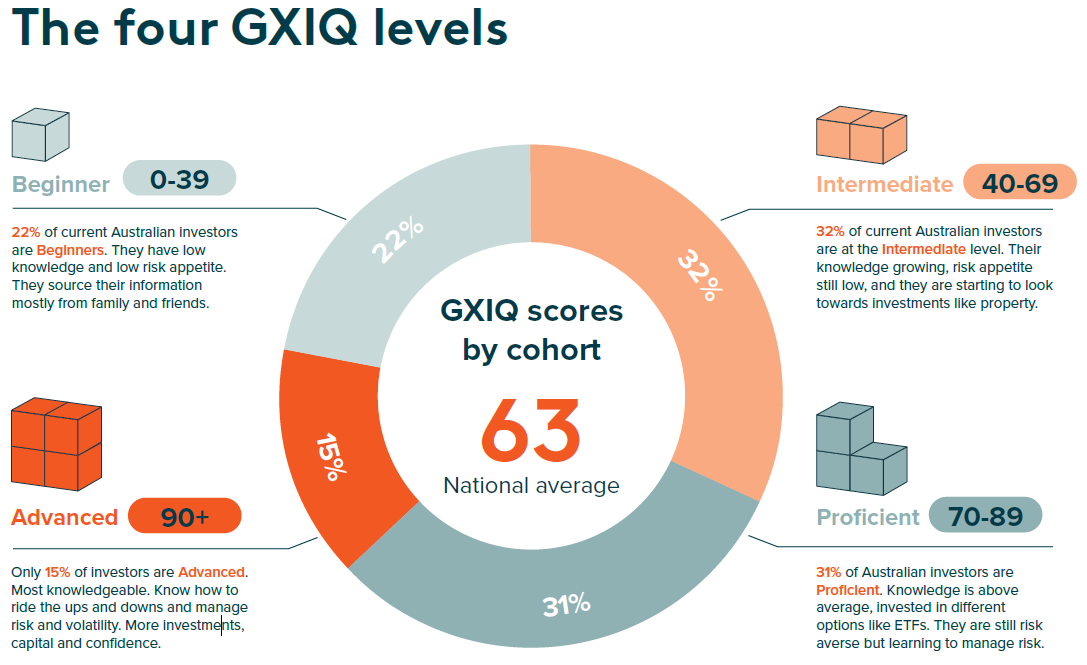
Five trends reshaping Australia’s investment landscape
1. Property is the preference among the least knowledgeable investors
Property remains Australia’s first investment language, but confidence in home ownership is falling. As affordability declines, Australians are beginning to reconsider how they will build wealth.
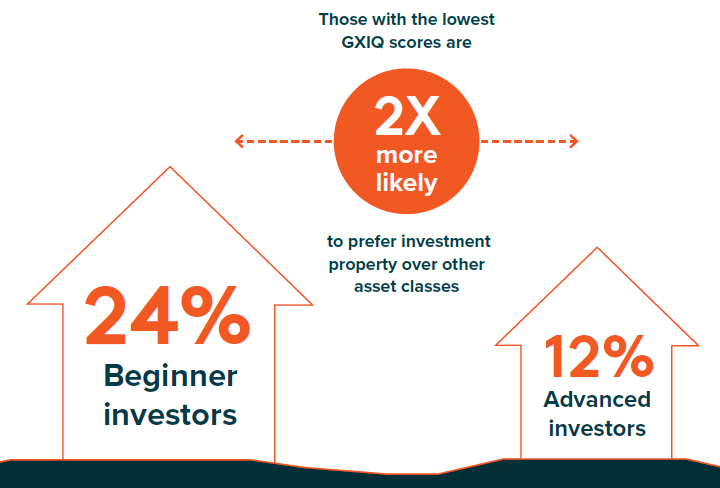
For now, investment property is one of the most popular assets for the average Australian. The research found that it is the preferred choice for Beginner and Intermediate investors.
However, for Proficient and Advanced investors, the preference shifts to Australian shares, additional superannuation contributions and ETFs.
2. 1 in 3 Prospective investors don’t understand the Federal Government’s CGT changes
Policy uncertainty is influencing investment decisions but not encouraging Australians to invest. Instead, many prospective investors are delaying investment altogether.
The negative gearing and capital gains tax (CGT) changes suggest prospective investors are less likely to invest in property, but no more likely to invest in shares or ETFs.
Confusion around the policy changes only adds to the uncertainty for Prospective investors. When asked why they haven’t started investing, lack of knowledge rivalled not having enough money as the primary reason. However, for women and those aged 18 to 34, lack of knowledge is the primary reason.
3. Australia has a gender knowledge gap to close
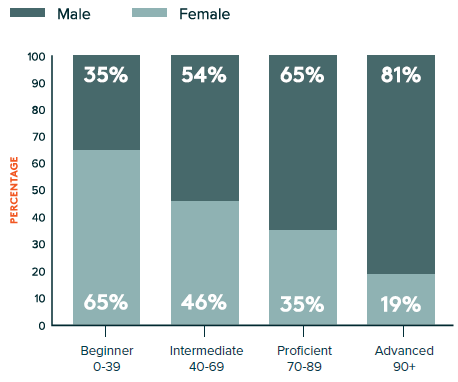
Two in three (65%) of beginner investors with lower investment knowledge are women, and relatively few progress to the highest levels of investment knowledge. The opportunity lies in helping more women to learn and broaden their investment knowledge.
The next generation of investors could be dominated by women if this gender progression gap can be addressed.
Global X Portfolio Manager, Jessica Leung adds:
“For many women, the biggest barrier isn’t a lack of interest, it’s simply not knowing where to start. Historically, financial markets and conversations around wealth have been spaces where women have been underrepresented. Add to that an industry full of jargon, and investing can easily feel like something you need to be an expert in before you can participate. But that’s also what makes this such an exciting opportunity. Investment knowledge is learnable. You don’t need a finance degree or to know everything before you start.”
4. AI has taken over super funds as a source of investment information
Australia’s younger, knowledgeable investors are building wealth differently, favouring diversified portfolios and looking beyond residential property as the cornerstone of long-term investing.
ETFs have overtaken property as the preferred investment for younger, knowledgeable investors.
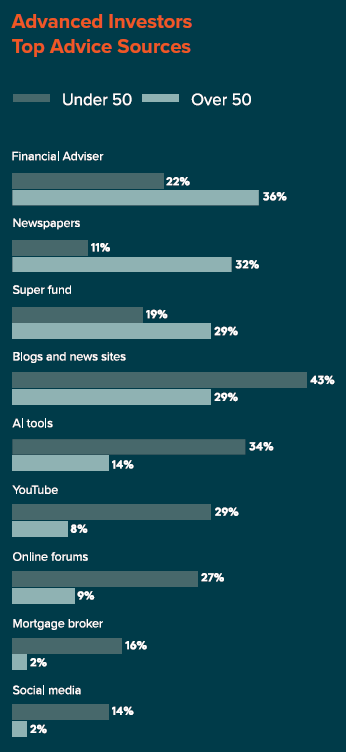
Investors are also using information sources differently based on their age. Advanced investors under 50 are relying more on online and free sources (e.g., AI tools, forums, YouTube) rather than traditional advice.
5. Investment risk could be misunderstood by many Australians
Investor knowledge plays a powerful role in shaping behaviour. Beginner investors are almost three times more likely than advanced investors to describe themselves as low risk (52% versus 18%), and more than five times as likely to invest without any strategy (34% versus 6%). By contrast, advanced investors are far more likely to diversify across asset classes and regions and are twice as likely to focus on low-cost investments. The data suggests that as knowledge grows, investors become more strategic, diversified and confident in managing risk.

Global X Senior ETF Strategist, Marc Jocum, adds:
“Australians have long preferred to invest in what they know. Whether it’s the family home, local shares, or household-name companies, familiarity often feels safer than venturing into unfamiliar investments. Our research suggests many self-described conservative investors hold concentrated portfolios, exposing themselves to significant risks if a single company, sector or asset class underperforms. In this sense, being too risk-averse can become a risk in itself. Getting risk controls right is critical. Taking too little risk can be just as damaging to long-term wealth creation as taking too much.”
Australia’s investment landscape is changing
The future of wealth creation won’t be determined by what Australians invest in, but by how much they understand investing. Australia is moving beyond a property-only mindset, with investment knowledge one of the strongest predictors of better investment behaviour.
Women represent the next wave of investor growth. We know that Australian women are eager to invest. But they are being held back by complex government policy and a lack of confidence.
Anyone can increase their knowledge of investing. Start the journey today and discover your own GXIQ with our free 15-question quiz. The full report is available here.
Alex Zaika is CEO of Global X ETFs Australia, a sponsor of Firstlinks.
Issued by Global X Management (AUS) Limited (‘Global X’) (AFSL 466778, ACN 150 433 828). This is general information only and not personal advice. This communication doesn’t consider your personal circumstances or needs. Investors should consider whether these products are appropriate for them, obtain financial advice and read the product disclosure statement (PDS), prospectus (as applicable) and target market determination (TMD) before making investment decisions. All PDSs, prospectuses and TMDs are available on our website. Investment in any products are subject to risks, including possible delays in repayment and loss of income and principal invested. Past performance is not a reliable indicator of future performance.