Register For Our Mailing List

Register to receive our free weekly newsletter including editorials.

Home / 664

The ticking clock on oil reserves

There is a point, somewhere around early August, when the global oil market runs out of road if current conditions persist. That is not scaremongering. It is arithmetic, and it is worth understanding the working.

The trigger is the double blockade of the Strait of Hormuz, the narrow waterway through which roughly 20 million barrels of oil per day would ordinarily flow. With that corridor constrained, the world is drawing down its reserves at an unsustainable pace. The clock is ticking, and the market, in my view, has not fully reckoned with what that means.

The numbers that matter

The global oil market consumes around 100 million barrels a day. Of the roughly 20 million barrels a day normally transiting through Hormuz, perhaps 5 million are being rerouted and 3 million are getting through. That leaves a shortfall of around 12 million barrels a day. Factor in approximately 2 million barrels a day of demand destruction caused by already-elevated prices, and you are still left with a 10-million-barrel-a-day hole, being plugged for now by inventory drawdowns at roughly 300 million barrels per month.

We began the year with approximately 8.5 billion barrels in storage across all definitions: crude, products, strategic reserves, pipeline fill, and refinery stocks. We have already committed to losing around a billion barrels. That brings the floor into view. Operational tank bottoms, the minimum inventory the system needs to keep functioning, sit at around 6.5 billion barrels.

If we continue drawing at this rate over May, June and July, we hit tank bottoms globally in early August. And before that, certain countries and geographies will feel the pinch sooner. Regional shortages are likely to emerge over June and July, ahead of any global reckoning.

The price needed to balance the books

Once you hit tank bottom, the calculus changes entirely. You can no longer borrow from storage. Supply must equal demand. And to close a 12-million-barrel-a-day shortfall through price alone, you need an oil price that forces significant demand destruction, particularly in emerging markets where consumers have the least capacity to absorb the blow.

My estimate is somewhere between $130 and $150 a barrel. Brent crude is currently hovering around $107.
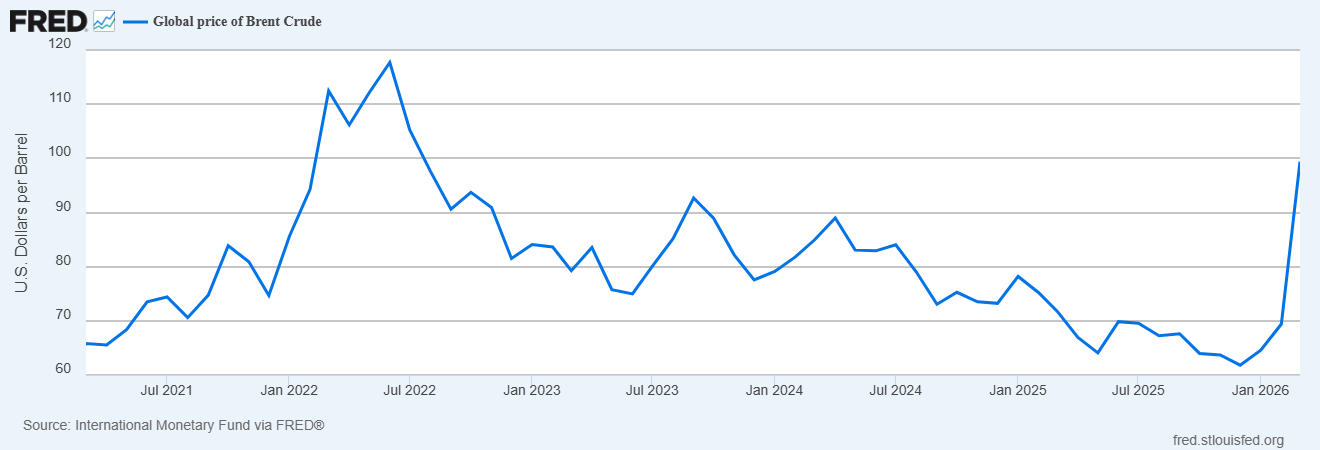
That is not a forecast of inevitability. A diplomatic or military resolution to the Hormuz blockade would change the picture considerably. But a solution is needed, and the longer it does not arrive, the more severe the eventual adjustment is likely to be.

Why equity investors are more cautious than you might expect

One might reasonably expect energy equities to have surged in this environment. They have not, and the reason is worth understanding.

Equity investors are wary of what I would call day-one headline risk. The moment a credible diplomatic breakthrough is announced, an estimated 120 million barrels of oil sitting in tankers behind the Strait of Hormuz could hit global markets relatively quickly. That initial price shock would weigh on energy equities, and investors are understandably reluctant to be caught on the wrong side of it.

There is also the sheer noise of the current environment to contend with. News flow is fast, contradictory, and heavily politicised. It is worth noting that when we look at the Brent oil price on screen, we are looking at the prompt month of a financial futures curve, not a physical barrel. The financial flows in these contracts run at roughly 100 times the volume of the physical market. That makes the price highly sensitive to tweets, headlines, and political messaging, some of which may well be deliberate.

The typical futures contract is also only four to six weeks out, and the market's working assumption seems to be that this will be resolved in that timeframe. In my view, the full impact of the disruption has not yet been properly priced in.

Where we are, and what comes next

Energy equities are currently pricing in something closer to $70 a barrel. I believe the mid-cycle oil price needed to balance global supply and demand over the next three to five years is closer to $80. That gap is meaningful, and for investors willing to look through the near-term uncertainty, it may ultimately represent an opportunity.

But the more immediate point is this: the oil market is not broken yet. Inventories are still providing a buffer. There is still time for a diplomatic solution to change the trajectory. What there is not, however, is an unlimited runway. The buffer is finite, the drawdown rate is high, and the mathematics of the situation are unambiguous.

The market may be used to living with geopolitical noise. What it is less accustomed to is a situation where the noise has a hard deadline attached to it.


Paul Gooden is Head of Natural Resources and a co-portfolio manager for the Global Natural Resources strategy at Ninety One.


  •   27 May 2026
  • 2
  •      
  •   
2 Comments
 

Leave a Comment:

RELATED ARTICLES

The biggest oil shock in history. Why isn't the price higher?

Oil does not have a supply side problem

Managing the impact of the Middle East conflict on listed infrastructure

banner

Most viewed in recent weeks

Noel Whittaker’s take on the budget

Marketed as a fix for inequality and housing affordability, the latest budget instead delivers a tangle of tax changes that leave everyday Australians worse off.

Australia has no death duties. Technically.

Australia may not levy formal death duties, but a growing web of tax measures is quietly shaping what wealth passes between generations. Now, the 2026 budget adds another layer.

Lithium's rally is real this time – but no-one trusts it

The lithium rally mirrors the early-2010s tech stock surge, with demand set to double by 2030. Supply has been slow to respond, creating a market deficit for future tech like humanoid robotics and solid-state batteries.

Welcome to Firstlinks Edition 662 with weekend update

The debate over the budget is increasingly shaped by frustration and perceptions of unfairness, rather than clear-eyed assessment of policy outcomes.

How inflation is quietly moving the goalposts on retirement

Inflation doesn’t just raise today’s bills - it quietly increases the amount needed to retire, while simultaneously making it harder to save. Three steps to take before June 30th to improve retirement outcomes.

How to minimise tax with a will

Inheritance tax implications in Australia may surprise some, as poor estate planning without proper wills or trusts can lead to costly tax bills and delays for beneficiaries.

Latest Updates

SMSF strategies

Meg on SMSFs: The CGT changes don’t impact super but what about Div 296 tax decisions?

New CGT rules could tip the scales in the super vs non-super debate. For those facing the Division 296 tax, the case for withdrawing has gotten more complex. A "comparison rate" tool may help assess decisions.

Planning

Testamentary trusts post-budget: Estate planning, tax reform and the ‘death tax’ debate

Proposed Budget changes to taxation are casting new uncertainty over testamentary trusts, prompting closer scrutiny of estate planning structures and the real implications of reforms still taking shape.

Taxation

Income tax and bracket creep

Examining how five "tax cuts" stack up against bracket creep. Why offsets and incremental changes may do little to ease rising average tax burdens, compared to structural reform through indexation over time.  

Exchange traded products

The limits of a quality investing approach in Australia

Quality strategies shine globally, but Australia's concentrated market tells a different story. Limited diversification and sector dominance can constrain the defensive outcomes investors have seen in broader markets.

Investment strategies

Balancing opportunity and complexity

As private markets expand, investors face a growing mix of structures, a stabilising private equity cycle and uneven AI disruption. Fresh questions are being raised about where the real opportunities now sit.

Investment strategies

Why strong returns matter as much as generosity

As EOFY approaches, structured giving offers a tax-effective way to support charities, while allowing donations to grow over time and play a longer-term role in family wealth and legacy planning outcomes.

Investment strategies

The most important investment decision you’ll ever make

Stock picking often gets the spotlight, but research shows asset allocation explains the vast majority of long‑term returns. Understanding your mix of growth and defensive assets is the real key to investment success.

Sponsors

Alliances

© 2026 Morningstar, Inc. All rights reserved.

Disclaimer
The data, research and opinions provided here are for information purposes; are not an offer to buy or sell a security; and are not warranted to be correct, complete or accurate. Morningstar, its affiliates, and third-party content providers are not responsible for any investment decisions, damages or losses resulting from, or related to, the data and analyses or their use. To the extent any content is general advice, it has been prepared for clients of Morningstar Australasia Pty Ltd (ABN: 95 090 665 544, AFSL: 240892), without reference to your financial objectives, situation or needs. For more information refer to our Financial Services Guide. You should consider the advice in light of these matters and if applicable, the relevant Product Disclosure Statement before making any decision to invest. Past performance does not necessarily indicate a financial product’s future performance. To obtain advice tailored to your situation, contact a professional financial adviser. Articles are current as at date of publication.
This website contains information and opinions provided by third parties. Inclusion of this information does not necessarily represent Morningstar’s positions, strategies or opinions and should not be considered an endorsement by Morningstar.