I once had a rather amusing interaction with an older gentleman at an investment conference.
We'd been discussing artificial intelligence and the speed at which it's embedded itself into every corner of the market. After nodding along for a few minutes, he laughed and declared, "Well, I'm glad I'll be dead soon – I don't have to deal with any of this AI stuff!"
I’ll be the first to admit that these conferences do strange things to people. Lock a few hundred attendees in a ballroom for eight hours of presentations and a comment like that no longer sounds unreasonable.
At the time, I filed it away as a good line. Lately I've been thinking about it differently. In the age of AI, which tasks are still worth doing ourselves?
A different kind of investment
Like most, I began 2026 with a collection of resolutions. Read more, spend less time staring at a screen, learn a new language (Guten tag) and so on. All of the aspirations that humanity collectively remembers in January.
Another resolution was to prioritise my health and wellbeing. I acknowledge it sounds like those virtuous, hippie endeavours that only wellness gurus with unlimited time and suspiciously flexible schedules can pursue. But my reasoning is considerably less enlightened.
As I continue further into what many insist on calling my 'late twenties', I've realised that neglecting my health is becoming less of a lifestyle quirk and more of a liability.
Our understanding of physical health has become increasingly sophisticated. And we've largely accepted that ageing well requires ongoing maintenance in this regard. That led me to another question. If my physical fitness deserves a level of attention, shouldn't my cognitive fitness deserve it too?
What happens when we outsource thinking?
Which brings me back to the conversation at the investment conference. AI may prove to be one of the most powerful thinking tools in human history. Refusing to use it entirely is about as practical as refusing to use the internet 20 years ago.
Every new tool that makes life easier also removes some of the mental load that previously accompanied the task. That isn't necessarily a problem, given humanity has spent thousands of years inventing ways to avoid unnecessary effort. I don’t wash clothes by hand to preserve my laundry skills.
But what happens when intellectual labour becomes outsourced?
History offers a useful analogy. A study from 2006 on London taxi drivers found that those who spent years learning the complex street network had developed measurable structural changes in the hippocampus. This is a region of the brain involved in memory and decision-making.
Later, the widespread adoption of GPS provided a contrast. As navigation was increasingly outsourced to technology, researchers observed declines in spatial memory among regular users. In other words, use it or lose it.
The risk for investors
Navigation and investment decisions are obviously very different tasks. Yet both illustrate the same principle. When technology consistently assumes responsibility for a cognitive function, we tend to exercise that function less ourselves.
More recent findings suggest an association between heavy AI reliance and weaker critical thinking, analytical reasoning and decision-making. This is largely because people begin outsourcing mental effort and accepting machine-generated answers with less scrutiny due to its perceived authority.
This perceived authority becomes concerning when we consider that over 3 million Australians already use AI to help manage aspects of their finances.
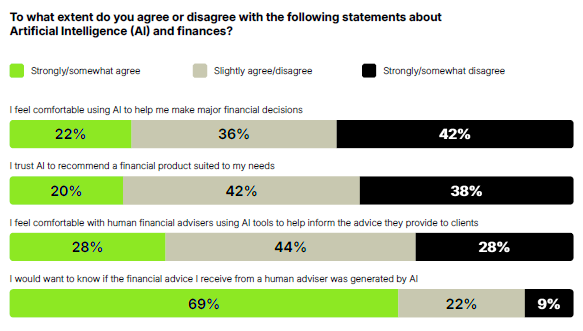
Source: Understanding Modern Australia. McCrindle. 2026.
Successful investing has always depended on questioning assumptions and exercising judgement. Unlike many disciplines, investing offers few objectively correct answers in the moment.
Investors are required to constantly operate under uncertainty, making judgement the scarce resource. This becomes problematic if AI becomes a substitute for thinking rather than a tool to enhance it.
I think the paradox is that the easier information becomes to access, the more valuable independent thinking becomes. The challenge is not whether to use AI, but how to ensure it supplements our abilities rather than replacing them entirely.
What can we do about it?
Many people assume that cognitive decline is an inevitable and largely uncontrollable feature of ageing. But researchers view the brain as remarkably adaptable in response to how it’s used.
The Harvard University Medical School coined the term ‘cognitive fitness’. That refers to the ability to learn, reason, remember and remain mentally engaged as we age. Importantly, the goal isn't to preserve the brain of a 30-year-old forever. It is to maintain the healthiest possible brain for whatever age you happen to be.
They propose a few tips to maintain your cognitive fitness. These were not developed with generative AI in mind, but they give us an interesting framework for maintaining the mental habits that AI increasingly encourages us to outsource.
-
Understand how experience makes the brain grow. Intellectual development doesn't stop in adulthood. Learning new skills, exposing yourself to unfamiliar situations and even observing others can physically strengthen and reshape neural pathways the same way exercise strengthens muscles. Whilst it's easy to fall into familiar routines, deliberately seeking new experiences continues to build mental capacity throughout life.
-
Work hard at play. The authors argue that adults often stop playing as they become older and more career-focused. But activities that involve experimentation, imagination, creativity and even a degree of risk continue to engage the brain. Intellectual growth always requires a balance between challenge and enjoyment.
-
Search for patterns. Cognitive fitness doesn't just involve learning new things. It's about building a sufficiently broad base of experiences so that you can recognise patterns others may miss. Intellectual curiosity helps the brain make better connections between seemingly unrelated pieces of information.
The cumulative effect of continuing to learn, adapt and engage with the world matters enormously. The age of AI has made cognitive fitness even more important. We don't need to compete with the machines, but rather maintain the skills required to use them wisely.
If we're prepared to spend decades building wealth so that we can enjoy later life, it seems sensible to devote at least some attention to maintaining the asset that will ultimately determine how much of that life we get to enjoy.
Simonelle Mody
***
Weekend Market Update
My Bui, AMP
US shares reached a fresh record high earlier this week before easing on renewed concerns about escalating Iranian strikes and reports that OpenAI’s annual revenue was $20bn below the previously reported $70bn. By the end of the week, the S&P 500 was up 0.6% and Japanese shares gained 0.5%, while markets elsewhere fell: European stocks dropped 1.8%, driven by surging bond yields, and Chinese shares declined 1.1%. Meanwhile, the ASX 200 was broadly flat, up 0.2% as we went to print. Gains in healthcare, utilities and real estate were offset by a fall in the IT sector, partly reflecting dampened sentiment following the postponement of data centre operator Firmus’s IPO.
Similarly, US bond yields eased slightly this week, but the bond selloff continued elsewhere, with the US 10-year ending the week at 5.23% (versus 5.27% last Friday). The forces driving yields higher, particularly elevated government debt and deficits, have been building for years. Over the past week, rising oil prices and renewed inflation concerns added further pressure, especially after reports that Iran intensified its strikes and hit a tanker deep inside the Persian Gulf near Oman. Surging French yields were also a major concern, raising fears of contagion to other countries and credit markets, as discussed below.
Oil flows from the Middle East rose to their highest level since the start of the war, while Bloomberg data showed that weekly seaborne oil exports from the Middle East and Africa have largely recovered to their 2025 average. Countries now appear to be finding ways to export oil despite the unresolved war and continued reports of Iranian attacks on ships in the Hormuz Strait. This has been achieved through alternative routes, including Saudi Arabia’s resumed use of the East-West Pipeline, US military air escorts for tankers and, most importantly, ship-to-ship transfers. This involves smaller shuttle vessels carrying crude to larger tankers stationed outside the strait, allowing the smaller ships to use routes better protected by the US Navy and sparing tankers from crossing the entire strait. A greater willingness by countries to accept risk while exporting oil may also be supporting supply.
The catch is that higher oil flows have not brought down prices, with Brent stillhovering above $100/bbl, while diesel spreads continue to spike. This is mainly because the cost of getting oil to refineries is now higher: ship-to-ship transfers take longer, require more complex logistics and use more tankers to deliver the same amount of oil. Bloomberg reported that more than 40% of the world’s fleet of large crude carriers is now in the Persian Gulf region, exacerbating a global tanker shortage and pushing up freight rates. Most vessels travelling through the region also face much higher insurance costs, particularly amid reports of crew casualties. The US military escort plan also appears fragile if tensions flare again. Adding to the pressure, demand from large buyers such as China appears to be recovering after months of drawing down reserves. Overall, spot markets remain unconvinced that current oil flows are sustainable.
Risk appetite was subdued in both gold and bitcoin, falling by 0.2% and 3.3% over the week, respectively. Why haven’t shares fallen further, with the S&P 500 and Nasdaq near record highs despite a near-zero equity risk premium and more than three weeks of bond yields above 5%? The explanation is familiar: AI earnings remain solid, evident by TSMC’s quarterly revenue which was up 51%; markets expect the AI capex cycle to continue; and rising manufacturing and services PMIs are pointing to decent global growth around 3.3% this year.
But several risks are beginning to emerge. First, the equity rally is very narrow. Since mid-September, when the 10-year Treasury yield crossed 5%, Information Technology has been the only S&P sector to rise materially, gaining almost 7%, while most others were flat or lower. Without IT, the S&P 500 would have fallen 0.5% rather than risen. Another evidence can be seen in the underperformance of the equal-weighted S&P 500 relative to the market-cap-weighted version, in which IT accounts for 60%.
Second, credit markets are starting to price in greater risk, particularly among the lowest-rated issuers. US corporate spreads to Treasuries remain generally resilient, but CCC high-yield spreads have widened to their highest level since late 2022–early 2023, when markets were debating whether the US would enter recession. The US investment-grade credit default swap index (CDX IG), which tracks the cost of insurance against corporate defaults, has also risen sharply since mid-September to its highest level since the Iran war began. Overall, wider spreads suggest investors are questioning whether AI revenues can keep pace with rising borrowing costs. Continued corporate bond issuance to fund AI capex, combined with wider high-yield spreads, will raise refinancing costs as the current wave of debt matures over the next few years.
Locally, the shelved Firmus IPO, originally touted as Australia’s biggest float since Telstra in the 1990s, is another sign of investor scepticism about AI. Firmus is an Australian data centre operator that initially sought a A$44bn valuation earlier this week. Within days, however, investor sentiment soured, with reported valuations at least 25–30% lower. The initial pricing was clearly aggressive for three reasons: 1) Firmus has only two operating data centres, while all contracted capacity depends on facilities yet to be completed; 2) the IPO was intended to raise A$7bn to build three data centres in Tasmania, but the proposed developments now face intense community backlash; and 3) Firmus is highly concentrated, relying on NVIDIA for technology and capital and Meta for most contracted revenue, very similar to the concentration risk facing other AI training data centres. Overall, we remain bullish on the sector, as data centre capex is likely to grow for another two to three years before plateauing, while Firmus is now likely to seek private-market funding. But in a higher-yield environment, investors are clearly demanding greater compensation for risk, including in equities, which places a cap on lofty valuations.
Another week – another immigration proposal from Australian politicians! Following earlier proposals from One Nation and Labor, the Coalition is promising to cut overseas migration to 100K for two years before settling at a long-term level of 160K. This is above One Nation’s proposed 130K, but below Labor’s 225K target and the historical average of 250K. The Coalition plans to achieve this by cutting international student commencements to 240K (from the current 270K cap), lowering the humanitarian intake to 10K (from 20K), restricting secondary applicants on student visas (similar to Labor), and abolishing Temporary Graduate Visas (except for PhD graduates, those studying health or education, and regional students). These reductions would be partly offset by removing caps for second- and third-year working holiday makers and adding 20K skilled visas.
Overall, the Coalition aims to reduce the stock of temporary visa holders by around 650K over four years, excluding visitors and New Zealanders, which will be very difficult. In particular, the reduction appears to be concentrated among student, Temporary Graduate and Bridging visa holders, who totalled 1.28 million in August. Achieving the target would require cutting this group by about half in just four years, while still allowing universities to take in new students. Note that many Temporary Graduate visa holders eventually enter skilled employment, while post-study work rights help Australia attract high-quality international students. Graduates with Australian qualifications and local experience are particularly valuable because they understand the labour market and can move more readily into skilled roles. Policy should therefore focus on attracting and retaining strong students and graduates, rather than simply reducing numbers. Ultimately, a competitive tax system will also be crucial to keeping this talent in Australia.
However, the Coalition’s focus on increasing the share of skilled migrants is welcome. Its proposals include expanding the Specialist Skills stream and Talent and Innovation visa, revising the skilled priority list, and prioritising skilled construction applications as well as permanent applicants based on criteria such as age, income, full-time employment, English proficiency and a skilled partner.
With all major parties seeking to reduce temporary and bridging visa numbers, we expect modest improvements in housing affordability and slower property price growth (but still positive) over the long term. However, inflation could rise in hospitality and other services that rely heavily on temporary visa workers. If we want to contain inflation in a sustainable way, the best solution would be to lift productivity by reducing burdensome regulation, red tape and taxes, while improving labour market dynamism.
Also in this week's edition...
Bond markets are adjusting to a new reality, but not in the ways most expect. Eric Souders believes higher yields are creating opportunities in global bonds.
Recession warning signs are flashing everywhere. Shani Jayamanne explains why investors face a different risk that can be just as dangerous for portfolios.
Meg Heffron is back to discuss how a key Division 296 calculation can sometimes attribute earnings in ways that many SMSF trustees won't expect.
Negative gearing changes formally begin in 2027, but the first consequences may already be here. Jade Xie examines which investors are most vulnerable.
The oil market is running out of easy answers. Damien Klassen argues why a more fragile reality is being masked.
Australians are investing more than ever, yet Alex Zaika shows a surprising divide is emerging between those building wealth effectively and those making costly mistakes.
Jim Bonham models how the 30% minimum CGT and a new definition of taxable capital gains has created a complicated structure that is not progressive, especially for seniors.
Curated by Simonelle Mody and Leisa Bell
Latest updates
PDF version of Firstlinks Newsletter
Monthly Investment Podcast by UniSuper
Monthly Gold ETF Flows from World Gold Council
LIC (LMI) Monthly Review (Aug data, revised) from Independent Investment Research
Monthly Bond and Hybrid updates from ASX
Listed Investment Company (LIC) Indicative NTA Report from Bell Potter
Plus updates and announcements on the Sponsor Noticeboard on our website