One of the challenges with investor surveys is separating what respondents say from what they actually do.
The State of the Australian Investor study attempts to test the gap between intention and reality by combining survey responses with portfolio and transaction data from almost 100,000 investors.
The stereotype of the typical retail investor can be difficult to shake. Popular culture still imagines a trader glued to multiple screens, chasing tips and trying to outsmart professionals. But the investors captured in this study are quite different.
Around 65% have been investing for over 20 years, almost 70% have more than $1 million invested (excluding their home) and roughly 84% make all or most investment decisions themselves. In many ways, I'd imagine that the survey cohort looks somewhat similar to the composition of Firstlinks readers. Despite the decades of experience, they remain just as capable as everybody else of worrying about what comes next.
Concerned, but not retreating
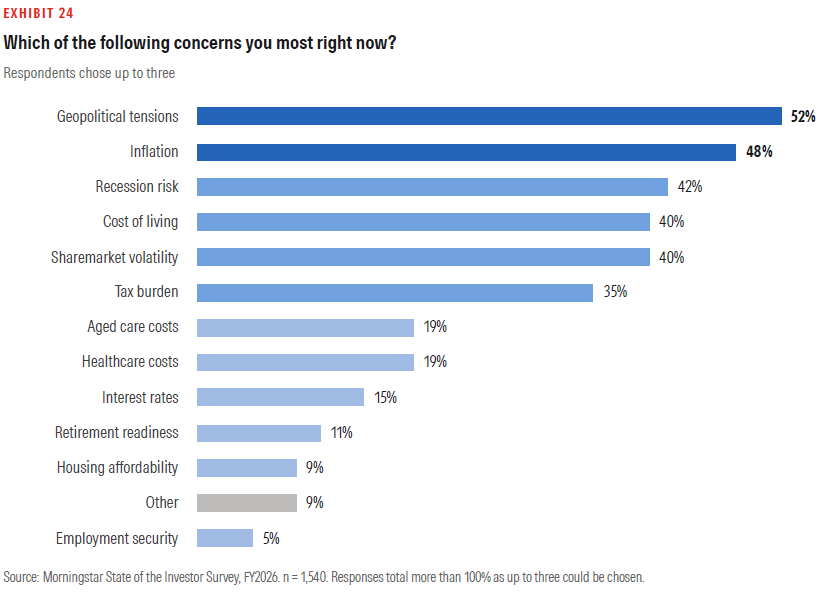
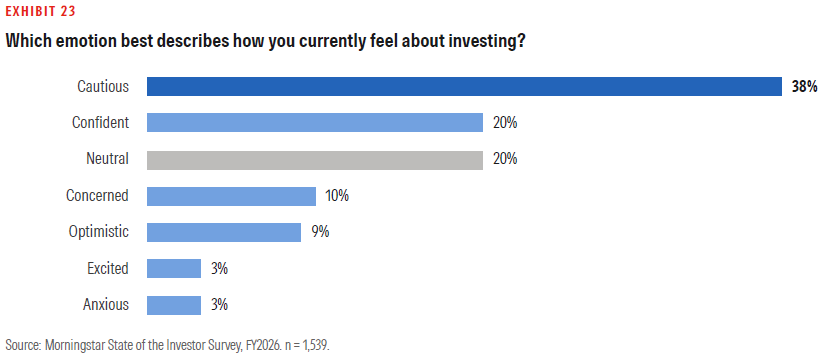
Markets have spent the past few years lurching from one fear to the next. Geopolitical tensions topped the list with inflation, recession risk, volatility and taxes close behind. "Cautious" was by far the most common emotion respondents selected when asked how they felt. If we analyse the sentiment in isolation, one could assume investors had spent the year retreating to cash and waiting for clearer skies. But that has not been the case.
During the August 2024 sell-off, the tariff correction in April 2025 and the period of tension surrounding the Iran conflict, participants became more active rather than less. The chart below shows how buying consistently outpaced selling by roughly two-to-one.
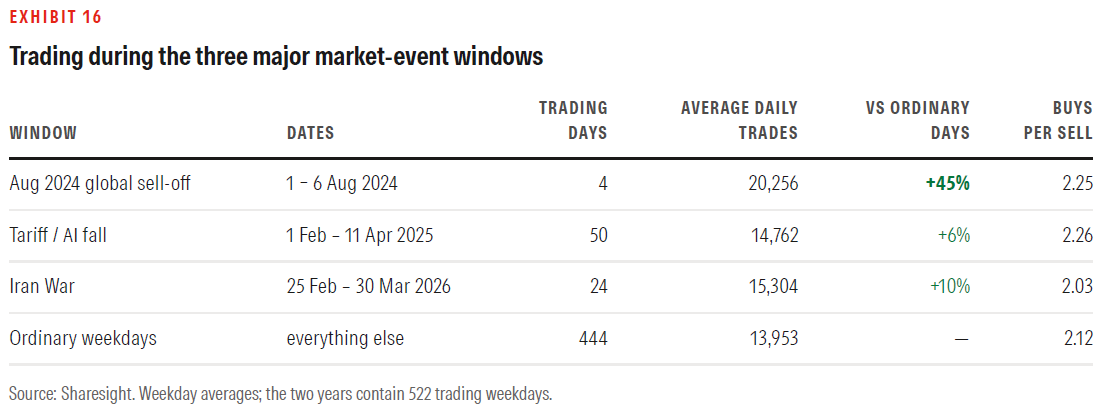
This paints a somewhat inconsistent picture. Education often focuses on the dangers of emotional decision-making and panic selling during downturns. However, many are now increasingly willing to look through market shocks, perhaps because they’ve seen enough.
One could argue that every meaningful downturn since Covid has eventually become a buying opportunity. Has this conditioned investors to buy the dip just as Pavlov trained his dogs? Or have uncertainty and extreme volatility simply become the new state of affairs? I'm not in the business of making forecasts, so I'll just say that it remains to be seen.
How did you perform against others?
What's particularly noteworthy is that portfolio returns significantly exceeded the ASX 200, which saw a 2.6% rise over FY26. The average investor enjoyed a very strong year with returns exceeding 13% in FY26. The median return was ~11% and more than 80% finished the year ahead. For most, these are enviable outcomes.
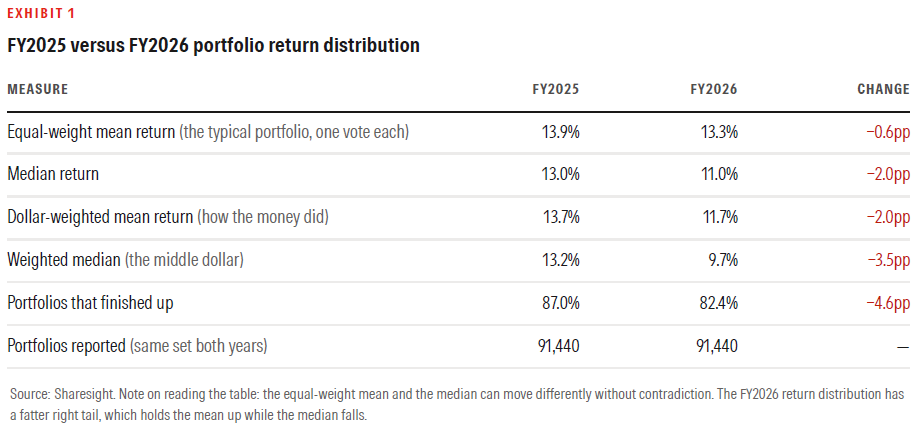
However, it is important to note that these portfolios contain a mix of global equities, cash flow from dividends, currency effects and different risk exposures. A direct comparison to the ASX is not particularly helpful. Yet the fact remains that the cohort achieved strong outcomes in a year when the domestic market was comparatively subdued. These results even outperformed most large, diversified growth-oriented industry super funds.
Income is making a comeback
A lot of industry commentary tends to frame success almost entirely through capital growth. Taking a deeper look into composition reveals that in FY26, income accounted for 4.1% of an 11.7% dollar-weighted portfolio return. In plain terms, over a third of total returns came from income.
The report argues that many are actively seeking income-producing investments rather than simply receiving income as a by-product of their portfolios. This is supported by the growing popularity of high-yield strategies like Vanguard's Australian High Yield ETF (VHY), which climbed from the 14th most traded security to 9th place over the year.
Part of the explanation may be demographic, but tax is likely also playing a role. Throughout the survey, the topic repeatedly emerged as a major concern. Recent policy changes have prompted a greater focus on after-tax outcomes, rather than simply chasing the highest headline figure. Two portfolios with identical pre-tax returns can look very different once tax is taken into account.
I believe there is also a psychological element. During uncertain periods, steady income can be a reassuring reminder that portfolio performance is not solely dependent on somebody else paying a higher price for an asset in the future. While you may not necessarily want less exposure to equities, there could still be a preference for a greater share of returns to be arriving as cash.
The ETF story isn't what you think
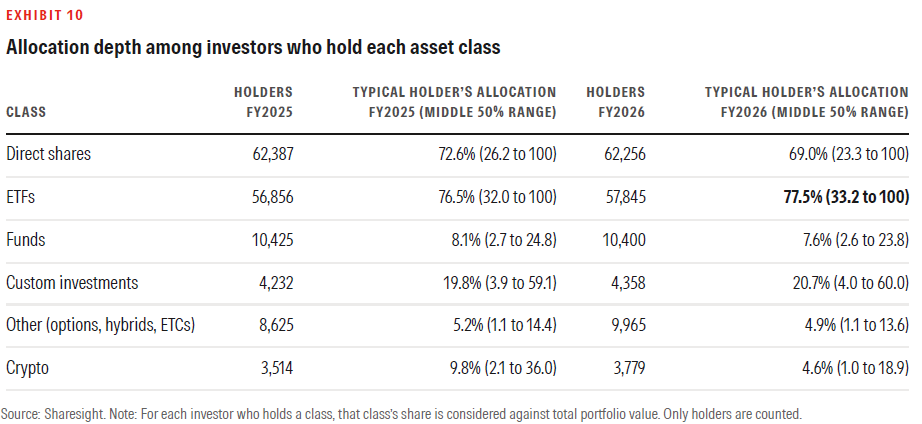
The data confirms something that most already know. ETFs are becoming the default, as purchases exceed sales by three to five times. In FY26, the median ETF holder allocated 77.5% of their portfolio to ETFs, compared with 69.0% for the median direct-share holder.
Importantly, this doesn't imply an abandonment of stock selection. The report rejects the simplistic idea that you can be either active or passive. What emerges is strong evidence that many are adopting a "core and satellite" model. Investors use broad funds as foundations, while maintaining direct holdings in companies where they possess conviction.
Retirement prospects
The final thing that stood out was the set of figures below.
Around 94% of respondents know exactly or roughly how much income they'll need once they stop working. That sits somewhat awkwardly beside the prevailing narrative that Australians are financially unprepared for retirement. Of course, there are certainly large pockets of the population where that concern is justified, but these findings reflect how many are operating from an entirely different position.
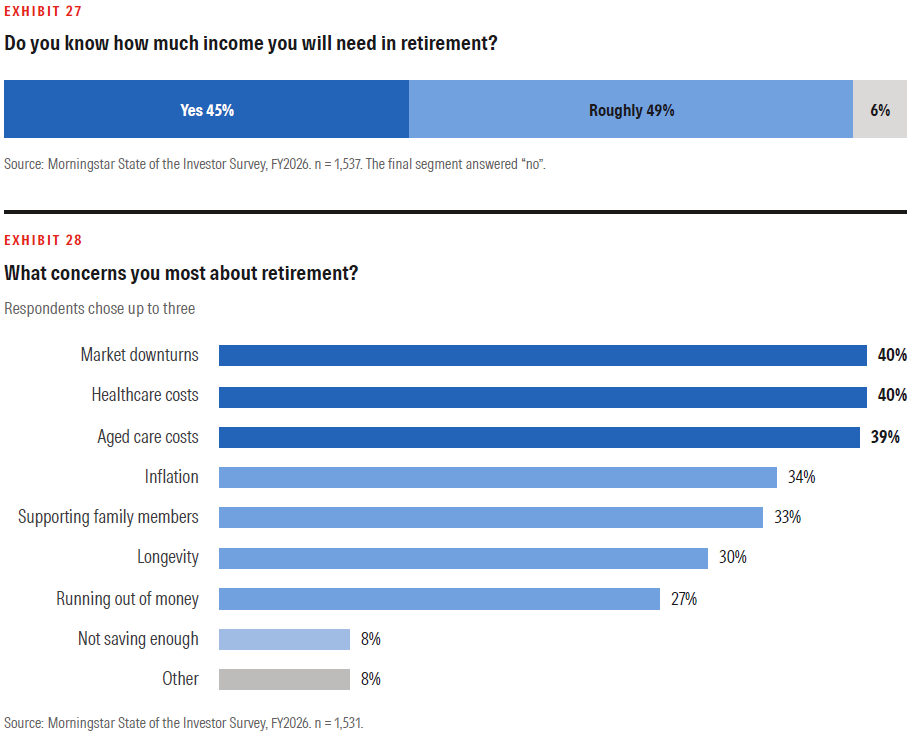
Running out of money and not saving enough aren't the primary concerns. Instead, there are worries that unknown costs or volatility will disrupt the retirement they have planned.
Simonelle Mody
***
Weekend Market Update
Diana Mousina, AMP
It was another rocky week across markets. For most of 2026, the narrative has been that investors have benefitted from strong earnings and AI investment. But now, rising oil prices, rising bond yields and central bank rate hikes are making the outlook more fragile. US shares were basically flat this week and haven’t moved much over the month. The tech sector did worse, with tech-heavy Nasdaq down 0.5% this week and 3.2% lower over the month. Investors are looking for more safe havens, with more rotating into US bonds, particularly as yields look attractive at these high levels. As a result, US 10-year bond yields fell nearly 12 basis points this week (down to 4.96%). The US dollar was unchanged this week but the $A was up again to 70 US cents. Australian shares were down by 0.5% this week, with energy, materials and IT down but better growth in communication, industrials and financials.
It’s been a disappointing year for Australian equities which have barely risen. US shares continue to outperform, up by nearly 12%. Japan has been even stronger, up 25% while Europe is up around 5%. Going into the last two months of this year, the downside risk for markets has moved from an earnings-led market correction to a broader repricing of interest rates, inflation and risk premiums. In particular, the market is getting concerned that there has been too much spending on data centres, power, GPUs and other parts involved with the AI build-out and that demand will not be there to justify this spending in the future. Basically, that there has been over investment.
Higher interest rates are adding another layer of pressure. Projects and businesses that looked viable when the cost of capital was low become much harder to justify when financing costs rise. This is starting to show up in parts of the corporate bond market, particularly among the lowest-quality borrowers. Credit spreads on CCC-rated and lower US corporate bonds have risen sharply to around 11 percentage points over Treasuries, while spreads across the broader high-yield market have risen much more modestly.
This is one of the effects of higher interest rates: they expose businesses that were sustainable when money was cheap, but struggle when the cost of capital rises. So far, however, this looks more like pockets of stress than a broad-based credit crisis. But it’s something to watch.
There have been plenty of tech wobbles in recent weeks. Last week it was concerns about CoreWeave, a specialised AI-native cloud computing provider. This week it was the listing by Elice Group, a South Korean AI computing supplier, dropped. The strains in the AI ecosystem are showing up in some parts, especially in leveraged businesses with rising fixed commitments from high capex spending. Back at home, the local tech worry was Australian data centre operator NextDC, which had a huge fall in its share prices (down by over 40%) after its FY27 earnings guidance was slashed after a proposed expansion at its Melbourne data centre could not get the electricity supply it required, due to intense community backlash. Interestingly, earnings guidance from US-listed tech companies this week was solid, including from SpaceX and Meta. Investors remain focused on whether the enormous amount of hyperscaler capex expected in 2027 can translate into sufficiently strong AI revenues and earnings to justify the scale of investment.
All of this means that the AI trade isn’t necessarily over, but it is changing. It is no longer a case of “buy everything”. There are trades within the AI trade and investors need to be much more selective about who is actually making money from the technology. But it is hard to get too bearish on equities overall just yet, with earnings growth still positive and the hard economic data holding up well.
Are we in for another Eurozone crisis? French 10-year bond yields have risen above 5%, their highest level since 2002. French bond yields were already rising from a difficult fiscal backdrop and political uncertainty ahead of the 2027 Presidential election, which currently indicates a victory by populist Marine Le Pen. But yields got another leg up after the civil unrest last weekend/ with hundreds of thousands of people nationwide initially protesting deteriorating education conditions which then morphed into cost-of-living concerns and declining public services.
The question for markets is whether the unrest and bond-market pressures spread to other European countries, pushing up their borrowing costs as well. There have been some signs of spillover into other European bond markets (but this could also reflect the global rise in bond yields), but so far nothing resembling the broad-based sovereign stress seen during the Eurozone debt crisis. French equities have also come under pressure, although the weakness has occurred against a generally softer backdrop for European equities.
Oil prices were up this week, with Brent over $110/barrel. Hopes for a US/Iran deal briefly resurfaced during the week which helped to put some downward pressure on prices. But this was quickly dismissed, after concern that Trump could resume strikes after the mid-terms with ongoing Houthi rebel attacks on Saudi Arabia and US State Department notice for non-emergency staff and families to leave Saudi Arabia. We expect oil prices to remain high at over $100/barrel, which will keep petrol and diesel prices elevated. Australian petrol prices are around $2.40/Litre, with the cost to fill up a 60L tank now back up to ~$140, around its highs but not quite reaching the $155/week back in March when the Iran war first broke out. Not good for consumer confidence.
It was a big week for US earnings. 25% of the top 500 US companies have reported third quarter earnings. Results have been strong, especially across financials. 83% of companies beat expectations, which is higher compared to normal. Earnings growth is beating expectations and is likely to be up by 30% over the year to September. US earnings growth is its highest level in over 2 decades (excluding the initial post-recession bounce). It’s hard to get too bearish on stocks with these types of numbers.
China’s monthly activity data came in stronger than expected and shows that the economy rebounded in the September quarter. Annual GDP growth rose to 4.5% (from 4.3% last quarter). Retail sales were 1.1% higher over the year to September (well above 0.4% last month), industrial production rose by 5.5% (also an improvement on last month), fixed asset investment was still weak, falling by 7.2% over the year to September and property investment was down by 20.6% over the year. Overall, domestic demand is still weak but external growth is better. The other issue is that data improvement in September appears to be seasonal. Historically, Beijing has pushed the economy into September – November after a mid-year slowdown by increasing stimulus and local government bond issuance, so the rebound in activity may not be persistent.
RBA Deputy Governor Andrew Hauser spoke at Citi's Investment Conference this week. Given his track record of shifting market expectations, investors paid close attention to his remarks, which struck a hawkish tone and reinforced the possibility of further interest rate increases. Following his comment, financial markets are now pricing in ~40% chance of a November rate hike, and it got all the way up to nearly 70% after Hauser’s speech (compared to 30% beforehand). Another rate rise in Australia would take the cash rate from 4.6% to 4.85%.
Markets clearly aren't convinced the hiking cycle is over. We think the central bank is done. Activity is slowing and, after four rate increases, including one just last month, it makes sense to give those hikes time to work through the economy. But the risk is firmly on the upside, and another hike over the next few months can't be ruled out.
Hauser’s main comment around inflation was that the [inflation] outlook looks “materially worse” than the RBA had projected in August. The July data was higher than expected, which led to the RBA rate hike in late September. The August data was more or less in line with expectations and some components looked better, especially for dwelling construction costs and rents. And the September inflation data is out next week. So, the RBA has already responded to upside inflation risks with the last rate hike. The question is whether the next inflation reading is stronger than the RBA is currently assuming.
In terms of comments around some of the slowing in activity data, like consumer and business confidence, the labour market and home prices – these were all mentioned but Hauser also said “we need a period of “below trend growth to bring inflation down” – so he wasn’t sounding the alarms on the activity indicators.
Also in this week's edition...
Rachael Rofe returns to discuss the recent Bills introduced into Parliament and why she thinks Treasury has picked the wrong reading.
The 4% rule has survived decades of scrutiny, but Mark LaMonica poses the question: Does an American retirement rule work for Australians?
Glencore has landed on the ASX. David Tuckwell explores whether the company offers something BHP and Rio can't.
Noel Whittaker proposes three common sense reforms that Australia needs right now.
Tony Dillion reflects on how the new CGT regime creates distortions and raises questions around tax neutrality.
Some effects of rising public debt never make the headlines. Ruchith Dissanayake uncovers the hidden cost for ASX investors.
Is fundamental investing losing its grip on markets? Joe Wiggins suggests the dominant force behind short-term returns may be something else altogether.
Curated by Simonelle Mody and Leisa Bell
Latest updates
PDF version of Firstlinks Newsletter
Australian ETF Review from Bell Potter
LIC (LMI) Monthly Review from Independent Investment Research
Listed Investment Company (LIC) Indicative NTA Report from Bell Potter
Plus updates and announcements on the Sponsor Noticeboard on our website