Christopher Nolan’s adaptation of The Odyssey brought one of the oldest stories in Western literature back to the spotlight. It is a tale packed with gods, monsters and shipwrecks but, for value investors, one episode in particular feels surprisingly familiar.
On his long journey home from the Trojan War, Odysseus is warned about the Sirens. They are creatures whose beautiful song is so irresistible that sailors who hear it are drawn helplessly towards them, steering their ships onto the rocks.
Odysseus wants to hear the song but knows he cannot trust himself to resist it. So, he comes up with a plan. His crew block their ears with wax, while he orders them to tie him tightly to the mast of the ship. Crucially, he tells them that if he later begs to be released, they should ignore him and, if necessary, bind him even tighter.
The Sirens of the stock market
The stock market is full of siren songs. Every investment cycle produces wonderful stories about the future: revolutionary new technologies, enormous untapped markets, exceptional businesses, structural growth and seemingly insurmountable competitive advantages.
Importantly, those stories are not necessarily wrong. Indeed, that is what makes them so powerful and persuasive. The most dangerous investment narratives are rarely complete fantasies. More often, they begin with a kernel of truth – a great company, an exciting technological breakthrough or an attractive new growth opportunity – and then gradually morph into the idea that almost any price is worth paying just to participate.
Tying ourselves to the mast
Odysseus understood an important lesson about human psychology. Simply knowing something is dangerous doesn’t mean we will be able to resist it when temptation arrives. So he didn’t rely on his willpower alone. Instead, he imposed a constraint on himself in advance.
That timing matters. The constraint is established before the temptation arrives. Because once the Sirens are singing, our judgement can no longer be assumed to be impartial.
At its heart, value investing is a similar form of pre-commitment. Rather than beginning with an exciting vision of the future and working backwards to justify what we might pay for it, we “tie ourselves to the mast” by insisting that an investment first offers a margin of safety. In simple terms, that means we want a prospective investment to look justified by something tangible and demonstrable – proven earnings power, proven cash flows or the hard tangible assets that sit on a company’s balance sheet.
That doesn’t mean the future is irrelevant. It always matters enormously. But it does mean we try to avoid making our investment returns solely dependent on a speculative – and often highly optimistic – version of the future coming to pass.
As Ben Graham put it: "The function of the margin of safety is, in essence, that of rendering unnecessary an accurate view of the future.”
Tighten the ropes
The trouble is, tying yourself to the mast isn’t always a barrel of laughs.
When highly valued growth companies are delivering spectacular returns, it can be genuinely painful to miss out. And at that point, there will always be reasons why traditional valuation discipline is said to matter less than it used to.
In the late 1990s, it was the internet. In other periods, it’s been emerging market growth or ultra-low interest rates. Today, artificial intelligence provides another powerful narrative for why investors should loosen the valuation ropes to make sure they “have some exposure”.
The headlines and the details change, but the behavioural temptation is always the same. And the longer expensive assets outperform, the greater the pressure to loosen those ropes.
It rarely happens all at once. First, paying a little more for dependable growth feels like a sensible compromise. Then paying substantially more seems reasonable given how exceptional the opportunity appears. Eventually, questioning whether the price paid matters at all can begin to sound hopelessly old-fashioned.
This is why Odysseus specifically instructed his crew that when he begged to be untied, they should bind him even more tightly. For investors, there is something useful in that image. The moment valuation discipline feels most frustrating is often the moment when it really matters.
Hearing the song
There is an important distinction here, however. Odysseus does not block his own ears like the rest of his crew. He does hear the song of the Sirens.
Likewise, value investing does not require us to ignore the forces of technological change or bury our heads in the sand when it comes to reasons why the future may look different from the past. Indeed, we probably spend a disproportionate amount of time considering how structural changes could negatively affect some of the deeply discounted companies that come onto our radar.
We don’t want to close our ears or live in denial of disruptive change. But we do want to avoid being lured onto the rocks by the siren call of “this time it’s different”.
Staying the course
Markets will never stop producing siren songs. There will always be a compelling reason why this particular company, this particular technology or this particular moment in history is sufficiently exceptional to defy the odds and rewrite the rules of investing.
Knowing that is the case, it is critical that we stay the course.
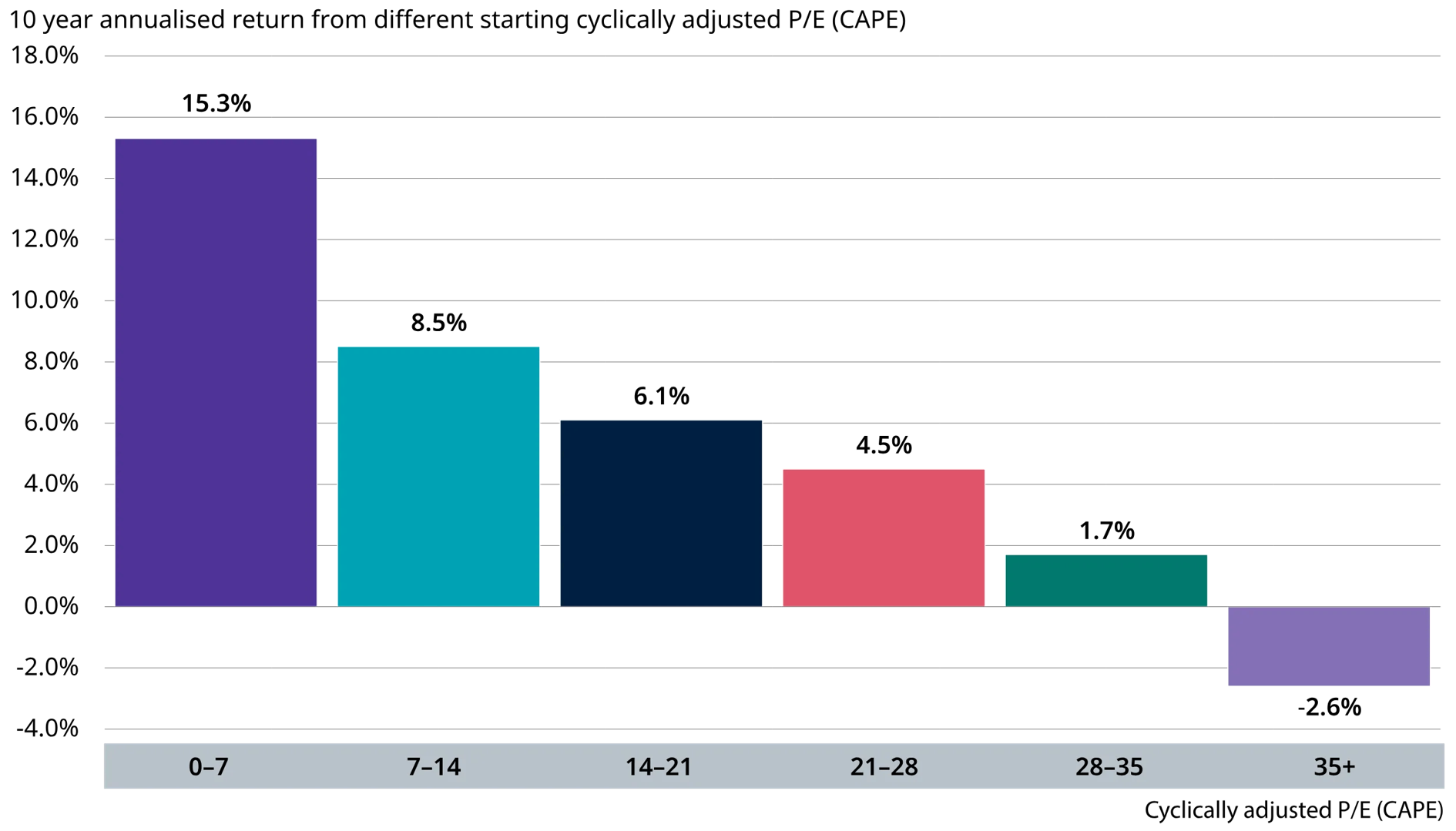
Valuation discipline is the rope around our mast. And – as supported by Figure 1 below – history suggests that when the siren song is most tempting, that is usually the worst possible moment to untie it.
Figure 1: In the long run, the price you pay for something really does matter
Past performance is not a guide to the future and may not be repeated.
Source: Stock market data used in "Irrational Exuberance" Princeton University Press, 2025 updated, Robert J. Shiller. Based on US equity market since 1871.
Issued by Schroders Investment Management Australia (ABN 22 000 443 274, AFSL 226473), a sponsor of Firstlinks. This article does not contain and should not be taken as containing any financial product advice or financial product recommendations. This article does not take into consideration any recipient’s objectives, financial situation or needs. Schroders does not give any warranty as to the accuracy, reliability or completeness of information which is contained in this material.
For more articles and papers from Schroders, click here.