Register For Our Mailing List

Register to receive our free weekly newsletter including editorials.

Home / 628

Will we choose a four-day working week?

The idea of a four-day work week is beguiling. Maybe we are feeling burned out or perhaps we are imagining what life could be like if AI does 20% of our work. The promise sounds fabulous: work less, live more and magically get the same or even greater productivity. It sounds like a more balanced, more human future.

Those who champion the four-day work week make a big assumption: namely that people can achieve the same outcomes in around 30 hours that they get currently in around 38 hours. This assumption is necessary because the beguiling big idea behind the four-day work week is that salaries will stay the same.

Advocates often point to trials. A six-month multinational study found that shorter weeks reduced burnout and improved health without impacting performance. A pilot within Australasia saw most participating organisations say that they would adopt the model long-term. The problem is that in a trial, most participants know they are being observed and measured and that carrot-and-stick of “make this work or lose it” is powerful. Whether the productivity gains persist for the long term is still to be seen. Whether they would persist if a four-day week was a permanent entitlement, without the discipline of trial conditions, seems unlikely. And it hasn’t yet been tested in many diverse environments beyond offices with laptops and deadlines.

Many jobs cannot be made more productive while shrinking the hours of work. An ICU nurse cannot work for 4 days instead of 5 and achieve the same levels of patient care. A childcare centre cannot run with 20% fewer staff on a Friday. An essential part of these roles is presence. To reduce hours without reducing service requires more staff.

Despite many trials in the US, a four-day week for school children has had mixed academic results. Student learning declines significantly unless the school day is made much longer (keeping the overall contact hours per week similar). In schooling, like care roles, hours cannot be compressed while hoping for the same outcomes.

And the same goes for construction, retail, hospitality or transport. An hour of labour is exactly that: an hour. By contrast, most high-profile trials of the four-day week have been run in white-collar workplaces, where tasks are more flexible.

Then there’s money. Many workers could already choose to reduce their hours. Some do, but most don’t. You can’t blame them. Housing affordability in Australia is at its worst levels in history. The national house price-to-income ratio now sits about eight. In Sydney it’s more than 13. The idea that twenty- and thirty-somethings will willingly trade income for leisure is fanciful. Even if productivity gains allowed salaries to remain unchanged on a four-day schedule, the incentive to work five days to save faster for a house deposit would be compelling.
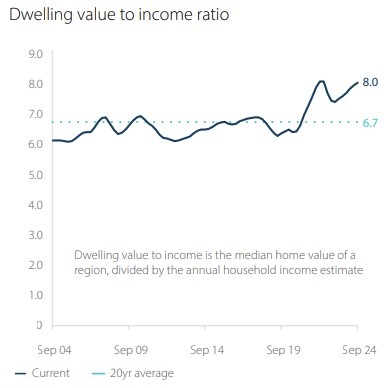

Source: ANZ CoreLogic Housing Affordability Report, Nov 2024. Data: CoreLogic, ANU.

The toughest obstacle may not be structural or economic but our own selves. A century of productivity growth should have freed us to enjoy much shorter weeks already. Our great-grandparents lived on far less real income, often without holidays, cars or early home ownership. Their ‘normal’ would strike us as austere. Yet rather than reducing work, our response to rising productivity has been to choose a higher standard of living. Consumption has expanded to fill our earning capacity.

Rising prosperity is one of the great achievements of modern economies. But it does reveal the tension at the heart of the four-day week. Even if AI delivers us enough economy-wide productivity advances to allow everyone to work four days at the same pay they get now for five days, will we choose that? How long will it be before our lifestyle expectations ratchet up again? Will our grandchildren view space tourism as casually as we view a trip to Bali?

The popularity of the four-day week speaks to a yearning for more balance, rest and humanity in our lives. It’s not a bad idea. But it is an idea whose time has not yet come. Until more people actually choose a shorter week over greater consumption, we should not consider a wholesale restructure of our society, offices and schools.

That day may come. We have seen patterns change throughout history. The idea of a weekend came out of manufacturing early in the twentieth century. The 8-hour day was an innovation as was the 40-hour week. But, for now, the four-day week feels a long way off.


Professor Jenny George is Dean of Melbourne Business School and Co-Dean of the University of Melbourne's Faculty of Business and Economics.


  •   10 September 2025
  • 5
  •      
  •   
5 Comments
JohnS
September 11, 2025

Over 25 years ago, a friend, who worked at a private senior high school told me about their introduction of a four day school week.
Half of the staff took each Wednesday off at home. The other half of the staff came to school. It was allocated so that half of the Maths faculty was there each Wednesday, and similarly for each of the other faculties.
Students were not expected to turn up for school on Wednesday, but could come in if they wished. This was consultative time, where those staff who were at school would give one on one assistance in answer to student's questions.
Each of the remaining school days were extended by an hour. So students effectively got the same number of face to face teaching time.
It worked brilliantly. And because the students were all over 16 years of age, the parents didn't need to worry about supervision at home.

Kim
September 11, 2025

Some years back South Australian Local Councils introduced a 9 day fortnight. Staff "were supposed to "work" 70 hrs. per fortnight. Judging by the results, work piled up in the streets, and clerical staff still didn't push themselves. I worked in private enterprise - had 1 day a month as a rostered day off. Didn't work for me as my workload remained the same but I needed stay in the office longer each day to keep on top of things. Local Government and the Public Service have workloads that are light with little pressure - I spent a 3 year period in the State Public Service after "retiring" and it was a breeze. No pressure, and no PKI's.

john
September 12, 2025

Had similar experience

Paul
September 12, 2025

Endorse the comments about the public sector. Totally inappropriate industrial relations laws and union solicitors happy to obfuscate and defend the indefensible mean that the lazy and irresponsible cannot be sacked or sanctioned in any way. There is almost no accountability in the public sector. ACCOUNTABILITY is what is missing from the debate about productivity. This craven government won't go near the issue of accountability-- explicitly excluded it from "the round table'' but they keep expanding the public sector.

Austin
September 14, 2025

Thanks for the article. Note however the 4 day week does not need to carry the same pay, indeed it may be less. Rather it depends on whether standards of living have improved. The biggest barrier to a successful 4-day working week is (still worsening) wealth inequality.


Leave a Comment:

RELATED ARTICLES

Was life really better in the good old days?

Who gains in an AI-supercharged economy?

10 policies to drive Australian productivity higher

banner

Most viewed in recent weeks

It’s time for LICs to die

A high-profile dividend cut and a prominent fund manager’s apology have reignited a long-running debate. If investors can access similar exposures more cheaply and efficiently elsewhere, what exactly is keeping LICs alive?

Testamentary trusts survived the trust tax. The drafting battle has just begun.

The fight over testamentary trusts looked settled. Then the draft legislation arrived. Hidden in a technical detail is a question that could force many families to rethink wills they thought were already future-proof.

The new capital gains tax trap for your portfolio

Investors have long accepted one portfolio rule without much question. A major tax shift could change that calculation entirely, forcing difficult trade-offs between risk, discipline and an overlooked cost lurking beneath.

The retirement scorecard: how many of these questions can you answer?

From the maths of retirement, estimating spending and picking the right asset allocation to survive a poor decade, here are the questions every retiree – current or future – should be able to answer for themselves.

How the typical Australian Family could save $844,350 in taxes

The value of a testamentary trust is not determined by wealth alone. Depending on circumstances, it can reduce the tax burden on inherited income, create efficiencies and help build intergenerational wealth.

The housing slide could become a crash

House prices are sliding across Australia, yet the most dangerous ingredient for a housing crash is still missing. If job losses surge amid growing economic risks, today's correction could become a historic property downturn.

Latest Updates

Testamentary trusts: Treasury has picked the wrong reading

A decades-old estate planning tool has survived one tax crackdown only to be caught by another. The surprise isn't who the reform is targeting, but who could end up paying the price for drafting choices made years ago.

Latest from Morningstar

Does an American retirement rule work for Australians?

The 4% rule has survived decades of scrutiny, but Australia's retirement system changes the equation in ways most overlook. Before accepting or rejecting this rule of thumb, it pays to understand what really drives retirement outcomes.

Shares

Glencore lands on the ASX. Should BHP and Rio shareholders switch?

A coal-heavy miner with governance concerns isn't the obvious choice for investors. Yet, Glencore's ASX listing may offer something BHP and Rio can't. The challenge is working out whether the opportunity outweighs the risks.

Why does the system treat capital gains and losses differently?

Investors are often told not to let tax policy drive their investment decisions. Yet, under the new CGT rules, portfolio construction, volatility and even how assets are owned may have an outsized impact on their final outcome.

Economy

Three common sense reforms that Australia needs

What do frozen bank accounts, mortgage traps and pension penalties have in common? They're all symptoms of a system that makes life much harder. Yet the obvious solutions seem to have escaped the attention of Canberra.

Shares

The hidden cost of government debt for investors

Some of the important effects of rising public debt never make the headlines. Research shows the immediate effects may already be unfolding, influencing corporate behaviour in ways that many investors would never suspect.

Investment strategies

When do fundamentals matter?

Is fundamental investing losing its grip on markets? Investors continue to search for valuation-based explanations for every price move, but the dominant force behind short-term returns may be something else altogether.

Sponsors

Alliances

  • ASA-Logo-RGB-ActiveGreen-web.png

© 2026 Morningstar, Inc. All rights reserved.

Disclaimer
The data, research and opinions provided here are for information purposes; are not an offer to buy or sell a security; and are not warranted to be correct, complete or accurate. Morningstar, its affiliates, and third-party content providers are not responsible for any investment decisions, damages or losses resulting from, or related to, the data and analyses or their use. To the extent any content is general advice, it has been prepared for clients of Morningstar Australasia Pty Ltd (ABN: 95 090 665 544, AFSL: 240892), without reference to your financial objectives, situation or needs. For more information refer to our Financial Services Guide. You should consider the advice in light of these matters and if applicable, the relevant Product Disclosure Statement before making any decision to invest. Past performance does not necessarily indicate a financial product’s future performance. To obtain advice tailored to your situation, contact a professional financial adviser. Articles are current as at date of publication.
This website contains information and opinions provided by third parties. Inclusion of this information does not necessarily represent Morningstar’s positions, strategies or opinions and should not be considered an endorsement by Morningstar.