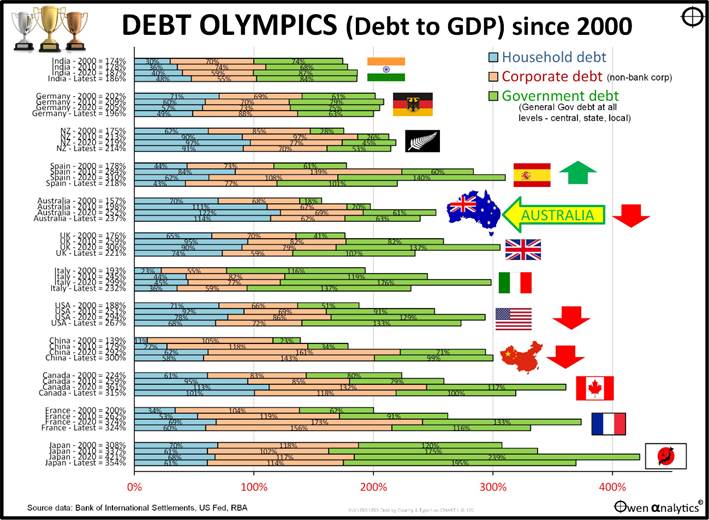
Sensational headlines this week - Australian government debt hitting A$1 trillion and the US hitting $40 trillion! But how serious are they really? Here is an update of my ‘Debt Olympics’ chart showing all levels of debt (government, corporate, household) since 2000.
Click to enlarge
The chart shows gross debt as a percentage of national income (GDP) for a dozen major peer countries. Each country has four bars:
- The top bar is the debt levels in 2000 – at the top of the late 1990s tech boom
- 2010 – after the debt-build-up in the 2000s credit boom, and the hand-outs and bailouts in the GFC,
- 2020 – after the government deficit spending binges and bailouts in the Covid lockdown recession,
- Latest – the most recent data
Each bar has three sections representing the main types of debt:
- household debt (blue),
- non-bank corporate debt (pink), and
- government debt, including all levels of government (green).
Australia
Australia has one of the lowest overall debt burdens in the world. Of our major country peers, only India, Germany, NZ and now Spain are lower. (Also lower, but not on the chart are: Türkiye, Indonesia, Mexico, Poland, Argentina, Saudi Arabia, Hungary, Chile and Brazil.)
Although we have relatively low levels of debt overall, our mix of debt is very different to our peers and therein lie some real challenges for Australia.
Our government and corporate debt levels are relatively low, but household debt is the highest (only Switzerland is a fraction higher).
Government debt
Australia had virtually no federal government debt going into the GFC, but the government quickly racked up debt to finance the GFC deficit spending sprees. Government deficits were reduced back to zero by 2019 but soared again to fund the Covid deficit spending sprees.
Other countries everywhere also racked up debt in the GFC and Covid, but Australia’s government debt levels are still the lowest in the world (even including state debts), thanks to windfall mining tax revenues in the long post-2001 mining/China boom.
Australia’s Federal government gross debt of A$1 trillion is actually LOW in historical terms (it only seems BIG because of inflation). It is also relatively LOW in world terms at just 34% of GDP.
Historically, our problem with government debt has been the STATES. Currently, State and Local government debts add another $820 billion, bringing total government debts in Australia to A$1.8 trillion, or 63% of GDP. This is still among the LOWEST in the world. (Also lower than Australia but not on the chart are: Russia, Türkiye, Luxembourg, Switzerland, Denmark, Sweden, Ireland, Chile and Netherlands.)
New Zealand also remains a fraction lower than Australia. NZ has fewer levels of government, no upper house, but also has none of Australia’s windfall mining revenues.
Corporate debt
Corporate debt levels in Australia have shrunk (relative to GDP) in recent years. The big banks used to specialise in business lending, but since the GFC and Hayne Royal Commission they have retreated and are now little more than bloated building societies lending mainly on housing. They much prefer mortgage lending over business lending because it requires half the capital and a fraction of half the brains.
The low level of corporate borrowing is a real policy problem for Australia. Companies are the engine room for employment, productivity, and economic growth, but the big dinosaur banks have long since lost the skill and will to lend to business.
There is a booming new industry in ‘private credit’ (also called ‘private debt’), including direct lending by industry funds.
‘Private debt/credit’ is just a fancy name for 'non-bank lending'. This is being done without the equity buffer of bank balance sheets, without scrutiny or regulatory supervision, without the strict disclosure rules that apply to banks, and without the credit management systems, collections, and work-out skills the banks used to have.
It will take decades for the new ‘private credit/debt’ industry to get up to the standard the big banks once had. (Spoiler alert: lending money is easy; pricing for risk and getting the money back in a recession is a lot harder! Most local funds have highly concentrated exposures to the property development / construction sector. Big losses are on the way in the next recession.)
Household debt
Australia is the perennial winner of the wooden spoon for the highest level of household debt relative to national income (only Switzerland is higher). Well before the GFC, Australia had the highest levels of household debt in the world and has increased its ‘lead’ even further since then.
Our high household debt levels, combined with the fact that the majority is on floating interest rates, makes Australian households (and the overall economy) more sensitive than any other country monetary policy based on short term interest rates.
Why don’t we have the CHEAPEST housing and LOWEST housing debt in the world, instead of the highest?
Australia should have the most affordable land and housing in the world for three reasons:
- We have the sparsest population in the world (ie we have the most land per person: an average of 298,000 square metres, or 74 quarter-acre blocks, per head of population). True, much of the land is uninhabitable, but Australia’s habitable land ratio is the highest in the world, higher than Norway, Canada, and Japan.
- We have an abundance of cheap building materials (dirt, rocks, timber, iron ore and coal for steel, bauxite for aluminium, silicon for glass, copper, nickel, lithium, lead, tin, etc).
- We have giant, lazy, well-capitalised banks that do almost nothing but lend on housing! (actually, therein lies a big part of the problem).
But somehow, we have the most expensive housing in the world, propped up by the highest levels of household debt in the world.
Fortunately for highly indebted borrowers, house prices have been kept relatively high by strong demand (mainly from immigration) and by intractable supply constraints (‘NIMBYs’, local councils, and high taxing state governments).
A looming housing /debt crisis? Probably not yet
As long as house prices are kept relatively high (thanks to immigration, NIMBYs, and property taxes), and unemployment remains below say 10% (unemployment reached 10.4% in the early 1981-3 recession, 10.9% in the 1990-1 recession, but only 5.8% in the GFC), another widespread housing / foreclosure / bankruptcy crisis is unlikely here in the current cycle.
Property developers / builders will be hit hard (private credit funds), but banks and housing should hold up relatively well. Banks are much better capitalised now than in prior property collapses (1890s, mix-1970s, early 1980s, early 1990s, and a large majority of regular housing borrowers have relatively low Loan-to-Value ratios thanks to inflation.
Debt per se is NOT a problem – BUT…
Although debts in almost all countries are still well below their historical peaks, there are three big problems with the current trend for deficits and debts:
(1) First – Deficits and debts are heading toward levels in WW1&2 and the 1930s Depression, but we are not in all-out war nor depression. Economies are not even in mild recession, so there is no economic need to run deficits.
Actually, the cause-effect relationship is the reverse: economies are effectively on life support, reliant on continuing deficit spending for growth. Reining in the current deficits would probably send many economies into recession.
(2) Debt is good, but only if it builds long-term productivity capacity that generates additional revenues greater than the interest bill on the debt. However, much of the recent increases in debt are being used for current spending, subsidies, hand-outs and uneconomic political pet projects to appease populist demands and buy votes.
Australia’s additional problem is our huge pile of relatively unproductive HOUSEHOLD debt from decades of failed housing policies at all levels of government.
(3) Governments have abandoned any sense of fiscal responsibility. They no longer aim to ‘balance the budget’ over a cycle. Instead they are resorting to 1950s-style ‘financial repression’ to suppress interest rates to use inflation to inflate away debts.
The US drives world markets and the race to financial repression is accelerating in real time at the moment. Rather than cut spending, Treasury Secretary Bessent is ramping up bond buying to suppress rates at the long end while Fed Chair Warsh is keeping rates low at the short end.
Inflation is not an unintended consequence of monetary and fiscal policy mis-steps. It is a deliberate policy outcome!
The biggest winners from inflation are geared-up asset owners. Trump may not know much, but that is one fact that he clearly understands, as he has been a geared-up asset owner benefiting from inflation all his life! The best way to increase inflation is to start a drawn-our war in the Middle East, so that’s exactly what he did!
Ashley Owen, CFA is Founder and Principal of OwenAnalytics. Ashley is a well-known Australian market commentator with over 40 years’ experience. This article is for general information purposes only and does not consider the circumstances of any individual. You can subscribe to OwenAnalytics Newsletter here and read the full article here.