Register For Our Mailing List

Register to receive our free weekly newsletter including editorials.

Home / 671

CGT reform and fund turnover: who really feels the impact?

The proposed capital gains tax (CGT) reforms announced in the Federal Government’s recent budget represent more than a simple change in tax mechanics. They alter the value of one of the most important advantages available to long-term investors: the ability to convert nominal gains into concessionally taxed capital gains.

Today, investors benefit from a 50% discount on gains realised after a 12-month holding period. However, under the proposed framework, that discount would be replaced by inflation indexation, meaning only the inflation-adjusted portion of a gain would be exempt from tax.

At first glance, both systems appear to reward long-term investing. In practice, however, the economics are quite different. The current regime rewards patience with a fixed 50% discount regardless of market conditions, while the proposed system ties the benefit directly to inflation. As a result, the current regime would produce superior after-tax outcomes in almost all instances, other than in an environment where inflation is high over a sustained period.

The key question for investors is therefore not simply whether taxes increase, but which investment strategies are most exposed.

Turnover: the hidden driver of tax outcomes

Portfolio turnover- the degree to which asset managers buy/sell assets in any given year - can have a significant impact on investment performance and tax outcomes. The reason? CGT is only payable on realised gains whereas unrealised gains continue to compound tax-free, creating a valuable deferral benefit for investors.

Let’s consider how two funds delivering identical pre-tax returns can produce very different after-tax outcomes, depending on how frequently gains are realised. The table below illustrates the proportion of gains assumed to be realised from positions held for less than, and more than, 12 months across different turnover levels.
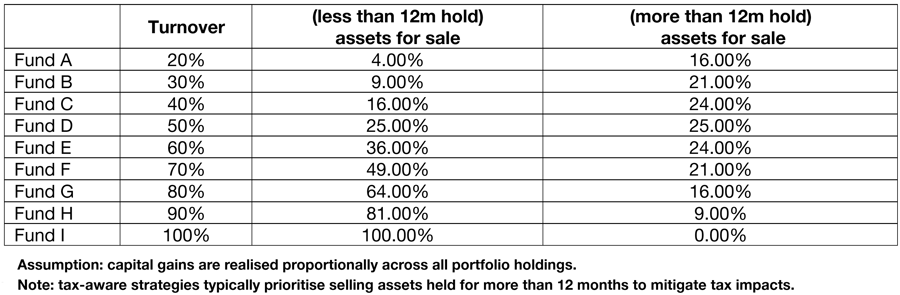
Consider a fund generating a 10% annual return with 20% turnover, a 30% tax rate (proposed minimum CGT) and inflation of 3%.

Only one-fifth of the portfolio return is realised each year. Of those realised gains, a relatively small proportion originates from shorter-term holdings and is fully taxable. The remainder comes from assets held for longer than 12 months and therefore qualifies for concessional treatment.

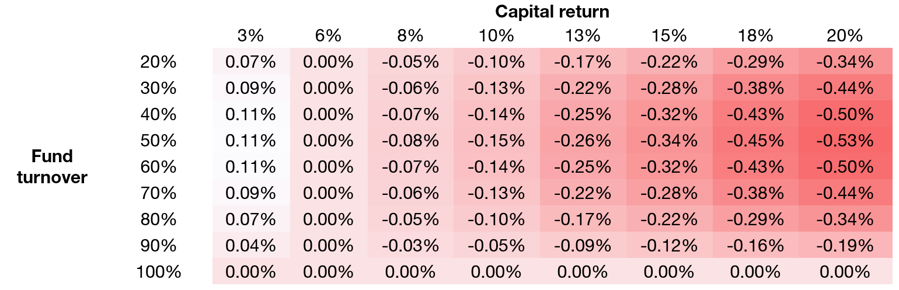
Under the current system, the tax payable on those longer-term gains is approximately 0.24% at the portfolio level. Under the proposed indexed approach, tax rises to around 0.34%. The result is a reduction in after-tax return of roughly 0.10% p.a.

While 0.10% may appear modest, its cumulative impact becomes meaningful over long investment horizons. More importantly, it highlights a broader principle: when investment returns significantly exceed inflation, a 50% CGT discount is substantially more valuable than inflation indexation.

The surprising impact on moderate-turnover funds

The impact of the reform is not linear. One might assume that high-turnover funds would be most affected because they realise more gains. In reality, the greatest impact falls on funds with moderate turnover.
Why? Low-turnover strategies defer most gains and therefore remain largely insulated from any changes to the taxation of realised gains.

High-turnover strategies are also relatively unaffected because a large proportion of their gains are already taxed at full rates. They receive little benefit from the current CGT discount and therefore have less to lose.

Moderate-turnover funds sit in the middle. They realise enough gains to create a meaningful tax liability, yet still rely heavily on long-term holdings that currently benefit from the 50% discount. These strategies enjoy the largest tax advantage under the existing regime and therefore stand to lose the most when that concession is replaced by inflation indexation.

In many cases, the after-tax impact peaks around turnover levels of 40-60%.

Market returns matter just as much

The impact of the reform also depends heavily on the return environment. When returns are close to inflation, there’s little difference between the two systems. In fact, indexation can occasionally be marginally more favourable, because inflation offsets much of the taxable gain.

However, as returns rise above inflation, the gap widens quickly. The current 50% discount becomes increasingly valuable, while the benefit provided by indexation remains fixed by the inflation rate. In other words, the reform matters most when investors are successful.

Strategies delivering strong capital growth are likely to experience the greatest deterioration in after-tax outcomes, particularly when combined with moderate turnover.

Implications for portfolio construction

Turnover remains a key driver of after-tax outcomes, determining the extent to which returns are realised and subject to tax. While the proposed reform doesn’t change this fundamental relationship, it reduces the tax advantage of long-term holdings by replacing the 50% CGT discount with a less generous indexation framework. The effect varies across strategies and is influenced by both turnover and investment returns, becoming more pronounced in stronger market environments. High-return, moderate-turnover strategies appear most exposed, while very high-turnover strategies are comparatively less affected.

From an investor's perspective, only gains accrued post 1 July 2027 are impacted, while existing unrealised gains retain access to the current discount. While our primary focus remains on maximising pre-tax risk-adjusted returns through active allocation and rigorous manager research, tax considerations will increasingly matter in preserving investor wealth.

Overall, tax efficiency is likely to become a more explicit input into manager selection and portfolio construction, alongside risk/return, style, diversification and liquidity.


Ethan Xing, CFA is a portfolio manager (Asset Allocation) at Zenith Investment Partners. This article is general information and does not consider the circumstances of any individual investor.


  •   15 July 2026
  • 18
  •      
  •   
18 Comments
John Graham
July 21, 2026

I agree. I also have a suspicion that the 30% tax rate will apply to the entire realised gain and not only to that part of the gain which accrues after 30 June 2027. If that’s the case, as a low income retiree, I will be realising at least some of my long term gains before 1 July 2027 to take advantage of a lower tax rate.

Wildcat
July 19, 2026

I think the biggest lie every uttered by a politician was that "this budget is about generational inequality and this budget seeks to fix that", Jim Chalmers 2026. (excuse me if not 100% verbatim correct, I couldn't be bothered to look it up as I'm still sickened by these comments).

Neville Chamberlain seemed to have known more about what was going on than Jimbo. Does anyone know he's actually doctor?? I'm assuming of spin.

Once again the young are being shafted by the tax, transfer and welfare system. 30% minimum tax equates to ~$200k as a flat tax. You have no application of the 30% if you are in receipt of $1 of transfer payments (aged pension).

The young are locked out of the property, resort to shares and crypto and the government are now pulling up the ladder.

15
PeterTaylor
July 19, 2026

The bricklayer policeman earns 18K tax free.
The investor now pays 30% min from the first dollar rather than at the marginal tax rate like the policeman. Is that what treating earning from labor and investment the same looks like to our goverment.

10
Kate
July 17, 2026

@Tom Newton
You are mixing up two concepts:
1. CGT 'discount' after only 12 months - that was always too generous. We'd need serious hyperinflation to justify the simplification a 50% discount in 12 months was trying to achieve. I haven't seen anyone argue with removing that.
2. The CGT floor of 30%, regardless of circumstance. It's targeting people who are too 'rich' for welfare, but not so rich they are in the 30% marginal tax rate. It means that you are now making people pay more tax than a bricklayer, a policeman or nurse, as they at least get progressive tax rates and pay 0 tax on the first $18k.

Wanting to keep Australia's progressive tax system is not the same as wanting a different concession.

5
John
July 18, 2026

Hi Kate, the “discount"component is widely misunderstood, partly having to do too much work as shown in table below, and partly being based on shares more than property. Ralph has certainly argued for it’s continuation, as you would expect, and based on the underlying assumption of shares being held around four years and property 10 years, it does a reasonable job, achieved the Asprey Committee’s desire for simplicity Interestingly, Henry did not propose a minimum tax rate, certainly considered CGT tax rate required to be below wages rates, retained negative gearing but considered a 40% discount could be considered in a wider review.

CGT/Indexation Component Items Keating Ralph
30% Minimum No No
Negative Gearing Yes Yes
Indexation Process Messy Discount -Simple
Wages/CGT same tax rate Yes Discount Component-Incentive
Averaging 20%/ Five Years Discount component
Symmetry -Real gains/losses No Discount component
Double Tax -Undistributed Profits Yes Discount component

Obviously, or in fact not so obviously, the two systems have major and important differences and should have been the subject of disclosure, explanation for changes, and the basis of an election outcome. The 30% minimum and loss of averaging are indefensible, in my opinion.


3
PeterTaylor
July 19, 2026

Yes. Journalists fail to ask if the intention was to make earnings from investment and labour the same then why are capital gains taxed from the first dollar at minimum 30% rather than at marginal tax rates as labour is taxed.
Deferred spending in the form of capital gains is taxed more harshly than earnings from labour.

8
Bill
July 21, 2026

The current system sought to include capital gains along with other income and tax it at the recipient's normal tax rate. The 50% discount was a reasonable attempt to account for inflation and recognize the unfairness of taxing the capital gain as though it had all been earned in the one year. The 50% discount was also an attempt to avoid the complexity of calculating the tax in terms of consumer price index changes from year to year. The government's new proposal seems to unnecessarily complicate what was a reasonable system.

1
Technical
July 16, 2026

I wonder whether there is any commentary on the effect of active managers / high turnover funds and impact on after tax investment returns to an individual investor, factoring in the 30% minimum tax on indexed capital gains from 1 July 2027?

4
Tom Newton
July 17, 2026

I love the CGT and negative gearing tax changes.
They provide a disincentive to flip, be it property or shares.
I could never understand why a bricklayer, a policeman or nurse had to pay tax on every dollar, while a share trader only paid tax on half his income.
Good bye speculators. Get a real job.

1
Dudley
July 17, 2026


"I could never understand": inflation.

"bricklayer, a policeman or nurse": wages increase in excess of it and set it.

"share trader": has no capital gains. Pays full whack.

Share investor (12 months+) capital is eroded by inflation and taxation.

9
Paul Smith
July 17, 2026

CGT discount is only after holding 12 months.
A tax-free threshold exists for income.
Share traders are a business like any other.
Flipping shares from an IPO after 12 months is only a strategy you could imagine, and not flipping
Flipping an existing property without renovation is uncommon and not speculation

3
James#
July 18, 2026

"I could never understand why a bricklayer, a policeman or nurse had to pay tax on every dollar, while a share trader only paid tax on half his income. Good bye speculators. Get a real job."

Perplexing sentiment and glaring inaccuracies aside, the changes to CGT are egregiously bad and discriminatory.

Why? Because they completely deny a citizen who has chosen to INVEST (at risk of loss) his/her after tax income, both the tax free threshold and the first lowest marginal (15%) tax rate available to every other citizen in our democracy, on income earned.

Almost every other country recognises that after tax income invested should be taxed more lightly than income from work out of fairness, and to encourage investment in productive enterprises. Government should also encourage savings and investment to build a more self reliant, resilient population and decrease the reliance on governmental support.

Australia now has the highest marginal CGT in the world, punishing savers. Well done!

17
Wildcat
July 19, 2026

You are kidding right?? A policeman or a nurse are not at risk of negative income (ie having to pay to show up) but an investor has that risk. Secondly gains are taxed in the year of disposal not calculated as if it was earned. This is equivalent to a nurse earning $100k being taxed only in year 5 at $500k. This is $88k (on the $500k) more tax as it was a capital gain. Lastly a part time nurse does not pay a minimum tax of 30%. You don't pay an average rate of 30% on income until you have earned $200k.

None of this is equitable nor fair.

I'm not saying the current system shouldn't have been changed but pendulum has swung completely and unfairly, especially for the young.

13
Ben
July 19, 2026

Tom,

People earn income and pay income tax on that. They invest that money which they have already paid tax (their after tax income) once through the system and pay capital gains tax.

Companies earn money and pay corporate tax on profits. If they retain earnings and invest it they also pay capital gains tax on any capital gains at a rate of 30%. If profits are distributed to shareholders then tax is paid at the marginal tax rates, the same as income.

In all scenarios, tax is paid the first time the money is made by the individual or the company. Nearly all countries tax capital gains less than labour because they understand capital is important to growing an economy.

Taxing capital gains is not the same as taxing income because tax has already been paid once in both scenarios. Those who save are facing a real disincentive in this country now. People might save and invest for various reasons, to start a business or to support their children or pay for their retirement. Arguably the highest capital gains tax rates in the world are a disincentive for hard work, saving and starting a business etc.

In the next 10 years, by 2035 the interest on federal government debt is expected to cost more than spending on NDIS or defence.

This is why we have these tax changes to increase government revenue.The government has a debt problem it’s trying to solve by raising taxes on people who save and invest. We are arguably going to become a poorer nation because of this. The government will continue to take more money out of the economy to pay for interest repayments.

10
Joachim
July 22, 2026

The government is not taxing your already taxed investment dollars. That stays untouched. Rather, the government is taxing the proceeds earned by that initial investment. To say otherwise demonstrates a lack of understanding of taxation or is deliberately misleading.

I'm a retiree and I acknowledge how much my cohorts relies on younger workers to pay for the services we need. I'm glad the government has made these changes. Are they perfect? No. But they are important steps in the right direction and are much better than the tax system that existed before May which had more holes than swiss cheese. It's time older people paid more for their own upkeep than whacking younger people who have their own problems to deal with.

Steve
July 19, 2026

Tom,
Genuine (share) traders are carrying on a business and as such are outside the scope of capital gains tax regime. If an individual, they are taxed at progressive rates just like your bricklayer, policeman and nurse.

3
Kate
July 22, 2026

Another complication is that international funds (not domiciled in Australia) report capital gains according to the tax laws in their country. This may not include inflation adjustment of the cost base.


Leave a Comment:

RELATED ARTICLES

The benefits of low turnover for after-tax outcomes

Budget tax changes only scratch the surface. Here are 4 reforms Australia needs next

The lesser-known effects of changed property taxes

banner

Most viewed in recent weeks

The strange effect of the 30% minimum capital gains tax

The 30% minimum tax on capital gains sits at the heart of the budget's proposed reforms. Yet the mechanics reveal anomalies that introduce unexpected distortions that raise questions about its design.

Does your will qualify for the discretionary testamentary trust exemption?

Treasury has confirmed the exemption many families were hoping for. But buried in the fine print are two conditions that could leave some wills on the wrong side of the exemption, despite years of careful planning.

Ranking three common retirement strategies

The defining challenge of retirement isn't just about building wealth, it's about converting your lifetime savings into sustainable income. A holistic understanding of different strategies can improve long-term outcomes.

Are you making these SMSF mistakes?

After four decades advising investors, there are a few common mistakes I've seen SMSF investors make. From holding too much cash and chasing yield to overtrading and trusting tips. Are these errors costing you?

Why Australian shares are falling behind the world

Australia’s market boasts a long record of outperformance, but recent results tell a different story. Is the ASX’s lagging performance a temporary setback or evidence that structural forces will keep global markets ahead?

Australia has saved $4.5 trillion for retirement. Here's what matters more

Most Australians approaching retirement can tell you the exact dollar value of their super account. But success depends on more than a sizeable balance. Here's four key questions to ask yourself at the start of the financial year. 

Latest Updates

Investment strategies

UniSuper CIO shares his reflections on the 2025-2026 financial year

Markets climbed a wall of worry in FY26, but artificial intelligence remained the dominant force, rewarding some of the world’s biggest companies while leaving others behind.

Planning

Post-Budget blues? A knee jerk won’t help

Sweeping tax changes are reshaping the investment landscape and many investors are considering major restructures. But before chasing lower tax bills, it's worth asking whether those decisions will strengthen—or undermine your ability to build wealth across generations.

Investment strategies

Is value investing still relevant in today’s stockmarkets?

Is value investing relevant in an age when momentum investing, quant strategies and index funds increasingly dominate markets? It is underappreciated how share price distortions may be creating some of the best opportunities for patient, disciplined investors.

Investment strategies

How to find opportunity in global equities

Australia's concentrated market makes global diversification essential, but breadth alone is not enough. Investors still need a disciplined framework combining business quality, sensible valuation and a credible catalyst.

Gold

What keeps the world’s most patient investors returning to gold

While many investors are asking whether gold has peaked, the world's central banks appear to be asking different questions altogether. Their thinking offers useful insights for long-term investors.

Investment strategies

Don’t underestimate Australia

Investor sentiment towards Australia has turned increasingly gloomy, but the data tells a different story. There are still plenty of reasons to remain optimistic.

Superannuation

Are you making these SMSF mistakes?

After four decades advising investors, there are a few common mistakes I've seen SMSF investors make. From holding too much cash and chasing yield to overtrading and trusting tips. Are these errors costing you?

Sponsors

Alliances

© 2026 Morningstar, Inc. All rights reserved.

Disclaimer
The data, research and opinions provided here are for information purposes; are not an offer to buy or sell a security; and are not warranted to be correct, complete or accurate. Morningstar, its affiliates, and third-party content providers are not responsible for any investment decisions, damages or losses resulting from, or related to, the data and analyses or their use. To the extent any content is general advice, it has been prepared for clients of Morningstar Australasia Pty Ltd (ABN: 95 090 665 544, AFSL: 240892), without reference to your financial objectives, situation or needs. For more information refer to our Financial Services Guide. You should consider the advice in light of these matters and if applicable, the relevant Product Disclosure Statement before making any decision to invest. Past performance does not necessarily indicate a financial product’s future performance. To obtain advice tailored to your situation, contact a professional financial adviser. Articles are current as at date of publication.
This website contains information and opinions provided by third parties. Inclusion of this information does not necessarily represent Morningstar’s positions, strategies or opinions and should not be considered an endorsement by Morningstar.