Register For Our Mailing List

Register to receive our free weekly newsletter including editorials.

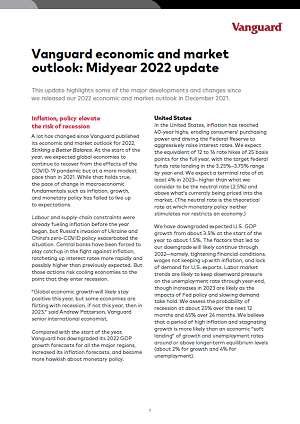
Economic and market outlook: Midyear 2022 update

Inflation, policy elevate the risk of recession

A lot has changed since Vanguard published its economic and market outlook for 2022, Striking a Better Balance. At the start of the year, we expected global economies to continue to recover from the effects of the COVID-19 pandemic but at a more modest pace than in 2021. While that holds true, the pace of change in macroeconomic fundamentals such as inflation, growth, and monetary policy has failed to live up to expectations.

Labour and supply-chain constraints were already fueling inflation before the year began, but Russia’s invasion of Ukraine and China’s zero-COVID policy exacerbated the situation. Central banks have been forced to play catchup in the fight against inflation, ratcheting up interest rates more rapidly and possibly higher than previously expected. But those actions risk cooling economies to the point that they enter recession.

“Global economic growth will likely stay positive this year, but some economies are flirting with recession, if not this year, then in 2023,” said Andrew Patterson, Vanguard senior international economist.

Compared with the start of the year, Vanguard has downgraded its 2022 GDP growth forecasts for all the major regions, increased its inflation forecasts, and become more hawkish about monetary policy.

Download the full paper here
 

  •   28 July 2022
  •      
  •   


Leave a Comment:

banner

Most viewed in recent weeks

Little‑known government scheme can help retirees tap into $3 trillion of housing wealth

The Home Equity Access Scheme in Australia allows older homeowners to tap into their home equity for retirement income, yet remains underused due to lack of awareness and its perceived complexity.

Origins of the mislabeled capital gains tax ‘discount’

Debate over the CGT discount is intensifying amid concerns about intergenerational equity and housing affordability. This analysis shows that the 'discount' does not necessarily favor property investors.

2 billion reasons to fix retirement income

A proposal to address Australia's 'stranded balances' in retirement by requiring super funds to transition members to pension phase at 65, boosting retirement income and reframing super as a source of income.

The ultimate superannuation EOFY checklist 2026

Here is a checklist of 28 important issues you should address before June 30 to ensure your SMSF or other super fund is in order and that you are making the most of the strategies available.

Div 296 may mean your estate pays tax on assets your beneficiaries never receive

The new super tax, applying from 1 July, introduces more than just a higher rate on large balances. It brings into focus a misalignment between where wealth sits and where the tax on that wealth ultimately falls.

Do super funds need a massive wake up call?

UK retirement expert, Guy Opperman, believes super funds are failing at supporting members in deaccumulation. Here is what Australia should do about it. 

Latest Updates

Retirement

How inflation is quietly moving the goalposts on retirement

Inflation doesn’t just raise today’s bills - it quietly increases the amount needed to retire, while simultaneously making it harder to save. Three steps to take before June 30th to improve retirement outcomes.

Investment strategies

Three strategies for investing amid AI whiplash

AI fears have shifted from bubble talk to disruption anxiety, driving investors toward asset-heavy, 'AI-resistant' businesses while punishing many software and service firms. This environment may be ripe for stock pickers.

Investment strategies

Are private market assets the answer in an unstable world?

Private markets can offer diversification and return potential, but their opacity, scale and wide dispersion of outcomes make manager selection and due diligence critical for non‑institutional investors.

Property

Mispriced in plain sight: The case for Global REITs

Global REITs have fallen out of favour, trading at deep discounts after years of underperformance, despite resilient earnings and improving fundamentals.

Investment strategies

Survival is the only success

True financial success isn’t about how much you make, but whether you can sustain it — survival is the only win that matters.

Investment strategies

$42 billion too late

Why Australia's biggest energy bet may already be redundant while a less celebrated government program is exceeding expectations. 

Investment strategies

Do investors accept lower returns from assets that make them feel good?

Assets that deliver emotional satisfaction tend to offer lower financial returns, as investors accept an “emotional yield” in place of performance which shapes how investors approach ESG and unpopular assets.

Sponsors

Alliances

© 2026 Morningstar, Inc. All rights reserved.

Disclaimer
The data, research and opinions provided here are for information purposes; are not an offer to buy or sell a security; and are not warranted to be correct, complete or accurate. Morningstar, its affiliates, and third-party content providers are not responsible for any investment decisions, damages or losses resulting from, or related to, the data and analyses or their use. To the extent any content is general advice, it has been prepared for clients of Morningstar Australasia Pty Ltd (ABN: 95 090 665 544, AFSL: 240892), without reference to your financial objectives, situation or needs. For more information refer to our Financial Services Guide. You should consider the advice in light of these matters and if applicable, the relevant Product Disclosure Statement before making any decision to invest. Past performance does not necessarily indicate a financial product’s future performance. To obtain advice tailored to your situation, contact a professional financial adviser. Articles are current as at date of publication.
This website contains information and opinions provided by third parties. Inclusion of this information does not necessarily represent Morningstar’s positions, strategies or opinions and should not be considered an endorsement by Morningstar.