I recently wrote an article about why your super isn’t going to be enough. Part of the reason that you’re likely underestimating how much you need in superannuation is that it’s based on a best guess or other people’s circumstances. Most people don’t come up with a personalised estimate based on the vision you have for your retirement or your likely future expenses.
This is understandable. It is a difficult task to imagine how much you’ll need in the distant future. It is multiple decades for some of us. For instance, I have around three decades before I hang up my keyboard.
Just because something is difficult doesn’t mean it isn’t worthwhile. As you move through life you can refine your goal as retirement gets closer. Creating an initial estimate and refining as you have more clarity is much more helpful than relying on articles showing average super balances by age.
The average super balance for a particular age is particularly disconnected from what an individual should have in super. It does not reflect any of your circumstances or whether you’re on track to have a comfortable retirement. I run through an exercise to estimate how much I should have in each decade, and the disparity with the average super balance, and the recommended balance from ASFA.
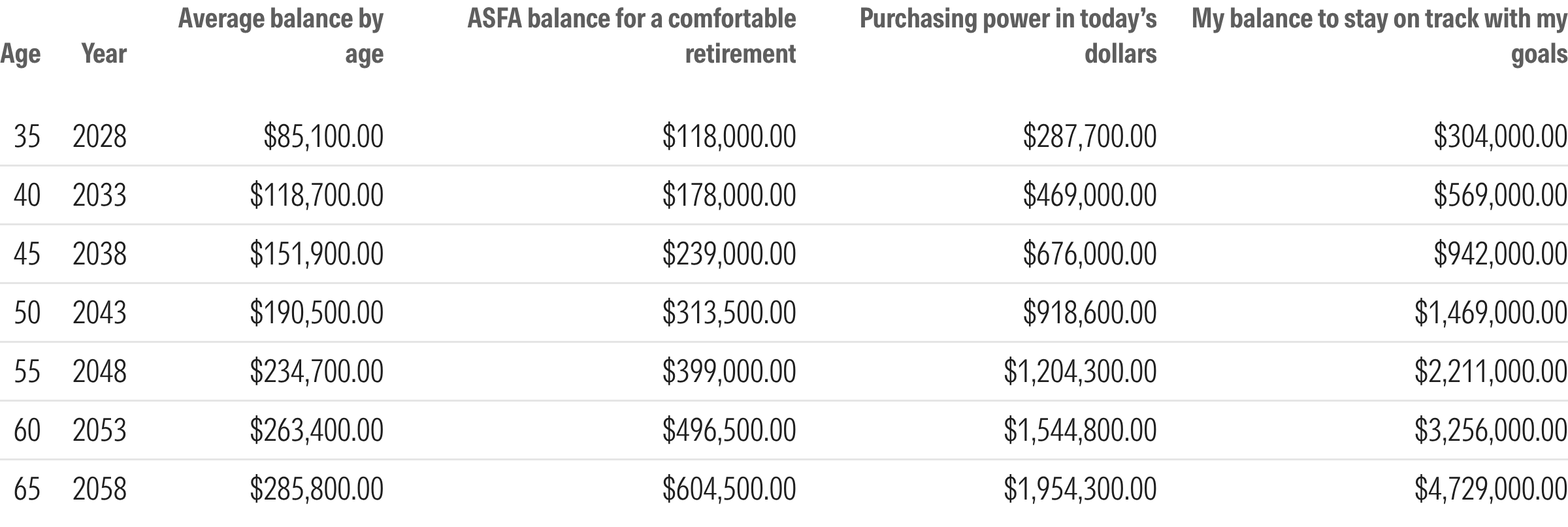
Source: APRA, ASFA and author’s own calculations
I encourage you to go through this exercise yourself. It’s important to spend some time thinking about the variables that go into the calculation.
My circumstances
I have estimated that I need an average of $75,000 in today’s dollars per year in retirement. This is a goal with two pathways. One path – the one I will explore today – I have purposely kept separate with my husband’s. I know I want to enjoy my retirement with him, and we will have a much more comfortable retirement with our combined balances. However, it is important to me that I maintain financial independence and have enough to support myself regardless of what happens in the multiple decades until retirement.
I have assumed in this scenario that my mortgage is paid off. Using the 4% rule, the balance I will need for my portfolio is $1,875,000 in today’s dollars (a future value of $4,485,195 in 2058).
Age
33 years old, with 32 years until fully accessing superannuation. These are the funds that I will use at age 65 when I am able to fully access my superannuation and set up a pension.
It does not include my Transition-To-Retirement plans or structuring. I have a separate financial goal with investments outside of superannuation to assist with transitioning out of full-time work prior to 65. This is supplemental to the $75,000. Think about your goal and when you are likely to access your retirement savings.
Retirement balance
$221,000. This is my superannuation but include any other accounts that will contribute to your retirement.
Contributions to superannuation per year (employer and salary sacrifice):
$27,000, or $23,000 after the 15% contributions tax. This will be all contributions to superannuation, after tax.
Projected returns in superannuation
Based on my asset allocation I’m estimating a projected return of 7.1%, after the 15% tax on earnings.
Inflation rate
Inflation should be included in any estimate of retirement needs. The inflation estimate doesn’t require a perfect inflation rate. It is about making a reasonable assumption about how your spending is likely to change over the long-term. Your retirement spending will look different from your spending today, and the inflation rate applied to the broader economy may not perfectly reflect your personal experience.
That is why I think it is more useful to focus on the big picture rather than constantly adjusting your retirement target every time the latest inflation number changes. A forward-looking assumption, such as Morningstar’s 2.8% long-term inflation assumption, gives you a consistent starting point for thinking about what your future expenses might look like.
My approach calculates your inflation rate based on your personal circumstances instead of an aggregate basket. However, my ‘basket’ is going to look very different in retirement than it does now. For example – my largest expense – housing – will hopefully be reduced to just maintenance costs as I would’ve paid off the mortgage.
When your personal inflation rate will matter most is when you are managing your portfolio in retirement. Many of us are living for as long as our working lives when we retire. Your spending of your portfolio will directly impact the way you should manage capital, and the returns that you need to manage longevity risk.
Other considerations
Age pension
For my retirement, I want to and expect to be fully funded. Understand whether this will form part of your retirement income. MoneySmart’s calculator will be able to help you.
Spouse
I’ve excluded my husband’s retirement funds from this goal, but it is a personal decision. You may be in a position where there is an age gap between spouses and when superannuation can be accessed. Account for this in your calculations, and how much income is needed from each account.
Changes to circumstance
It is likely that there will be changes to your income over such a long period of time. It is important to account for career breaks where possible and adjust your goal accordingly. I have chosen not to include any salary increases in my calculation until they are realised. I then adjust my goal based on these increases if they happen.
Common ways retirement needs are calculated
There are a few ways that Aussie investors track progress. Back of the envelope checks may be inadequate and contribute to retirement shortfalls. For this piece I’m going to focus on two common methods investors use as a point of comparison:
- Looking at the average balance for their age and using that as a guide. Many people think they are fine as long as they keep up with the age-based bracket amounts as they age. Women are retiring with $380,000 on average.
- Looking at what the industry says. ASFA’s retirement standards says a comfortable retirement can be achieved with $630,000 for a single person who owns their own home.
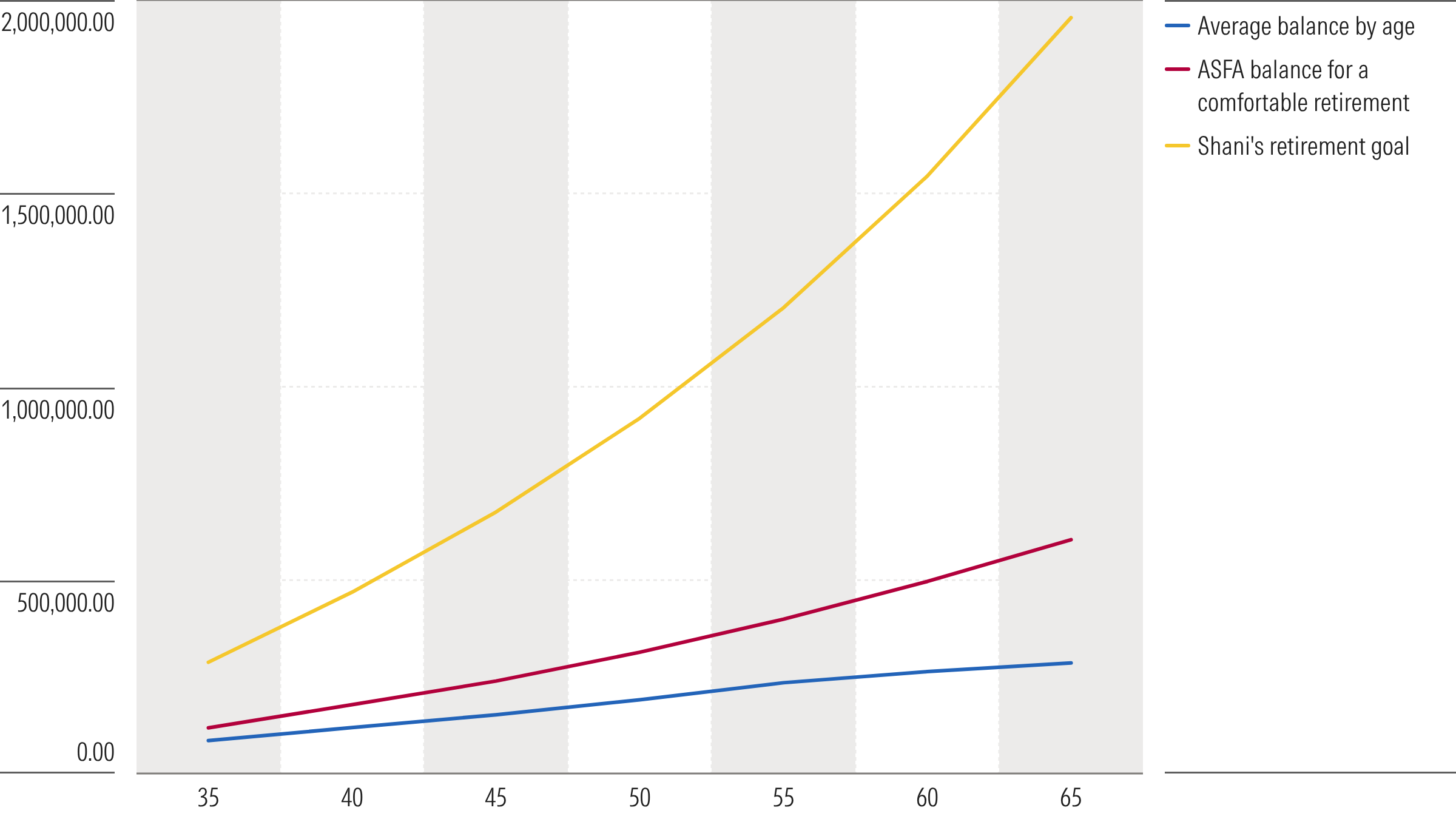
There are issues with these sense checks. None take you or your circumstances into account. The average balance check meaningfully underestimates what many people will need for a comfortable retirement.
Comparison can also leave you discouraged and confused given the different measures of retirement progress. The purpose of measuring what you need in retirement is to give you an actionable goal that informs your decision making. This goal can be adjusted as your circumstances in retirement become clearer. The important thing is that it is specific to you and not based on measures that have nothing to do with your actual spending needs.
Difference in goal balance compared to common methods to estimate retirement needs
Final thoughts
The average balance for your age might give you a point of comparison, and industry benchmarks can provide a useful sense check, but neither tells you whether you are building enough to fund the life you want.
Working backwards from your retirement income goal gives you something much more useful: a target that is based on your circumstances, your spending and the time you have to get there. My target is likely to change as my circumstances do, and yours will too. I may earn more, spend differently, or decide that my retirement looks different from what I imagined at 33.
I have a number that gives me direction, but I know it will change. For me, that means checking in at different points throughout my working life and asking whether my balance, contributions and investment strategy are still moving me towards the retirement I want. That is far more actionable than simply asking whether my super balance is above average.
Shani Jayamanne is Director, Investment Specialist, at Morningstar Australia.