Register For Our Mailing List

Register to receive our free weekly newsletter including editorials.

Home / 656

Indexation implications – key changes to 2026/27 super thresholds

The Australian Bureau of Statistics has released the average weekly ordinary time earnings (AWOTE) and consumer price index (CPI) figures which are used to determine key superannuation rates and thresholds that will apply from 1 July 2026. This article outlines the rates and thresholds that are changing and those that aren’t. It also explains key considerations and opportunities in the lead up to 30 June 2026 and beyond.

Transfer balance cap

The transfer balance cap limits the amount of superannuation that can be used to start a pension, where the investment returns are generally tax free. The transfer balance cap was introduced from 1 July 2017 at $1.6 million and is indexed periodically to the CPI in $100,000 increments.

From 1 July 2026 the transfer balance cap will increase from $2 million to $2.1 million.

Contributions

All key indexed thresholds that impact contribution planning will increase from 1 July 2026.

Total super balance

The value of the general transfer balance cap is used to determine the total super balance threshold which impacts eligibility for making non-concessional contributions and spouse contributions, as well as receiving Government co-contributions. This will increase to $2.1 million from 1 July 2026.

When determining eligibility for contributions, the total super balance is measured at the previous 30 June, not at the time a contribution is made.

Concessional contributions

The concessional contributions cap is indexed to AWOTE in $2,500 increments. The concessional contributions cap will increase to $32,500 from 1 July 2026.

This also impacts the concessional contributions that can be made under the five-year catch-up concessional contribution rules by individuals who have a total super balance at the previous 30 June of less than $500,000. The five-year catch-up total super balance threshold is not indexed.

Individuals who have a total super balance on 30 June 2026 below $500,000 could have a potential a concessional contribution cap of up to $175,000 in 2026/27. This includes the 2026/27 cap of $32,500 and the maximum of $27,500 for 2021/22, 2022/23, 2023/24, $30,000 for 2024/25 and 2025/26. Remember that the current year’s concessional contribution cap is always used before applying any catch-up contributions.

From 1 July 2026, any unused concessional contributions from 2020/21 or earlier will no longer be available to use. This means that 2025/26 is the last year that individuals can use any unused concessional contribution cap from 2020/21.

Non-concessional contributions

The non-concessional contributions cap is calculated as four times the concessional contributions cap. From 1 July 2026 the non-concessional contributions cap will increase to $130,000.

The two- and three-year bring forward limit also increase to $260,000 and $390,000 respectively from 1 July 2026.

The total super balance thresholds for determining eligibility to make non-concessional contributions will change, as outlined in the table below:
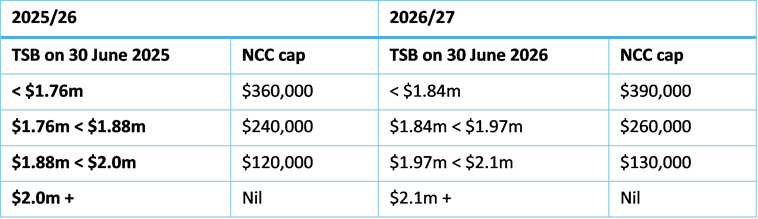
Importantly, the two- or three-year bring forward maximum contribution is based on the non-concessional contributions cap at the time the two- or three-year bring forward is triggered. There is no benefit from indexation in 2026/27 for individuals who triggered a bring forward in 2024/25 or 2025/26.

Example

Oscar triggered the three-year bring forward in 2024/25 by making a $150,000 non-concessional contribution. In 2024/25 the maximum three-year bring forward was $360,000. Oscar can contribute a further $180,000 prior to 30 June 2027 (subject to their total super balance). Oscar doesn’t benefit from indexation of the non-concessional contributions cap during this time.

Thresholds not indexed

The $500,000 threshold for accessing the five-year concessional catch-up contributions is not indexed. In addition, the $300,000 total super balance threshold for determining eligibility for the work test exemption is not indexed.

Historic rates and thresholds

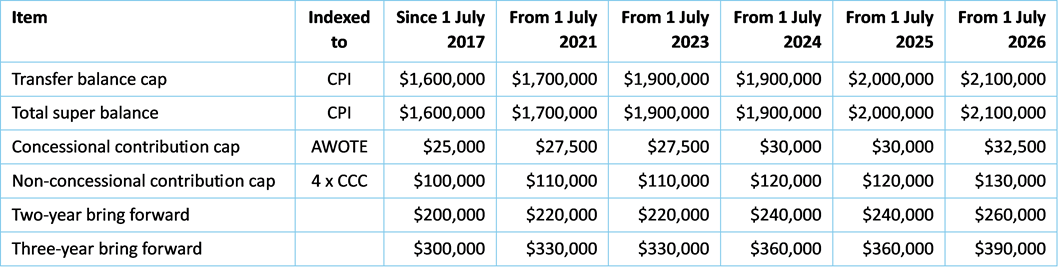
The table below summarises the history of the rates and thresholds:
Summary

The superannuation rules changed dramatically in 2017 and introduced a variety of thresholds that determine eligibility for certain tax concessions and the ability to make contributions. The indexation of the thresholds adds an additional layer of complexity from 1 July 2026. Understanding the additional complexities will assist individuals to maximise the opportunities available within super in both 2025/26 and 2026/27.


Julie Steed is a Senior Technical Services Manager at MLC TechConnect. This article provides general information only and does not consider the circumstances of any individual.


  •   1 April 2026
  • 8
  •      
  •   
8 Comments
Jon Kalkman
April 02, 2026

The Transfer Balance Cap (TBC) is what it says on the label. It is designed to limit the tax concessions flowing to an individual with a super pension fund which means the fund’s investment returns are tax-exempt and so are the mandatory pension payments received by the individual.

It is best seen as a personal allocation. If you started a super fund in 2017 with $1.6 million you have used all of your allocation and you can’t put any more into a tax-free pension fund, but your existing investments have had the opportunity to grow in a tax-free environment over the past 9 years. Your pension balance will be a function of your pension withdrawals and your investment returns. If you take lump sums instead of pension payments, you rebuild your personal TBC allocation.

If you started your pension in 2017 with $1.2 million you have used 75% of your allocation and so you are allowed to use 25% of the standard increase ($2.1 million less $1.6 million, = $500,000) or $125,000. So your allowance in July 2026 is the $125,000 of the increased allowance, plus the unused $400,000 from 2017. Your personal TBC in 2026 is $1,725,000, of which you used $1,200,000 in 2017. Of course you can wait for the standard cap to increase further, but you can only ever use 25% of the increase because you have already used 75% of your personal allocation.

If you haven’t started your pension yet, your whole allocation is still intact and your personal TBC is $2.1 million from July 2026.

If there were no cap, people could keep topping up their pension fund to access unlimited tax-free benefits. The cap makes it fair for everyone.

2
GeorgeB
April 02, 2026

"people could access unlimited tax-free benefits"

Isn't this exactly what people drawing an age pension already do - even if they made zero contribution to the taxes that fund them - note also that they are using their own funds to top up their pension fund not the taxpayers!

Retirement Dr
April 02, 2026

Great article Julie. Thanks for posting. The summary tabel is especially useful.

1
Robert
April 03, 2026

Regarding the table under ‘Non-concessional contributions’, if I’m interpreting it correctly, for the 2025/26 year I can contribute the full $120,000 even if my TSB is say $1.99m at 30 June 2025 and for the 2026/27 year I can contribute the full $130,000 even if my TSB at 30 June 2026 is say $2.095m.

1
Lauchlan Mackinnon
April 02, 2026

Re “ The $500,000 threshold for accessing the five-year concessional catch-up contributions is not indexed.” - it should be!

Paul
April 02, 2026

Tax fee I'm not sure, with the new deeming rates your affectively taxed 50% with lose of pension for any amount in super over 225K now.

Dudley
April 03, 2026


Google: "New deeming rates effectively taxes at 50%?"

'The Age Pension income test reduces payments by 50 cents for every dollar of income over the threshold.'

Abolish Mean Tests.


Leave a Comment:

RELATED ARTICLES

2025-26 super thresholds – key changes and implications

A guide to excess non-concessional super contributions

Understanding the bring forward rule

banner

Most viewed in recent weeks

Want your loved ones to inherit your super? You can’t afford to skip this one step

One in five Australians die before retirement and most have not set up their super properly so their loved ones can benefit from all their hard work and savings. 

Super is catching up, but ageing is a triple-threat

An ageing Australia is shifting the superannuation system’s focus from accumulation to the lifecycle of retirement. While these pressures have been anticipated for decades, they are now converging at scale and driving widespread industry change.

Has Australia wasted the last 30 years?

The 20 years after Peter Costello left Treasury have been deemed wasted...by Peter Costello. The missed opportunities for Australia began long before.  

The 5% deposit scheme is bad for homeowners and Australia

An ‘affordability’ scheme making the county more vulnerable to economic shocks and contributing to the deteriorating financial situation of everyday Australians.

3 ways to defuse intergenerational anger

With the upcoming budget increasingly likely to include bold proposals to alter the tax code I’ve outlined three incremental steps with fewer unintended consequences.

Navigating the next stage of life in retirement

Retirement planning is more than just saving enough money. Long-term care needs, housing choices, and social networks are just as critical for a happy and enjoyable life.

Latest Updates

Superannuation

Indexation implications – key changes to 2026/27 super thresholds

Stay on top of the latest changes to superannuation rates and thresholds for 2026, including increases to transfer balance cap, concessional contributions cap, and non-concessional contributions cap.

Economy

Central banks need higher inflation targets

In a shift away from solely targeting low inflation, central banks are considering raising inflation targets to combat economic challenges, but face potential drawbacks and conflicts in policy implementation.

Exchange traded products

The missing 30%: how LIC returns are understated, and why it matters

The perceived underperformance of LICs compared to ETFs is due to existing comparison data excluding crucial information, highlighting the need for proper assessment and transparent reporting.

Latest from Morningstar

Alpha isn’t dead. You’ve just been measuring it wrong

New research shows smarter portfolio construction—not new factors—is the real edge in the hunt for alpha. However, finding it requires a fundamentally different mindset.

Investment strategies

The diversification illusion: why 'balanced' portfolios may be exposed

Many 'diversified' portfolios are increasingly driven by the same narrow set of forces. As concentration builds beneath the surface, understanding how portfolios behave - not just how they’re constructed - is critical for investors.

Investment strategies

The case for staying the course in credit

Rising oil prices and inflation pushed Australian yields higher. Markets expect further tightening, but weaker growth may reverse rates. Locking income and maintaining duration is a sound strategy for widening credit spreads.

Investment strategies

One risk after another

Investors often focus on front-of-mind risks, reacting to each headline event without considering long-term impacts. Cass Sunstein and Timur Kuran define this as an "availability cascade," affecting financial decision-making.

Sponsors

Alliances

© 2026 Morningstar, Inc. All rights reserved.

Disclaimer
The data, research and opinions provided here are for information purposes; are not an offer to buy or sell a security; and are not warranted to be correct, complete or accurate. Morningstar, its affiliates, and third-party content providers are not responsible for any investment decisions, damages or losses resulting from, or related to, the data and analyses or their use. To the extent any content is general advice, it has been prepared for clients of Morningstar Australasia Pty Ltd (ABN: 95 090 665 544, AFSL: 240892), without reference to your financial objectives, situation or needs. For more information refer to our Financial Services Guide. You should consider the advice in light of these matters and if applicable, the relevant Product Disclosure Statement before making any decision to invest. Past performance does not necessarily indicate a financial product’s future performance. To obtain advice tailored to your situation, contact a professional financial adviser. Articles are current as at date of publication.
This website contains information and opinions provided by third parties. Inclusion of this information does not necessarily represent Morningstar’s positions, strategies or opinions and should not be considered an endorsement by Morningstar.