Register For Our Mailing List

Register to receive our free weekly newsletter including editorials.

Home / 686

Is the US market as expensive as CAPE says?

This article is the first in a new mini-series, Eight Temptations of Market Lore, which explores popular investing rules of thumb and the pitfalls that can accompany them.


Before there were seven deadly sins, there were eight temptations. In the fourth century, the monk Evagrius Ponticus listed eight thoughts that lead people astray. Two centuries later, they evolved into the seven deadly sins.

Markets have their own temptations. This series covers eight popular shortcuts that investors reach for because they are easy to use. They are not naive rules. Many were developed by serious thinkers and hold real insight. But each rests on an assumption that is easy to miss, and costly when it fails.

Shiller’s famous CAPE ratio

Robert Shiller’s book Irrational Exuberance made the cyclically adjusted price-to-earnings ratio, or CAPE, famous.

CAPE fixes a problem with the ordinary PE ratio. A single year of earnings can give the wrong signal about value, because profits swing with booms and busts. CAPE instead divides the share price by the average of the past ten years of inflation-adjusted earnings to cover a full business cycle. The idea came from Benjamin Graham, who in 1934 advised averaging earnings over seven to ten years.

Shiller’s timing was uncanny. His book was published in March 2000, the month the Nasdaq peaked. CAPE had just hit a record of about 44, and US shares went on to suffer a lost decade. In 2013, he shared the Nobel Prize in economics. With a track record like that, it is easy to trust his measure. I have been tempted by it myself.

Today the S&P 500’s CAPE sits near 41. That is higher than before the 1929 crash, and second only to the dot-com peak. On that measure, US shares look very expensive.
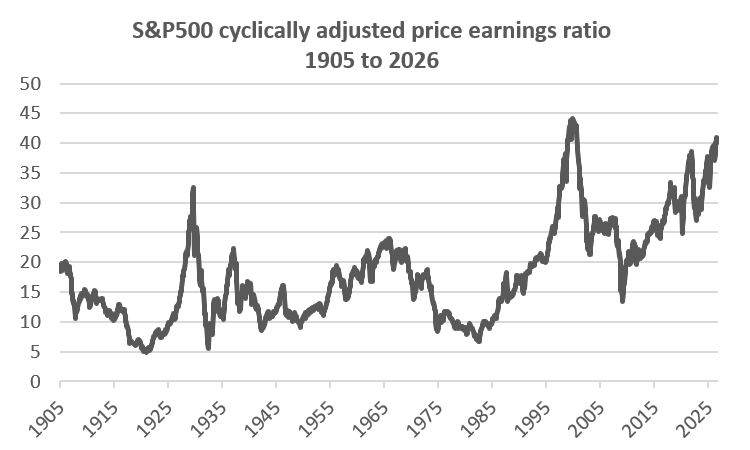

Source: Robert Shiller

But the ten-year average that solves one problem creates another. It assumes the past decade is a fair guide to normal profits. If today’s earnings sit well above that average, CAPE treats the gap as a boom that will fade.

The gap can close in two ways. Margins can fall back, and CAPE is proved right. Or margins stay high until ten years of higher earnings pass through the average, and CAPE falls without prices falling. But if margins keep rising, the gap never closes, and CAPE keeps overstating how expensive shares are.

Margins have structurally shifted
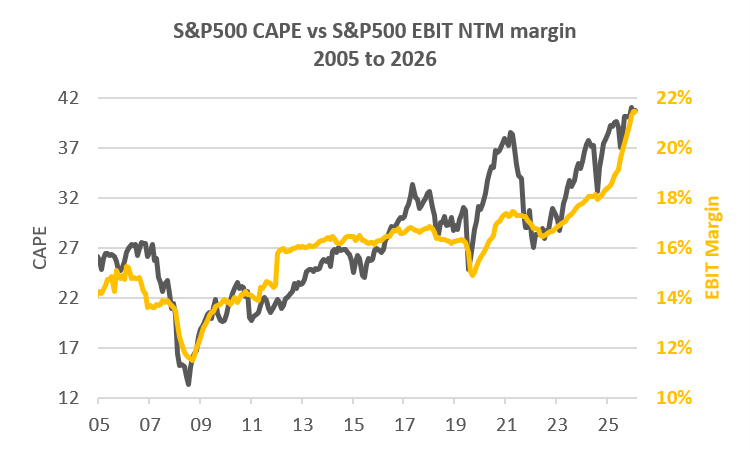

Source: FactSet, Robert Shiller

Since 2005, the S&P 500’s operating (EBIT) margin has risen from about 14% to just under 22%, and CAPE has moved closely with it. The two fell together in the GFC and climbed together through the 2010s. Today they sit together at their highs. Rather than returning to its long-run average, CAPE has followed profitability. In other words, the market looks expensive on CAPE partly because it has become more profitable.

For investors who followed CAPE, this shift was costly. As margins rose, the ten-year average lagged. The market looked expensive year after year, so CAPE signalled low returns for a decade that never came. Earnings kept compounding instead.

The exception was 2021. CAPE surged to about 38, while margins only recovered to their pre-COVID level of about 17%. For once, prices had run ahead of profits. It was a smaller echo of the 1999 tech boom, with heavy speculation in unprofitable companies, SPACs and meme stocks. CAPE and prices fell back in 2022, when the S&P 500 dropped about 19%.

Why have margins risen? Much of it reflects the index’s changing mix. Technology and tech-related companies make up close to half of the S&P 500, against about a fifth two decades ago. These businesses earn higher margins than the typical company.

The best of them have also shown a rare ability to reinvent themselves. Microsoft moved from selling software licences to renting cloud computing. Amazon began by selling books online, then sold almost everything, before building a cloud business and an advertising arm. Netflix went from posting DVDs to streaming, then to making its own shows, and has since added advertising. Each pivot opened a large new source of growth, and is one reason high margins may prove more durable than CAPE assumes.

Conclusion

CAPE is tempting because it reduces valuation to a single number. But that number cannot tell you whether the businesses behind the earnings have changed. Twenty years ago, financial companies were one of the largest parts of the S&P 500. Today the index is led by technology businesses that earn higher margins.

So read CAPE alongside margins. The question to ask is not “Is CAPE high?” but “Is it high because profits are, or because prices are?”


Jason Teh is a financial commentator and portfolio manager. This article is general in nature and does not constitute or convey personal financial advice. It has been prepared without consideration of anyone’s financial situation, needs, or financial objectives. Before acting on the areas discussed and contained herein, you should consider whether it is appropriate for you and whether you need to seek professional advice.


  •   28 October 2026
  • 6
  •      
  •   
6 Comments
Peter Bayley
November 01, 2026

Agree. The theory ‘this time it’s different’ comes to mind.

1
Nadal
October 29, 2026

I would love to see a CAPE graph, sector by sector rather than of the overall S&P500 (to remove this increasing margin / changing mix factor); my hypothesis is that "old world" sectors would look different to "new world" sectors.

2
Geoff Warren
October 31, 2026

I like this article by Jason because it raises the point that a P/E ratio has two components - Price and Earnings - and that you get richer insights by considering both and whether either may be subject to mean reversion (or otherwise). Taking this perspective also invite thinking about quality and sustainability of earnings. Here I suspect the shift towards large capex spend on A.I., climate transition, etc is pivotal in three ways:

- Less free cash flow now underpins each $ of earnings, which places question marks over quality of earnings
- Whether the capex will generate adequate returns in due course: currently a major topic of debate
- Implications for aggregate reported earnings. When capex spend accelerates it is recorded as a boost to revenue and profit for the suppliers but capitalised and then depreciated over time by the buyers. Profit appears now, cost appears later. An important question for the risk of margins mean reverting is how much of the margin boost is due to the capex cycle, how it is accounted for and when that cycle might turn.

I haven’t done the sums in depth, but I suspect that the above points sum up the current margin surge ultimately proving unsustainable unless there is some productivity miracle that is captured in aggregate corporate profits.

1
Franz
October 29, 2026

On this theme Campbell Harvey (he of the yield curve) has an interesting video.
https://www.youtube.com/watch?v=G_PPov6Ogbw

Stan
October 29, 2026

Franz,thanks,excellent video.

1
 

Leave a Comment:

RELATED ARTICLES

Why 'overvalued' has been such an expensive word

Why the ASX may be more expensive than the US market

Recession surprise may be in store for the US stock market

banner

Most viewed in recent weeks

Division 296: the initial moves to make before the windows close

What if the best superannuation strategy isn't about earning more, but acting before your options disappear? Several overlooked planning windows are narrowing, with consequences that can last for decades.

The retirement scorecard: how many of these questions can you answer?

From the maths of retirement, estimating spending and picking the right asset allocation to survive a poor decade, here are the questions every retiree – current or future – should be able to answer for themselves.

Testamentary trusts: Treasury has picked the wrong reading

A decades-old estate planning tool has survived one tax crackdown only to be caught by another. The surprise isn't who the reform is targeting, but who could end up paying the price for drafting choices made years ago.

Superannuation’s structural failings

Politicians are fighting over access to super, but they may be arguing about the wrong thing. The system’s three fundamental flaws have been hiding in plain sight for decades, costing Australians far more than they realise.

Avoid unnecessary CGT with this estate planning clause

A simple estate plan can create a ticking time bomb. One overlooked clause can pit spouses against children, delay inheritances, and potentially leave a family facing an unexpected tax bill worth hundreds of thousands of dollars.

Does an American retirement rule work for Australians?

The 4% rule has survived decades of scrutiny, but Australia's retirement system changes the equation in ways most overlook. Before accepting or rejecting this rule of thumb, it pays to understand what really drives retirement outcomes.

Latest Updates

Superannuation

Bill Kelty: Super can't solve everyone's problems

One of the key figures behind Australia’s superannuation system reflects on how it began, what has changed, and why some of today’s biggest debates may be asking too much of a retirement savings system.

Investment strategies

Rising yields have put bonds back in business

For the past decade, investors were forced to chase income wherever they could find it. With yields now offering competition to dividends, the new challenge is deciding whether they're still being adequately rewarded for risk.

Strategy

Do you want a bucket with that?

Retirees, advisers and super funds all talk about the bucket strategy as if it's one thing. It's not. The differences can be significant, and some may matter far more than investors realise when markets become volatile.

Investment strategies

What The Odyssey can teach us about valuation discipline

Investment temptations are hard to resist in the moment, but successful investing is not about ignoring compelling opportunities or ideas. For value investors, the smart move is to prepare before momentum clouds judgement.

Shares

Does market concentration really mean more risk for investors?

One of the most closely watched trends in global markets has become a growing source of investor concern in recent years. Whether that concern is justified, however, turns out to be a far more complicated question.

Retirement

Retirement in reality - 8 months in

Health goals, new friendships and lingering questions about identity have dominated this month. The experience has challenged widely held beliefs about purpose, belonging and what it really means to leave work behind.

Shares

Stagnation might be OK at this point

Australia's economic problems are hardly a secret. The more interesting question for investors is whether the stock market is as exposed to those problems as commonly assumed, or whether the picture is more nuanced.

Sponsors

Alliances

  • ASA-Logo-RGB-ActiveGreen-web.png

© 2026 Morningstar, Inc. All rights reserved.

Disclaimer
The data, research and opinions provided here are for information purposes; are not an offer to buy or sell a security; and are not warranted to be correct, complete or accurate. Morningstar, its affiliates, and third-party content providers are not responsible for any investment decisions, damages or losses resulting from, or related to, the data and analyses or their use. To the extent any content is general advice, it has been prepared for clients of Morningstar Australasia Pty Ltd (ABN: 95 090 665 544, AFSL: 240892), without reference to your financial objectives, situation or needs. For more information refer to our Financial Services Guide. You should consider the advice in light of these matters and if applicable, the relevant Product Disclosure Statement before making any decision to invest. Past performance does not necessarily indicate a financial product’s future performance. To obtain advice tailored to your situation, contact a professional financial adviser. Articles are current as at date of publication.
This website contains information and opinions provided by third parties. Inclusion of this information does not necessarily represent Morningstar’s positions, strategies or opinions and should not be considered an endorsement by Morningstar.