Register For Our Mailing List

Register to receive our free weekly newsletter including editorials.

Home / 582

Stars align for fixed income

It’s been a common and persistent claim in global financial markets for the last year or so that “Bonds are back!”

Performance from fixed income markets over this time has indeed been favourable, with global core bonds returning 6% over the last 12 months, and global credit performing even better, with 8% returns for investment grade and 12% for high yield[1] .

Yet some investors may understandably be asking themselves: Have I missed the boat?

I believe that the answer to that question is an emphatic "no" and that the opportunity in fixed income is just getting started. The combination of high starting yields and a supportive macro backdrop means that the stars are finally aligning for investors considering a fixed income allocation.

The power of yield

The post-GFC period was one marked by near zero rates, quantitative easing and other forms of liquidity provision by central banks. This was a challenging environment for fixed income, reflected in lower bond returns.

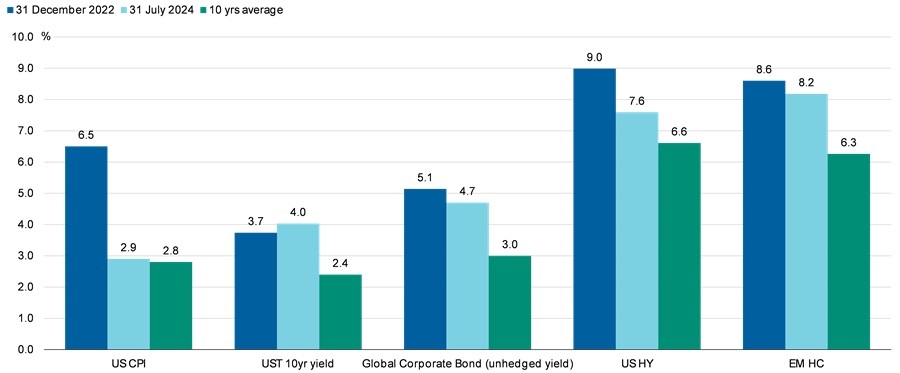
The environment today is very different. The hiking of monetary policy rates by central banks in 2022/3 was painful at the time but had a silver lining – investors in fixed income are now well compensated for holding this defensive ballast, in the form of historically high bond yields.

And even with the strong returns of bond markets over the last 12 months, those yields remain well above historical averages today. In addition, inflation has come down, meaning real yields are today well into positive territory.

This is important because the starting yield of a bond is highly correlated to its future total return. For example, high quality global corporate bonds today offer a starting yield of more than 5%; history suggests this correlates to mid-to-high single digit total returns over the coming 5 years.
Potential benefits from rate cuts

In addition to the high starting yield, returns generated by fixed income could see an additional tailwind from the capital gains that typically come with rate cuts.

The macroeconomic backdrop has been marked by a shift in focus from one of inflation to a potential slowdown in growth. This means duration changes, from being a possible drag on portfolio results to a positive contributor.

The disinflation trend that we’ve seen in the US over the past 18 months has led the Fed to begin cutting rates – a first 50bps rate cut in September is expected to be followed by more cuts over the coming quarters and years. If this does in fact play out, higher quality fixed income markets such as global corporate bonds should benefit from price appreciation as a result of their duration.

Analysing past rate cycles confirms the strong boost to returns that fixed income securities can expect to see in this environment. Looking back at every period of sustained rated cuts of the last 40 years reveals that, on average, investment grade credit returned 10% p.a. in the 3 years after the last hike in a cycle.[2]

In the current cycle, the last Fed hike was just over a year ago in July 2023.  Since then, global corporate bonds have returned 9.5%. If historical patterns hold, history suggests that the next few years should provide similarly strong returns – an opportunity that investors will need to move quickly to take advantage of.

The defensive role of fixed income is more important than ever

A key role of bonds in a broader portfolio is to provide defensive ballast – to protect investors capital and diversify against equity market volatility.

While this diversification role has been less prevalent in recent years, there is reason to believe it is returning. In the recent mini correction in global equity markets, bonds delivered positive returns (see chart below). What we saw was a return of the ‘fabled’ negative stock-bond correlation.
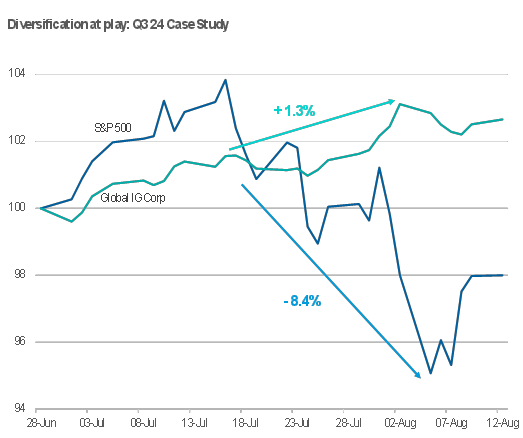
As the market narrative on risks has shifted, from concern about a potential reacceleration of inflation, toward recession concerns, we believe the negative stock-bond correlation could well persist.

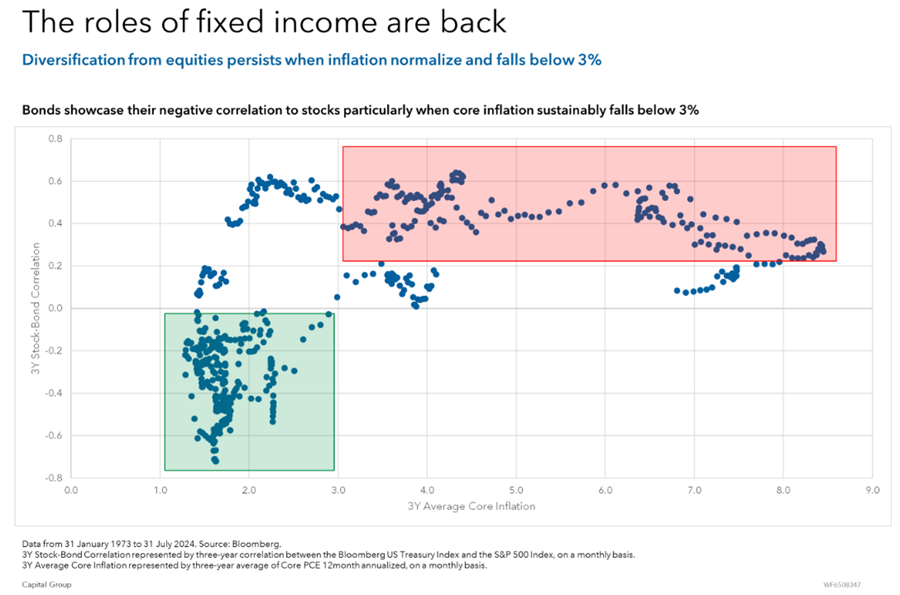
Historical analysis shows that the stock-bond correlation varies over time. Typically, in periods of greater inflation uncertainty it turns positive, while in periods of growth uncertainty it is often negative.

Further, as shown in the chart below, historically when inflation falls below 3%, the correlation between bonds and equity normalises and turns negative.

The current environment of moderating inflation, along with a Fed that is primarily concerned about growth risks, suggests a higher likelihood of bonds playing that diversifying role in the future.
So, what does all this mean for investors?

Given the historical relationships between bonds and equities, and the current macro environment, investors might consider deploying cash and investing in fixed income, gradually increasing duration to benefit from the price appreciation coming from lower yields.

Inflationary concerns are today much lower and Fed rate cuts are now more certain; the question is how much rather than if the Fed is going to cut. Investors have the opportunity to take advantage of this early phase of the easing cycle by investing in fixed income securities and particularly high quality corporate bonds, which we expect to deliver high single to low double digit total returns over the next years, driven by a combination of income and price appreciation from yields dropping.


Haran Karunakaran is an Investment Director at Capital Group (Australia), a sponsor of Firstlinks. This article contains general information only and does not consider the circumstances of any investor. Please seek financial advice before acting on any investment as market circumstances can change.

For more articles and papers from Capital Group, click here.


[1] As of 30/8/2004 in AUD hedged terms. Based on Bloomberg Global Aggregate Total Return AUD Hedged, Bloomberg Global Aggregate Corporate Total Return AUD Hedged and Bloomberg Global High Yield Total Return AUD Hedged indices respectively.
[2] Source: Bloomberg. Based on Bloomberg US Corporate Bond Index. Rate cycles captured 1988-89, 1994-95, 1999-2000, 2004-06, 2015-18.


  •   16 October 2024
  • 3
  •      
  •   
3 Comments
Warren Bird
October 18, 2024

"high quality global corporate bonds today offer a starting yield of more than 5%; history suggests this correlates to mid-to-high single digit total returns over the coming 5 years."

Don't need history to tell you this! It's the maths of bonds that tells you that a 5% yielding portfolio with a duration of around 5 years will return close to its yield to maturity over the next 5 years.

While on the subject of yield, can I ask that whenever FirstLinks publishes an article about whether bonds are attractive or not they always get the author to provide a little table showing where key yields are at the time of writing? It makes a huge difference how you think about arguments like this what the yield on, say, a 10 year Australian government bond was at the time. If this article was written a few weeks ago when the 10 year bond was paying less than 4% then I'd be arguing against its conclusion. (I sold some of my personal bond fund holdings at that time.) If it was written a year ago when the 10 year bond yield was 5%, I'd be going along with it (I bought at that time). If it was written this week when the 10 year bond was 4.25% then I'd have a more neutral view.

Whether or not 'the stars are aligning' for bonds changes day by day and week by week. So articles like this without context aren't actually helpful.

James Gruber
October 18, 2024

Good point, Warren, noted.

Joan Scott
October 24, 2024

I have seen a number of articles along these lines in recent months. It would be helpful to understand how this might translate to bonds funds vs individual bond investments.


Leave a Comment:

RELATED ARTICLES

Passive investing has risks too

Busting the bond myth

Putting portfolios together when the world is falling apart

banner

Most viewed in recent weeks

How to minimise tax with a will

Inheritance tax implications in Australia may surprise some, as poor estate planning without proper wills or trusts can lead to costly tax bills and delays for beneficiaries.

Testamentary trusts post-budget: Estate planning, tax reform and the ‘death tax’ debate

Proposed Budget changes to taxation are casting new uncertainty over testamentary trusts, prompting closer scrutiny of estate planning structures and the real implications of reforms still taking shape.

Meg on SMSFs: The CGT changes don’t impact super but what about Div 296 tax decisions?

New CGT rules could tip the scales in the super vs non-super debate. For those facing the Division 296 tax, the case for withdrawing has gotten more complex. A "comparison rate" tool may help assess decisions.

High quality businesses are on sale

Beneath the dominance of the ASX's largest stocks, much of the market has been left behind. High-quality companies are now trading at levels rarely seen, offering opportunities for investors willing to look deeper.

The investment mistake killing your returns

Retail investors face an increasingly complex product environment, but simplicity may be the most overlooked advantage in building a portfolio you can actually live with.

Welcome to Firstlinks Edition 667 with weekend update

The downfall of the giant and three lessons for investors.

  • 18 June 2026

Latest Updates

SMSF strategies

Meg on SMSFs: How wide is the ban on LRBAs?

The government's recent deal with the Greens has put SMSF property borrowing on the chopping block. The change raises tricky questions about timing, exceptions and what SMSFs will still be able to buy.

Shares

Why Australian shares are falling behind the world

Australia’s market boasts a long record of outperformance, but recent results tell a different story. Is the ASX’s lagging performance a temporary setback or evidence that structural forces will keep global markets ahead?

Taxation

The strange effect of the 30% minimum capital gains tax

The 30% minimum tax on capital gains sits at the heart of the budget's proposed reforms. Yet the mechanics reveal anomalies that introduce unexpected distortions that raise questions about its design.

Shares

The next phase of Australian equity leadership

For years, banks have powered Australian sharemarket returns. But changing economic conditions, stretched valuations and global trends suggest the next generation of winners may not be found in familiar domestic sectors.

Economy

Global market growth hinges on Iran War and AI rollout

Global growth is facing mounting pressure from war, higher oil prices, inflation and trade tensions. But a wave of AI-related investment may prove powerful enough to support economic activity and reshape the outlook for markets.

Retirement

The retirees who can't spend

Why do so many retirees pass away with their wealth intact? Conventional wisdom blames pension rules for the reluctance to spend, but a case study from New Zealand shows that the answer may not be as predictable.

Investment strategies

Here’s my investment philosophy. What’s yours?

Investors often hear they need an “investment philosophy,” yet few know what that really means. Beneath the jargon sits a simple idea: a handful of core beliefs that shape every financial decision, for better or worse.

Sponsors

Alliances

© 2026 Morningstar, Inc. All rights reserved.

Disclaimer
The data, research and opinions provided here are for information purposes; are not an offer to buy or sell a security; and are not warranted to be correct, complete or accurate. Morningstar, its affiliates, and third-party content providers are not responsible for any investment decisions, damages or losses resulting from, or related to, the data and analyses or their use. To the extent any content is general advice, it has been prepared for clients of Morningstar Australasia Pty Ltd (ABN: 95 090 665 544, AFSL: 240892), without reference to your financial objectives, situation or needs. For more information refer to our Financial Services Guide. You should consider the advice in light of these matters and if applicable, the relevant Product Disclosure Statement before making any decision to invest. Past performance does not necessarily indicate a financial product’s future performance. To obtain advice tailored to your situation, contact a professional financial adviser. Articles are current as at date of publication.
This website contains information and opinions provided by third parties. Inclusion of this information does not necessarily represent Morningstar’s positions, strategies or opinions and should not be considered an endorsement by Morningstar.