For months now there’s been an online joke that anyone who doesn’t learn about AI will be a part of the “permanent underclass.” The permanent underclass represents the new have-nots of society—all of those who will be left behind in the coming AI wave. While a subset of the population will have all of their work done by LLM-powered agents, the permanent underclass will be left jobless and in perpetual destitution.
It’s a nice theory, but it has no historical precedent. For example, the share of the U.S. workforce employed on farms fell from 90 percent in 1790 to less than 2 percent today. If I came to you in 1790 and told you that 98 percent of all farming jobs would be eliminated in the future, you’d have a difficult time predicting what all of those people would be doing today.
You’d have no clue that they’d be social media managers, real estate agents, data scientists, or the thousands of other roles that literally didn’t exist at the time.
This is why the fear mongering around AI today is misguided. Because this technological shift will create many new roles and increase demand within existing ones. This explains why software development job postings are up over 10% over the last year despite increased reliance on AI for creating software. As Kenton Varda, a technical lead at Cloudflare, explained:
Worries that software developer jobs are going away are backwards. There is SO MUCH software to build right now, that previously wasn’t possible (uses AI directly) or wasn’t cost-effective (too niche). We’re going to have more developers, and orders of magnitude more software.
This phenomenon is known as Jevons’ paradox, where the increased efficiency of a given resource (e.g., software creation) leads to an increase, not decrease, in its consumption. This is going to happen across a host of different jobs and industries as a result of AI. And when it does, humans will be better off in the long run.
Some will argue that “this time is different” because AI is replacing knowledge work, not just physical work. And, if this comes to pass, what will there be left for people to do?
It’s a compelling argument, but people made similar arguments about the automation of physical work. There was literally a group of people in England in the early 1800s called the Luddites who destroyed weaving machines due to their adverse impact on textile workers.
The Luddites couldn’t imagine what would replace their livelihoods and the same is true for us now. There will be future roles that require a different set of human skills that we can’t even imagine today. These skills won’t directly compete with LLMs, but will enhance them.
And while the speed of AI disruption will likely be faster than previous cycles, the recovery will be as well. Since information travels much faster today than in the past, people will be able to reorganize and re-skill at a much faster pace than in prior centuries.
David Oks wrote a great piece on why the impact of AI on the labor market won’t be as harsh as people initially expect:
…the relevant question for labor impacts is not whether AI can do the tasks that humans can do, but rather whether the aggregate output of humans working with AI is inferior to what AI can produce alone.
Fortunately, we are still at the point where AI + human is better than AI alone.
If you’re still worried though, consider how prior technological changes have permeated throughout society. I know of no case in recorded history where a new technology was widely adopted and the percentage of people living in poverty increased over time.
In fact, over the last half century, the opposite seems to have happened. The number of people worldwide living in extreme poverty has declined by roughly 66% since the 1970s, despite many groundbreaking, technological advancements:
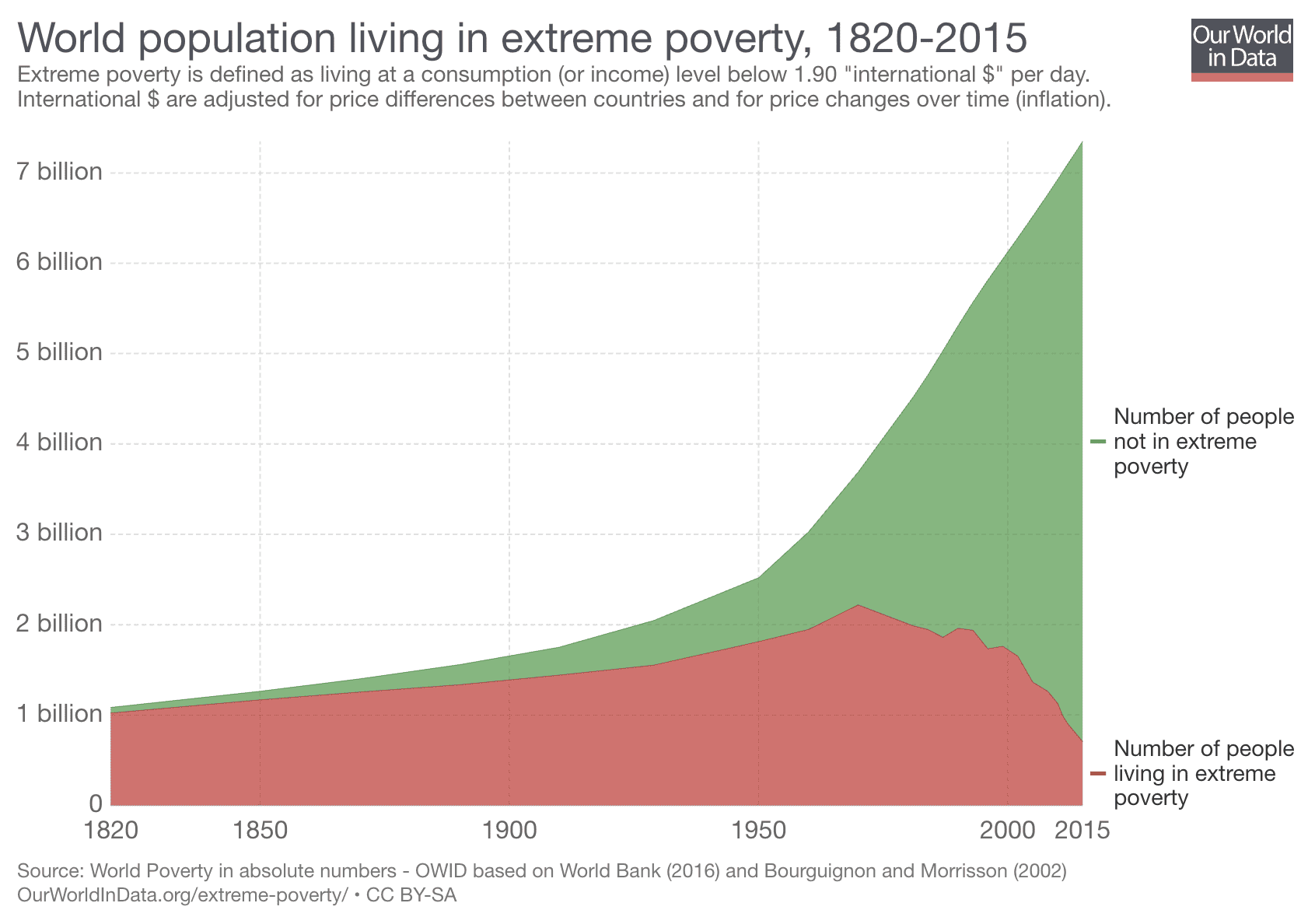
Of course, there have been short periods where a new technology has led to some local displacement/decline. The early years of the Industrial Revolution were a period where life was arguably worse for the typical laborer (e.g., the Luddites). However, such setbacks were short-lived and never resulted in a permanent underclass.
Some of you will see this data and argue that it’s irrelevant because extreme poverty isn’t the right metric. What matters is the relative difference in wealth, not the absolute difference. After all, even if we eliminated all extreme poverty, there still can be an underclass, right?
In some ways, yes. But that’s already true today. We already have a small subset of the global population that flies private, owns a yacht (or two), and doesn’t need to work a 9-5 job. Thankfully, such lofty positions are almost never permanent.
The temporary elite
One of the biggest reasons why I’m not worried about an AI-induced class divide (even if it does come to pass), is that it’s likely not to last very long. If you look over the course of history, you will notice that fortunes tend to rise and fall within families. Some families have wealth and power in one generation, only to lose it in the next. If you are under the impression that rich families stay rich forever, consider this (from Fortune’s Children):
When 120 of Cornelius Vanderbilt’s descendants gathered at Vanderbilt University in 1973 for the first family reunion, there was not a millionaire among them.
Cornelius Vanderbilt was born poor, yet became the richest man on Earth. Nevertheless, even that fortune didn’t last more than a few generations. The dominant industry of Vanderbilt’s time (railroads) gave way to others that overtook it.
This simple example illustrates how even those in the current AI-elite will eventually lose their fortune in one way or another. It reminds me of that Warren Buffett quote:
I try to invest in businesses that are so wonderful that an idiot can run them. Because sooner or later, one will.
Well, guess what? No matter how rich or successful you are today, one of your future descendants will be the “idiot” that loses your fortune, one way or another. Attributes like talent, intelligence, and temperament exhibit mean reversion over time. This is what makes it near impossible for a family to hold onto great wealth for long.
It’s also why I’m skeptical of a future, AI-induced class divide. Because, even if there is, it won’t last.
There will be no permanent underclass because there is no permanent elite.
All such places of privilege and power are temporary. History has demonstrated this time and time again.
So, stop worrying about getting left behind and start focusing on how to be more useful in the first place.
Nick Maggiulli is the creator of personal finance blog Of Dollars And Data and the Chief Operating Officer at Ritholtz Wealth Management. For disclosure information please see here. This article was originally published on the Of Dollars and Data blog and is reproduced with permission. If you liked this article, consider signing up for Nick’s newsletter.