Register For Our Mailing List

Register to receive our free weekly newsletter including editorials.

Home / 363

What is happening with SMSFs? Part 1

The primary source of data for this review is the 2017–18 SMSF annual tax returns. The key limitations associated with these returns are their frequency (only annual) and their currency - the deadline for the returns is long after the end of the financial year. However, the ATO has used 2018–19 information for registrations, wind-ups, total populations, demographic data, estimated total SMSF assets and asset allocation and auditor contravention reports (ACRs).


The 2017-18 financial year was the first financial year after the extensive 1 July 2017 superannuation changes, which included the $1.6 million transfer balance cap coming into effect. Accordingly, the statistics provide interesting analysis of the behavioural changes of SMSF trustees after these measures took effect, particularly in relation to contribution levels and benefit payments.

The key take aways are:

  • SMSFs are continuing to grow
  • A reversion to normal for contributions and benefit payments, and
  • A greater understanding of actual operating costs of SMSFs.

In addition, more granular data which breaks down how expenses are apportioned within an SMSF and for different sizes of SMSFs provides a clearer picture of the actual costs of running SMSFs. The typical operating costs are below $5000 a year for most newly established SMSFs.

SMSFs accounted for 99.7% of all super funds in Australia and collectively held 26% or $747 billion of the $2.9 trillion in super assets under management. SMSFs, therefore, continue to be an integral and significant part of the superannuation system.
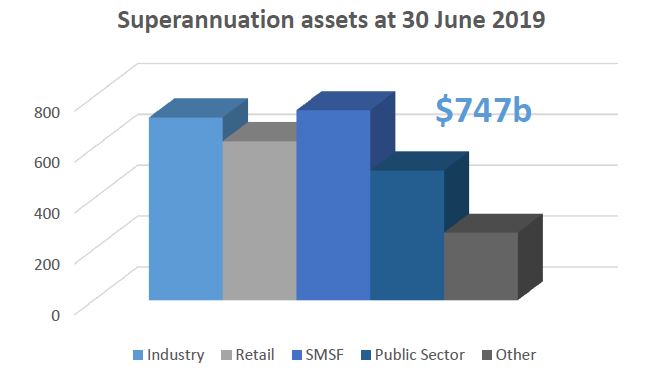
There are 1.125 million Australians in nearly 600,000 SMSFs with an average fund balance of $1.3 million and a median fund balance of $720,000 (the median value is more reflective of the typical SMSF as a small minority of very large SMSFs distort the average figure).

SMSFs are typically made up of a couple with an average of 1.9 people in an SMSF and 43% of SMSFs are in some form of pension phase. These are two crucial factors that are typically glossed over when analysing SMSFs. Median assets have grown by 36% over the five years to 2018.

Better explanation of expenses

The biggest change to the ATO’s statistics is a welcome update of the reporting of expenses for SMSFs. As many in the industry would be aware, recent expense data has made it difficult to objectively examine the operating expenses of an SMSF. This was recently highlighted in an ASIC SMSF fact sheet that we believe was well intended to help people consider whether an SMSF was a suitable choice. However, it lacked balance and would benefit from more context regarding different expense components.

Previous analysis has relied on the use of averages, which ignores distortions from very large SMSFs and included SMSFs that have chosen to use extensive administration, insurance and investment services.

The SMSF Association has been encouraging the ATO to publish more granular expense data and we are extremely supportive of the updated data that has now been released.

So, what is new?

  1. New tables that break down median and average expenses by type and asset size.
  2. ‘Administrative and operating expense' has been renamed 'Operating expense'. Its components of approved auditor fee, management and administration expenses, other amounts and SMSF supervisory levy remain unchanged.
  3. ‘Management and administrative expenses’ therefore now only refer to amounts entered into management and administrative expenses in the SMSF annual return.
  4. ‘Investment expense' now only refers to amounts entered into investment expenses in the SMSF annual return.

With this new breakdown, the median ‘operating expense’ of an SMSF is $3,923. As highlighted above at point 2, this includes the typical expenses an SMSF would need to incur.
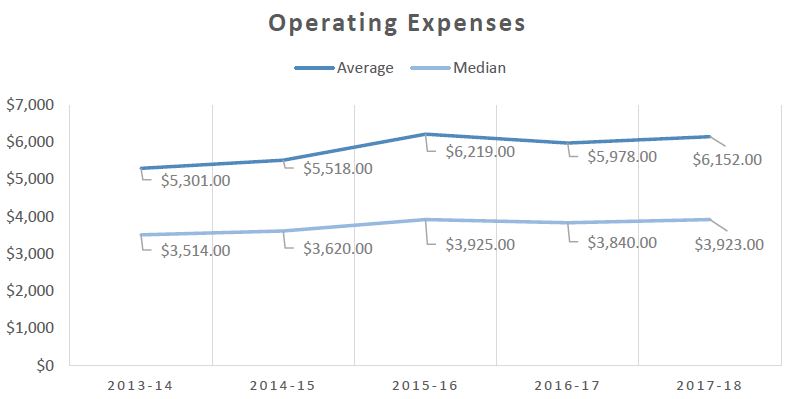
The breakdowns also allow us to determine how much the average and median expenses have been affected by those funds which undertake optional services or incur less common expenses.

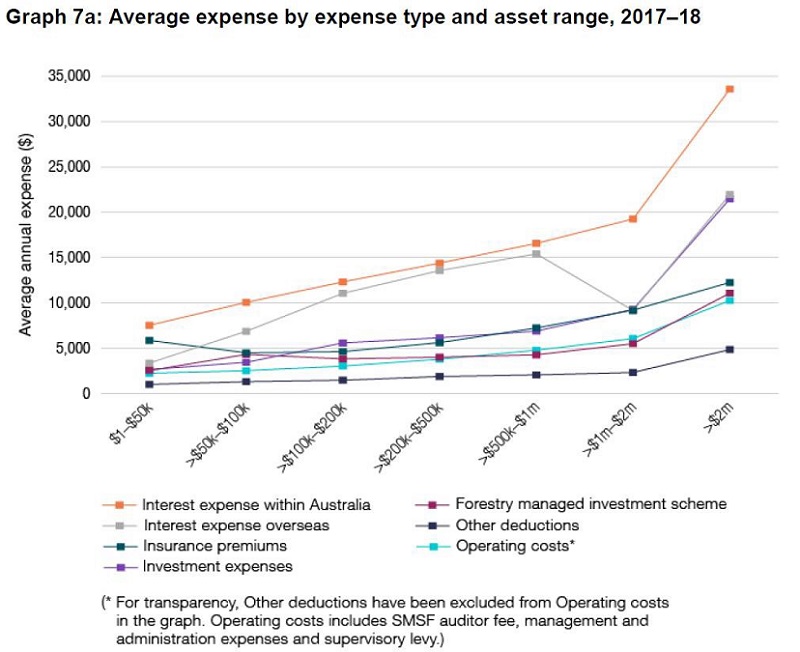
The SMSF sector may be wondering how the total average expense cost of $14,879 was calculated for the 2017-18 financial year. Graph 7a below supplied by the ATO provides a visual determination.

Funds with over $2 million had a significant impact on the weighting of the costs allocated to an average figure. In addition, expenses such as investment expenses, insurance and interest were attributed to the average when many SMSFs did not use these services. The spike in these amounts is also quite evident for funds on the higher end of the scale. In particular, interest expense relating to borrowings is an expense aimed at achieving higher investment returns and not an operating expense.
Greater information can be taken from the following table on median expenses. It details the number of funds which are reporting an expense, as well as a clear breakdown for asset sizes.
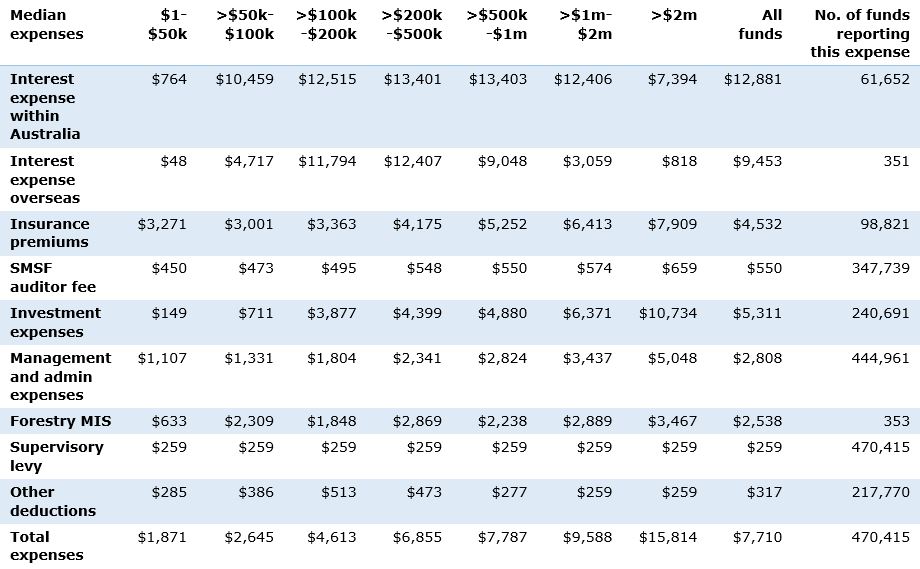
If we take a fund with a typical establishment balance of between $200,000 and $500,000, only including the typical operating expenses, removing those with investment expenses, insurance, interest, and forestry MIS we can roughly estimate the median operating expense as $3400 for these SMSFs.

The updated expense data shines a light on the many optional expenses an SMSF could incur. With these breakdowns, it is clear that previous analysis included expenses such as insurance premiums and interest expenses that were not operational expenses.

We are now able to see a clearer picture of where SMSFs choose to voluntarily incur expenses that members believe provide value to their fund.


Franco Morelli is Policy Manager at the SMSF Association.

Part 2 of the analysis of the new data will be published next week.


  •   24 June 2020
  • 14
  •      
  •   
14 Comments
RobG
June 24, 2020

The glaring omission in the above, is the fact that accounting, audit, supervisory and reporting expenses in SMSF's DO NOT fundamentally change with the size of the fund, unlike their Industry and Retail "competition" that still maintain a mixture of "asset based" charges. For many SMSF's, that is their only expense.

The relevant comparison is to compare total fees across the range between SMSF's/Industry and Retail Funds and we all know who would have the lowest costs. Bigger the fund, bigger the gap.

As to the table - if the average SMSF is paying $2538 in Forestry MIS fees, I would be staggered!

Peter
June 24, 2020

Majority of industry funds these days cap their "asset based" charges to a max of $750-$800 pa., so there is fund size benefits for the investor in industry funds too, not only SMSF.

And if an investor subscribe to the idea of passive, low-cost index investing (substantiated by numerous studies to outperform the vast majority of other investment strategies), there is very little reason to have an SMSF, if one can implement such an effective, low-cost portfolio with greater simplicity and no Trustee admin responsibilities, etc.

While not perfect, Sunsuper and First State Super are great examples of the above, as both offer aussie and international equities passive options at rock bottom fees, and cap the "asset based" admin fee to approx. $750-$800 p.a.

Brendan
June 24, 2020

Great article, my SMSF (2 members) has approx 1.1 million in assets and annual expenses of about $3,000. I imagine this is not atypical. With almost half SMSFs in some form of pension phase it is also totally disingenuous for Industry funds and others to compare the annual performance returns of their predominantly accumulation funds with our sector.

Dudley.
June 24, 2020

I self manage my super funds so it costs me time and my SMSFs nothing. The Supervisory Levy $249, Actuary $110, Auditor $0; total $359 each.

SH2071
June 26, 2020

How do you manage a $0 audit fee, whilst also complying with the legal requirement to have your SMSF audited annually?

Dane
June 24, 2020

Unless you want to invest in more esoteric assets like business real property or direct resi, I struggle to understand what the advantage is in running an SMSF vs a low-cost retail platform with an extensive investment menu. Many platforms now have greater flexibility around pensions and EP features, nullifying some of the previously held advantages of SMSF's. $3,400 p.a. is not immaterial especially for balances under $1m. Then there is the opportunity cost of time, given all the additional responsibilities required of Trustees. Those that consult a professional for investment advice (seems prudent) are likely adding another 1% p.a. in fees. Is it really worth it just to say you are 'in control' of your assets if the likely result is lower asset values over time??

Kim Wilkinson
June 24, 2020

I only use a SMSF in order to be able to invest in "ethical" funds. I am not attracted to the "industry funds" that go as far as ESG, so I put my money into funds like Australian Ethical. That is where there is a negative screen that takes out companies involved in a range of industries. My last "super company" would not move into these areas, so I said goodbye.

Sallie
June 27, 2020

So SMSF trustees did the right thing AND made a killing!! Good for us!

Ramani
July 14, 2020

This begs a much more basic question: allowing for differential risk preferences (some like control even if their capacity to control may be moot; some have more time; some have had a bad experience with APRA funds...) the basic premise of a SMSF (trustees have the willingness and ability to manage the SMSF) is not continually (or at all) tested. Given dominant trustees (one runs the SMSF others are a shadow), advisers acting as shadow trustees in substance and more critically, the relentless ageing of the population including SMSF trustees, we do require a test of capacity beyond a defined age. Age-related disability including Parkinson's and Alzheimer's cannot be wished away. ATO just does not have the resources or willingness to test this, also because it is a revenue-collector not really a prudential regulator.
Like seniors being tested for their driving licence beyond say 80, we need a check. Given the revenues involved, this is not a victimless breach. The taxpayer will be the collateral loser.
The powers that be need a long term vision if we must avoid a crash in confidence. With preemptive enforcement. Ask Hayne.

John
June 24, 2020

Many large cap stocks typically held by SMSFs in pension phase for income (ANZ, NAB, WBC, Telstra, etc) are currently trading at up to 40% discounts from their highs. Hence, there would be many SMSFs with significant paper losses, biding their time waiting for the inevitable recovery in 5 years. Because its not permitted to move fund assets in situ from an SMSF to any other fund, these capital losses would have to be crystallised first. So, it may not be worth moving unless the new super fund allows the same shares to be repurchased at low cost on transfer. None of the good ones do, of course.

Graham W
June 24, 2020

SMSF's are also able to hold gold and silver bullion and also access unlimited availability of financial institutions.Bullion especially gold has been a very good investment for diversification and very good returns.I don't like collectibles, but for younger business folk, business real property is a no brainer. Insurance choices are much wider as well. My SMSF annualised return this financial year,over 20% pa, operating cost 0.20%.

Paul
June 24, 2020

600k SMSFs, but only 470k pay supervisory levy. Does the levy not apply to all?
Just asking.

Ramani
July 14, 2020

Could it be due to the quirk in the way the ATO levy is not payable when an ongoing fund lodges its final return, with levies being spread between successive years?

Simon Taylor
June 24, 2020

The big industry and retail players hate SMSF. They are missing out on creaming their big fees for poor performance and vague reporting. They will continue to lobby governments and produce "fake news" that SMSF perform poorly or cost too much. Those of us with SMSF know better!
If you don't like it - don't do it.


Leave a Comment:

RELATED ARTICLES

What is happening with SMSFs? Part 2

New tax gives incentive to move money out of super

Meg on SMSFs: Withdrawing assets ahead of the $3m super tax

banner

Most viewed in recent weeks

Are you making these SMSF mistakes?

After four decades advising investors, there are a few common mistakes I've seen SMSF investors make. From holding too much cash and chasing yield to overtrading and trusting tips. Are these errors costing you?

Why have Australian living standards 'fallen' and how do we fix it?

For the last few years there has been much talk of a 'cost-of-living' crisis in Australia and of 'falling living standards'. Lately this has flared up again with the pickup in inflation resulting in a renewed fall in real wages.

Will you run out of money in retirement?

Fear of running out has become a defining retirement anxiety. Why do some retirees die with substantial wealth while others deplete their nest egg? Evidence suggests the answer is more complicated than we think. 

Four options for an income investor’s next dollar

What if Australia’s golden age of dividends is ending? Rather than overhaul your portfolio, it may be worth considering where new capital can work harder. I discuss four income strategies and the trade-offs behind each.

Retirement spending is not one-size-fits-all

New data challenges the idea that Australians are underspending their super. The bigger issue may be helping retirees navigate complexity, make confident decisions and use their savings to support security, wellbeing and choice.

The missing link in the CGT debate

A little-noticed consequence of Labor’s tax changes could have implications well beyond investors’ tax bills. The issue raises bigger questions about incentives, capital allocation and the drivers of long-term economic growth.

Latest Updates

SMSF strategies

Meg on SMSFs: What do we think about reversionary pensions these days?

Reversionary pensions have long been a staple of SMSF estate planning, but are they still the best option? Meg Heffron revisits a once-clear favourite and asks whether changing super rules have shifted the balance.

The ageing ‘crisis’ has not and will not happen

Rising age dependency is frequently treated as a warning sign for economies. But when actual workforce participation is examined, a strikingly different picture emerges about ageing, productivity and economic sustainability.

Retirement

How does the 4% rule stack up?

The 4% rule has long been retirement's gold standard. But after a difficult period for investors, fresh analysis suggests a more conservative approach may significantly improve the chances of making savings last.

Shares

Four charts that expose market concentration risk

Investors have recently been rewarded for backing market leaders, but history suggests this eventually comes at a cost. Now may be the time to review whether your portfolio is carrying unintended risks beneath the surface.

Investment strategies

The case for gearing beyond property

Most Australians gear into property but ignore shares. That may be a mistake. Used carefully, geared equity strategies can enhance long-term returns, reduce cash tied up in growth assets and support retirement income goals.

Economy

Australia's $1 trillion debt pile

The headlines exclaiming that Australian government debt has hit A$1 trillion and US government debt has hit $40 trillion has turned heads, but how serious are they really? Will Australia's mix of debt create challenges?

Economy

Has 100 years of growth made us any happier?

For decades, GDP has been the benchmark for economic success, but has it made us materially happier? If happiness does not rise in lockstep with prosperity, are we overlooking what constitutes a successful society?

Sponsors

Alliances

  • ASA-Logo-RGB-ActiveGreen-web.png

© 2026 Morningstar, Inc. All rights reserved.

Disclaimer
The data, research and opinions provided here are for information purposes; are not an offer to buy or sell a security; and are not warranted to be correct, complete or accurate. Morningstar, its affiliates, and third-party content providers are not responsible for any investment decisions, damages or losses resulting from, or related to, the data and analyses or their use. To the extent any content is general advice, it has been prepared for clients of Morningstar Australasia Pty Ltd (ABN: 95 090 665 544, AFSL: 240892), without reference to your financial objectives, situation or needs. For more information refer to our Financial Services Guide. You should consider the advice in light of these matters and if applicable, the relevant Product Disclosure Statement before making any decision to invest. Past performance does not necessarily indicate a financial product’s future performance. To obtain advice tailored to your situation, contact a professional financial adviser. Articles are current as at date of publication.
This website contains information and opinions provided by third parties. Inclusion of this information does not necessarily represent Morningstar’s positions, strategies or opinions and should not be considered an endorsement by Morningstar.