The wealthy were never the borrowers
Investors with substantial wealth generally have alternatives to borrowing inside super to acquire property. They can often buy outright or use borrowing arrangements outside super that offer greater flexibility and liquidity. Limited recourse borrowing matters to a different group: people with enough super to be credible borrowers, but not enough to write a cheque for a property outright.
The ATO’s own statistics bear this out. About 58% of SMSF members report taxable income below $100,000, and 74% below $150,000. Only 3.2% report income above $500,000. The balance data says the same thing. In the most recent annual breakdown, limited recourse borrowing is most concentrated in funds holding between $500,000 and $1 million, and that band alone accounts for roughly a third of all LRBA exposure. That is the group for whom borrowing is likely to be most relevant: large enough to contemplate property, nowhere near large enough to buy it outright.
The data therefore raises the question of whether the measure primarily affects the investors it was designed to target. It closes a pathway that many middle and upper-middle balance funds used to obtain an asset, while large funds continue to access the same asset class through scale.
A rule that tracks structure rather than risk
It is worth being precise about what has changed, because the shorthand has been loose. LRBAs are not banned. From 10 August 2026, real property acquired under a new LRBA has to be business real property. Residential dwellings fail that test, as does some mixed-use property that falls short of the technical definition. Arrangements entered into before commencement are grandfathered, along with the refinancing of them.
Meanwhile, the large APRA-regulated funds most Australians belong to still hold residential property and will continue holding it. They simply do not do it by buying individual dwellings.
Australian Retirement Trust has flagged its largest annual investment in Australian property, committing $3 billion over twelve months to developing housing supply, new offices and industrial land, on top of the roughly $19 billion it already holds in real estate equity. Aware Super’s property portfolio runs to about $12 billion, roughly 70% of it in Australian real estate, including build-to-rent apartments and its Essential Worker Housing program.
That is exposure built through scale, property platforms and partnerships with developers and fund managers. A fund with a few hundred thousand dollars cannot assemble anything like it. What the new rule removes is one of the practical ways a smaller, self-directed investor could obtain direct residential property exposure within super.
Two investors can seek exposure to the same underlying asset class yet face very different regulatory treatment depending on the structure through which they invest.
Why hold any property in the first place
Few would sensibly argue for putting an entire retirement portfolio into housing. The argument is for holding a portion of it. Shares and residential property do not move in lockstep, and that is part of what makes a portfolio resilient. In calendar 2008, Australian shares lost 39.2% including dividends, while capital city established house prices fell 4.1%. Both recovered the following year, shares by 37.9% and house prices by 13.8%. A fund holding both came through that period better than a fund holding shares alone.
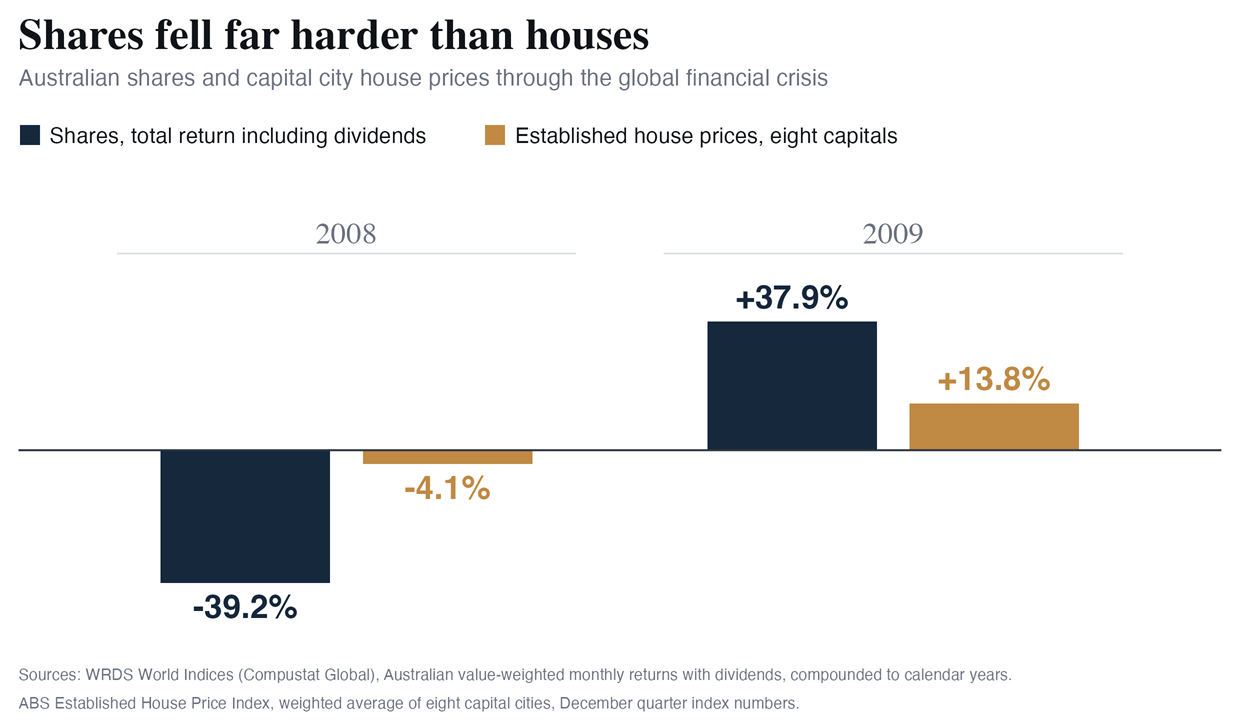
Restricting a smaller investor’s ability to own residential property directly within super may reduce one source of risk, but it can also leave their retirement savings more exposed to whatever the share market happens to do that year.
The risks are real. They are not universal.
None of this means the concerns behind the change were invented. Borrowing to buy property inside super can create genuine problems: excessive gearing, over-concentration in a single asset, liquidity pressure when rents fall or rates rise, and the high-fee property spruiking that has shadowed this corner of the industry for years.
But those risks are not present in every arrangement. A conservatively geared purchase supported by a liquidity buffer and proper advice presents a different risk profile from a heavily geared bet on a mediocre property.
The aggregate numbers also raise questions about the scale of systemic risk involved. As at the March 2026 quarter, self-managed funds held just under $30 billion in borrowings against more than $1 trillion in assets. Across the geared arrangements themselves, borrowings run to about 36% of the value of the assets sitting under them. That is real leverage. But it is happening in a small corner of the system now served by only around 20 lenders, the major banks having withdrawn years ago. The market remains relatively small and specialist compared with mainstream mortgage lending.
What a proportionate approach would have looked like
Where the risks are genuine they can be dealt with directly. Cap the gearing. Limit how much of a fund can sit in one asset. Require a liquidity buffer. Large funds already manage exactly these risks inside a prudential framework overseen by APRA. Self-managed funds sit largely outside that framework, and one response to that gap would be to extend proportionate safeguards to them, not to remove an asset class from one group of investors while leaving everyone else untouched.
A blanket prohibition cannot tell a reckless arrangement from a prudent one, so it ends both.
That distinction will matter well beyond this particular measure. The provision arrived late, by amendment, without consultation or an explanatory memorandum, and industry submissions have already pressed for a carve-out for newly built housing. If the policy is revisited, the key question worth asking is not whether borrowing inside super carries risk. It plainly can. The question is whether the regulatory response is directed at the risk itself or primarily the investment structure through which the risk arises. Retirement policy should be slow to narrow what an ordinary saver is allowed to hold while the large and the wealthy carry on exactly as before.
Figures in this article are drawn from the ATO’s Self-managed super fund quarterly statistical report, March 2026.
Dr. Ruchith Dissanayake is a Senior Lecturer in Finance at the Queensland University of Technology and a Chief Investigator on an AHURI-funded housing finance research project. Ama Samarasinghe is a Lecturer in Financial Planning and Tax at RMIT University. Ruchith is also Principal of BID Capital, a mortgage and finance brokerage whose business has included arranging SMSF loans for residential property. This article is general information only and does not consider the circumstances of any investor. The views expressed are those of the authors and do not necessarily reflect the views of QUT, RMIT or AHURI.