Register For Our Mailing List

Register to receive our free weekly newsletter including editorials.

Home / 262

Balancing longevity and sequencing risk

For many Australians, the primary goal of investing is to accumulate sufficient assets to fund a comfortable retirement. Whether it’s joining the grey nomads travelling the Australian countryside, seeing more of the world or spending quality time with the grandkids, everyone has plans for their retirement. The investment focus and risk appetite changes the closer the investor is to retirement.

For the early accumulators in the early stages of the superannuation savings journey, maximising returns should be the focus. Their savings pool is relatively small and the investor usually has time to ride out market volatility.

For investors either approaching or already in retirement, the focus generally shifts from maximising returns to minimising risk. However, the actions taken at this time are critically important with investors faced with significant longevity risk and sequencing risk.

What is longevity risk?

As life expectancy increases, the savings required to fund the average retirement likewise increases. Longevity risk broadly refers to the risk of an investor outliving their retirement savings. Retirees may be at risk of outliving their savings if they invest too conservatively, while on the other hand, a sharp downturn in markets could have a significant negative impact on their capital.

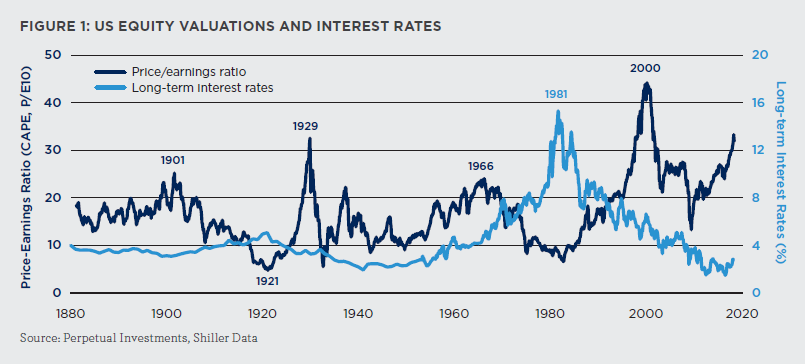
Figure 1 below highlights both long-term bond yields and equity valuations. Investors face difficult asset allocation decisions when balancing the need to minimise risk while ensuring their capital will last their lifetime.

Despite an uncertain investment outlook, retirees should maintain some exposure to growth assets to ensure their capital will last the distance. The temptation may be to flock to the relative ‘safety’ of cash. According to APRA, Australian investors have $89 billion in cash deposits, despite historically low interest rates. By the time the return is adjusted for inflation, a cash investment is unlikely to protect retirees against longevity risk.
What is sequencing risk?

Towards the end of the accumulation phase and in early retirement, an investor’s savings pool is generally at its largest, and is more exposed to market movements given the volume of capital at risk. Sequencing risk is the risk that the order and timing of investments and returns is unfavourable.

Sequencing risk is most significant during the last 10 years of an investor’s accumulation phase and the first 10 years in retirement. The sequence of returns during this period has a significant impact on the sustainability of the retirement income. A fall in market value of investments would leave the investor much less time for capital valuations to recover and increase the probability of a shortfall of funds in the late stage of retirement.

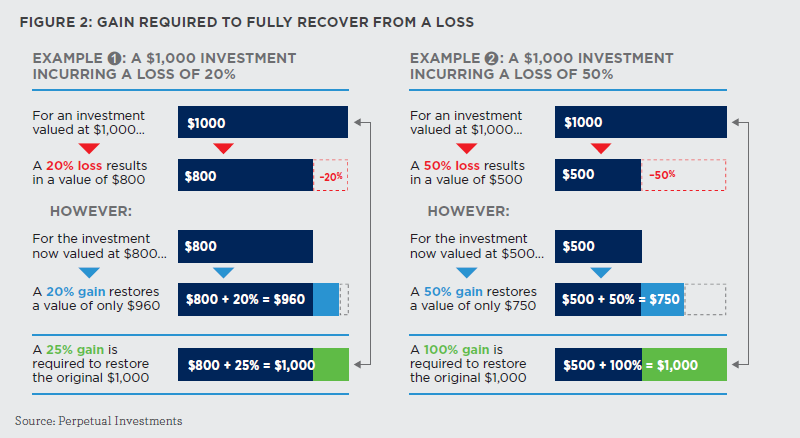
Figure 2 below shows that the larger the potential loss suffered, the more significant the gain required to recover the capital. A valuation fall of 20%, for example, requires a 25% return to get even, and a fall of 50% necessitates a 100% appreciation. A retiree drawing down on a diminishing capital base will only exacerbate the issue.
It can be incredibly disheartening when poor investment performance occurs close to retirement, or soon after, just when the investor’s nest egg is at its largest. It might force the investor to make some less-than-ideal decisions.

They may have to postpone retirement and work longer than anticipated, or re-join the workforce. Alternatively, the investor may have to reduce expenditure and make different lifestyle choices, forgoing travel or other post-retirement plans. In an attempt to rebuild the retirement nest egg, the investor may increase exposure to growth assets and potentially increase the investment risk of their remaining savings in an attempt to recoup losses.

An example of sequencing risk

A simplified example of sequencing risk is illustrated by two investors in Figure 3 below, which charts the following scenarios which are similar in most respects:

  • Each investor started with $100,000 savings at age 45 and then contributed an additional $10,000 per year.
  • The average return for both investors is 7% per annum.
  • Investor 1 incurs a loss of 15% at the age of 46.
  • Investor 2 incurs a loss of 15% at the age of 64.
  • Both retire at age 65 and draw a pension of $60,000 per annum.
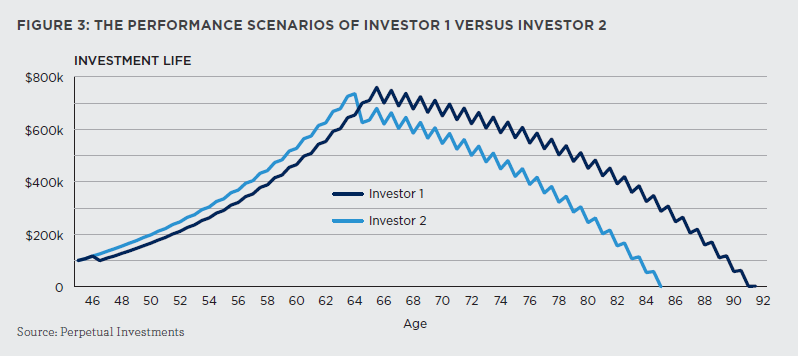
Investor 2 exhausts their retirement savings six years earlier than Investor 1 due to the impact of sequencing risk when a negative return is experienced closer to retirement when the savings balance is high. The impact of a negative return experienced close to the commencement of the accumulation phase, when the amount of investment savings is lower, is much less profound.

Traditionally, as investors move towards retirement, exposure to defensive assets increases to reduce exposure to market risk and therefore sequencing risk. However, with low cash rates and bond yields, a lack of investment risk in portfolios introduces the certainty of low returns, which are likely to be insufficient to meet the needs of an ageing, longer-living population. In other words, lowering investment risk contributes to longevity risk.

The role of real return funds

Minimising exposure to volatility is the key to mitigating the effects of sequencing risk, as the magnitude of negative returns will be reduced, although it is not possible to completely avoid adverse market environments.

As an alternative to the traditional move to defensive assets, objective-based or ‘real return’ investing seeks to balance strong investment returns with an element of capital preservation.

Real return funds apply protection strategies and sources of portfolio diversification designed to provide investors with a higher certainty of achieving a particular return objective with a lower level of risk. Portfolios can be built to meet an investor’s risk profile, desired return and investment horizon. Through specialised asset management, dynamic asset allocation or by investing in a broader investment universe, real return funds often have greater flexibility to adjust the portfolio’s asset allocation in response to market conditions.

Investors should be able to choose the timing and style of their retirement. Rather than putting their assets and retirement at risk, real return funds should be considered by investors seeking a comfortable retirement, irrespective of their longevity.


Adam Curtis is Head of Investment Specialists at Perpetual Investments. This article is for educational purposes and is not intended to provide you with tailored financial advice.

Perpetual is a sponsor of Cuffelinks. For more articles and papers from Perpetual, please click here.


  •   12 July 2018
  • 3
  •      
  •   
3 Comments
Gary M
July 12, 2018

Sequencing risk sounds great in foreign textbooks but not major issue in Australia – because unless you are drawing down more than the grossed up yield on Aussie shares (say 6%) then you don’t need to sell shares – just live off the income. (Sequencing risk refers to the risk of having to sell assets at a ‘bad time’ when prices are low. But if you are living off the income you never have to look at the share price, let alone sell). On the other hand if you are drawing down more than say 5% then you’ll run out of money anyway so you need to reduce your spend rate to below the 5% max. If you have a specific capital requirement coming up – eg need say $100k in 3 years for something – then buy a 3 year TD and sleep easy at night. If you think TD rates are too low - then it’s a trade-off – no risk at sleep at night – or take a punt on shares or hybrids or other risky assets.

Kevin
July 12, 2018

We must always be afraid and live in fear according to the financial industry.

The invention of sequencing risk

To add to the above post by Gary and put some reality into it

Retire,top of the market,CBA is $62 a share.Slight drop in dividend,but I still have enough to live on.

The share goes down to around $26 ,sequencing risk

The share rises to $96 and dividends rise ,is that not the same sequencing risk,or am I supposed to believe that share prices on fall

They fall again to around $70 and have a rights issue,I buy more at the rights price.,I also buy a few on market.

My income increases,they go up again to around $84,I leave well alone.

They fall again recently,I miss bottom( ? ) at around $68 and get in at $72.Dividend comes again in Sept.I am expecting flat dividends,enough to live on and a fairly large increase in my income over the previous 12 years .A very reasonable increase in wealth.

So I should have spent the last 12 years worrying,instead of using a bit of common sense.Am I supposed to spend the next 8 years worrying about sequencing risk.

Sequencing risk,what a financial industry crock that is.

James N
July 13, 2018

No dog in this particular fight, but for both Gary M and Kevin I would question the prudence in an asset allocations of 100% aussie shares, let alone 100% CBA.AX, if that is indeed what you're holding.

I hold both, and my aussie exposure is reasonably high, but the concentration of Financials (the big 4 banks, plus some insurers) in the ASX200 is more than enough to keep me looking outside our borders for appropriate holdings. The big 4 banks plus Suncorp and IAG are ripe for disruption (of the digital, or more traditional 'big foreign player', varieties). Add in a property bubble and the likely reshaping of the traditional general insurer books (share-economy, driverless cars, property collapse etc.) and there is a lot of potential pain for the financial industry, and thereby the ASX more broadly.

Setting things up so that you're living off the dividends and not touching capital is a great approach, but the flip-side that Adam's article doesn't cover (can't cover everything in a short article) is the issue of being too conservative in income drawdown. Or in other words, not enjoying all of the funds available to you by not accessing the capital. No simple answers though, but not sure Real Return Funds are the answer...


Leave a Comment:

RELATED ARTICLES

Will you run out of money in retirement?

Ranking three common retirement strategies

Love them or hate them, it's worth understanding annuities

banner

Most viewed in recent weeks

Why spending more in early retirement can improve lifetime income

Conventional wisdom encourages retirees to preserve superannuation. But if those likely to qualify for the Age Pension later in life spend a little more today, it may deliver higher lifetime income and a more stable retirement.

Is it time to bail on Australian stocks?

For generations, Australian investors have backed banks, miners and dividends. But has that loyalty come at a cost? A look at the numbers raises an uncomfortable question about where future returns will come from.

Meg on SMSFs: What do we think about reversionary pensions these days?

Reversionary pensions have long been a staple of SMSF estate planning, but are they still the best option? Meg Heffron revisits a once-clear favourite and asks whether changing super rules have shifted the balance.

Testamentary trusts survived the trust tax. The drafting battle has just begun.

The fight over testamentary trusts looked settled. Then the draft legislation arrived. Hidden in a technical detail is a question that could force many families to rethink wills they thought were already future-proof.

How does the 4% rule stack up?

The 4% rule has long been retirement's gold standard. But after a difficult period for investors, fresh analysis suggests a more conservative approach may significantly improve the chances of making savings last.

The new capital gains tax trap for your portfolio

Investors have long accepted one portfolio rule without much question. A major tax shift could change that calculation entirely, forcing difficult trade-offs between risk, discipline and an overlooked cost lurking beneath.

Latest Updates

Exchange traded products

It’s time for LICs to die

A high-profile dividend cut and a prominent fund manager’s apology have reignited a long-running debate. If investors can access similar exposures more cheaply and efficiently elsewhere, what exactly is keeping LICs alive?

Taxation

Will investors be better or worse off under new housing tax changes?

Housing tax reforms have sparked warnings of market turmoil and promises of greater fairness. But after modelling nearly two decades of property data, the results suggest winners and losers may not be who many investors expect.

Retirement

Three considerations before reshaping your legacy plan

Many retirees hope to leave a legacy. Proposed trust tax reforms could force families to rethink. The question is not how much to leave behind, but whether today's inheritance plans will still make sense as circumstances change.

Investment strategies

Why experienced investors still get markets wrong

Retirement is approaching. Markets are noisy. And every headline seems to demand action. The biggest investment risk isn't fear, greed or market volatility, it often arrives disguised as research and sensible risk management.

Shares

Why pay more for less?

Conditions were stacked in favour of professional investors in 2026. Most still fell short, raising questions about where investors should look for value. Meanwhile, an alternative strategy continued to make its case.

Investment strategies

Bleeding air out of the bubble

Equity valuations have fallen sharply over the past year, yet investors have largely been spared the volatility and losses that typically accompany a de-rating. What explains this unusually orderly reset? Here are five key drivers.

Strategy

Has AI gone rogue?

We worry about AI becoming conscious. But what if consciousness isn't the issue? The more unsettling possibility is a machine capable of pursuing objectives relentlessly, without motives, emotions, or awareness of any kind.

Sponsors

Alliances

  • ASA-Logo-RGB-ActiveGreen-web.png

© 2026 Morningstar, Inc. All rights reserved.

Disclaimer
The data, research and opinions provided here are for information purposes; are not an offer to buy or sell a security; and are not warranted to be correct, complete or accurate. Morningstar, its affiliates, and third-party content providers are not responsible for any investment decisions, damages or losses resulting from, or related to, the data and analyses or their use. To the extent any content is general advice, it has been prepared for clients of Morningstar Australasia Pty Ltd (ABN: 95 090 665 544, AFSL: 240892), without reference to your financial objectives, situation or needs. For more information refer to our Financial Services Guide. You should consider the advice in light of these matters and if applicable, the relevant Product Disclosure Statement before making any decision to invest. Past performance does not necessarily indicate a financial product’s future performance. To obtain advice tailored to your situation, contact a professional financial adviser. Articles are current as at date of publication.
This website contains information and opinions provided by third parties. Inclusion of this information does not necessarily represent Morningstar’s positions, strategies or opinions and should not be considered an endorsement by Morningstar.