Register For Our Mailing List

Register to receive our free weekly newsletter including editorials.

Home / 665

Calculating the business cost of Australia’s new 'productivity tax'

A Productivity Tax exists when the interplay of different taxes means high productivity businesses pay a higher tax rate than low productivity businesses.

A high productivity business is a business that grows fast, at a speed above inflation; low productivity businesses grow more slowly, usually at or below the inflation rate.

High-productivity businesses create more jobs and more economic activity. Low productivity businesses do the opposite, often shedding jobs over time.

In a profound oversight, a new economic analysis shows that the new business tax regime announced in the recent federal budget creates this exact situation.

Two identical businesses, delivering the exact same service, one highly productive, the other unproductive, will now face vastly different effective capital gains tax rates.

As the example below shows, the high productivity businesses, the business that creates more jobs and more economic growth, will pay a vastly higher rate of capital gains tax on the sale of the business than a low productivity, low growth business.

How the 'productivity tax' works in practice

There are two industrial cleaning businesses started at the same time, by two different husband-and-wife teams. Both couples are in their early thirties.

Business 1 is a low productivity business. Business 2 is high productivity.

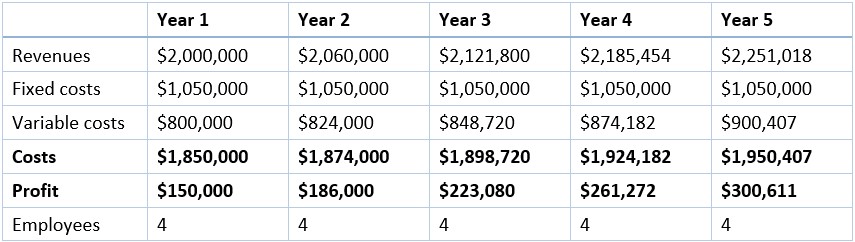
They both begin with an initial investment of $450,000. This is the life savings of both husband-and-wife teams. Both businesses generate $2,000,000 of revenue in their first year. Both have 4 employees, and both generate a profit of $150,000 in their first year.

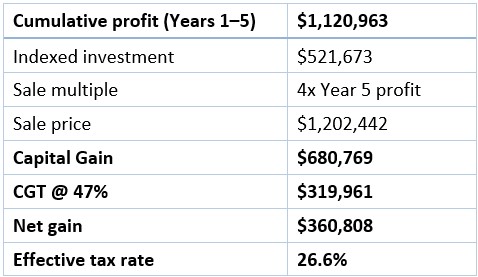
Over the next five years, Business 1 – the low productivity business – grows at 3% a year, ends up generating a profit of a little over $300,000 in the 5th year, and is sold for 4 times that – around $1.2 million. It still employs 4 people. With inflation at 3% a year, Business 1 has a taxable capital gain of $680,000. Under the new capital gains tax regime, they pay 47 cents on the dollar, or about $320,000 in CGT. That’s an effective tax rate of 26.6% of the sale price.

Business 1: Low productivity business, with a growth rate of 3% p.a., inflation rate of 3% p.a. and initial investment of $450,000:
Business 1: profit, capital gain and effective tax rate:
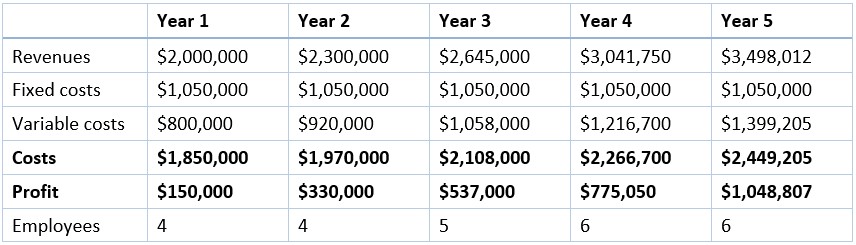
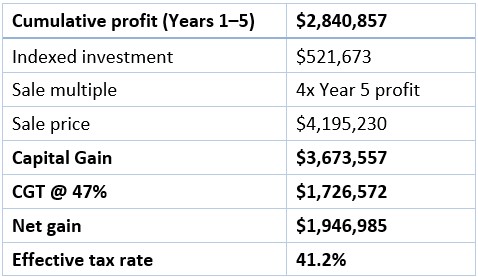
Over the same five years, Business 2 – the high productivity business – grows at 15% a year each year for 5 years. They end up employing 6 people. They also sell it for 4 times the year 5 profit of $1.05 million, or $4.2 million. They have a taxable capital gain of $3.67 million, pay $1.7 million in CGT, for an effective tax rate of 41.2% of the sale price.

Business 2: High productivity business, with a growth rate of 15% p.a., inflation rate of 3% p.a. and an initial investment of $450,000:

Business 2: profit, capital gain and effective tax rate:

Both businesses took a risk, grew a business, employed people, and paid tax, and both sold for the same multiple of profit. It’s just that Business 2 was more productive.

In return for this high productivity the couple who started Business 2 are punished with a capital gains tax rate more than 55% higher than the owners of Business 1.

In other words, the new tax system will now punish businesses more likely to create jobs and economic growth, and reward businesses more likely to shed jobs.
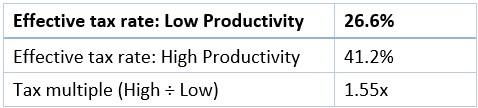
This is the worst possible plan for a country in need of more jobs, and more economic growth. It’s a Productivity Tax in the middle of a productivity crisis.

Unfortunately, that is the perverse logic of a Productivity Tax, they punish high productivity businesses for doing well, growing fast, and creating more jobs.

Young people will pay the biggest price for this profound policy error, because they will miss out on the jobs, growth, and prosperity that productive businesses create.


Richard Holden is Vice-Chancellor’s Professor and Chief Societal Economist at UNSW Sydney. He is also Director of the Economics Manos Institute for Cognitive Economics, and President Emeritus of the Academy of the Social Sciences in Australia.

This article was originally published by UNSW’s BusinessThink research platform. 


  •   3 June 2026
  • 7
  •      
  •   
7 Comments
Jarrod Lilkendey
June 04, 2026

Whatever came of the productivity summit anyway?

Stephen
June 04, 2026

Higher taxes.

2
Old super hand
June 04, 2026

These are both very productive case studies, with even the supposed low productivity having a large increase in profits and a subsequent capital gain.
If the couple paid the amount of tax in the worked examples they would be very poorly advised by their accountant. There are various concessions that apply when a small business is sold where the capital value is under $6 million.
https://www.ato.gov.au/businesses-and-organisations/income-deductions-and-concessions/incentives-and-concessions/small-business-cgt-concessions/small-business-cgt-concessions-eligibility-conditions
A bigger question is what is a fair rate of tax to pay if your investment value increases nearly 10 fold in a five year period. Pretty academic in any case for a husband and wife cleaning team in their 30s!

Chris Hedge
June 04, 2026

Gee Richard, that really is a "clutching at straws" argument that one. Absolutely ANY business that is more profitable than the business next to it will pay more income tax than the business next to it. So, using your argument above, that also will become a "tax on productivity". Really ?

Steven Jackson
June 04, 2026

Indonesia has far and away lower taxes and commensurately less services, this country was a shining example of an egalitarian system but it lowered the share of the pot for capital holders post war and increased the share to labour to the highest level of all times some suggest, this egalitarianism is gone and we have a burgeoning homelessness problem that even extends to housing strain on a registered nurse living in Western Sydney or similarly the Northern or Western suburbs of Melbourne earning $90k pa who still has a HECS debt when previously for late boomers it was free for a period and the chance of the nurse being able to buy her self a house is slipping away from her rapidly.


Now we hear howls of complaint when a tiny tinkering of the balance is being attempted after the very large transfer of wealth to capital in the last 30 years. What sort of country do we want, an egalitarian country like I grew up in or an American style country were you go bankrupt for medical care if unemployed hence uninsured?

John G
June 04, 2026

Why should it be any different to two employees working for the same company? One worker stays in the same role for 5 years and the other increases their qualifications and subsequently gets promoted with commensurate increase in income and tax bracket.


Leave a Comment:

RELATED ARTICLES

Australia’s government debt and its ‘lazy balance sheet’

Noel Whittaker’s take on the budget

The lesser-known effects of changed property taxes

banner

Most viewed in recent weeks

The ultimate superannuation EOFY checklist 2026

Here is a checklist of 28 important issues you should address before June 30 to ensure your SMSF or other super fund is in order and that you are making the most of the strategies available.

Noel Whittaker’s take on the budget

Marketed as a fix for inequality and housing affordability, the latest budget instead delivers a tangle of tax changes that leave everyday Australians worse off.

Australia has no death duties. Technically.

Australia may not levy formal death duties, but a growing web of tax measures is quietly shaping what wealth passes between generations. Now, the 2026 budget adds another layer.

Lithium's rally is real this time – but no-one trusts it

The lithium rally mirrors the early-2010s tech stock surge, with demand set to double by 2030. Supply has been slow to respond, creating a market deficit for future tech like humanoid robotics and solid-state batteries.

Welcome to Firstlinks Edition 662 with weekend update

The debate over the budget is increasingly shaped by frustration and perceptions of unfairness, rather than clear-eyed assessment of policy outcomes.

Two months into retirement

A retirement researcher's take on retirement and her focus on each of her six resource buckets to stay engaged during the transition and beyond.

Latest Updates

Are the government’s CGT changes better for young investors?

New CGT rules promise fairness, but could young investors lose out? A practical scenario reveals how changes impact deposit goals, investment choices, and long-term wealth building for the next generation.

Retirement

How to minimise tax with a will

Inheritance tax implications in Australia may surprise some, as poor estate planning without proper wills or trusts can lead to costly tax bills and delays for beneficiaries.

Investment strategies

AI can’t pick winning funds, but it can help you avoid losers

Machine learning has been touted a game changer investment management. But a new study overturns claims that AI can generate positive alpha in mutual funds. Here are some practical takeaways for investors.

Investment strategies

Inflation BIG picture: Boomers got lucky, next Gen not so much

A 150-year view shows inflation's upward bias, driven by shifting monetary regimes and war stocks. This marks an end to the low-inflation boom that enriched boomers and ushers in a higher-inflation era for younger investors.

Planning

Tax deductibility of financial advice improves affordability

A shrinking adviser workforce and rising costs are squeezing access to financial advice, just as demand surges. Expanded tax deductibility offers a modest but meaningful boost to affordability.

Retirement

Retirement in reality – 3 months in

A reflection on travel mishaps, smart decision-making, time pressures and rebuilding health habits. Three months in, here's how to navigate the surprising realities of life after work.

Taxation

Calculating the business cost of Australia’s new 'productivity tax'

Amid a national productivity crisis, new economic analysis finds the tax changes in the 2026 Federal Budget create Australia’s first-ever by design 'Productivity Tax', where young people will pay the biggest price.

Sponsors

Alliances

© 2026 Morningstar, Inc. All rights reserved.

Disclaimer
The data, research and opinions provided here are for information purposes; are not an offer to buy or sell a security; and are not warranted to be correct, complete or accurate. Morningstar, its affiliates, and third-party content providers are not responsible for any investment decisions, damages or losses resulting from, or related to, the data and analyses or their use. To the extent any content is general advice, it has been prepared for clients of Morningstar Australasia Pty Ltd (ABN: 95 090 665 544, AFSL: 240892), without reference to your financial objectives, situation or needs. For more information refer to our Financial Services Guide. You should consider the advice in light of these matters and if applicable, the relevant Product Disclosure Statement before making any decision to invest. Past performance does not necessarily indicate a financial product’s future performance. To obtain advice tailored to your situation, contact a professional financial adviser. Articles are current as at date of publication.
This website contains information and opinions provided by third parties. Inclusion of this information does not necessarily represent Morningstar’s positions, strategies or opinions and should not be considered an endorsement by Morningstar.