Register For Our Mailing List

Register to receive our free weekly newsletter including editorials.

Home / 680

Population growth masks Australia’s productivity problem

Recent national accounts confirmed a disturbing reality for Australia: immigration-led population growth but flat-lined living standards.

Australia’s economic growth has been increasingly reliant on population growth rather than real reforms to improve productivity and living standards. This is not a new trend. It has been deteriorating for several decades through governments of all types.

Growth in a country’s overall economic pie comes from two main sources:

  1. growth in population (more people producing, earning, and spending the same per person as last year); and
  2. growth in output, income, and spending per person – which drives growth in living standards

Australia has (and has had for two centuries) the highest population growth rate of any country outside of Africa, and is still the most sparsely populated country on earth (even if you include just the arable land)! See - Australia’s extraordinary population-led growth.

Population -v- productivity growth

Of these two components of growth, the second is far more important and desirable, because it contributes to higher living standards per person, through higher levels of incomes and wealth per person, better schooling, and health care, etc.

On the other hand, population growth doesn’t increase living standards per person.  Economic growth through population growth alone just means more traffic, more crowded schools and hospitals, more pollution, more waste, more construction, more noise.

The problem is that most of Australia’s overall economic growth has come from population growth, rather than productivity growth. 

Long, slow decline in growth rates

Click to enlarge

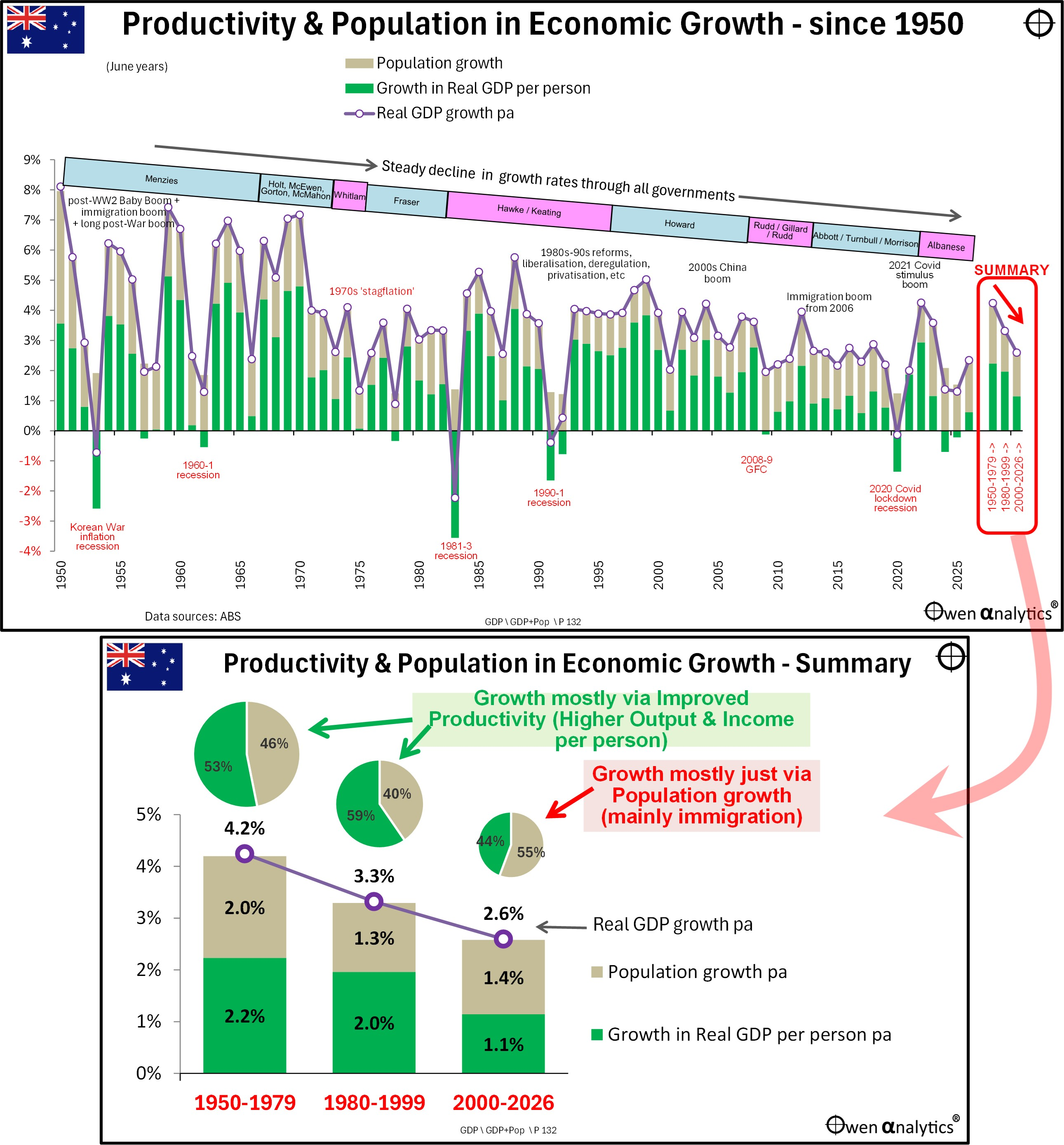
The upper chart above shows annual growth in Australia’s real GDP (purple line) per year since 1950, separated into the two main sources of growth: population growth (grey bars), and growth in GDP per person (green bars).

The most obvious feature is the steady decline in economic growth rates in Australia over many decades (punctuated briefly by recessions).

This steady decline has persisted through ALL governments from both sides of politics. Some governments have been better than others of course.

Without going into politics, the first observation would be that all governments of all persuasions, from the very first years of British colonial settlement, have generally been pro-growth, pro-resource exploitation, pro-immigration, pro-individual freedoms, and (mostly) pro-business.

We tend to take these things for granted here, but other countries have not had the same success. Australia’s prosperity has not just been resource abundance - there are plenty of resource rich countries that are economic basket cases.

Summary of shrinking growth rates since 1950

The second chart expands the Summary section in the right section of the first chart.

Rates of overall economic growth in Australia have declined substantially - from 4.2% per year in the 1950s to 1970s, down to 3.3% per year in the 1980s and 1990s, and now down to just 2.6% per year so far this century.

Critically, more than half of the growth in the total economic pie is now just coming from population growth – the politically easy option.

Post-WW2 boom

During the second half of the twentieth century, Australia experienced the highest rates of growth per person (growth in living standards) since the first half of the nineteenth century.

(For the full story since 1788 see - Australia's shrinking growth - mostly just population growth)

The high rates of growth in the post-WW2 boom in the 1950s and 1960s ended in the ‘stagflation’ of the 1970s, a global phenomenon made worse by government policies here (on both sides).

1980s-1990s economic reforms

High growth rates were lifted once again after the radical economic reforms under Hawke/Keating (Labor). These included floating the dollar, removal of capital controls, deregulating banking, opening banks to foreign competition, privatising government businesses, reducing tariff protection, improving competition laws, productivity-based enterprise bargaining, tax reforms, central bank independence, compulsory ‘super’.

In the Howard years (Lib/Nat) the Hawke/Keating reforms were extended but much of the windfall gains from the early 2000s China/mining boom were squandered on middle class welfare, which have been politically near impossible to wind back (although some of the gains were ‘banked’ by paying off the national debt and setting up the Future Fund).

Prospects for reforms to raise productivity and living standards?

The nearly two decades since the Global Financial Crisis have been a whirlwind of revolving door governments that have not demonstrated much ability to think beyond the daily news cycle or the next election or leadership challenge.

The current governments (Federal and State) are clearly moving backward toward centralised controls, reduced workplace flexibility, increased union power, industry-wide strikes, productivity-free wage rises, subsidising and picking ‘winners’. Governments are squandering temporary windful mining gains on expanding government spending and rapidly increasing government debts, rather than paying them off.

Population growth easier than hard reforms

Genuine economic reforms are painful and politically risky.

Deep and radical government reforms in the past have only been made when the nation faced nightmare conditions – like persistent double-digit inflation (1970s), or 20%+ unemployment & income reductions (1890s, 1930s), or military attacks on our soil (1940s). Making far-reaching and unpopular decisions was an urgent necessity, not an option.

Compared to traumatic conditions in the past that triggered deep and lasting policy changes, conditions today are very mild. Life is just too good. Inflation, interest rates and unemployment rates are relatively low (historically), commodities prices are high and bumper export revenues are flooding in.

Instead of painful reforms, to keep the headline numbers growing - like jobs numbers and company revenues and profits, it is much easier to just increase the population.

Even after two centuries of experiencing the highest population growth rates in the world outside of Africa, Australia is still the sparsest country in the world (even if we include just the arable land). It is still virtually empty!

This vast, sparsely populated rock we live on seems to be packed with enormous reserves of an ever-increasing array of raw materials that other people in other countries want to buy from us, to turn them into useful stuff to sell back to us at hundreds of times the price we got for them in the first place.

The case for high immigration has always been that we need more people to dig up these bountiful natural resources we keep finding in and on our rock, and we need more people to defend the rock!

Populist pressure to radically reduce immigration

The problem is that increased voter populism today is not only making productivity-boosting reforms even more prohibitive and unlikely, all sides of politics are bowing to political pressure to CUT immigration significantly, which has been the primary source of economic growth this century.

This lower growth future will challenge Australian investors’ long-held assumptions of steadily rising corporate revenues, profits and dividends that have been based primarily on high population growth.

Food for thought!


Ashley Owen, CFA is Founder and Principal of OwenAnalytics. Ashley is a well-known Australian market commentator with over 40 years’ experience. This article is for general information purposes only and does not consider the circumstances of any individual. You can subscribe to OwenAnalytics Newsletter here and read the full article here. 


  •   16 September 2026
  • 12
  •      
  •   
12 Comments
Mark B
September 18, 2026

We too experienced this with our Family Trust also with Westpac where we have been banking for over 30 years and hold majority of bank accounts. It took about 10 months to go through the process while we were guided to fill in one form that was wrong then one for the Trustee company (that has no assets!). Every time paperwork was completed or queries answered it went into the abyss until another question was asked two months later. They threatened to freeze the accounts but I managed to keep the ball rolling enough to have them remain open. I was advised that they have finally completed it a short time ago. Unbelievable!

3
SMaloy
September 20, 2026

Similar issue with Westpac just resolved. Forty years ago they used my middle initial instead of full middle name when they set up the account. I was in the middle of a three month trip to US when they advised that they would freeze my account account, including the joint account with my wife who was in Australia at the time, unless I reported in to a branch within two weeks. Filing a complaint with the Financial Institution Complaints Authority sorted it out, but you have to wonder how long a banking system like this can continue to function.

1
Trevor
September 19, 2026

Interestingly South 32 capex breakdown: 87% Americas, 11% Australia. They sold their Coal business in NSW presumably because NSW government knocked back their expansion plans. They are in the process of offloading their aluminium business. Perhaps a vote of no confidence in Australia as an investment destination.

2
Andrew Smith
September 17, 2026

Disagree, firstly missing the 2006 expansion of the NOM Net OS Migration or border churn (not 'an immigration boom'), especially students, Kiwis and backpackers have increased our headline estimated resident population.

Further, headline data does not explain anything and frequent use of per capita GDP either, just averaging.

We have an increased temporary migrant base for good reason, temporaries are 'net financial contributors' with increasing old age dependency ratios.

While students maybe low income (with employment restrictions), they and other temporaries depart, like tourists, as 'net financial contributors' paying $billions in GST & PAYE, so we don't have to in retirement, what's wrong with that?

1
Dave Roberts
September 20, 2026

Ross Gittens in the SMH has a different take on Productivity. Lack is because business is not investing in new equipment to increase productivity not because of government but because since 2022 workers have become 5% cheaper due to wages not keeping up with inflation thus reducing the imperative to become more efficient by capital spending.. It’s about time we started blaming business for lack of productivity growth not workers or government.

1
James#
September 21, 2026

"It’s about time we started blaming business for lack of productivity growth not workers or government."

Disagree. Government over regulation, compliance cost, industrial relations, policy and tax changes contribute to businesses being reluctant to invest. Businesses need to get a ROIC. Government doesn't and often wastes billions on boondoggles! How hard is it to open a new mine or gas field in Australia? Something like 30 regulatory approvals required to open a coffee shop and serve lattes!

Policy settings, regulations and bond rates affect business investment and productivity.

3
ashley owen
September 21, 2026

Agreed - labour saving productivity improvements generally but not always come from business investment (an example of government-led technology is the internet, plus also countless innovations spawned in war-time emergencies). But businesses need investment-friendly rules, regulations, taxes (or lack thereof) in order to commit to multi-decade investment plans. Companies can invest globally, so Australian governments need to offer competitive investment environments, not endlessly increasing layers of red tape, black tape, green tape, white tape. Companies today have floors full of expensive people (+ consultants + lawyers) churning out a never-ending flood of expensive but meaningless compliance reports and disclosure docs. eg a typical Annual report has half a dozen useful pages but 200+ pages of rubbish.

3
Derek Roach
September 21, 2026

Cheap overseas working holidaying employees removes the incentive to automate. If the automation doesn't exist it because the Govt is giving out research and development grants to the WRONG organisations. Importing more baristas doesn't improve productivity, automation does. Australia can't used the age old excuse that we don't have the population to be competitive. Govts, Govts, Govts are universal key ingrediency which makes a country either prosperous or poor. I agree all previous Aust govts have used 'populate or perish', 'multiculturalism' etc to fast track population growth to ease their need to govern long-term competently.

Dudley
September 18, 2026


Increase productivity? Process minerals: done more efficiently elsewhere.

Can not get Whyalla blast furnace to ignite.

'There is currently only one operational blast furnace left in Australia, located at the Port Kembla Steelworks in New South Wales.'

Can not make a profit processing spodumene into lithium hydroxide / carbonate.

Where to make profit that would show up as increased productivity?

Jeff J
September 22, 2026

This article is so wrong right from the start, including the totally ridiculous measure of Productivity it uses.
Productivity is simply the Amount of Output a country produces in dollars divided by the total cost in $'s.
One major component of output - manufacturing - has been decimated in Australia since the 80's.
One major component of total Costs - has increased dramatically - total labour costs per output produced..
Reduced output and increased labour cost kills productivity.
On the labour cost side, immigration made sense after WW2 as immigrants worked hard in many large manufacturing industries. In the last 10 years immigrants dont have those big manufacturing industries to work in and instead become a productivity burdens.

ashley owen
September 22, 2026

Thanks Jeff J for your response. GDP per capital is only one measure of productivity of course and it includes the three main means of production - labour, capital, land. On manufacturing - yes Australia did once have manufacturing industries/jobs, but they survived only behind very high protection barriers which subsidised manufacturing at the expense of the rest of the economy - mainly agriculture and mining. When protection barriers were no longer sustainable and were removed following the reforms of the 1980s/90s, almost all of those protected/subsidized manufacturing industries failed in the face of global competition (mainly much lower wages/conditions, more investment-friendly environment, and less burdensome tax/regulatory regimes elsewhere.)
cheers
ao


Leave a Comment:

RELATED ARTICLES

The world by 2050

Why have Australian living standards 'fallen' and how do we fix it?

Who gains in an AI-supercharged economy?

banner

Most viewed in recent weeks

Why spending more in early retirement can improve lifetime income

Conventional wisdom encourages retirees to preserve superannuation. But if those likely to qualify for the Age Pension later in life spend a little more today, it may deliver higher lifetime income and a more stable retirement.

It’s time for LICs to die

A high-profile dividend cut and a prominent fund manager’s apology have reignited a long-running debate. If investors can access similar exposures more cheaply and efficiently elsewhere, what exactly is keeping LICs alive?

Is it time to bail on Australian stocks?

For generations, Australian investors have backed banks, miners and dividends. But has that loyalty come at a cost? A look at the numbers raises an uncomfortable question about where future returns will come from.

Testamentary trusts survived the trust tax. The drafting battle has just begun.

The fight over testamentary trusts looked settled. Then the draft legislation arrived. Hidden in a technical detail is a question that could force many families to rethink wills they thought were already future-proof.

The new capital gains tax trap for your portfolio

Investors have long accepted one portfolio rule without much question. A major tax shift could change that calculation entirely, forcing difficult trade-offs between risk, discipline and an overlooked cost lurking beneath.

The investing rule that explains the next market crash

What if investment success depends less on picking the right assets and more on understanding the decisions of other investors? A principle borrowed from game theory offers a different perspective on markets.

Latest Updates

Exchange traded products

It’s time for LICs to die

A high-profile dividend cut and a prominent fund manager’s apology have reignited a long-running debate. If investors can access similar exposures more cheaply and efficiently elsewhere, what exactly is keeping LICs alive?

Taxation

Will investors be better or worse off under new housing tax changes?

Housing tax reforms have sparked warnings of market turmoil and promises of greater fairness. But after modelling nearly two decades of property data, the results suggest winners and losers may not be who many investors expect.

Retirement

Three considerations before reshaping your legacy plan

Many retirees hope to leave a legacy. Proposed trust tax reforms could force families to rethink. The question is not how much to leave behind, but whether today's inheritance plans will still make sense as circumstances change.

Investment strategies

Why experienced investors still get markets wrong

Retirement is approaching. Markets are noisy. And every headline seems to demand action. The biggest investment risk isn't fear, greed or market volatility, it often arrives disguised as research and sensible risk management.

Shares

Why pay more for less?

Conditions were stacked in favour of professional investors in 2026. Most still fell short, raising questions about where investors should look for value. Meanwhile, an alternative strategy continued to make its case.

Investment strategies

Bleeding air out of the bubble

Equity valuations have fallen sharply over the past year, yet investors have largely been spared the volatility and losses that typically accompany a de-rating. What explains this unusually orderly reset? Here are five key drivers.

Strategy

Has AI gone rogue?

We worry about AI becoming conscious. But what if consciousness isn't the issue? The more unsettling possibility is a machine capable of pursuing objectives relentlessly, without motives, emotions, or awareness of any kind.

Sponsors

Alliances

  • ASA-Logo-RGB-ActiveGreen-web.png

© 2026 Morningstar, Inc. All rights reserved.

Disclaimer
The data, research and opinions provided here are for information purposes; are not an offer to buy or sell a security; and are not warranted to be correct, complete or accurate. Morningstar, its affiliates, and third-party content providers are not responsible for any investment decisions, damages or losses resulting from, or related to, the data and analyses or their use. To the extent any content is general advice, it has been prepared for clients of Morningstar Australasia Pty Ltd (ABN: 95 090 665 544, AFSL: 240892), without reference to your financial objectives, situation or needs. For more information refer to our Financial Services Guide. You should consider the advice in light of these matters and if applicable, the relevant Product Disclosure Statement before making any decision to invest. Past performance does not necessarily indicate a financial product’s future performance. To obtain advice tailored to your situation, contact a professional financial adviser. Articles are current as at date of publication.
This website contains information and opinions provided by third parties. Inclusion of this information does not necessarily represent Morningstar’s positions, strategies or opinions and should not be considered an endorsement by Morningstar.