Register For Our Mailing List

Register to receive our free weekly newsletter including editorials.

Home / 402

Consumers need an effective super performance test

The Your Future, Your Super (YFYS) reforms are designed to improve outcomes for superannuants, which is nearly all of us. The reform package is undoubtedly well-intended. Therefore it is critical that it achieves its intended purpose. This has been our focus when we have reviewed one of the most important reform measures, an investment performance test.

Unfortunately, our research (open to anyone, available here) finds that the performance test will not effectively achieve its intentions and will generate some undesirable outcomes. Statistically, the performance test will struggle to distinguish ‘good’ funds from ‘bad’. Further, the performance test will significantly constrain the investment strategies of super funds, to such a degree that the opportunity cost of the constraints may exceed the projected benefits of the YFYS reforms.

The YFYS performance test explained

The YFYS performance test assesses past investment performance. For background, super funds have two primary functions when managing portfolios:

  1. They choose the mix of assets (we call this asset allocation); and
  2. They implement their asset allocation (implementation), sometimes by investing directly and sometimes via external asset managers, who charge fees.

The YFYS performance test ignores asset allocation (which has a large impact on performance) and only assesses implementation performance. It does this by mapping portfolio exposures to a limited set of public market indices.

The example below places context around the total performance outcome. Fund A outperforms Fund B because it chose a better performing asset allocation, which more than offsets its weaker implementation performance. Yet Fund A will fail the YFYS performance test.

Performance component

Fund A

Fund B

Asset allocation

7.5%

6.5%

Implementation

-0.5% pa

0% pa

Total performance

7.0% pa

6.5% pa

Will the test be able to effectively distinguish between ‘good’ and ‘bad’ performers?

Performance varies over time. A fund may have strong capability and is expected to perform well over time, but variability exists and there is a chance they will fail the performance test at some point in time. Similarly there is a chance, again due to variability, that a fund with poor processes will pass a performance test. Greater variability takes the likelihood of failure towards 50%, akin to a coin toss. Longer timeframes smooth out the impact of variability.

The statistically-minded may recognise these scenarios as type I (identifying a ‘good’ fund as poor) and type II (identifying a ‘poor’ fund as good) errors. These essentially reflect the statistical effectiveness of the test. An effective test will have low likelihoods of both errors occurring.

We found that two design characteristics of the YFYS performance impair its effectiveness.

The first, as previously explained, is that the test ignores asset allocation performance, which can create large variability in fund performance.

The second is the benchmarking approach. There are many assets which are not benchmarked accurately, most notably private equity, unlisted property, unlisted infrastructure, all forms of credit, inflation-linked bonds, and the entire universe of alternative assets. This creates significant variability in the performance test results.

The good news is that for funds with extremely poor implementation performance the YFYS performance test will be quite effective. The bad news is that in less extreme situations, the ones more likely to be faced in the future, the test won’t work well.

Calibrated to realistic future scenarios our research revealed that the likelihood of the YFYS performance test mistakenly identifying a ‘good’ fund as poor was 35%, and the likelihood of mistakenly identifying a ‘poor’ fund as good was 42% (full results here).

Consumers deserve an effective performance test and industry deserves a fair assessment. As it stands the YFYS performance test won’t provide either.

Will the test constrain super funds from achieving best outcomes?

For super funds, the penalties of failing the performance test are severe. Accordingly, we expect them to actively manage their portfolios to ensure a high likelihood of passing the test.

This means reducing variability to the performance benchmark (this variability is known in industry as 'tracking error'). In turn this means limiting exposure to all those above-mentioned assets which the test doesn’t benchmark accurately (we found it would take over 50 indices to create a reasonably effective implementation test).

If present investment strategies are maintained, funds may find they have to frequently adjust their portfolios in reaction to short-term underperformance, which could incur sizable transaction costs.

In future, super funds will seek a stable investment strategy which provides a high likelihood of passing the performance test and low likelihood of having to frequently alter their portfolios.

How much would portfolios have to be shifted from current state, which is focused on member best outcomes, to future state, where they need to account for the performance test? This effectively represents the constraints imposed by the performance test. The diagram below presents the conflict faced by super funds.
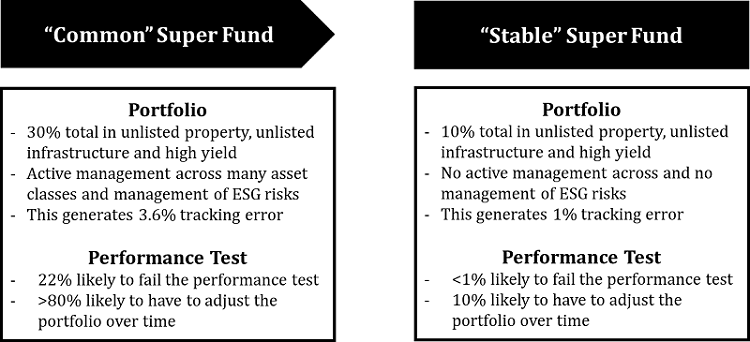
Using conservative estimates (here) we calculated the opportunity cost of the portfolio constraints implied by the YFYS performance test. In aggregate we estimate these will exceed $3 billion per annum, greater than the projected benefits of the YFYS reforms in total ($17.9 billion over 10 years).

Can we design a better YFYS performance test?

A well-designed performance test can benefit consumers. Our research, which combined academic techniques with industry experience, has identified flaws in the performance test which will cost consumers. We believe the test can be modified in a simple manner by including an additional metric which focuses on risk-adjusted returns. This would remove many of the shortcomings and provide consumers the protection they need and deserve.


David Bell is Executive Director of The Conexus Institute, a not-for-profit research institution focused on improving retirement outcomes for Australians. This article does not constitute financial advice.


  •   7 April 2021
  • 6
  •      
  •   
6 Comments
John De Ravin
April 07, 2021

Thank you for your interesting and well reasoned article about the YFYS performance tests David. I agree with you (and much of the industry) that the tests need tweaking in some way. However I have two reservations about whether simply adding a “risk-adjusted” metric will resolve the issues.

Firstly isn’t the “risk-adjusted” return partly subject, for unlisted assets, to the valuation approaches adopted by the funds?

And secondly, assuming that “risk-adjusted” means that short-term volatility is taken into account (Sharpe ratios etc), I would query whether short-term volatility is of very crucial interest to a very long-term investor. What does it matter to a 20-year old, whose funds will be inaccessible for 40 years, that the single-year standard deviation of returns is higher in Fund X than in Fund Y, when really it’s the 40-year-averaged standard deviation that is really relevant to this member’s outcome? Put another way, the “risk vs return” trade off seems to me to be different for fund members with different time horizons.

David Bell
April 07, 2021

Hi John,

Thanks for sharing your thoughtful insights.

Our starting point was that the Government is intent on implementing the performance test, so the question became “what is one relatively simple change we would recommend which offsets many of the shortcomings?”
Your first point is a good one. YFYS is agnostic to how much risk – it remains one of a number of remaining “lottery effects” which will create significant dispersion in outcomes between members of different funds. Unfortunately, I don’t think we can address this issue in this round of reforms.

However, this doesn’t mean we need to ignore the risk efficiency of funds. Consider a future where the performance test is applied to lower risk choice products and retirement solutions. There are many ways to achieve a targeted level of risk and diversification can play a big role in the risk outcomes. That is why we advocate for a risk-adjusted metric. And it is far from a free ride either – our suggested metric compares outcomes against a portfolio of stocks and bonds delivering the same realised risk outcome – so there is effectively a benchmark diversification outcome embedded. Why bother? Well, many of the diversifying assets are the ones most heavily penalised in the proposed test.

Your second point is also well made. Whether, and the degree to which, the risk of unlisted assets is understated is the source of much debate. We have done work which details the option of incorporating a crude volatility adjustment to account for unlisted assets.

Overall, our biggest concerns with the performance test are that it ignores asset allocation decisions, has a large range of benchmarking issues, and ignores diversification benefits. This metric addresses these issues but is far from perfect. Fail both and you are out!

Cheers, David

Trevor
April 09, 2021

I just WISH that "they" ...the "know it all experts"......would just BACK OFF and leave the system alone !
By the time "one" adjusts to the "new , improved scheme" [ which is always retrograde or adverse IMO ]
"they" have another "new , improved scheme" on the slip-way ready to be launched !
So , instead of being able to RETIRE and RELAX in retirement , "one" is constantly "alarmed and alert" ,
the very opposite to what had been assumed before "one" retired , accepted redundancy or became equally removed and unable to repair any financial miscalculations.
IF "they" MUST TINKER ..... then do it with THE NEW COHORT.....and leave the REST OF US ALONE to rest !

.

john
April 29, 2021

A simple quick question. Do the performance tests include retail for profit funds as well as industry super funds ?? And of course final result for the client, that is after fees etc ??

David Bell
May 02, 2021

Hi John,
Thanks for your question, it is quite timely! On Wednesday 28 April the Government announced some changes to the design of the performance test. One change is to incorporate administration fees. This means that all sources of fees are included in the performance test, meaning it now captures any margin charged by retail funds. We think this is a good improvement but be aware that funds provide different service levels.
Cheers, David

David Bell
May 02, 2021

On Wednesday 28 April the Government announced two important changes to the performance test. One was the inclusion of administration fees (for further detail, see response to John’s question below). The other was the inclusion of three additional indices to benchmark unlisted property and infrastructure. This change removes a lot of the noise from the benchmarking process, to the extent that the concerns raised in the second section of this article (including the diagram) become far less significant.

Great to see Government and Treasury taking feedback on board.

David


Leave a Comment:

RELATED ARTICLES

Three reasons why super performance test fails

Extending performance tests to retirement super is a bad idea

The current super system fails the poor

banner

Most viewed in recent weeks

Noel Whittaker’s take on the budget

Marketed as a fix for inequality and housing affordability, the latest budget instead delivers a tangle of tax changes that leave everyday Australians worse off.

Australia has no death duties. Technically.

Australia may not levy formal death duties, but a growing web of tax measures is quietly shaping what wealth passes between generations. Now, the 2026 budget adds another layer.

Welcome to Firstlinks Edition 662 with weekend update

The debate over the budget is increasingly shaped by frustration and perceptions of unfairness, rather than clear-eyed assessment of policy outcomes.

How to minimise tax with a will

Inheritance tax implications in Australia may surprise some, as poor estate planning without proper wills or trusts can lead to costly tax bills and delays for beneficiaries.

How inflation is quietly moving the goalposts on retirement

Inflation doesn’t just raise today’s bills - it quietly increases the amount needed to retire, while simultaneously making it harder to save. Three steps to take before June 30th to improve retirement outcomes.

Back to the future - Why indexing CGT is a good idea

A return to indexation of capital gains would be a fairer way to compensate households for the effects of inflation than the current discount. Importantly, it opens the door to future, broader reforms to stop the taxation of inflation.

Latest Updates

Investment strategies

High quality businesses are on sale

Beneath the dominance of the ASX's largest stocks, much of the market has been left behind. High-quality companies are now trading at levels rarely seen, offering opportunities for investors willing to look deeper.

Investment strategies

The whirlwind is upon us

Something unusual is happening in markets. The winners are pulling further ahead at an extraordinary pace. As return dispersion hits extreme levels, volatility is rising and the investing landscape is becoming harder to navigate.

Strategy

Inequality destabilises economies

Extreme wealth concentration is no longer just a side effect of growth. As inequality deepens, its consequences are shifting from a social concern to a broader threat to economic stability and democratic resilience.

Investment strategies

Have AI’s four horsemen arrived?

AI exuberance is colliding with economic reality. Cracks are emerging as spending surges, ROI remains uncertain and enterprise behaviour shifts. The next phase may look less like an expansion and more like a reckoning.

Taxation

Budget tax changes only scratch the surface. Here are 4 reforms Australia needs next

The 2026 budget has reignited Australia’s tax reform debate, but more work remains. Beneath the surface lies a harder question: what structural reforms are needed to make the country's tax system fit for the future?

Taxation

Negative gearing: quarantined, not killed

The Budget's negative gearing changes defer deductions rather than deny them, yet a worked example shows quarantining can halve the tax benefit's present value for buyers of established dwellings.

Investment strategies

Family offices have quietly taken over Australian private capital

In just four years, Australia's private capital landscape has transformed. We are seeing changes across who deploys capital, how deals are structured and why new platforms and investor pathways are rapidly emerging.

Sponsors

Alliances

© 2026 Morningstar, Inc. All rights reserved.

Disclaimer
The data, research and opinions provided here are for information purposes; are not an offer to buy or sell a security; and are not warranted to be correct, complete or accurate. Morningstar, its affiliates, and third-party content providers are not responsible for any investment decisions, damages or losses resulting from, or related to, the data and analyses or their use. To the extent any content is general advice, it has been prepared for clients of Morningstar Australasia Pty Ltd (ABN: 95 090 665 544, AFSL: 240892), without reference to your financial objectives, situation or needs. For more information refer to our Financial Services Guide. You should consider the advice in light of these matters and if applicable, the relevant Product Disclosure Statement before making any decision to invest. Past performance does not necessarily indicate a financial product’s future performance. To obtain advice tailored to your situation, contact a professional financial adviser. Articles are current as at date of publication.
This website contains information and opinions provided by third parties. Inclusion of this information does not necessarily represent Morningstar’s positions, strategies or opinions and should not be considered an endorsement by Morningstar.