Register For Our Mailing List

Register to receive our free weekly newsletter including editorials.

Home / 137

Diversification is the foundation of a solid portfolio

It is well recognised that avoiding large losses is a key element in building wealth. The focus on capital preservation is warranted as heavy losses require very high rates of return to restore the original capital. For example, a 100% gain is required to recoup a 50% loss.

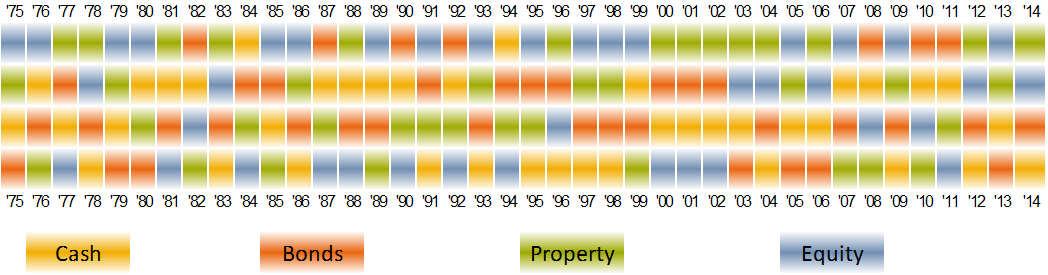
Exhibit 1 shows the annual returns of each of the four major asset classes over a 40-year period. The asset classes are arranged in descending order of return so that the best performing asset class is at the top and the poorest performing asset class is at the bottom. It is clear from the ‘gameboard’ that no single asset class either outperforms or underperforms consistently. The largest recorded annual fall in the 40-year period was property with 55.3%.
So how do we avoid the extreme losses to capital?

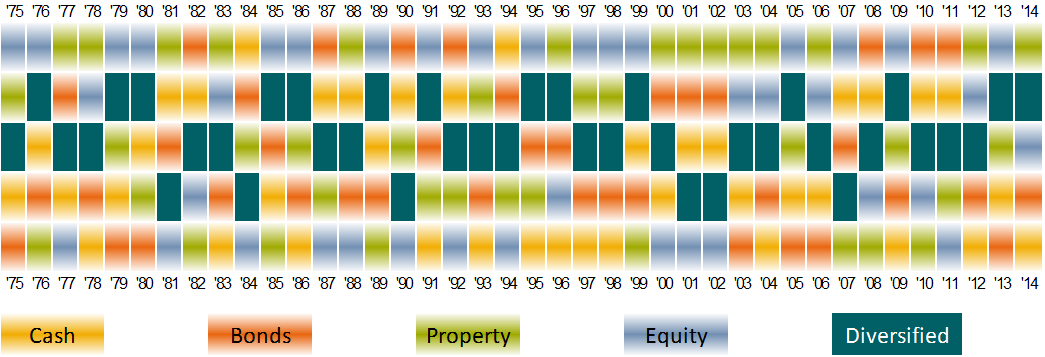
Diversifying or spreading investments across multiple asset classes reduces an investment portfolio's overall risk. This is because losses made in one asset class can be offset by gains in others. The benefits of diversification can be seen in Exhibit 2. It illustrates how a diversified multi-asset portfolio (60% growth assets) has performed compared to individual asset classes in the same 40-year period. In 34 years, the diversified portfolio has achieved a return in the top 3 asset classes and in only six periods, the portfolio has produced a return in the second-last ranking asset class. The diversified portfolio is neither the best- nor, more importantly, the worst-performing investment in any given year. The risk of a large loss to capital has been significantly reduced and the overall return is less volatile.
 

Peter Gee is Research Products Manager with Morningstar Australasia. Information provided is for general information only, and individuals should seek personal advice before making investment decisions. The objectives of any individual have not been considered in this article.

  •   3 December 2015
  • 3
  •      
  •   

RELATED ARTICLES

Five fundamental investing lessons

Asset allocation in a world of riskier developed markets

The perfect portfolio for the next decade

banner

Most viewed in recent weeks

Australia's retirement system works brilliantly for some - but not all

The superannuation system has succeeded brilliantly at what it was designed to do: accumulate wealth during working lives. The next challenge is meeting members’ diverse needs in retirement. 

Australian stocks will crush housing over the next decade, 2025 edition

Two years ago, I wrote an article suggesting that the odds favoured ASX shares easily outperforming residential property over the next decade. Here’s an update on where things stand today.

The 3 biggest residential property myths

I am a professional real estate investor who hears a lot of opinions rather than facts from so-called experts on the topic of property. Here are the largest myths when it comes to Australia’s biggest asset class.

AFIC on the speculative ASX boom, opportunities, and LIC discounts

In an interview with Firstlinks, CEO Mark Freeman discusses how speculative ASX stocks have crushed blue chips this year, companies he likes now, and why he’s confident AFIC’s NTA discount will close.

Where to hide in the ‘everything bubble’

It might not be quite an ‘everything bubble’ but there’s froth in many assets, not just US stocks, right now. It might be time to stress test your portfolio and consider assets that could offer you shelter if trouble is coming.

Property versus shares - a practical guide for investors

I’ve been comparing property and shares for decades and while both have their place, the differences are stark. When tax, costs, and liquidity are weighed, property looks less compelling than its reputation suggests.

Latest Updates

Investment strategies

History says US market outperformance versus Australia will turn

Much has been made of how US markets, especially the NASDAQ, have significantly outperformed the ASX over the past two decades. History suggests the pendulum will swing back once again in Australia's favour.

Investment strategies

Announcing the X-Factor for 2025

What is the X-Factor - the largely unexpected influence that wasn’t thought about when the year began but came from left field to have powerful effects on investment returns - for 2025? It's time to select the winner.

Economy

The illusion of progress

What is progress? Is it GDP growth? Increasing wealth? New and improving technology? This argues that our measure of progress has become warped, and we're heading backwards rather than forwards.

Strategy

Our favourite summer reads

Summer is a great time to catch up on a good book. Here is a list of books on leadership, investing, and well-being for those looking to learn, reflect, and gain inspiration over the holiday season.

Sponsors

Alliances

© 2026 Morningstar, Inc. All rights reserved.

Disclaimer
The data, research and opinions provided here are for information purposes; are not an offer to buy or sell a security; and are not warranted to be correct, complete or accurate. Morningstar, its affiliates, and third-party content providers are not responsible for any investment decisions, damages or losses resulting from, or related to, the data and analyses or their use. To the extent any content is general advice, it has been prepared for clients of Morningstar Australasia Pty Ltd (ABN: 95 090 665 544, AFSL: 240892), without reference to your financial objectives, situation or needs. For more information refer to our Financial Services Guide. You should consider the advice in light of these matters and if applicable, the relevant Product Disclosure Statement before making any decision to invest. Past performance does not necessarily indicate a financial product’s future performance. To obtain advice tailored to your situation, contact a professional financial adviser. Articles are current as at date of publication.
This website contains information and opinions provided by third parties. Inclusion of this information does not necessarily represent Morningstar’s positions, strategies or opinions and should not be considered an endorsement by Morningstar.