Register For Our Mailing List

Register to receive our free weekly newsletter including editorials.

Home / 152

Don't be misled by investment classifications

Investment professionals need to communicate as clearly as possible, and some classifications which market experts think are obvious can be confusing. This is a short piece with a few simple ideas on some investment descriptions. Anyone expecting a great piece of gravitas from me here will be disappointed.

In my view, many institutional investors follow herd-type thinking, without robust logic, because everyone before them followed the same line of thought. My many years of experience in investment markets have caused me to dismiss some of this traditional thinking. Much of what is preached is not robust enough in my view and I am not alone in my skepticism, though certainly in a minority. The investment community is prone to putting concepts into neat little boxes, which does not work because investing is more of an art than a science, despite the continued attempts to make it a more predictable subject.

Thinking about risk and return

A good example of what I am talking about is the distinction between defensive assets and growth assets and their relationship to risk and return.

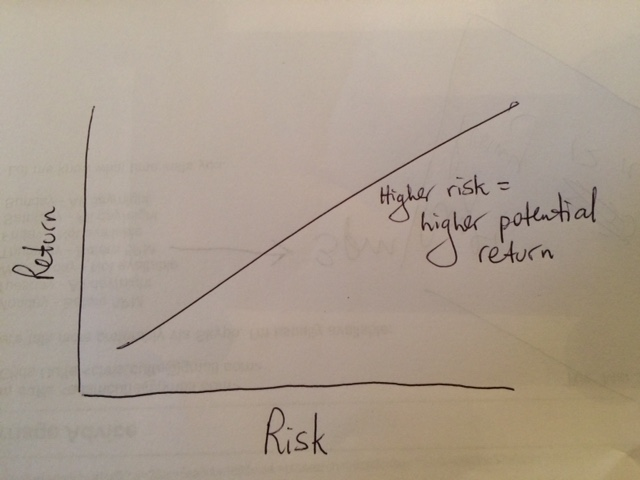
Like many, I think a good and simple way to think about investing is to visualise a line graph with risk on one axis and return on the other and with an arrow pointing from lower left to upper right. It represents the range of possible investment outcomes. This basically depicts the view that the greater the expected return from an investment then the greater the risk. This is a sensible way to think of investing within a framework of no free lunches.
Many investment professionals then segment this risk/return line into two sections. The bottom part comprises ‘defensive’ assets and the top part comprises ‘growth’ assets.
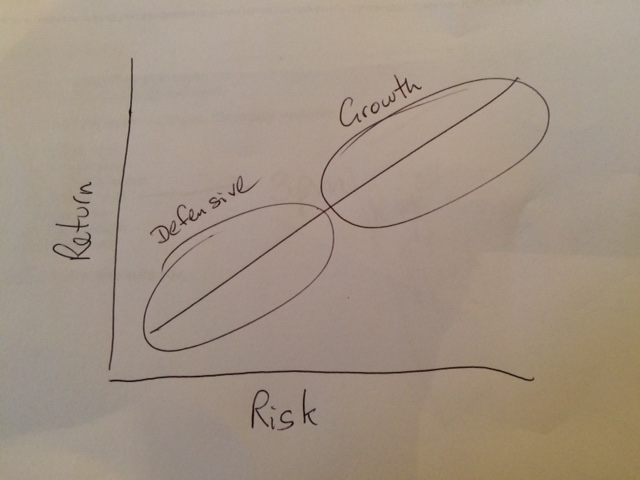
And most think of defensive assets as comprising cash and fixed interest, with growth assets comprising shares and property.

It’s neat, simple and convenient but in my view, these classifications are likely to mislead.

Avoid the word ‘defensive’

The largest option category run by institutional superannuation funds is their Balanced Accumulation option. Such investment products are usually classified as having approximately 30% in defensive assets and 70% in growth assets. And if the manager is feeling bearish about equity markets, they will proclaim that they are increasing their allocation to defensive assets.

The language is wrong. If we must use a two basket classification, then I prefer the terms ‘income’ and ‘growth’ which is a reference to where the majority of the return of a security or asset class is predicted to come from. Generally speaking, assets whose returns are largely from income (on the assumption the income is relatively secure and predicable) are considered less risky than assets whose returns are largely from growth (and hence dependent on many variables, mostly on future prospects).

I dislike the term ‘defensive’ because it is subjective and makes no reference to current valuations, timeframes or investment objectives. Defensive against what? And if I look in the dictionary the word ‘defensive’ has positive and comforting connotations like defending, guarding, safeguarding, protecting and shielding. So if the term is used, we need to be sure we know what we are talking about.

Some simple examples to illustrate the point:

  • You will lose a lot of money from holding a 10-year government bond (regarded as a risk-free asset and hence one of the more defensive of all assets) if interest rates move up materially and you are required to sell it before maturity, or if your performance and measurement are judged on a quarterly basis.
  • Cash is considered a very defensive asset. But if my investment objective was, say, to achieve a return in excess of CPI over the medium to long term, then cash may be a high risk asset. Many investors who went into cash after the GFC saw their incomes fall significantly, with real returns now below zero. Similarly, holding a portfolio of high quality equities over the long term gives a high probability of beating inflation, and dividends from shares and rents from property usually fall only 20-30% in a recession. But ‘cash’ is usually the lowest risk (and most appropriate) asset if your investment time frame is very short (say less than one year).
  • If the spread (margin above a government bond) on the debt of blue chip company is much tighter than the long-term average, then it may be a high-risk investment. Spreads can easily widen in different economic climates with resultant capital losses.

My point here is that hard-wired classifications can be misleading. It’s better to think of defensive as a relative concept, not the absolute that the word implies to most people.

Cash does offer certainty of capital value and immediate liquidity, and those are fine ‘defensive’ qualities, while bonds offer certainty of capital value and interest income if held to maturity (and assuming no defaults).

What do we really mean by ‘risk’?

What does the term ‘risk’ mean when we are trying to look at the risk/return characteristics of a security on the assumption we have a long-term time frame?

Most investment professionals (and non-professionals) equate risk to the degree of volatility in asset prices, usually measured as some variance around a mean return. However, I don’t believe this tells us much at all. In my article titled ‘We need to talk about risk’ I state that, like Howard Marks (a renowned US investment manager and investment author), I think the possibility of a permanent capital loss from owning an asset is at the heart of what investment risk is truly about. Then follows the possibility of an unacceptably low return from holding a particular asset. Marks believes much of risk is subjective, hidden and unquantifiable and is largely a matter of opinion. He makes the point that investment risk is largely invisible before the fact – except perhaps to people with unusual insight – and even after an investment has been exited.

No less an investor than Charlie Munger, Warren Buffett’s investing partner, said:

“In thinking about risk, we want to identify the thing that investors worry about and thus demand compensation for bearing. I don’t think most investors fear volatility. In fact, I’ve never heard anyone say, ‘The prospective return isn’t high enough to warrant bearing all that volatility.’ What they fear is the possibility of permanent loss.”

I agree with him. Market professionals like the traditional measure of risk, volatility, because they can measure it and sound intelligent. But if I am confident about the long-term prospects of a company, and I plan to hold its shares over the long term, then I don’t care about the short-term volatility. In fact, I try to ignore the share price except when I’m forced to do my accounts.

Like the word ‘defensive’, let’s also be careful how we think about and use the term ‘risk’.


Chris Cuffe is co-founder of Cuffelinks; Portfolio Manager of the charitable trust Third Link Growth Fund; Chairman of UniSuper; and Chairman of Australian Philanthropic Services. The views expressed are his own and they are not personal financial advice.


  •   21 April 2016
  • 3
  •      
  •   
3 Comments
Graham Wright
April 21, 2016

Being in the market is a risk, Being out of the market is a risk. Which risk do I need to accept now? As time passes I will need to re-assess these risks.

Jason
April 22, 2016

Some great points here. Once you see fixed interest investments doing negative you tend to stop using the word defensive. Rather than being worried about using the word "'defensive"'. I would be more worried about using the word "balanced". A balanced fund using 70% equities and even up to 85% which is common amongst some super fund would be more misleading and more worrying than using the word defensive. The word balanced implies a balanced mixture of both income and growth investments, that being around 50/50 or approx. Not 70% to 85%.

David
April 30, 2016

Chris I agree with you about the term "risk". When talking about dispersion of potential returns it is "volatility" not risk. Why do we have to unnecessarily confuse and frighten investors by using the term "risk" to describe volatility, when their understanding of risk is quite different?

While I take your point about "defensive", I'm not so sure "income" is the best alternative term. Many Australian investors now perceive "income" investments to be shares with high dividends, and this concept has crept into product labelling of some share funds.

I particularly agree with Jason's comment about the term "balanced". This would have to be the most misleading and inappropriate term in the Australian investment landscape. For goodness sake, 99% of Australians think "balanced" means 50/50. When investment professionals define it as 60/40, 70/30, or even 80/20 it is just a recipe for confusion and bad investment decisions. How many people switched their retirement savings to high performing "balanced" funds in early 2007, when the high performance of those funds (to that point) was primarily due to their 80/20 asset allocation?

I know some people will say balanced is derived from efficient frontier theory and is not supposed to mean balanced in its common usage sense. But it is simply not reasonable to expect average investors to learn academic investment theory, and unlearn their understanding of language.

So let's use the term "volatility" for volatility, and banish the term "balanced"!


Leave a Comment:

RELATED ARTICLES

Let’s clarify growth/defensive and move forward

Three underrated investment risks in retirement

Is FOMO overruling investment basics?

banner

Most viewed in recent weeks

Building a lazy ETF portfolio in 2026

What are the best ways to build a simple portfolio from scratch? I’ve addressed this issue before but think it’s worth revisiting given markets and the world have since changed, throwing up new challenges and things to consider.

Meg on SMSFs: First glimpse of revised Division 296 tax

Treasury has released draft legislation for a new version of the controversial $3 million super tax. It's a significant improvement on the original proposal but there are some stings in the tail.

Ray Dalio on 2025’s real story, Trump, and what’s next

The renowned investor says 2025’s real story wasn’t AI or US stocks but the shift away from American assets and a collapse in the value of money. And he outlines how to best position portfolios for what’s ahead.

10 fearless forecasts for 2026

The predictions include dividends will outstrip growth as a source of Australian equity returns, US market performance will be underwhelming, while US government bonds will beat gold.

13 million spare bedrooms: Rethinking Australia’s housing shortfall

We don’t have a housing shortage; we have housing misallocation. This explores why so many bedrooms go unused, what’s been tried before, and five things to unlock housing capacity – no new building required.

10 things I learned about dementia and care homes from close range

My mother developed dementia before eventually dying in June last year. She was in three aged care homes before finding the right one. Here is what I learned along the way.

Latest Updates

Taxation

Is there a better way to reform the CGT discount?

The capital gains tax discount is under review, but debate should go beyond its size. Its original purpose, design flaws and distortions suggest Australia could adopt a better, more targeted approach.

Property

It's okay if house prices drop

The assumption that falling house prices are electorally fatal has shaped policy for decades. Evidence from upzoning suggests affordability can improve without reducing overall housing wealth.

Investment strategies

Investment bonds for intergenerational wealth transfer

Investment bonds can be a versatile and a tax-effective option for building wealth for longer-term investment goals. They can also be used as an estate planning tool, enabling the smooth transfer of wealth to younger generations.

Investment strategies

Why switching to income may make sense in 2026

Investors are jumpy as valuations continue to rise and income investing may provide a respite. In a challenging market for income investing AML offers their top picks.

Interviews

Retiring Schroders boss on lessons he’s learned, industry changes, and the market outlook

CEO Simon Doyle is retiring after 38 years in the finance industry. In an interview with James Gruber, he shares the three main lessons he’s learned, and where he sees opportunities and risks in markets today.

Investment strategies

How US midterm elections affect the markets

Investors may overlook the US midterms amid global events, but they could still impact markets. History shows markets react during midterm years, with increased volatility and lower returns. Will this year be any different?

Investing

Does increasing geopolitical risk lead to higher equity market returns?

Increasing geopolitical tensions has investors on edge but one study shows evidence of a war premium for equity markets.

Sponsors

Alliances

© 2026 Morningstar, Inc. All rights reserved.

Disclaimer
The data, research and opinions provided here are for information purposes; are not an offer to buy or sell a security; and are not warranted to be correct, complete or accurate. Morningstar, its affiliates, and third-party content providers are not responsible for any investment decisions, damages or losses resulting from, or related to, the data and analyses or their use. To the extent any content is general advice, it has been prepared for clients of Morningstar Australasia Pty Ltd (ABN: 95 090 665 544, AFSL: 240892), without reference to your financial objectives, situation or needs. For more information refer to our Financial Services Guide. You should consider the advice in light of these matters and if applicable, the relevant Product Disclosure Statement before making any decision to invest. Past performance does not necessarily indicate a financial product’s future performance. To obtain advice tailored to your situation, contact a professional financial adviser. Articles are current as at date of publication.
This website contains information and opinions provided by third parties. Inclusion of this information does not necessarily represent Morningstar’s positions, strategies or opinions and should not be considered an endorsement by Morningstar.