Since ChatGPT launched in 2022, some AI-related stocks have soared to record highs despite elevated inflation, sweeping tariffs and war in the Middle East. A small group of companies now make up an outsized share of the US market, pushing concentration to levels not seen in decades.
That means investors in some index funds may be holding unintended risks in their portfolios, since market capitalisation-weighted funds, which weight companies based on their market value, are not as broadly diversified as many expect.
1. Today’s market is among the most concentrated in history
It is undeniable that we are living through an extraordinary market environment. Today’s market concentration stands out, with the top 10 companies approaching 40% of the S&P 500 Index.
However, we have seen this before. Similar levels of concentration emerged in Japan’s 1980s boom and the US Nifty Fifty era. Specifically, in 1964, the top 10 stocks reached 39% of the S&P 500 Index. The largest holdings included AT&T, General Motors, ExxonMobil, IBM and Texaco — diverse businesses from a range of sectors.
Markets have long rallied around compelling investment themes
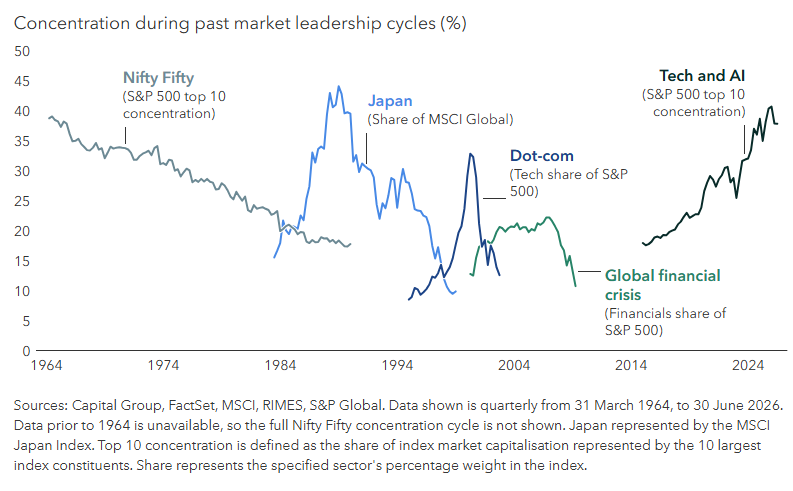
Today’s concentration differs from the 1960s because many of the largest companies, including NVIDIA, Microsoft, Amazon and Micron Technology, are tied to a single theme: AI investment. As a result, semiconductor stocks, for example, could decline in tandem if demand for chips drops.
This is precisely what we saw during the early July pullbacks in the market, which were led by companies such as SK Hynix and Sandisk.
Prior episodes of intense concentration eventually broke down, often painfully, before returning to more balanced levels. That does not mean a market crash is imminent, nor are we predicting one. Concentration is not a timing tool, but it is a reminder that trees don’t grow to the sky.
As investors crowd into AI-related stocks, some high-quality businesses have been left behind. These are companies with growing profits, strong dividends and durable franchises. Many are trading at discounts to their historical valuations of 20% or more. Examples include Royal Caribbean, Procter & Gamble and Citigroup.
2. AI concentration is a global phenomenon
Market concentration is not limited to the US. The seemingly insatiable demand for specialised chips has catapulted technology companies in South Korea and Taiwan to new highs. The top 10 firms in the MSCI Emerging Markets Index account for 41% of its total market capitalisation, with just three — SK hynix, Samsung Electronics and TSMC — making up 29%.
Worldwide demand for computer chips has fueled market concentration
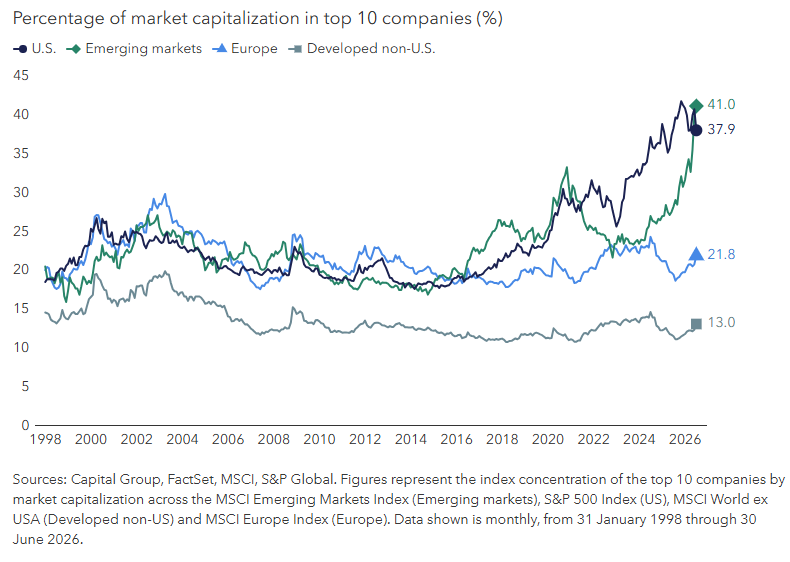
Meanwhile, global markets continue to offer other attractive opportunities, particularly in Europe and parts of Asia, where valuations remain compelling. Such examples include UK-based drug giant AstraZeneca and China-based Tencent, the largest gaming company in the world.
Similarly, there may be opportunities to be found by sifting through the artificial intelligence wreckage for companies that may have been unfairly hit by fears that easy-to-use AI applications will impair their business. These include large software companies like Germany’s SAP, as well as companies in the online travel space, including China’s Trip.com and Spain’s Amadeus IT Group.
3. US GDP heavily relies on AI spending
Concentration risk extends beyond the top 10 stocks in the US index to the broader economy. The data centre build-out has supported US growth, with AI-related investments contributing nearly 1% to real GDP in the first nine months of 2025, or 39% of overall growth during that period, according to the St. Louis Federal Reserve.
Thus, company earnings and the broader economy may be more vulnerable to an AI-induced slowdown. The growing profit pools are all driven by the same physical build-out of data centres. Chipmakers have grown the most because roughly 50% of data centre-related costs are tied to semiconductors, but companies that provide heating and air conditioning, electricity, water treatment and transformers are also enjoying strong tailwinds.
AI drives large parts of the global economy
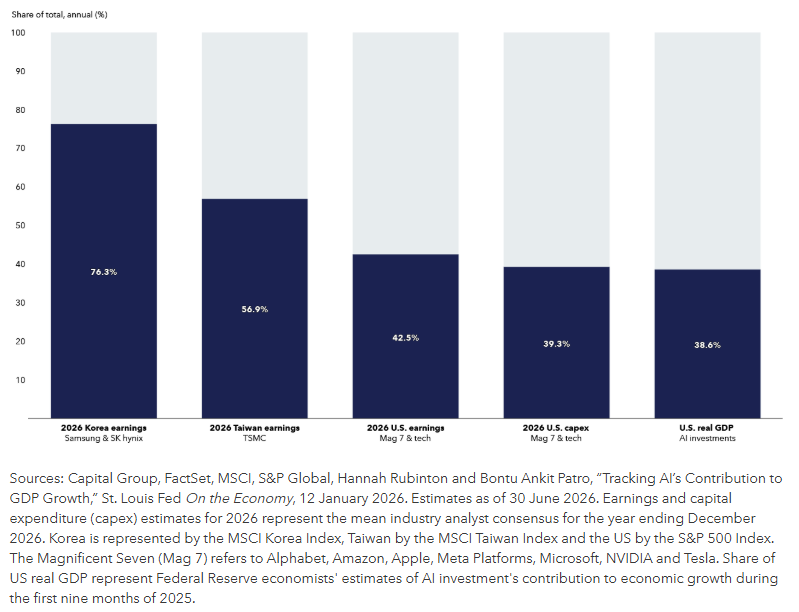
Arguably, the next chapter of the story may be about beneficiaries outside of the capex boom. These include companies that can use AI to gain a competitive advantage they haven’t had historically. Within industries such as financials and healthcare, certain companies will use AI in ways that will help them grow faster or become more profitable relative to competitors.
4. AI fatigue is hitting the bond market
Another corner of the AI boom showing signs of strain is the US corporate bond market. The tsunami of bond deals has weighed on the debt prices of high-profile companies including Meta, Amazon and SpaceX.
Today, hyperscalers including Alphabet and Meta account for roughly 4.8% of the Bloomberg US Investment Grade Corporate Bond Index, an increase of 78% from a year earlier.
AI-related companies have flooded debt markets
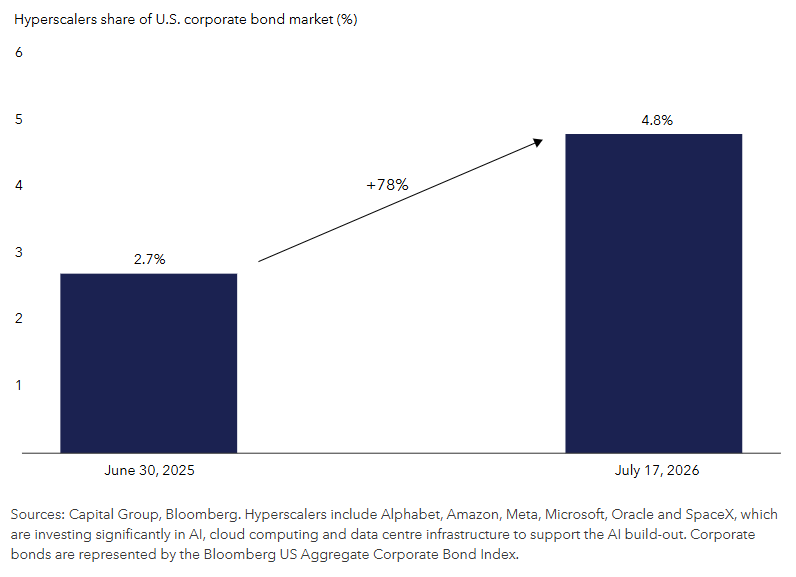
The sheer volume of deals tied to AI underscores the importance of diversification in fixed income, particularly because bond prices tend to have more downside risk than upside potential. Evaluating opportunities one by one is critical. Some hyperscalers offer attractive yields relative to their strong cash flows and credit ratings, but being more selective when it comes to certain newer project financing structures is important.
Despite the surge in issuance, we remain constructive on the broader credit market.
Strong corporate earnings, healthy consumer spending and a resilient labour market provide a supportive backdrop for credit. We don’t believe AI-related borrowing will derail that picture, but it reinforces the value of maintaining exposure across investment-grade and high-yield corporate bonds, securitised credit and emerging markets.
A call to rebalance and diversify
The market concentration in AI reveals some of the trade-offs tied to investing in index funds. There is a common misperception that index funds somehow are safer for most investors. Passive funds are cheaper on average. But cheaper is not the same as safer, nor does cheaper necessarily equate to better investor outcomes.
This is not an argument against owning the companies driving the artificial intelligence era. Many are extraordinary businesses with durable prospects. The point is, at today’s weights and valuations, the benchmarks — and the passive strategies following them — increasingly assume one set of outcomes will dominate.
A more balanced approach calls for investors to review their risks, both intended and unintended. Arguably, the winners of this current period will need to be both bold and humble. Bold enough to own great companies when the fundamentals justify it. Humble enough to recognise that no single theme, however powerful, should dictate the shape of portfolios. Bold enough to differ from the benchmark when risk and reward call for it. Humble enough to know that being different can be uncomfortable but necessary, especially when a narrow market continues to rise.
Matt Reynolds is an Investment Director for Capital Group Australia, a sponsor of Firstlinks. Statements attributed to an individual represent the opinions of that individual as of the date published and may not necessarily reflect the view of Capital Group or its affiliates. This article contains general information only and does not consider the circumstances of any investor. Please seek financial advice before acting on any investment as market circumstances can change.
This content is issued by Capital Group Investment Management Limited (ACN 164 174 501 AFSL No. 443 118), a member of Capital Group.
© 2026 Capital Group. All rights reserved.
For more articles and papers from Capital Group, click here.