Register For Our Mailing List

Register to receive our free weekly newsletter including editorials.

Home / 376

How the age pension helps retirees cope with losses

The immense value of the age pension is often underappreciated when markets are strong, but its worth is never greater than in a crisis.

The government age pension can potentially offset a one-third decline in the value of a wealthy retired couple's investment portfolio, according to our analysis. This revelation will provide some much-needed comfort to investors as the COVID-19 pandemic creates widespread job losses and wipes billions of dollars from retirement balances.

How the age pension makes a difference: a practical example

Theo and Sue are a hypothetical 65-year-old couple who own their home and have $1 million in pension assets.

Their comfortable position means they initially aren’t eligible for the age pension. However, they may well become eligible in future as they draw income from their investments. This can provide them with enormous additional value.

Milliman has modelled thousands of future scenarios for the couple, which demonstrates that the potential future age pension payments they might receive over the next 25 years have a median value of about $180,000 over the course of their retirement.

If Theo and Sue’s assets fall by 30% in a major shock to the market, the value of the age pension increases even more. This is because they are more likely to receive larger age pension payments, as well as benefiting from receiving them earlier into their retirement.

In fact, the median value of their age pension more than doubles, rising to approximately $500,000, essentially offsetting the entire fall in their retirement savings.

(The current level of a full age pension is $37,000 a year or $1,423 a fortnight including supplements for a couple).

What it means for different people

Wealthier retirees often receive the largest financial buffer from the age pension as their private savings decrease, even where they consider themselves to be self-funded retirees.

That’s because retirees with lower retirement savings already receive a full age pension. Those people, most of whom don’t receive financial advice, benefit far less as there is no more age pension to receive either now or in the future.

This is demonstrated in the following graph, which shows how the median value of future age pension amounts (the black line) can combine with the value of their private superannuation savings (blue line) to protect the value of their total retirement income (orange line) as retirement savings fall.

As eligibility for the full age pension becomes more likely at around a $400,000 pension balance, the value of future age pension payments levels off, leaving these individuals' retirement incomes more exposed to further market falls.
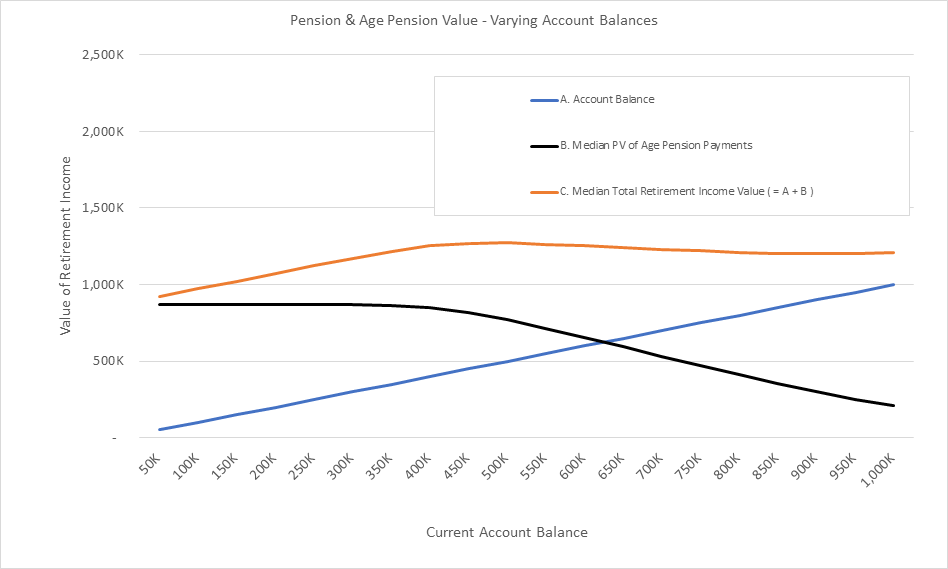
Source: Milliman analysis

Financial advice in turbulent times

The emotional impact on retirees of seeing huge falls in the value of their retirement savings needs to be appreciated, along with the behavioural biases that come to the fore at times like these. The pain felt by many retirees has been proven to be much greater than that experienced by younger people.

In the current environment of falling investment values, understanding the role of the age pension as part of their retirement plan can provide welcome reassurance.

These complexities underline the value of ongoing advice and analysis to assist retirees in navigating turbulent and volatile environments. Advisers can help retirees better manage this issue in the current climate, by implementing portfolios that provide explicit protection against current and future market falls.

Key assumptions and methodology

Analysis is modelled using the Milliman GBA Platform to model 1,000 random future scenarios. Analysis assumes a couple, both aged 65-years-old who own their own home. The couple’s assets are all invested in a 70/30 Growth/Defensive asset mix within an account-based pension, with no further sources of income or assets (for age pension means-test purposes).

The couple draw down the usual minimum required income each year from their pension account (not the temporary COVID levels). All income (including age pension) is assumed to be spent, with no reinvestment of future income.

Future age pension payments are valued by means testing to determine payment amounts in each modelled scenario, then discounting those payments to today’s dollars using modelled wage inflation in each scenario. Future age pension amounts assume payment rates and thresholds (indexed in line with AWOTE) as at 20 March 2020 with deeming rates based on the announced deeming rates effective from 1 May 2020.

The analysis runs 1,000 stochastic simulations through to age 90 (i.e. over 25 years), assuming both of the couple survive to this time.

Economic models use Milliman’s standard Australian Stochastic ESG calibration and setup as at 31 December 2019. This setup is intended to be used to model the long-term dynamics of a wide range of economic variables, including asset returns, income, inflation and interest rates, and is updated quarterly as part of Milliman’s GBA Platform modelling services.


Wade Matterson is a Principal, Senior Consultant, and leader of Milliman’s Australian Financial Risk Management practice and a fellow of the Institute of Actuaries of Australia. This article is general advice only as it does not take into account the objectives, financial situation or needs of any particular person.


  •   23 September 2020
  • 6
  •      
  •   
6 Comments
Aussie HIFIRE
September 23, 2020

Retirees who get the age pension should be the least affected by the current situation. Their age pension payments have likely gone up, they've got two extra payments of $750 per person (so $3,000 for a couple), their expenses have likely gone down, and the value of their investments assuming a 50/50 split between broadly diversified growth and defensive investments has fallen by maybe 5-7% or so from a year ago. There are a lot of people who are working who would love to be in that position!

Trevor
September 30, 2020

"There are a lot of people who are working who would love to be in that position!" Really? Swap  youth and opportunity for a pitiful income ? Those "beneficiaries" are old and reduced to living on "the pension" having worked and paid taxes almost all their lives ! There were no "hand-outs" for them during the polio and flu epidemics so they could "shelter at home" in style! It's amazing to me how people can justify this governmental-largesse to support a lifestyle that is profligate and "unsustainable" at the very least ! Can't even be bothered to accept a job fruit-picking when it is urgently needed. There seems to be no end to the "feeling of entitlement" evident in your envious remarks. 

ERIC COWAN
September 24, 2020

I still can't see how the government justified giving jobseekers more fortnightly income than people who worked for 50 years paying the government taxes.

C
September 26, 2020

Maybe the government realised that the sudden huge increase in unemployment would lead to massive social unrest and likely reduce their chances of staying in power. Also, consider the ramifications across the whole economy. We would likely be in a depression, not just a recession. The Newstart payment was/ is barely enough to live on. People receiving it still rely on charity to survive. The poorest people spend all their income. The government needed to keep money flowing around the economy and keep businesses going and people employed. I actually think that this was one of their better decisions. Imagine how much worse things could be.

Janis Flynn
September 30, 2020

Doesn't this show that it would be better to make superannuation voluntary and give workers their 9.5% now, save the Govt $43B a yr now in tax breaks for the high income contributor to Super and increase the age pension which has been shown does not get affected in times of financial downturn. We don't need to be told when, how, and how much to save. Go back to Simon Crean speech in 1981 when he said "the early stage of union involvement in Superannuation issues is that control over funds will provide unions and govt with financial leverage which can be used to advance the cause of Socialism in Australia" 

Andrew Long
October 01, 2020

This is a fantastic article! Is there a link to white paper at all by any chance that delves into this analysis further?


Leave a Comment:

RELATED ARTICLES

Retiree spending patterns differ from most expectations

Time to smash the retirement nest egg - but how?

Four reasons many Australians will work until they're dead

banner

Most viewed in recent weeks

Australian stocks will crush housing over the next decade, 2025 edition

Two years ago, I wrote an article suggesting that the odds favoured ASX shares easily outperforming residential property over the next decade. Here’s an update on where things stand today.

Australia's retirement system works brilliantly for some - but not all

The superannuation system has succeeded brilliantly at what it was designed to do: accumulate wealth during working lives. The next challenge is meeting members’ diverse needs in retirement. 

Get set for a bumpy 2026

At this time last year, I forecast that 2025 would likely be a positive year given strong economic prospects and disinflation. The outlook for this year is less clear cut and here is what investors should do.

Meg on SMSFs: First glimpse of revised Division 296 tax

Treasury has released draft legislation for a new version of the controversial $3 million super tax. It's a significant improvement on the original proposal but there are some stings in the tail.

The 3 biggest residential property myths

I am a professional real estate investor who hears a lot of opinions rather than facts from so-called experts on the topic of property. Here are the largest myths when it comes to Australia’s biggest asset class.

Property versus shares - a practical guide for investors

I’ve been comparing property and shares for decades and while both have their place, the differences are stark. When tax, costs, and liquidity are weighed, property looks less compelling than its reputation suggests.

Latest Updates

Investment strategies

Building a lazy ETF portfolio in 2026

What are the best ways to build a simple portfolio from scratch? I’ve addressed this issue before but think it’s worth revisiting given markets and the world have since changed, throwing up new challenges and things to consider.

Investment strategies

21 reasons we’re nearing the end of a secular bull market

Nearly all the indicators an investor would look for suggest that this secular bull market is approaching its end. My models forecast that the US is set for 0% annual returns over the next decade.

Property

13 million spare bedrooms: Rethinking Australia’s housing shortfall

We don’t have a housing shortage; we have housing misallocation. This explores why so many bedrooms go unused, what’s been tried before, and five things to unlock housing capacity – no new building required.

Investment strategies

Market entry – dip your toe or jump in all at once?

Lump sum investing usually wins, but it can hurt if markets fall. Using 50 years of Australian data, we reveal when staging your entry protects you, and when it drags on returns. 

Investment strategies

The US$21 trillion question: is AI an opportunity or excess?

It has been years since the US stock market has been so focused on a single driving theme, and AI is unquestionably that theme. This explores what it means for US and global markets in 2026.

Economy

US energy strategy holds lessons for Australia

The US has elevated energy to a national security priority, tying cheap, reliable power to economic strength, AI leadership, and sovereignty. This analyses the new framework and its implications for Australia.

Strategy

Venezuela’s democratic roots are deeper than Trump knows

Most people know Maduro was a dictator and Venezuela has oil. Few grasp the depth of suffering or the country’s democratic history - essential context as the US ousts Maduro and charts Venezuela’s future. 

Sponsors

Alliances

© 2026 Morningstar, Inc. All rights reserved.

Disclaimer
The data, research and opinions provided here are for information purposes; are not an offer to buy or sell a security; and are not warranted to be correct, complete or accurate. Morningstar, its affiliates, and third-party content providers are not responsible for any investment decisions, damages or losses resulting from, or related to, the data and analyses or their use. To the extent any content is general advice, it has been prepared for clients of Morningstar Australasia Pty Ltd (ABN: 95 090 665 544, AFSL: 240892), without reference to your financial objectives, situation or needs. For more information refer to our Financial Services Guide. You should consider the advice in light of these matters and if applicable, the relevant Product Disclosure Statement before making any decision to invest. Past performance does not necessarily indicate a financial product’s future performance. To obtain advice tailored to your situation, contact a professional financial adviser. Articles are current as at date of publication.
This website contains information and opinions provided by third parties. Inclusion of this information does not necessarily represent Morningstar’s positions, strategies or opinions and should not be considered an endorsement by Morningstar.