Register For Our Mailing List

Register to receive our free weekly newsletter including editorials.

Home / 146

Multi-manager diversification or tax efficiency or both?

The taxation structure of superannuation funds in Australia is curious by world standards. Most countries follow the ‘EET’ taxation structure (Exempt contributions, Exempt investments, Taxable benefits). Australia, unusually, follows the ‘TTE’ structure (Taxable contributions, Taxable investments, Exempt benefits), though the ‘T’ is levied at concessional rates. It will be fascinating to see what will change as the Government moves through its tax reform agenda this year.

Taxation in the accumulation and pension phase

Management of the ‘middle T’ taxation of the investment earnings of superannuation funds is therefore a particularly Australian challenge, and appears alien to our US and UK counterparts. Finding reliable research, expertise and solutions in the area of managing institutional superannuation portfolios after tax is quite challenging, yet the task is an important one. This is true not only for superannuation members in the taxable accumulation (pre-retirement) phase but also for pension phase members who care about that other Australian tax peculiarity, franking credits, along with foreign withholding taxes.

An early challenge large funds face as they move to an after-tax investing focus for their equity portfolios is how this fits within a multi-manager framework. Funds typically spread their portfolios across a range of managers to access different styles and achieve an optimal blend of diversity – an application of the more familiar theme of diversifying across asset classes to reduce risks and increase returns to further improve the overall risk/return profile of the fund’s equity portfolio. This results in the equity portfolio of a large superannuation fund having an architecture that looks something like the diagram below.
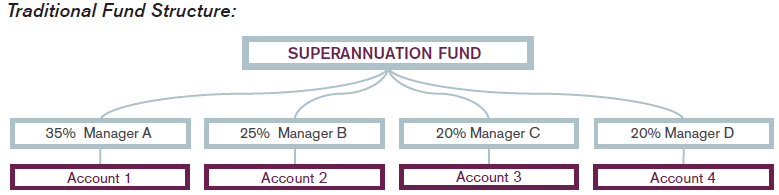
Multi-manager structure tax inefficiencies

Naturally, each manager is unaware of the other managers’ portfolio holdings, trading and investment insights. This protects each manager’s intellectual property and the diversity of the structure as a whole. But here’s the rub: it is a very inefficient, possibly damaging way to manage the fund’s overall capital gains tax (CGT) liabilities from equity trading. Each manager can, at best, manage the CGT on their own portfolio, but still have no knowledge of the tax positions of other managers or of the portfolio as a whole. This can generate dysfunctional decision-making.

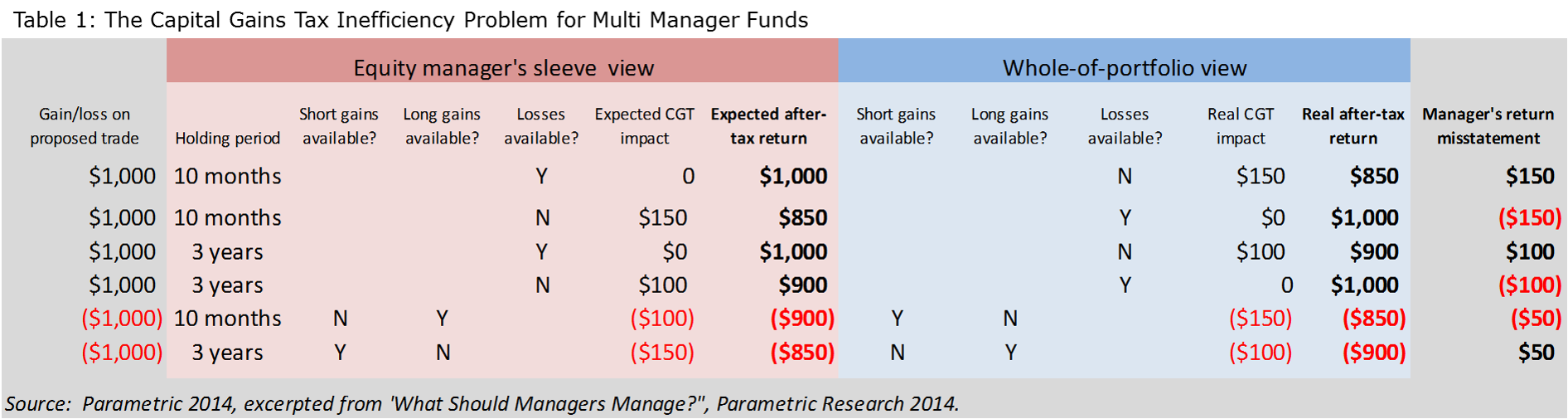
For example, Table 1 below illustrates three types of potentially sub-optimal behaviour by equity managers:

  • trading which looks value-accretive but in fact reduces value post-tax
  • not trading, hence forgoing active returns, because of an illusory tax hurdle
  • delaying the timing of a trade, hence increasing tracking error risk, because of an illusory CGT discount benefit.
Effective CGT management requires centralisation or line-of-sight across the whole portfolio. Superannuation funds may think they are doing the right thing for their members by asking their equity managers to concentrate on after-tax returns, but actually it makes little sense to hold those managers accountable for the fund’s overall CGT liability.

The use of Centralised Portfolio Management

There is a solution, well-established in the US and gaining traction in Australia, which can help superannuation funds with multi-manager equity portfolios solve this problem. ‘Tax-managed Centralised Portfolio Management’ (CPM) combines each manager’s investment insights with a central implementation manager with the job of ensuring

trades are tax-optimised at the whole-of-portfolio level as shown in the diagram below.
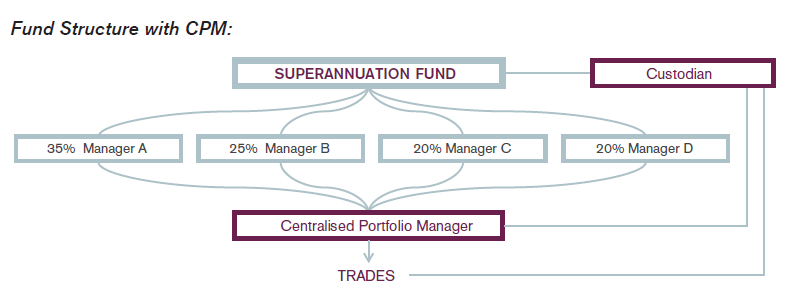
In this solution, a large superannuation fund can continue to appoint managers based on the fund’s own objectives, style preferences, and risk and fee budgets. This preserves the multi-manager blending and diversification benefits the fund is seeking. But instead of each manager routing trades separately through their own set of brokers, the execution of these collective manager insights is centralised. Daily, the managers’ recommended trade lists are received and offsetting ‘redundant’ trades identified and eliminated by a single implementation manager (e.g. where Manager A buys BHP shares as Manager B sells BHP shares). The implementation manager, viewing the entire portfolio, can then address tax inefficiencies; for example, by identifying the same stock in a different manager’s portfolio with lower embedded CGT; or by choosing to hold off on a proposed trade so that it qualifies for the CGT discount. There are also numerous other (non-tax) benefits of centralising implementation in this way.

CPM as a dedicated, sophisticated after-tax focused investment solution shows how funds need not be forced to choose between multi-manager diversification and tax efficiency – both important objectives. With a little innovation, a fund really can have both.


Raewyn Williams is Director of Research & After-Tax Solutions at Parametric, a US-based investment advisor. Parametric is exempt from the requirement to hold an Australian Financial Services Licence under the Corporations Act 2001 (Cth) (the “Act”) in respect of the provision of financial services to wholesale clients as defined in the Act and is regulated by the SEC under US laws, which may differ from Australian laws. This information is not intended for retail clients, as defined in the Act. Parametric is not a licensed tax agent or advisor in Australia and this does not represent tax advice. Additional information is available at www.parametricportfolio.com/au.


  •   11 March 2016
  • 5
  •      
  •   
5 Comments
Stella Young
March 10, 2016

I get the article, but Table 1 doesn't illustrate the points well. Could you please add some descriptive material to Table 1 to make it easier to understand?

Things that would help are answers to the following questions. How many portfolio managers are we looking at? Just 1? 3? 6? Where do the Ys and Ns come from? Who decides them? What is actually making the whole portfolio view different from the manager's view here? How do the rows of the table work together for the whole portfolio thinking?

The last column suggests, perhaps mistakenly, that all the pluses and minuses balance out in the table, so over all there shouldn't be problem - which is not the point the article wants to make.

Thank you.

Oh, by the way, I am a wholesale client and I love reading Cuffelinks on a regular basis.

Fundie
March 10, 2016

Custodians provide a service that can go at least part of the way (propagation) to solving this problem.

Raewyn Williams
March 13, 2016

Stella - thanks for your feedback. As the author, I have a strict word limit for the article so not feasible to explain the table painstakingly, though there is more explanation in our full published research paper "What Should Managers Manage?". Two quick comments: 1)the Ys and Ns are just different scenarios and aren't meant to balance out. The 2 different coloured sets of columns show the distinction between what the manager sees and what a whole-of-portfolio view shows. The rows are just different trade scenarios; 2) as to how many managers, no strict minimum or maximum, but the more managers you have, generally, the greater the problem is.

Fundie - thanks for your feedback also. We published research ("The Road to Reward") last year suggesting propagation could provide 5-10% of the benefits of tax-managed CPM, though there are variations. Note also that you get innate propagation (plus more) in a CPM structure.

Geezer
March 14, 2016

What happens when the implementation manager holds off trading the stock (despite the fund manager's instruction) and the share price falls, thereby having a negative impact on performance?

Danny
August 06, 2018

My understanding is that a CPM manager uses tracking error budget to discretionary choose which of the stock picking managers trades he will do. In exercising that discretion he is targeting a better after tax outcome. But it is possible that the after tax outcome leaves the pretax/tax naive outcome worse. So does the stock picking manager get judged on the performance of his "model" portfolio or the dicretionarily adjusted/real portfolio? Cant you get a widening drift in the real and model portfolios?


Leave a Comment:

RELATED ARTICLES

Portfolio diversification: when a free lunch can cause indigestion

Do HNWI get better advice?

Are the good times about to end?

banner

Most viewed in recent weeks

Making sense of record high markets as the world catches fire

The post-World War Two economic system is unravelling, leading to huge shifts in currency, bond and commodity markets, yet stocks seem oblivious to the chaos. This looks to history as a guide for what’s next.

3 ways to fix Australia’s affordability crisis

Our cost-of-living pressures go beyond the RBA: surging house prices, excessive migration, and expanding government programs, including the NDIS, are fuelling inflation, demanding bold, structural solutions.

Is there a better way to reform the CGT discount?

The capital gains tax discount is under review, but debate should go beyond its size. Its original purpose, design flaws and distortions suggest Australia could adopt a better, more targeted approach.

How cutting the CGT discount could help rebalance housing market

A more rational taxation system that supports home ownership but discourages asset speculation could provide greater financial support to first home buyers.

Welcome to Firstlinks Edition 648 with weekend update

This is my last edition as Editor of Firstlinks. I’m moving onto a new role though the newsletter will remain in good hands until my permanent replacement is found.

  • 5 February 2026

It’s economic reality, not fear-based momentum, driving gold higher

Most commentary on gold's recent record highs focus on it being the product of fear or speculative momentum. That's ignoring the deeper structural drivers at play. 

Latest Updates

Superannuation

Super is catching up, but ageing is a triple-threat

An ageing Australia is shifting the superannuation system’s focus from accumulation to the lifecycle of retirement. While these pressures have been anticipated for decades, they are now converging at scale and driving widespread industry change.

Investment strategies

Corporate earnings show resilience against volatility but risks remain

Evidence for a strong reporting season had been piling up for months and validated an upgrade cycle already underway. However, risks remain from policy uncertainity. 

Superannuation

Want your loved ones to inherit your super? You can’t afford to skip this one step

One in five Australians die before retirement and most have not set up their super properly so their loved ones can benefit from all their hard work and savings. 

SMSF strategies

Sixteen steps in a typical SMSF borrowing

Getting a mortgage is never an easy process but when an investment property is purchased in a SMSF the complexity increases significantly. Read this before taking the plunge. 

Planning

Do HNWI get better advice?

Good advisers lead to more diversification, lower turnover and less home bias. However, studies show the average adviser may not be adding much value to clients. 

Strategy

AFL Final Ten with wildcard edit 'unlevels' the field

When the new AFL season kicks off a wild-card will be added to the finals. Is this new formula fair and how does it impact the odds of winning the premiership.

Planning

Love them or hate them, it's worth understanding annuities

Investors have historically balked at exchanging a lump sum for a future steam of income. Breaking down the financial and emotional considerations of purchasing an annuity.        

Sponsors

Alliances

© 2026 Morningstar, Inc. All rights reserved.

Disclaimer
The data, research and opinions provided here are for information purposes; are not an offer to buy or sell a security; and are not warranted to be correct, complete or accurate. Morningstar, its affiliates, and third-party content providers are not responsible for any investment decisions, damages or losses resulting from, or related to, the data and analyses or their use. To the extent any content is general advice, it has been prepared for clients of Morningstar Australasia Pty Ltd (ABN: 95 090 665 544, AFSL: 240892), without reference to your financial objectives, situation or needs. For more information refer to our Financial Services Guide. You should consider the advice in light of these matters and if applicable, the relevant Product Disclosure Statement before making any decision to invest. Past performance does not necessarily indicate a financial product’s future performance. To obtain advice tailored to your situation, contact a professional financial adviser. Articles are current as at date of publication.
This website contains information and opinions provided by third parties. Inclusion of this information does not necessarily represent Morningstar’s positions, strategies or opinions and should not be considered an endorsement by Morningstar.