Register For Our Mailing List

Register to receive our free weekly newsletter including editorials.

Home / 561

Protecting retirement income from inflation shocks

Since the creation of compulsory superannuation in the 1990’s, inflation hasn’t been a notable issue, but the past two years has been a stark reminder of the impact inflation can have on the spending power of retirees. Inflation spikes are less of an issue in the accumulation phase as there is time for investments to recover, but retirement is different. In retirement, regular income must be protected and maintained to give retirees confidence to spend on essentials, while ensuring maximum enjoyment of their golden years.

Are equities the answer?

A commonly held perception is that the best way to account for inflation is maintaining exposure to equity markets. The assumption is market returns will solve for the issue of inflation. However, looking back at historical performance across all asset classes, the reality is markets can take more than a decade to recoup the lost income in retirement.

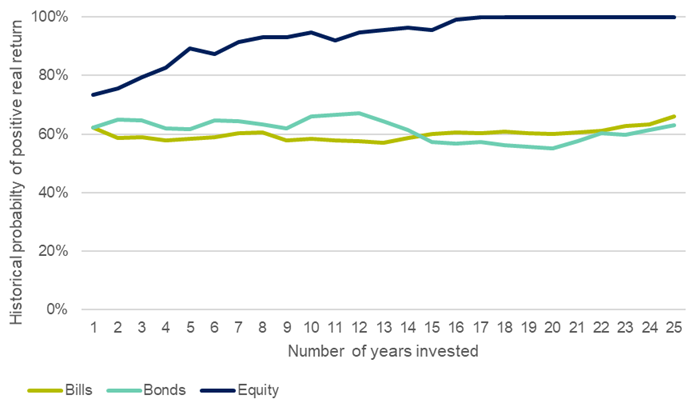
Analysing historical real returns generated by equities, bonds, and cash, what always matters is the long-term. Analysing returns from 1900 through to 2023, we see that equity markets have proven to deliver returns that outstrip inflation in 81 years – or 73% of the time. Bonds and cash provided a positive real return only 62% of the time over the same period.

Figure 1 Historical probability of positive real returns, 1900-2023
Source: Calculations, based on data from Morningstar, S&P, Bloomberg and ABS

Historically, all investment horizons of 16 years (and longer) have provided a positive real return for Australian equity investors. By contrast, a diversified portfolio showed a 70/30 fund (70% equities and 30% bonds) needed 20 years to ensure a positive real return, while a 50/50 balanced fund needed 25 years.

So, while waiting for long-term returns to overcome any near-term short falls is a tried and tested approach in the accumulation phase, it needs to be considered differently in and approaching retirement. The impact is not just the length of time to recover the real capital value, but the income that is lost over that period.

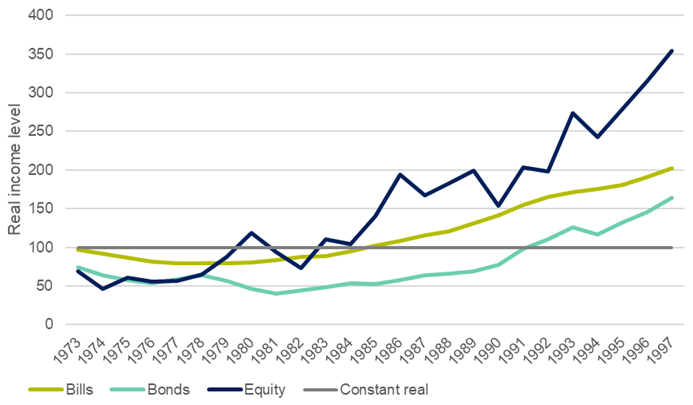
The last time we saw anything like the recent inflation spike was in the 1970s. A retiree who started drawing their income linked to the equity markets in 1973 would have seen their income fall by 30.7% and take nine years, through to 1983, to return to their initial level of income. Cash would have taken until 1985 to recover and bonds until 1992 (see figure 2 below). While history does not provide a guarantee of future performance, a person who started drawing an income linked to markets in 2023 could very well be facing a similar proposition.

Figure 2 Investment-linked income example
Source: Calculations, based on data from Morningstar, S&P, Bloomberg and ABS

With history showing that market-linked investments don’t necessarily protect an income stream from inflation over the short to medium term, the question becomes how do retirees maintain their lifestyle in the face of cost-of-living increases?

A different strategy needed in retirement

There are three common approaches to addressing this very real and present challenge.

The Age Pension represents an income stream that is indexed to inflation and it is a good safety net for some retirees.  However, those who desire a lifestyle goal beyond the Aged Pension need additional inflation protection.

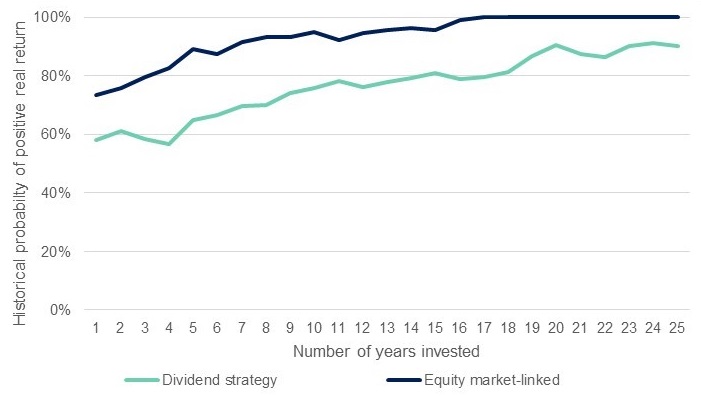
Living off dividend income is another approach that is particularly popular with retirees. Dividend yields tend to be counter-cyclical so are not as volatile as share prices. Historically dividend growth over 25 years was below inflation in 10% of the scenarios. However, the bigger challenge is the level of under spending by retirees taking this approach. By not drawing down on their capital, retirees experience a lower level of lifestyle than would have otherwise been possible.

Figure 3 Inflation protection of a dividend strategy
Source: Challenger calculations, based on data from Morningstar, S&P, BHM, Bloomberg and ABS

Alternatively, by consuming capital in retirement, retirees can generate increased income. A CPI-linked lifetime income stream, for example, sustains the lifestyle of the retiree by adjusting their payments with changes in the cost-of-living.

Protecting your nest egg in retirement

Protecting an investment portfolio from inflation can be an important concern for any investor. In retirement, the challenge increases as a retiree needs to protect their income stream to be able to sustain their lifestyle.

We know retirees are seeking an increased level of certainty in retirement. Recent research by YouGov, commissioned by Challenger, found that 2 in 3 Australians over 60 said cost-of-living impacted their confidence they would have enough money for retirement, while more than 70 per cent believe a guaranteed income in retirement would significantly boost happiness.

Inflation risk has a different impact on a portfolio in the retirement phase. It requires a unique investment approach to mitigate risks, while providing retirees with the confidence to safely spend. When investments in growth assets have returns below inflation (or negative), the only option for retirees is to reduce their lifestyle or run down their capital early. This inflation risk can have serious flow-on consequences for longevity and sequencing risk in a portfolio in the decumulation stage. There is more at stake for retirees – they do not have the luxury of time and are at heightened risk to the impacts of inflation, requiring a hedge in their retirement portfolio that can protect income and maintain lifestyle.

While the fall in inflation from multi-decade highs is good news for our economy, many retirees continue to struggle with cost-of-living because of the cumulative impact inflation has had on their financial position. Retirees need to consider how they can maintain their lifestyle in the face of inflation and cost-of-living pressures. There is a misguided perception that equity market exposure will be sufficient to achieve this, but the data shows retirement requires an investment strategy that will guarantee lifestyle regardless of market returns or inflation spikes. An inflation-protected income-strategy is vital to this, and while the Age Pension does deliver some income, it often falls short of meeting the financial needs and lifestyle expectations of many retirees.

As we continue to navigate a volatile market and geopolitical landscape, retirees need a portfolio with protection from inflation risks so that they don’t experience another cost-of-living crisis when inflation has another upturn. With more than 2.5 million Australians, 10% of our population, set to retire in the coming decade, retirement is a top priority for government, industry, and aging Australians. We, as an industry, have a responsibility to empower confidence to spend in retirement, provide assurance that income will keep pace with inflation, and protect from the swings in market-linked investments.


Aaron Minney is Head of Retirement Income Research at Challenger Limited. This article is for general educational purposes and does not consider the specific circumstances of any individual.


  •   22 May 2024
  • 3
  •      
  •   
3 Comments
Kevin
May 23, 2024

Came up early on my google feed,or whatever it is.

How much do I need always seemed to be group think to me.Cracked it decades ago. How much income do I need to retire on was the obvious answer.So if I just replaced my work income with passive income ( dividends) then I couldn't lose. If we got by on wages for an entire working life then retirement would easy on the same income,with no mortgage to pay,and kids off the hands.Party,party,party.

Put in a margin of safety and retire when passive income was higher than earned income.Obvious?.

So the only question is how dependable is that income,an easy problem to solve,keep some money in the bank for the unlikely event that dividends dive.Decades ago I worked out that everything is remarkably stable if you look at prices once a year or so,and the income is a surprise when I do my tax form.I don't recall any year when income fell.Every year income went up,rising dividends,and increasing the number of shares through a DRP.

Retirement is the same,income rises as dividends rise.excess income goes back into the DRP,so income rises even if dividends stay the same,because the shareholding increases every year.Common sense and go for the simple and the obvious.

Then of course super kicked in to produce even more income.I missed the obvious there,but saw it after 6 months or a year.If the drawdown rate is 9 or 10%,and average return is 9%,you never run out of super.Events of course can change this,3 years of good losses and super will run down.the famous and well known black swan event

This leads to what people think is a curse.Pay a good chunk of tax and this means you've got an even bigger chunk of after tax money in your pocket.If you ever want to have a problem,that would be the problem to aim for.

This leads to the crisis that you need. Other people have a cost of living crisis,we have a what the hell do we spend all this money crisis.

I've always been baffled why people think complication must be better.A lifetime plan of simple and obvious works great.

The last "problem" is then you die with far more than you retired with.The Buffett answer solves that,don't overthink it,give it to Bill Gates,he knows what he is doing in that field. That last "problem"of course may change as I put a bit more thinking into it .That might be a coffee and 3 Tim Tams problem,deep thought is needed there.

Mark Hayden
May 24, 2024

I do not believe the CPI linked income stream is the best result for retirees. Inflation is an important consideration for investors in the drawdown phase, and the best solution in my view is to segregate assets. RHS to be Cash & Term Deposits to be consumed as drawdowns and LHS to be equities which will do well in the long-term, and with dividends going to the RHS.

ED
May 24, 2024

Some interesting observations. I totally agree that inflation is especially problematic for retirees (though it obviously seriously impacts others on fixed incomes). That said, the article was good at highlighting the dilemma but doesn’t really offer any new solutions.


Leave a Comment:

RELATED ARTICLES

5 charts every retiree must see…

The overlooked driver of energy inflation

Three underrated investment risks in retirement

banner

Most viewed in recent weeks

Indexation implications – key changes to 2026/27 super thresholds

Stay on top of the latest changes to superannuation rates and thresholds for 2026, including increases to transfer balance cap, concessional contributions cap, and non-concessional contributions cap.

The refinery problem: A different kind of energy crisis in 2026

The Strait of Hormuz closure due to US-Iran conflict severely disrupted global energy supply chains. While various emergency measures mitigated the crude impact, the refined product market faces unprecedented stress.

The missing 30%: how LIC returns are understated, and why it matters

The perceived underperformance of LICs compared to ETFs is due to existing comparison data excluding crucial information, highlighting the need for proper assessment and transparent reporting.

Little‑known government scheme can help retirees tap into $3 trillion of housing wealth

The Home Equity Access Scheme in Australia allows older homeowners to tap into their home equity for retirement income, yet remains underused due to lack of awareness and its perceived complexity.

Origins of the mislabeled capital gains tax ‘discount’

Debate over the CGT discount is intensifying amid concerns about intergenerational equity and housing affordability. This analysis shows that the 'discount' does not necessarily favor property investors.

Div 296 may mean your estate pays tax on assets your beneficiaries never receive

The new super tax, applying from 1 July, introduces more than just a higher rate on large balances. It brings into focus a misalignment between where wealth sits and where the tax on that wealth ultimately falls.

Latest Updates

The ultimate superannuation EOFY checklist 2026

Here is a checklist of 28 important issues you should address before June 30 to ensure your SMSF or other super fund is in order and that you are making the most of the strategies available.

Retirement

Two months into retirement

A retirement researcher's take on retirement and her focus on each of her six resource buckets to stay engaged during the transition and beyond.

Superannuation

Markets have always delivered for super fund members. What if they don’t?

What happens if market resilience in the face of ongoing geopolitical tensions ends? Potential decade-long market weakness shows the need for contingency planning.

Retirement

We tend to spend less in retirement …

Studies show that a drop in expenditure during retirement leads to a happier retirement. But when costs ramp up again later in life, it's a guaranteed income that makes spending more hurt less.

Shares

Can you value a share just using dividends?

A cow for her milk, a stock for her dividends. Investors are too quick to dismiss this valuation technique. 

Property

The 25-year property trust default is being questioned

The 33% CGT discount rate being floated isn’t random. It sits at the structural break-even between trust and company for the multi-property cohort. That’s driving the conversation we’re hearing now.

Investment strategies

Are active managers bringing a knife to a gunfight?

How passive investing has permanently changed market structure — and why sophisticated tools are now the price of survival.

Sponsors

Alliances

© 2026 Morningstar, Inc. All rights reserved.

Disclaimer
The data, research and opinions provided here are for information purposes; are not an offer to buy or sell a security; and are not warranted to be correct, complete or accurate. Morningstar, its affiliates, and third-party content providers are not responsible for any investment decisions, damages or losses resulting from, or related to, the data and analyses or their use. To the extent any content is general advice, it has been prepared for clients of Morningstar Australasia Pty Ltd (ABN: 95 090 665 544, AFSL: 240892), without reference to your financial objectives, situation or needs. For more information refer to our Financial Services Guide. You should consider the advice in light of these matters and if applicable, the relevant Product Disclosure Statement before making any decision to invest. Past performance does not necessarily indicate a financial product’s future performance. To obtain advice tailored to your situation, contact a professional financial adviser. Articles are current as at date of publication.
This website contains information and opinions provided by third parties. Inclusion of this information does not necessarily represent Morningstar’s positions, strategies or opinions and should not be considered an endorsement by Morningstar.