Register For Our Mailing List

Register to receive our free weekly newsletter including editorials.

Home / 82

Superannuation and our growing wealth

Universal superannuation became an embedded component of the savings and wealth accumulation of workers some 21 years ago; a coming-of-age in 2014, so to speak. Only retired, non-working and some self-employed households missed out on the compulsory saving as part of employee’s remuneration, although voluntary contributions were to rise as well.

Of course, Life Offices had been offering retirement benefit packages for a long time in the form of industrial (weekly payments), ordinary (monthly payments) and superannuation type policies, of which only the last mentioned is of any significance today.

And government employee retirement benefits had also been around for many decades, usually unfunded, with retirement benefits paid out of current government receipts from taxes and Government Business Enterprises surpluses. That unfunded legacy is with us today, but addressed to some extent by the Howard/Costello Government while it was in office via the Future Fund.

The first chart shows the spectacular growth of superannuation assets, only temporarily reversing for two years during the onset of the GFC.
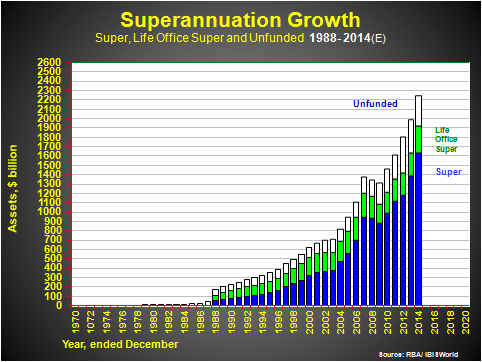
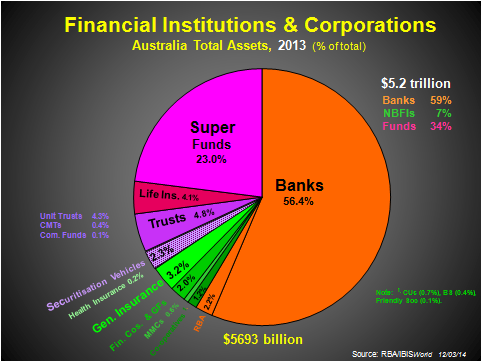
Assets will pass $2.2 trillion this year, from less than $100 billion 30 years ago. They will account for nearly 30% of the total assets of all financial institutions by the end of 2014, with banks diluted from an 80% lion’s-share of all assets up to 1940, to around 55% today. Still dominant. The second exhibit provides perspective in this regard.
At the end of 2013, approaching half the superannuation assets were in local shares (where they control nearly 60% of the ASX by capitalisation), 17% in overseas assets (including shares), 14% in bonds and other securities, 13% in cash and deposits, and the balance in property and other assets.

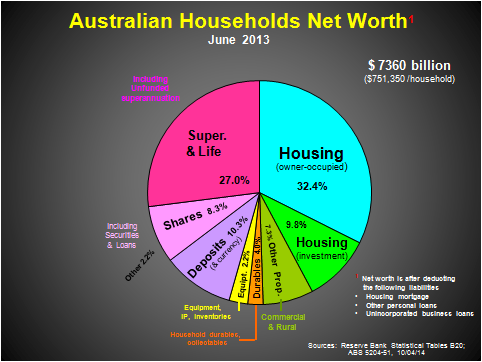
Clearly, superannuation has become an important part of household net worth as the third exhibit highlights.

At 27% of average household net worth of $751,000 in mid-2013, it is well ahead of investment property (16%) and is likely to overtake the value of owner-occupied housing (32%) soon.

Indeed, financial assets in total – including super, shares and deposits – are poised to overtake all hard assets (property, equipment and durables) within a few years. Some 25 years ago, financial assets represented 35% of net worth (including 11.4% in super). By the end of this year, the ratio will be over 50% with 24% in super.

This is a very positive development, as hard assets only yield a modest rental return plus capital gain, and never match the returns from active assets, notably shares.
So how much super does one need to have to be able to retire independent of the pension and with dignity? Twice as much as the average home, meaning that a home should no longer be regarded as the biggest investment of one’s life, as was the claim for much of the post-WWII years (although with a wide diversity of property values, every person’s position is unique).

Average household income for the 9 million+ households of the nation will be just over $150,000 by the end of 2014: yes, surprising as that figure is. It is suggested that retiring on a one-third share of average household income is a desirable goal. In turn, this would suggest a nest egg of around $830,000 taking out 6% each year and leaving enough to grow the capital in line with inflation.

Currently average super sits at around $100,000 per person or $240,000 per household in 2014, but this includes young people and households as well as retired ones. So a look at the differences across age groups is helpful in seeing how close we are to ‘dignified retirement’ at present, as the final exhibit shows.
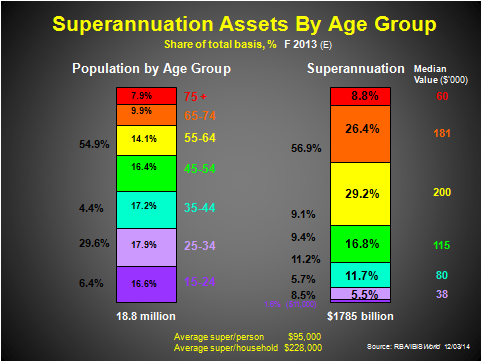
It suggests that recent retirees (aged 65-74) have a median value of super of $181,000 per person, or around $360,000 per household, or 40-45% of the ‘dignified retirement’ level. The even-older households are generally pensioners, with less than $75,000 per household in super (much of it via Life Offices).

Being averages, a minority of these age groups live comfortably, but most - perhaps over two-thirds - would be living a more abstemious lifestyle.

The younger Baby Boomers are currently the best-off in super, with over $400,000 per household and the capacity to improve on that level with a continuing working life for a decade or more. Their average could edge up towards 55-60% of the desirable level if they work long enough. Again, some retirees in this age bracket will easily reach a comfort zone. Generally, only a third or so of Baby Boomers (49-71 years) will retire with their wished-for comfort and dignity.

So, it is not all that salubrious, reminding us that we have a long way to go. It will take at least two generations (of an average of 20 years each) from 1993 to achieve the desired level of comfort for retirees. The Net Generation (12-32 years old) and the youngest of the Gen Xers (33-48 years old) are the first of the retirees likely to be comfortable. In theory, provided they have super and assuming no interim catastrophes and set-backs. But we are on the way, and leading the world.


Phil Ruthven AM is Chairman of IBISWorld.


  •   2 October 2014
  • 4
  •      
  •   
4 Comments
Paul Resnik
October 03, 2014

Great summary of Australian personal asset and income growth trends.

Kevin
October 05, 2014

Very interesting. Even more interesting that our Government continues to tax superannuation and deliberately restricts contributions given the obvious shortfall this article demonstrates. My interpretation is the Government is not concerned with us providing ourselves a comfortable retirement, merely to get us off the pension. As I’ve mentioned previously, this means ~$500K in super which if converted to an indexed lifetime annuity closely equates to the pension. Viewed from this perspective you can see why given the data in this article – specifically “The younger Baby Boomers are currently the best-off in super, with over $400,000 per household and the capacity to improve on that level with a continuing working life for a decade or more”, the Government has so heavily restricted the Baby Boomer’s super contributions compared to the previous very generous contribution limits.

Ben Hillier
October 06, 2014

Hmm, Kevin, I have to disagree somewhat. Are you suggesting super shouldn't be taxed at all, and that contributions should be uncapped? Who do you think this would assist? Certainly not the low-balance retirees mentioned in the article. These people are not putting any extra in super at the moment - they aren't getting close to the caps. Anyone who can contribute up to the caps over a period of time will be very well off indeed in retirement. Your ideas would just assist the wealthy to avoid tax in an unlimited manner. Super guarantee increases beyond 9.5% are the only real option to boost low super balances.

Tim
October 09, 2014

Eliminating super tax would blow an additional $8 billion hole in the federal budget. Who pays for that in order for retirees to live in an effective tax haven for 20-30 years?


Leave a Comment:

RELATED ARTICLES

The growing debt burden of retiring Australians

Super performance test will destroy viability of some funds

Three retirement checks for when you have enough

banner

Most viewed in recent weeks

Why have Australian living standards 'fallen' and how do we fix it?

For the last few years there has been much talk of a 'cost-of-living' crisis in Australia and of 'falling living standards'. Lately this has flared up again with the pickup in inflation resulting in a renewed fall in real wages.

Will you run out of money in retirement?

Fear of running out has become a defining retirement anxiety. Why do some retirees die with substantial wealth while others deplete their nest egg? Evidence suggests the answer is more complicated than we think. 

Four options for an income investor’s next dollar

What if Australia’s golden age of dividends is ending? Rather than overhaul your portfolio, it may be worth considering where new capital can work harder. I discuss four income strategies and the trade-offs behind each.

The investment that sidesteps the new tax traps

Tax rules have changed, but many investors are still using yesterday’s strategies. Insurance bonds may offer advantages for those seeking greater control, tax efficiency and certainty about their wealth.

Why spending more in early retirement can improve lifetime income

Conventional wisdom encourages retirees to preserve superannuation. But if those likely to qualify for the Age Pension later in life spend a little more today, it may deliver higher lifetime income and a more stable retirement.

Testamentary trusts have secured the CGT exemption

Treasury’s latest CGT reform draft delivers a win for testamentary trusts and deceased estates, exempting estate-derived gains from the 30% floor. However, questions on death and divorce rollovers remain unresolved.

Latest Updates

Retirement

Why spending more in early retirement can improve lifetime income

Conventional wisdom encourages retirees to preserve superannuation. But if those likely to qualify for the Age Pension later in life spend a little more today, it may deliver higher lifetime income and a more stable retirement.

SMSF strategies

Who really loses from the SMSF borrowing ban?

The ban on borrowing to buy residential property inside a self-managed super fund was framed as closing a loophole for the wealthy. Yet ATO data suggests its effects may be felt more heavily on members with moderate balances.

Investment strategies

The investing rule that explains the next market crash

What if investment success depends less on picking the right assets and more on understanding the decisions of other investors? A principle borrowed from game theory offers a different perspective on markets.

Investment strategies

Gold: should you own the metal or the miners?

Gold is back in the headlines but investors may be asking the wrong question. Before deciding where prices are headed next, it's worth considering whether the investment you choose will deliver the outcome you're actually seeking.

Fixed interest

Global bonds markets are hiccupping

For decades, investors looked the other way as government debt ballooned. But a reckoning may be beginning. Bond markets are stirring and the consequences could reach far beyond markets into everyday life.

Property

Why investors are looking beyond traditional property sectors

A little-known corner of the property market may be quietly benefiting from powerful demographic and healthcare trends. Could this specialised sector offer investors something increasingly difficult to find: enduring demand?

Retirement

Retirement in reality - 6 months in

Is retirement really an identity crisis, or is something else at play? New insights challenge conventional thinking and reveal why some retirees struggle to fully embrace life after work.

Sponsors

Alliances

  • ASA-Logo-RGB-ActiveGreen-web.png

© 2026 Morningstar, Inc. All rights reserved.

Disclaimer
The data, research and opinions provided here are for information purposes; are not an offer to buy or sell a security; and are not warranted to be correct, complete or accurate. Morningstar, its affiliates, and third-party content providers are not responsible for any investment decisions, damages or losses resulting from, or related to, the data and analyses or their use. To the extent any content is general advice, it has been prepared for clients of Morningstar Australasia Pty Ltd (ABN: 95 090 665 544, AFSL: 240892), without reference to your financial objectives, situation or needs. For more information refer to our Financial Services Guide. You should consider the advice in light of these matters and if applicable, the relevant Product Disclosure Statement before making any decision to invest. Past performance does not necessarily indicate a financial product’s future performance. To obtain advice tailored to your situation, contact a professional financial adviser. Articles are current as at date of publication.
This website contains information and opinions provided by third parties. Inclusion of this information does not necessarily represent Morningstar’s positions, strategies or opinions and should not be considered an endorsement by Morningstar.