The rally in Australian shares in 2021 and forecasts of rising house and other asset prices suggest good times are back for investors. That might be true for growth investors seeking capital gains, but for income investors who live off their portfolio’s yield, times have never been tougher.
Many conservative Australian investors face the biggest problem ever seen in markets, with record-low interest rates punishing savers and distorting asset valuations. Nobody is more affected by low rates than retirees.
Declining income for retirees
In dollar terms, a pre-GFC retiree with $1.25 million in term deposits could generate around $103,000 of risk-free annual income without touching their capital, based on a term deposit rate of 8.25%. Today, the same retiree can generate only $3,125 of income from that investment, based on a term deposit rate of around 0.25%.
Worse, a retired couple today would need around $25 million invested in cash to fund a comfortable standard of living at the current average term deposit rate of around 0.25% based on the the Association of Australian Superannuation Funds (ASFA) Retirement Standard of $62,828 for a retired couple who want a 'comfortable lifestyle'. Retirees who invested the bulk of their savings in cash and term deposits in the past decade could have suffered immense financial damage (in real terms). Sadly, many retirees have adapted to lower returns by downgrading their living standards.
Our industry should not accept this. Nobody wants retirees investing most of their savings in cash and term deposits because they are fearful of either losing or running out of their money.
Two changes required
I believe two behavioural shifts could improve retirement investing and enhance living standards for many older Australians.
The first is financial advice. Our industry must encourage more retirees to seek financial advice much earlier in their investing journey. We know that Australians who have financial advice are in a significantly better position than those who go it alone, yet only about one in five people who planned to retire last year was likely to pay for financial advice, according to the Financial Planning Association. This means about 351,000 Australians (of approximately 438,000 who planned to retire) will not pay for financial advice (Retirement and Retirement Intentions, Australia. Australian Bureau of Statistics, 2018-19).
The result? Too many unadvised retirees will park the bulk of their savings in cash and term deposits and earn a negative return (after inflation). Some retirees will automatically roll over term deposits year after year, even though cash returns are falling. Or worse, make major asset-allocation shifts after a market shock – such as moving entirely to cash after the GFC – and never returning to markets because they fear sharemarket volatility.
The second change relates to how advisers build the defensive component of portfolios in retirement. In a low rate environment, with an aging population, the traditional 60/40 model of portfolio allocation is on life support.
Consider a portfolio with 60% in growth assets and 40% in defensive assets. The current, very low returns from defensive assets means that 40% of the portfolio is simply not earning enough return. If a retiree is then drawing down on a pension of 4, 5, 6 or 7% p.a., they could be going backwards. In this scenario, there is a strong argument to introduce more growth assets.
But with growth assets comes greater volatility. According to Callan Associates research, for investors to earn a 7.5% return 30 years ago, they could have done so with no exposure to growth assets and a standard deviation of 3.1%. In 2019, to earn that same return, the exposure to growth is set at 96% with the standard deviation skyrocketing to 18%.
According to Callan, retirees are about five times more loss averse than the average investor. To increase returns in this environment, investors may be taking bets on the defensive side of the portfolio, increasing duration, credit risk or other risks within portfolios. But in many cases, this makes the assets more akin to growth and subject to significant volatility.
The question then becomes: “How can the 40% in defensive work harder to deliver greater returns without excessive risk?”
The need for a protected retirement product
Protected retirement products are not just for growth allocations in portfolios. Increasingly, advisers are using such products as a sleeve in a portfolio’s defensive allocation. Of course, that is only part of the answer in a low-rate environment. Protection strategies are not risk free and can involve long-term products that discourage individuals from withdrawing their investment early.
For example, by using a protection strategy with a 0% floor (that is, zero loss tolerance), a retiree could earn a maximum potential return of 2.55% p.a. with a maximum downside of -0.8% p.a. (the fee on the structure) in the defensive allocation.
(This example is based on a Allianz Retire+ Future Safe seven-year investment interval, 0% floor, 50/50 investment into S&P/ASX 200 Total Return (3.50% cap) and MSCI World Net in AUD (3.20% cap) indexed at June 2021. Net of 0.80% pa fee.*)
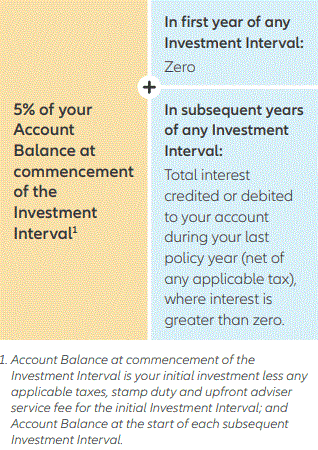
The product is designed to be held for the full term although it enables investors access to income (liquidity), either through regular or ad hoc withdrawals, up to a free withdrawal amount. The free withdrawal amount is 5% of the initial investment from year 2, the total credited or debited to the account during the previous policy year (net of any applicable tax), where interest is greater than zero, as shown in the diagram below.
Withdrawals above the free withdrawal amount are permitted but are subject to a market value adjustment.
Research consistently shows retirees want better returns than those currently on offer but they have limited appetite to dial up their risk exposure in order to achieve it. Most of all, retirees want to sleep easy at night, knowing their savings won’t run out when they need it most. That requires an element of certainty and protection, but financial advisers have had few such tools available to provide this. Previous protection products were too costly, complex or required too much upside to be given away.
Change is coming. A potential extra 1-2% return each year on portfolios compounds over time.
Caitriona Wortley is Head of Distribution at Allianz Retire+. This material is for general information purposes only. It is not comprehensive or intended to give financial product advice and does not take into account your objectives, financial situation or needs.
*This example uses past-performance data, which is not a reliable indicator of future performance and is no guarantee of future returns. The returns on the Future Safe product issued by Allianz Australia Life Insurance Limited ABN 27 076 033 782, AFSL 296559 (Allianz Retire+) which are used in this example are subject to a number of variables including investor elections, market performance and other external factors, and may differ from this example. Investors should consider the Product Disclosure Statement (PDS) which is available on (www.allianzretireplus.com.au).